In this week’s episode, like Icarus, both our storytellers fly a little too close to the sun—and learn the hard way that confidence doesn’t always equal competence.
Part 1: As a kid, JR Denson is determined to master the art of homemade french fries—but then his kitchen experiment goes up in flames.
JR Denson --a Washington, DC native-- is a full-time college educator and a part time emergency medical technician (EMT). He has become increasingly involved in the DMV's storytelling scene ever since accidentally falling into right before the pandemic. JR has performed for both local and national storytelling organizations such as The Perfect Liar's Club, the Stone Soup Storytelling Festival, and NPR’s The Moth.
Part 2: Faced with a looming Science Olympiad deadline, Adam Ruben is sure his last-minute “clock” made from a bag of water will do the trick.
Adam Ruben is a writer, comedian, and molecular biologist in Washington, DC. He writes the monthly humor column “Experimental Error” in the AAAS journal Science Careers and is the author of two books: Surviving Your Stupid, Stupid Decision to Go to Grad School, and Pinball Wizards: Jackpots, Drains, and the Cult of the Silver Ball. He has appeared on the Science Channel, the Food Network, the History Channel, the Travel Channel, the Weather Channel, Discovery, Netflix, and NPR and is a writer for the preschool cartoon “Elinor Wonders Why” on PBS Kids. Adam has performed on stage in 34 states and six countries, including two solo shows. He has told stories onstage with Story Collider, Story District, and Story League, and is a five-time Moth Story Slam Champion and a Lead Producer for the DC/Baltimore chapter of Mortified. He has three kids, two cats, and a day job as a molecular biologist for the US federal government that feels less secure every day.
EPISODE TRANSCRIPT
PART 1
The summer between 7th and 8th grade, I was really into making homemade French fries. I still like to cook and make homemade French fries now but, then, it was new and it was fun. I mean, I'm getting the potatoes, I'm peeling them, I'm cutting them, I'm eating them, frying them, it's delicious. Maybe not all in that order.
One day, I am preparing some fries to get ready to drop in the oil. My house is the meetup house for all of my other pre‑teen friends, and so I'm getting ready to drop these fries, and then DJ comes over. So I go ahead and put them in the oil, and then DJ and I go down to the basement to play some video games.

JR Denson shares his story at Baltimore Theatre Project in Baltimore, MD in May 2025. Photo by Laurie DeWitt.
We're down there and we're having some Mortal Kombat. It's great. Then my sister comes down to the basement. She says, “Um, brother, I think you should come upstairs because your French fries, they're on fire.”
And I've seen movies. Every time in a movie or a TV show where there's a fire, the person is yelling and screaming and running and there's drama. She's doing none of that, like she's way too calm. This is a prank. She's a liar.
I'm like, “Go upstairs. Leave me alone. We're playing this game,” and she does. She goes back upstairs, we keep playing our game. Then about a minute, minute‑and‑a‑half later, she comes back and she's like, “Brother, I really think you should come upstairs because your French fries, they're on fire.”
I'm like, “Look, I'm going to go upstairs and I'm going to look at them fries. And if there's not a fire, we're going to have a problem.”
And so we go up there, me, my sister, and DJ. DJ is excited because either way he's getting a show. It's either going to be a fire or a fight. Fire/fight, he's excited.
So we get up there to the kitchen and, sure enough, there's a flame in the frying pan. To this day, I maintain that I did what any rational 12‑year‑old boy would do. I went to the cupboard. I got a cup. I took that cup to the sink. I filled that cup up full of water. And I threw that water into the frying pan. I know. Oppenheimer. The first nuclear explosion over American soil is in my kitchen right now.
I'm freaking out and my sister is crying, and DJ is singing, “We didn't start the fire. It was always burning as the world was turning.”
And I know what I did wrong. I know what I did wrong. The problem is I did not use enough water. I know.
So I get that cup and I go back to the sink and I fill that cup up full of water. And this is just in time. I told you, my house is the meetup house. So right as I'm getting ready to take care of this fire, my other friends show up just in time to witness the second nuclear explosion over American soil as I throw this water into the frying pan and the mushroom cloud goes up to the ceiling.
I am terrified and my sister is a mess. And DJ has recruited the rest of the boys into his pop chorus boy band singing more songs. “The roof, the roof, the roof is on fire. We don't need no water, let that mother…”
I'm like, “Hey, hey, hey, shut up. I can't think. Give me a minute.”
I know what I did wrong. I need more water. So I find two pot holders and I put one on each hand and I grab that pot and I throw it into the sink and I flip on the sink and finally the fire goes out, the water is still running, thank God.
DJ comes over to the sink and he pulls out one of the French fries and he eats it. He's like, “Oh, man, these are good.”
Like, thanks a lot, DJ. I'm glad to know that my mother will be pleased to hear that no fries were harmed in the making of this World War II documentary.
So I'm surveying the chaos, the damage, the weeping, and the gnashing of teeth. I'm looking around what's going on in this kitchen and then I'm watching out the window as this fire truck is roaming up and down the street.

JR Denson shares his story at Baltimore Theatre Project in Baltimore, MD in May 2025. Photo by Laurie DeWitt.
And I'll be honest, I don't know this for sure, but I'm pretty sure living in a row house in D.C., the smoke detector is going off, there's a whole lot of smoke, there's a whole lot of fire, and somebody that lives right next to us does not want their house to burn down, so they've called 911. But, of course, the fire truck doesn't know which house is on fire, so they're just roaming up and down the street looking for the chaos, but they can't find it because we have done everything that we could do to hide the destruction from the fire department.
So I'm like, “We have to fix this. My mom is going to come home and none of you all are even supposed to be here. We have got to fix this kitchen and we got to fix it now.”
The first place we got to start is the ceiling, because I look up at the ceiling and right above the stove it's black. That’s a problem because it was white. Half of the ceiling is for sure black and the other half behind me is white.
So I'm like, “We've got to clean the kitchen. We're going to start here. We're going to get some mops and rags and we're going to clean the ceiling.”
We quickly learn that this charred char is not coming off. So if I can't make the whole ceiling white, I've got to make the whole ceiling gray. So we're just going to smear this charredness all over the kitchen ceiling.
And DJ has got the boy band singing more songs, like these fire spirituals, “This ceiling’s on fire, this ceiling’s on fire…”.
I know we can’t stop at the kitchen because I know my mom, when she comes home, when she senses anything is wrong, she's going to start investigating. I got to get ahead of this woman, so we can't stop at the ceiling and the kitchen. We've got to clean the whole house.
We used all of the bleach and Pine‑Sol and air freshener in the entire tri‑state area, making sure this house did not smell like a campfire. Luckily for me, my mom, at the time, was driving this old, hoopty beater car that backfired. People that weren't around my house a lot would be like, “Oh, man, like, what's that popping? Is that a drive by?” Like, “Nah, that’s just my mom.”
“Two‑minute drill. Let's go, let's go, let's go. Rags in the bin, boys out the house, we got to get out of here.”
So we're doing all that stuff. We've got the two‑minute drill going and then we kick the boys out. Then my mom pulls up in the driveway. And then me and my sister, we stand in the hallway right by the door. We're like these five‑diamond, five‑star hotel staff, White Lotus style. We're standing there waiting for my mom to come in.
She comes in and of course this is weird, because why are her children standing at the door like hotel staff? We're professionals. And it's weird but she doesn't see anything obviously off. Yes, the house smells super clean but that's not bad, right? Nothing appears to be broken and so she's not sure what's up.
But she goes on up to her room, because that's her evening routine. She comes home, she checks in on us and she heads on up to her room before coming back down to spend time with us.

JR Denson shares his story at Baltimore Theatre Project in Baltimore, MD in May 2025. Photo by Laurie DeWitt.
A few months later, we're getting ready to move out of this rental that we have. And many of you, that if you've rented before, you know that when you rent a place, you put down a deposit and that deposit you get back if you haven't burned your house down.
So I'm not there. Actually, my mom is telling my sister this funny story about the inspection, about how she was in the unit with the manager that was coming through to inspect the unit and how this manager is telling my mother that there's fire damage in the kitchen and she's going to have to pay for that.
And my mom tells him, “I'm a strong independent woman. I'm the adult in this house. I know everything that happens in this house. Nothing happens in this house without me knowing. How dare you insinuate I would not know there was a fire or fire damage in this kitchen. If there was fire damage in this kitchen, it was here before we moved in and you simply missed it. I will not pay these charges and you will take care of it yourself.”
And he said, “My apologies. I think that if there's fire damage in this kitchen, it was maybe here before you moved in, and we simply missed it.”
And she's like, “You're right.”
So she's telling my sister this funny story, because, you know, “Isn’t that funny, Meshia? Isn’t that funny that this happened?”
And my sister goes, “Well, what happened was…”
And my mom was like, “We didn't pay that deposit though.”
I walk around every day with a computer in my pocket. And to this day, I cannot tell you exactly why you should not put water on an oil fire. But I can tell you that if you're 12 and you almost burn down your mother's house, clean the whole house. It works every time.
PART 2
One thing I've learned in my career as a scientist is that you can love something, feel very passionately about it. It can feel very rewarding to you, both intellectually and creatively, and yet not start working on it until the night before it's due.
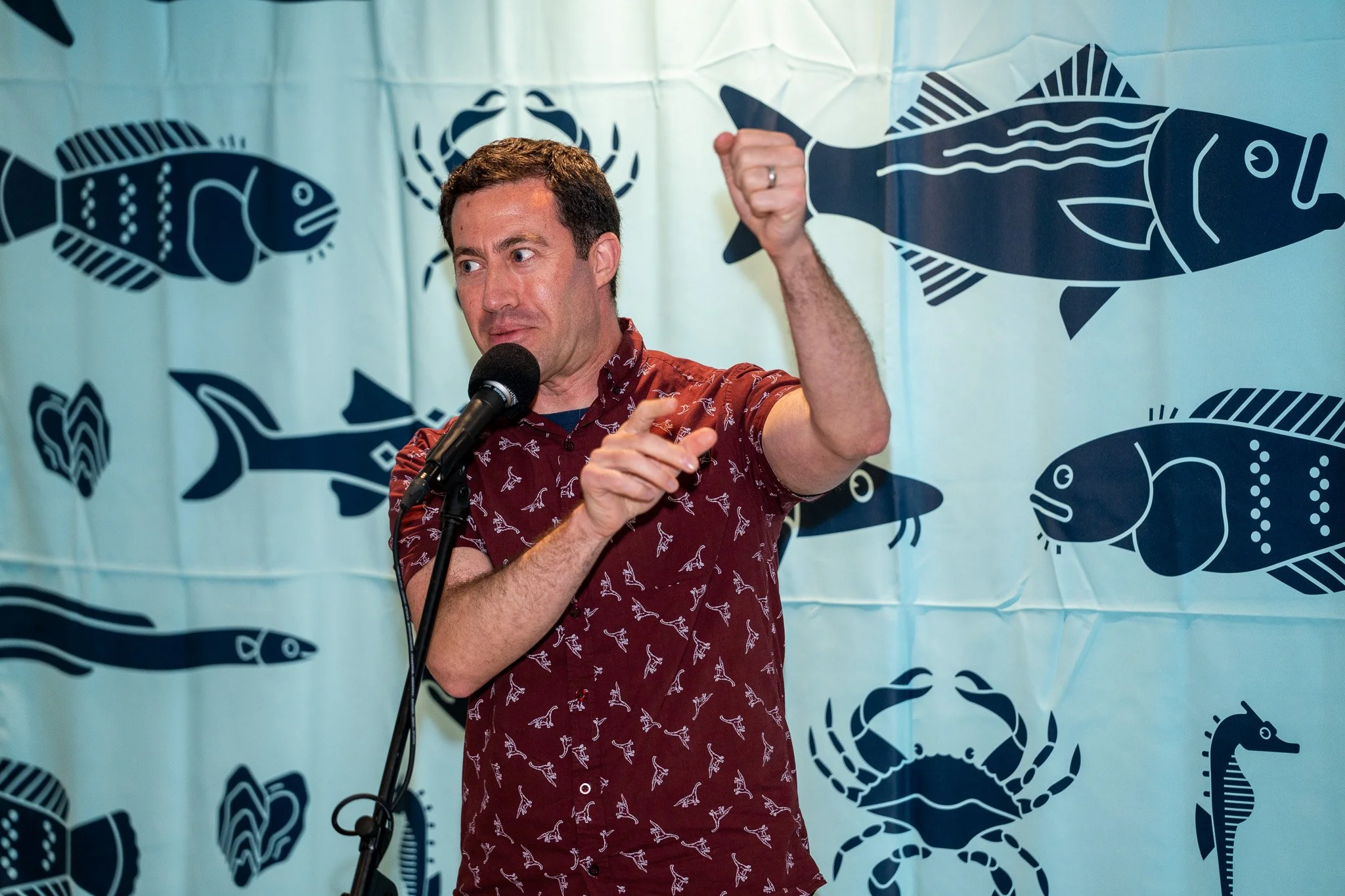
Adam Ruben shares his story at Pier57 in New York, NY in September 2025. Photo by Jason Serrano.
When I was growing up, I did this thing called Science Olympiad, which was this really super fun series of events. You'd spend most of the school year building something, and then in the spring you'd bring it to the university for the big competition day.
I built Rube Goldberg machines. I made musical instruments. I trained a hamster to run a maze. I built a car powered by a mouse trap. Not in the same event as the hamster in the maze. “Run, hamster, run.” No, it was not that.
This one particular year in high school, I decided to do an event called It's About Time. The event was about birds. No, it wasn't about birds. It was about time. The idea was you're supposed to build a clock yourself at home using no commercially available clock parts. Then you'd bring your clock to the competition and the moderator would say “Start” and “Stop”, and you would time the intervals and see how accurate you could get with your homemade clock.
And it's the night before we have this big competition. I'm at home and I'm looking at my clock. I want you to picture what this clock looks like. I'm gesturing at nothing, because I have nothing. I have not built a clock. And it's because I was doing what I always did as a kid. I procrastinated. I put things off till the last minute even if it was something that I knew I would enjoy doing. I wish I could say, “Well, I had a very busy social calendar,” but I'm a scientist. We all know that's not true.
Or even that it was just because of my classes or clubs or something, but I know what I was doing at that time in my life. I was playing a ton of Game Boy. That's all it was. I had a Game Boy. I remember that I learned how to beat Super Mario Land 2, and then I learned how to beat Super Mario Land 2 playing only with one hand. Then, and I'm not making this up, I learned how to beat Super Mario Land 2 playing with my toes. That's what I was doing when I should have been building a damn clock.
So it's the night before and I'm walking around my house. I'm going, “Clock, clock.” This is pre‑internet, so I can't look up how you make a clock. I started thinking, like, “All right, how did people measure time before they had clocks? Sundial. Nah, the competition is indoors and it doesn't do seconds. Hourglass. Uh‑huh, sand in an hourglass. I don't have sand, I don't have an hourglass, but I can make something similar.”
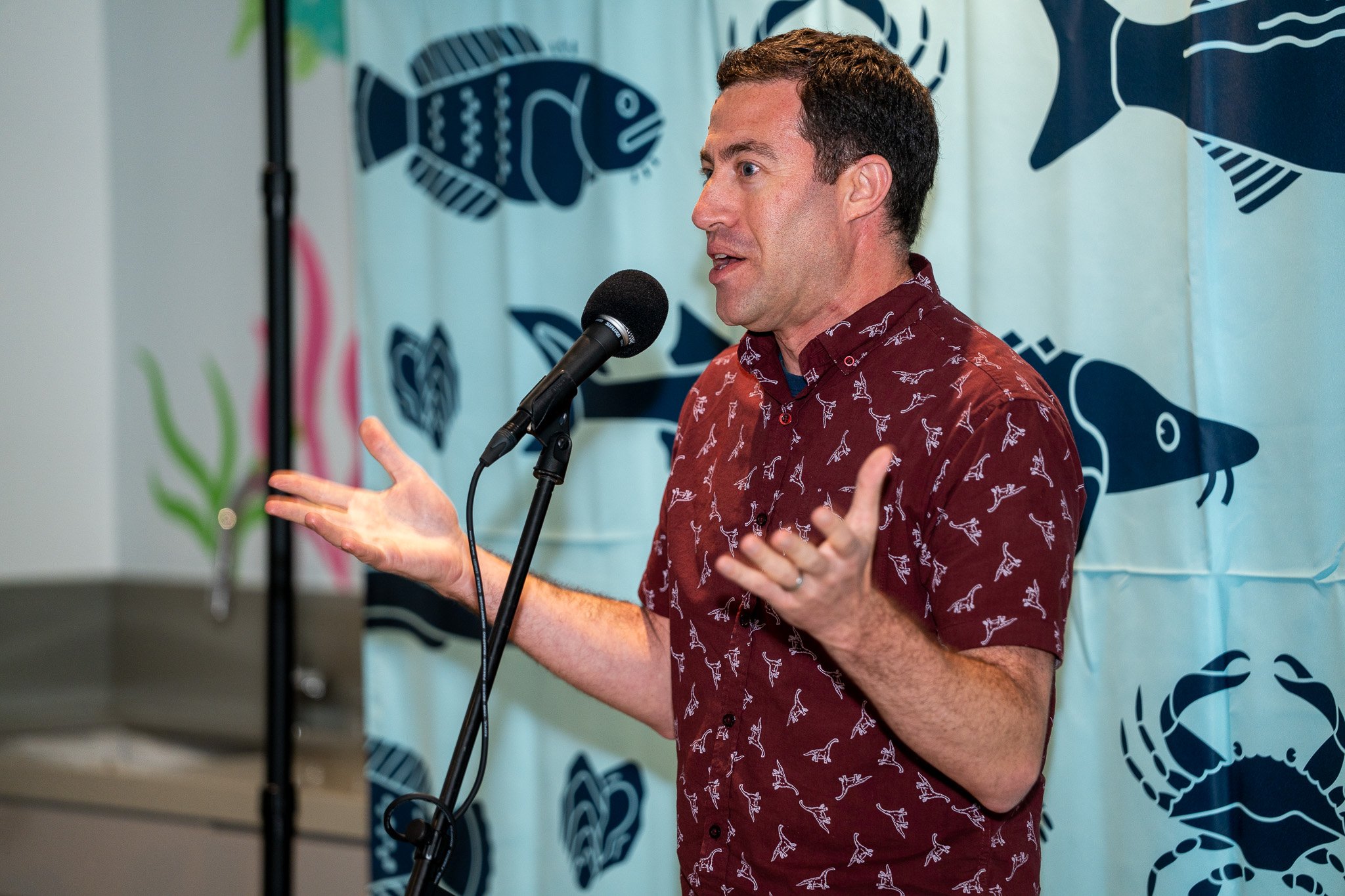
Adam Ruben shares his story at Pier57 in New York, NY in September 2025. Photo by Jason Serrano.
So I get a Ziploc baggie. I fill it with water. Take a little safety pin, I poke a hole in the Ziploc bag, and the bag goes drip, drip, drip. I time the drips. I time about 100 drips. I take an average. Okay. That's one drip every 1.54 seconds. That's how I'm going to enter the competition. That's my clock.
When they say “Go”, I'm going to count the drips until they say “Stop”, multiply by 1.54 and that is how many seconds have elapsed.
This seems like a really great solution. I'm pretty proud of myself, until I show up the next day and I see what happens when a kid spends six months building a clock. Oh, my God! There are clocks taller than me. There are clocks that are pendulums. Some of the clocks actually use lasers. Kids are saying things like, “Oh, no, the humidity has warped the escarpment. We’d better modify the oscillator to compensate.” Meanwhile, I'm pulling this shriveled bag out of my pocket, still moist from the night before. I'm like, “Uh, anyone know where I could fill this up?”
So the moderator says, “Okay, you've got a couple minutes to calibrate your clocks.” And kids are like taking the arcsine of the pendulum angle, or however you calibrate a clock. Wouldn’t know, never built one.
I'm holding my clock filled with water. I hold it up over this lab sink, and the bag goes, drip, drip, drip, drip, drip, drip. I'm like, “Shit, shit, shit, shit, shit, shit.” Because somehow, overnight, that tiny little pinhole got a little bit less tiny. Now, it's just a steady stream of water coming out of the bag. There's no discrete drips. There's nothing to count. There's no 1.54 seconds. And
I have no clock. All I have is a Ziploc bag that can pee. And now the moderator says, “Ready, go.”
So I start thinking again, “Okay, what did people do before they had clocks? Sundial, sand timer, water timer.” And then my next thought is, “One one thousand, two one thousand, three one thousand…” and I'm staring at my bag pretending it's giving me some information, but in my head I'm just, “One one thousand, six one thousand…”
Then when the moderator says stop, I'm at 74 one thousand, so I write down 74 seconds.
She does, “Okay, go for the next interval of time.”
That's how I get through the competition. I would stare at this meaningless bag while I'm one‑one thousanding in my head. Although at some point I think I upgraded the precision of my internal clock and I switched from one thousands to Mississippis. That’s how I timed every interval.
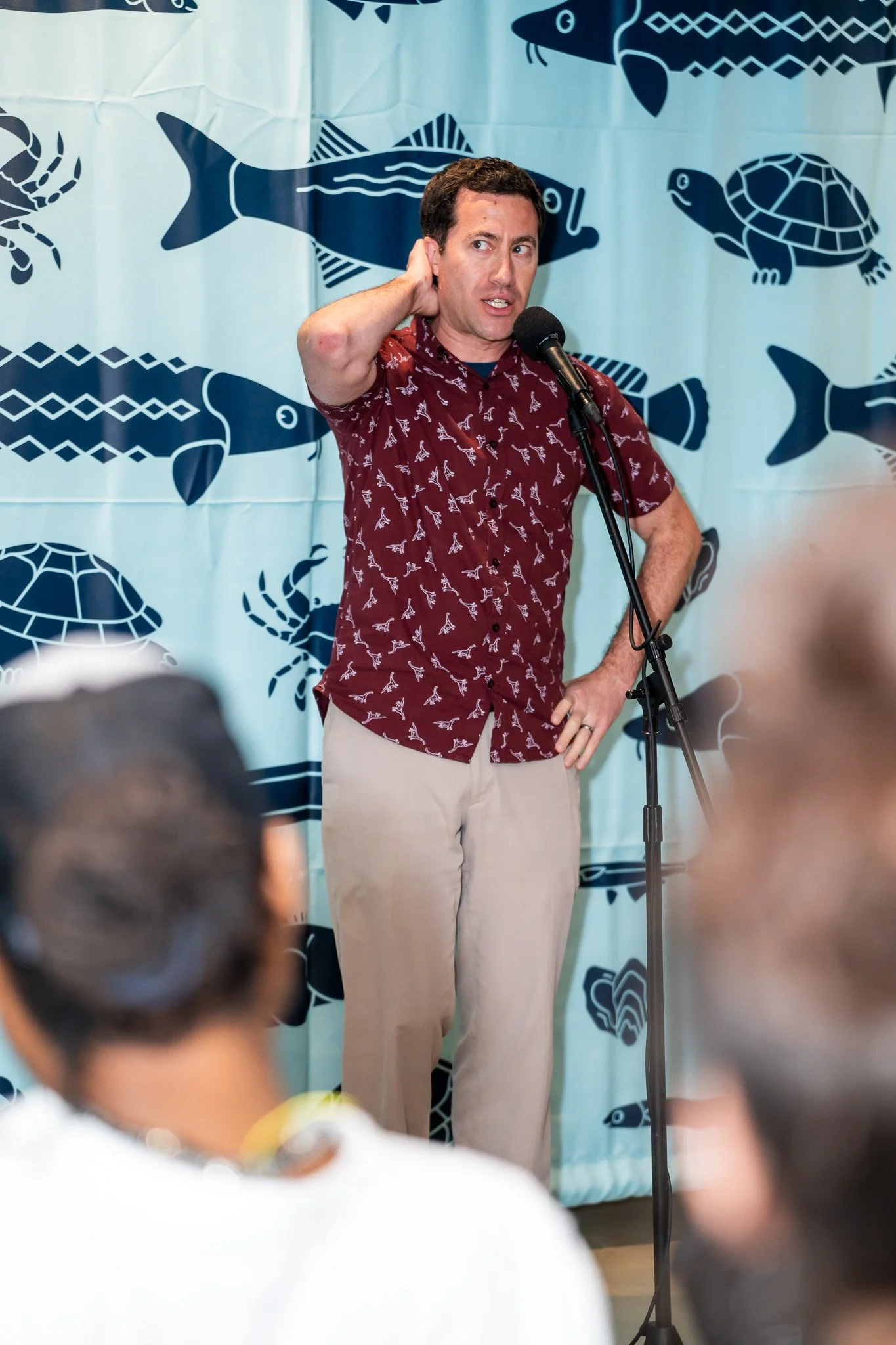
Adam Ruben shares his story at Pier57 in New York, NY in September 2025. Photo by Jason Serrano.
Later in the day, they have the award ceremony and there are all these kids hugging their giant clocks, and then they announce that I have won ninth place in the state.
So I learned a couple of lessons from this right away. First, I learned that sometimes as a scientist, you have to solve problems with whatever materials you have at hand, even when it's not what you want to have.
I also learned that sometimes the best solution to a problem is the stupid solution, or at least that's the ninth best solution. Because the best solution is whatever the eight kids ahead of me did. Those are better.
And I also learned that if you want to place in a statewide science competition, it is very helpful to have the state be Delaware. Go, Blue Hens!
Now, it is 30‑ish years later and I wish I could say I don't procrastinate anymore. I learned some lesson about that, but I still do. I think all of us do to some extent, but I no longer waste these giant blocks of time doing nothing. I have not touched video games since I deliberately deleted Angry Birds from my Droid in 2011. Not again.
I think I don't procrastinate now just because I've got other things to do as an adult. I have a job. I have a house. I've got three kids, for goodness sake. My youngest is in kindergarten. My oldest, this week, just started high school. So my time is spent preparing meals and washing dishes and folding laundry and reading bedtime stories and driving people places. I don't have time to procrastinate.
I think my younger self would find that to be a pretty good outcome. And he would say, “Well, that's wonderful. You've moved past this. It's about time.”
Thank you.