Both of this week’s stories come from Chan Zuckerberg Initiative’s Rare As One Project grantees, who share their deeply personal experiences with rare diseases and illustrate how research is so essential in the search for better treatments and cures.
(For more stories like these, you can also check out our previous episode The Story Collider produced with Rare As One in 2019, 2021, 2023, and 2024, as well as our Rare Disease playlist.)
Part 1: After multiple relapses, Carlos Guerrero-Anderson takes a chance on an experimental treatment for his rare cancer.
Carlos Guerrero-Anderson is an executive leader and patient advocate committed to amplifying the voices of Hairy Cell Leukemia and rare disease communities. Diagnosed with a rare blood cancer at age 25, Carlos transformed his personal journey into a lifelong mission to advance equity and create inclusive spaces for patients and families. He currently serves as the Director of Multicultural Engagement & Insights at the Hairy Cell Leukemia Foundation, supporting patients through education, outreach to underrepresented communities, data analysis, program promotion, and the sharing of diverse patient stories. With over 20 years of experience in healthcare insights and data-driven communications, Carlos combines strategic expertise with a lived perspective to create and lead culturally responsive programs that strengthen trust, amplify patient voices, and deliver measurable impact across diverse communities. He is an active member of several national patient advocacy groups, and his work has been featured at national conferences, most recently at the NORD Rare Disease Summit 2025. Carlos believes that storytelling is one of the most powerful tools for breaking barriers, building trust, and ensuring that no patient has to fight alone.
Part 2: Angie Weaver holds onto an unshakable belief that her daughter, who has a rare SCN2A disorder, will beat the odds.
Angie Weaver is the Director of Philanthropy and Development for the FamilieSCN2A Foundation, whose mission is to accelerate research, build community, and advocate to improve the lives of those affected by SCN2A-related disorders around the world. After her daughter Amelia was diagnosed with SCN2A, Angie became a passionate advocate for rare disease families—sharing her story to advance research, policy change, and awareness. She lives in northern Minnesota with her husband, Josh, and their youngest daughter, Penelope.
EPISODE TRANSCRIPT
PART 1
I grew up in a joyful home that fueled my determination to succeed. I had a group of friends that they were from more privileged families and background money‑wise, but it sparked ambition, not envy. I wanted to prove I could belong at any table, not through luck but through hard work and persistence.
I was this kind of person who ran for class president many times because I loved making ideas real. And I represented my country internationally, in different competitions, like Harvard National Model United Nations. And by graduation, multinational companies were already recruiting me.
I climbed quickly, regional roles, promotions, no vacations for six years. I went to the gym at 5:00 AM because it was the only time still mine.
One morning, in a quiet gym listening to the treadmill sound, I started feeling a strange pressure under my left ribs. Not sharp, but wrong. I wasn't that concerned because I used to be very, very healthy. But then, over months, I became tired, lost weight, noticed a growing hard balloon on my left side and had night sweats. But I kept pushing, that's what high achievers do.
Eventually, I couldn't deny it. So, doctors, tests, waiting rooms. At the same time, I was planning a trip to Madrid with my friends, my first real vacation in many years. After getting a phone call from my doctor to go the next day to meet with her in person, which was interesting, she asked me to go with my parents.
I go there. I went with my parents and two friends. They waited for me outside at the hospital corridor. And there in this cold ‘80s‑style room with my parents and the doctor, she goes that the results came back and she's very scared and worried about the results. I have an urgent hematologist appointment the following day.
The following day at 6:00 AM, I'm there in the specialist’s office. She finger‑pricked, go to the microscope, then ordered a bone marrow biopsy to be performed right in that moment, and I waited for the results.
When the results were ready, I was with the doctor. Then the doctor looked at me and said, “You need to start treatment now.”
My answer to that was, “I have a trip to Spain, and I'll deal with this when I'm back.”
She said, “If you don't start treatment now, you may not be alive in two weeks. Go to ER immediately. Carlos, you are dying.”
I was 25 years old. She diagnosed me with a rare blood cancer.
Fear didn't arrive with a scream. It arrived as a calculation. I was really worried about my career, my future, my reputation. And fear whispered, “If they find out, you’ll lose opportunities. They'll see you as failed.”
So I decided to keep silent and I worked through treatment in secret. I was getting emails and participating in phone call meetings with an IV, saying that I had a flu, and then that the flu turned into pneumonia.
When I recovered enough, I returned to work pretending nothing happened, and I relapsed several times and hid it each time. I used vacation days for treatment sessions. I took calls from infusion chairs.
But silence has a cost. It caused me a career in Switzerland, a major promotion, even chances for a family, a partner. The silence took more than the disease.
Eventually, I quit and decided to build my own business, not out of ambition, but survival, to manage my disease privately. Eventually, I decided to move to New York City to learn English, to improve my English and also to manage my company from New York. I was looking not just to survive but to grow.
Eventually, I relapsed. At that time, I ran out of treatment options in Latin America. So being in New York City, I met with doctors and I started an experimental target therapy that only a few people had tried. It was a therapy which consists of eight huge pink pills. And this dose, they started with the highest dose because they weren't sure about the exact dose to treat this condition.
The side effects were brutal. My skin felt on fire. One night, the pain overwhelmed me. I collapsed on the cold floor, screaming and shaking and crying. It is in that moment the most painful moment of my life.
I'm questioning everything. “Why me? Do the doctors know what they are doing? What's next? Am I going to survive?”
But then something shifted and I realized my body carried data and my pain carried knowledge. Someone in the future would suffer less because of what I endured. It's when I felt that it wasn't about me, it was about us, all of us.
That thought softened the floor beneath me, and the pain eased. I felt held on warm arms and I fell asleep in peace, not defeat.
Years later, the dose was reduced. Same results, fewer side effects. Nowadays, when patients say today that the treatment has no major side effects, I smile quietly, because I know the hidden story behind that progress. I was part of it.
I realized that silence is the most dangerous side effect of any disease. It isolates, it chains, it steals hope. Illness stripped my identity until I finally met the real me. That moment became an invitation to live a life with meaning. I shift to rare disease advocacy.
Today, I bring my full story everywhere, not as a secret but as a banner. Visibility won't cure a disease, but it cures loneliness. And when we stand together, we become a movement. Being a survivor is not the end of the sentence. It's the beginning.
My mission now is to turn pain into purpose, to unite patients and doctors, connect science and humanity, and spark conversations that save lives. I was not broken. I was being called. This is no longer just about surviving. It is about making sure no one ever has to fight alone.
PART 2
The sleet slaps across my face as I stumble out of the ambulance into the pitch black night. I haven’t slept. I haven’t eaten. The adrenaline pumping through my body makes me sick to my stomach. Red lights flash. I can barely see.
Amelia, my tiny daughter, nine years old, is being loaded onto a small plane. She's wrapped in a thick hospital transport cover, rigid, heavy, velcroed shut like cargo. But inside, I made sure her purple, fuzzy blanket is tucked in close, the one she sleeps with every night, the one that smells like home.
As I follow behind her stretcher, she's having one seizure after another. Full body convulsions, the kind people picture when they hear the word seizure. Arms jerking, legs thrashing, her whole body taken over like something out of a nightmare.
My hair is soaked. My mascara smears. I can't stop shaking. My boots crunch on the icy ground. The air smells like fuel and cold metal. I taste the metallic panic in my mouth, but I keep walking. I repeat to myself, “She's so strong. She's a fighter. We'll get through this too.”
A 42‑minute flight from our small town in northern Minnesota to Mayo Clinic is a blur of failed IV pokes. They try again and again. She seizes. They poke. She seizes again.
I sit hunched in the corner of the plane, water pooling at my feet, trying to remember how to breathe.
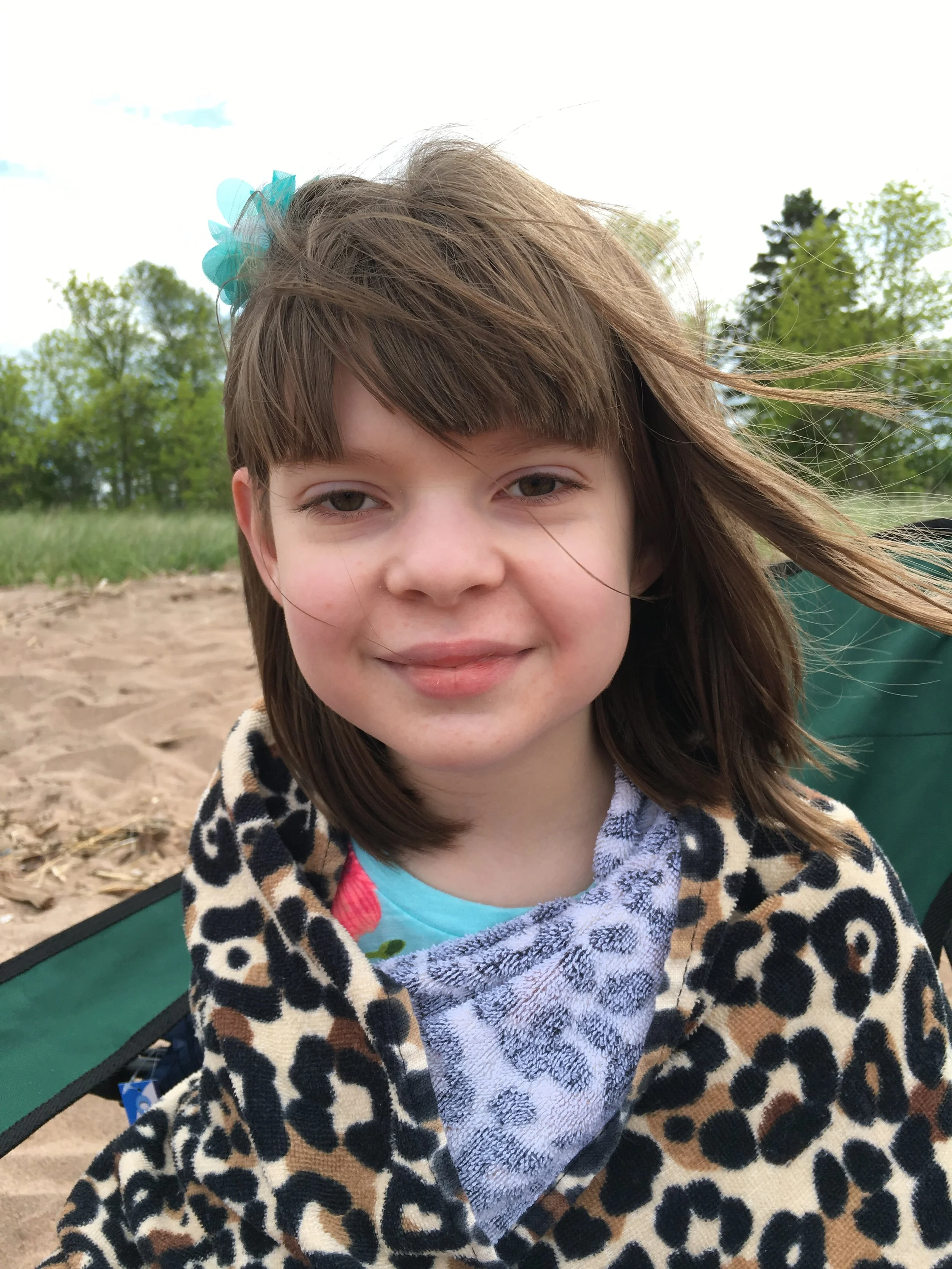
A picture of Amelia on the beach. Photo courtesy of Angie Weaver.
I'm 34. It's 21 days till Christmas. I should be home wrapping presents, baking cookies, not watching my daughter fight for her life, not being this helpless.
In the pediatric intensive care unit, I do what I always do. I rattle off her meds, her allergies, her rare disease diagnosis, SCN2A.
SCN2A is a gene we all carry. But when it mutates, like it has with Amelia, it can cause catastrophic disorders, severe epilepsy, movement disorders, developmental delays, autism. There's no cure, no treatments.
For Amelia, it means hundreds of seizures a day, regression, losing her ability to speak and, at times, walk, wheelchair and medical equipment, over 20 failed medications, more specialists than I ever knew existed.
I explain what's helped, what hasn't, and I make it clear the wrong meds can quickly escalate into life‑threatening seizures. So I watch the doctors closely. Who listens? Who dismisses me?
Some look at me with pity, like they've already decided I'm just a young mom in leggings and wet boots, that they know more, despite never having heard of SCN2A until I said the word. And honestly, it makes me angry because I live every hour of this. I hold her through every seizure. I track every dose. I read research. I connect with parents to learn what works for their kids. I educate. I advocate.
And I did trust the doctors back when Amelia had her first seizure. They sent me home with medications that nearly killed her. So I learned to stand in a room full of PhDs and tell them things they might not want to hear from a mom. But I don't care what they think of me. I only care that my daughter lives. This is life and death. My Minnesota Nice goes out the window. I don't have the luxury of falling apart. If I unravel, I might miss something. And I won't let her die because I took a nap and an intern gave her the wrong medication.
It's 3:00 AM before they get a central line in, then a breathing tube. Amelia is finally sedated, still, no longer seizing.
I haven't gone to the bathroom in hours. I haven't sat down. I haven't cried. I sing to her as they intubate, read to her as they place EEG leads, hold her down while they draw blood. I do all the things no mother should ever have to do. And I don't think about the next hour or the one after that. I’ve been doing this for nine years now.
We get her home and start the long work of getting her back to baseline: meds, therapies, follow‑up visits. She's home but she's still not herself. Her body is tired, so is mine.
Time stretches and folds in on itself. Some days feel like two hours, others like two months. We miss a season, maybe two. The days blur.
But somewhere in that tangle of follow‑ups, another name quietly appears on her care team, palliative care. They start asking different kinds of questions, not just about symptoms but about comfort, quality of life, what Amelia would want if she could tell us.
At first, I don't know what to feel. No one has ever said the word death out loud. No one has looked me in the eye and told me she might not survive. So when they bring it up, it feels like I've slipped into a conversation I didn't know I was in.
I wanted to tell them, “We're still fighting. She's still here, still trying.” Do they know how hard she fights?
The thought of losing her is my worst nightmare. It makes my chest tighten, like I can't breathe. Even saying it in my own head feels impossible. But they're not asking us to stop fighting. They're giving us space to talk about things we've never dared say, to think about comfort, not just survival, to imagine a version of care that honors how hard this is. It sees Amelia not just as a patient, but as a child with a life worth living, however long it lasts.
And it terrifies me because it makes it real. It makes me wonder if they see something I can't face yet.
One quiet morning, I'm standing in the kitchen. The fridge hums. The coffee in my hands is already cooling. I hear Amelia and her nurse downstairs doing physical therapy in the lower level we remodeled just for her, for all her medical equipment. It's peaceful, but not normal. We're still trying to get her back to baseline.
She's tired. Her body feels heavier. Our calendar is filled with follow‑up appointments and med changes. Everything still feels fragile.
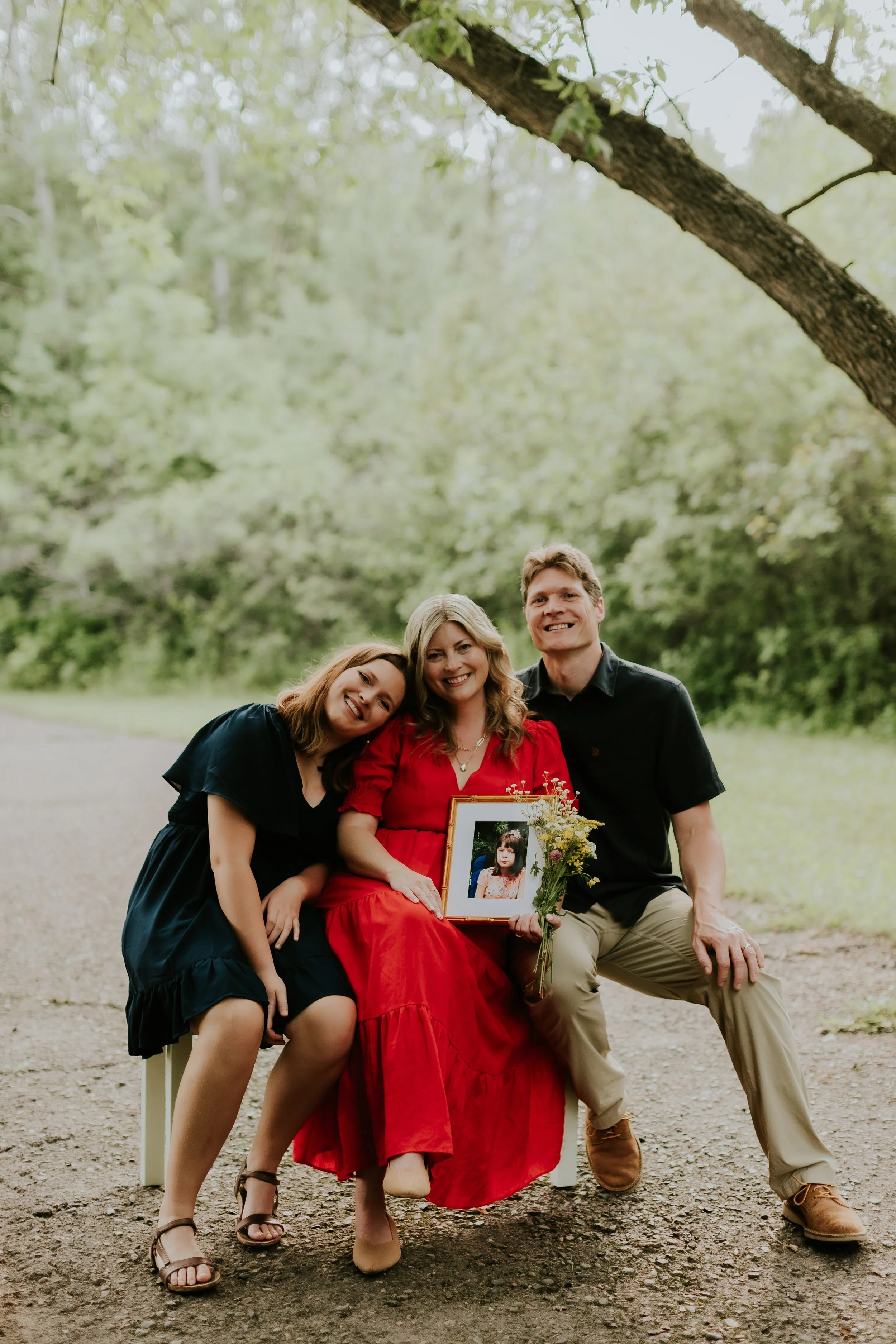
Angie Weaver and her family. Photo courtesy of Angie Weaver.
I stand there, not moving, just listening. And I think about something I learned from the FamilieSCN2A Foundation, brain donation.
At the time, I tuck it away thinking, “God, I hope I never need to know this.” But after our last hospitalization, I can't shake it. Watching your child suffer like that, it breaks something in you. There's a helplessness so deep it settles into your bones. And as much as I want to believe she'll keep fighting, I also know she might not.
I turn to my husband, who has loved me since we were 18, and I say words I never thought I'd say out loud. “I think we need to talk about some plans I hope we never need. What if we donated her brain?”
He looks at me with the saddest eyes. He always says, “Amelia is the one who's going to beat the odds. She's such a fighter.”
We both want to believe we'll never need to make this decision, but we also know we're on the same page. And it brings a strange kind of peace. It doesn't come from giving up. It comes from needing her life to matter in every possible way. We hug and hold each other really tightly for a long time.
Amelia survives that December, and she keeps fighting. But the line between surviving and living keeps getting thinner, and then it's gone.
She dies on a cloudless day in August at Mayo Clinic after another month‑long PICU stay. She's 12 years old.
I hold her hand. I sing her a song. And then a sound leaves my body that I don't recognize. It's the sound of a mother losing her child. It's pure heartbreak.
Amelia's donation becomes the first ever made through the FamilieSCN2A Foundation. Her cells are helping researchers understand SCN2A‑related disorders. I know it sounds clinical, but to me it's not. That brain carried every seizure, every giggle, every inch of who she is. And now, it's still here, still teaching, still giving, still fighting.