In this week’s episode, both of our storytellers confront the real-world consequences of misinformation—and how it can spread faster than the truth.
Part 1: Growing up, Modesta Abugu knows firsthand the challenges rural African farmers face. But when she discovers that misinformation is making things worse, she sets out to change the narrative.
Modesta N. Abugu recently obtained her Ph.D. in the Department of Horticultural Science at North Carolina State University, where she conducted research to identify genetic tools that can be used to improve flavor in sweetpotato, guiding the development of high-quality varieties. As a National Science Foundation interdisciplinary research fellow at the Genetic Engineering and Society Center, NCSU, she examined the scientific, policy, and public-engagement dimensions of agricultural biotechnology within integrated food, energy, and water systems to help develop sustainable and responsive solutions that bridge innovation, policy, and societal needs. Modesta is also passionate about communicating science to the public, especially on the potential of agricultural biotechnology tools in promoting food security. She has been widely involved in grassroots campaigns geared towards creating an enabling policy environment for farmers to gain access to new agricultural innovations globally. Through her awareness and advocacy efforts, she contributed to the passage of Nigeria's biosafety bill into law, and the commercialization of Bt cowpea in Nigeria. Modesta obtained her Bachelor of Science degree in biochemistry from the University of Nigeria in Nsukka, Nigeria, and an MSc in horticultural science from the University of Florida. Outside of work, she loves to hike and visit new places.
Part 2: While living in South Africa, Fiona Tudor Price witnesses how AIDS misinformation devastates an entire nation.
Fiona Tudor Price is a seasoned producer, director, and science communicator with a unique blend of expertise in biology, media and education. With a BSc. Hons. in Biology and Film & Television Studies, Fiona began her career at TVOntario and Corus Entertainment, contributing to award-winning environmental and science documentaries. In 1999, she moved to South Africa and founded Atomic Productions, where she directed and produced impactful natural-history content for global networks including National Geographic, Discovery Channel, Animal Planet and WWF. Transforming complex scientific concepts into compelling, human-centred narratives, Fiona earned a reputation for making science accessible to broader audiences. A passionate advocate for women in media, Fiona founded Women in Film and Television South Africa (WIFT SA), providing a platform for mentorship, networking, and empowerment within the industry. She is deeply committed to educational equity, particularly for learners with dyslexia. Fiona collaborated with Decoding Dyslexia, Ontario, to initiate the transformational Ontario Human Rights Commission’s Right to Read inquiry, to address systemic issues in education for learners with dyslexia. Currently, Fiona is a Digital Media and Accessibility Specialist at Humber Polytechnic, focusing on the intersection of multimedia, AI, and accessibility in education, driving innovation at the crossroads of education and technology.
EPISODE TRANSCRIPT
PART 1
I grew up in a family of eight, two brothers and three sisters, in Enugu State, Eastern Nigeria. As a little girl, I was trained to care and nurture for my family and people in my immediate environment. Some of my fondest memories were playing with my siblings and friends. And after school, we would spend time at the backyard, inventing innovative games or building forts with sticks and leaves, or staging performances of our imaginative future families.
In that family, I always played the role of a mom, cooking, cleaning, and taking care of my baby doll. It was a perfect time when joy and laughter filled our home.
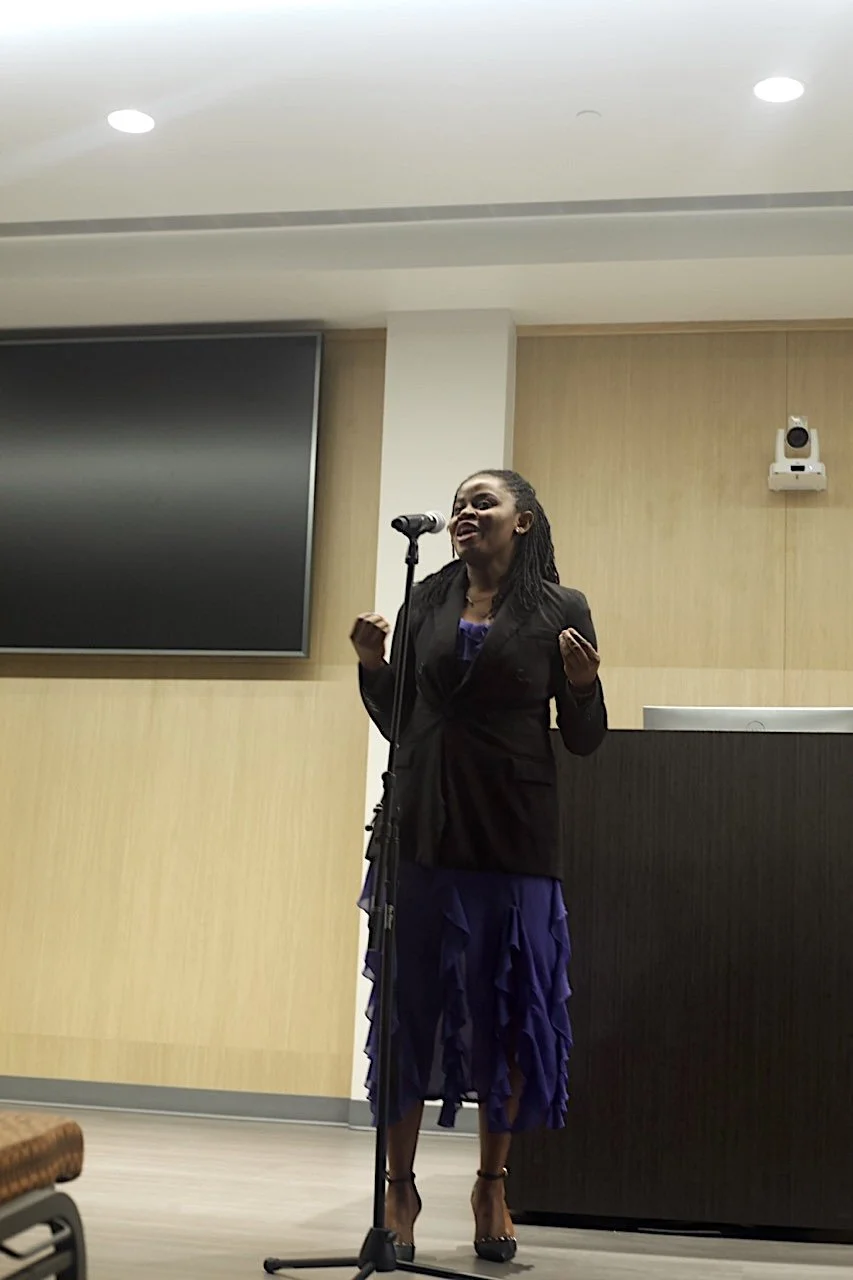
Modesta Nnedinso Abugu shares her story at North Carolina State University in Raleigh, NC in April 2024. Photo by Corey Bellamy.
Our home was a three‑bedroom house and, around it, it's surrounded by knee‑high marsh grasses. The earth smelled like marsh, a scent that occasionally mixed with the breeze that came from the nearby stream of water. To us, this home was a place of peace and seclusion, a retreat from the hustle and bustle of the outside world.
When I was 14, my dad was expected to retire from civil service due to his age, and his pension was negligible. On top of that, he didn't quite start receiving his pension until a year later. My mom's income as a civil servant was not sufficient to sustain our family. So in order to supplement her income, she converted some of the piece of land around our house into a farm where she planted corn, cassava, and cowpea.
This farming required a tremendous amount of work. Grow fertilizer application, weeding, spraying against insects and pests, and watering during the dry season. So my mom would go to work in the morning and then come back in the evening to start her day over again as a farmer.
My siblings and I would go to school in the morning, then come back in the evening to help my mom out in the farm. We hated this work so much. We were kids. All we wanted to do was to play with our friends. Instead, we had to work under the scorching sun, weeding until our backs hurt and our waist ached so much. We could not afford high‑level equipment for this process, so we did this backbreaking work by hand.
But we're smart and resourceful kids, so we're not sad and gloomy. As kids, we will always find something to play with in the farm when helping out in the field. My siblings and I would throw dirty earthworms at each other and argue about who is going to take the biggest ear of the corn during harvest.
I think that this drove my mom crazy sometimes that she would yell at us saying, “Umuaka, kwusi ya egwuregwu ahu.” What this meant is, “You, children, take your work seriously.”
My youngest sister, Olichi, will say, “Mommy, you're such a workaholic.” We would all laugh at that.
But now, I see that my mom worked so hard. The reason why she worked so hard and cared for her farm so much is because we needed our farm. We needed our farm to eat. Without her tireless work and effort, we would have gone to bed hungry most nights.
My experience was less difficult than most of other people in my country, Nigeria. 70% of our population are smallholder farmers, which means that they depend on their farm not only for their livelihood, but also to feed their families. If anything goes wrong, they don't eat. This is why one out of every four Nigerian child goes to bed hungry every single night. One out of every four. This is untenable.
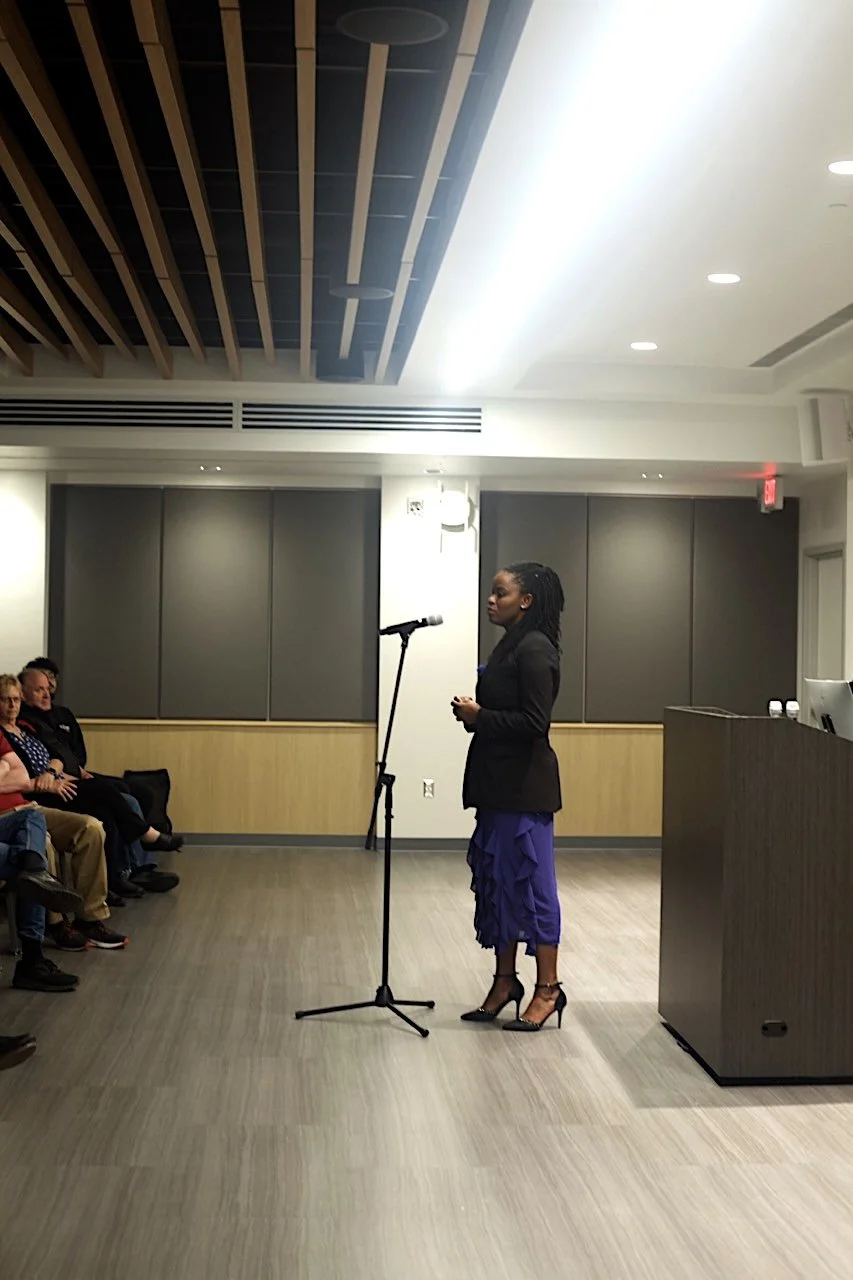
Modesta Nnedinso Abugu shares her story at North Carolina State University in Raleigh, NC in April 2024. Photo by Corey Bellamy.
The worst part is that technology actually exists to help the situation of these smallholder farmers, but these poor farmers cannot access it.
In America, you have a crop called the black‑eyed peas. In Nigeria, we call it cowpeas. Nigeria is the biggest producer and consumer of this crop. Yet, despite being the biggest producer of this crop, we still have to import cowpea from neighboring countries because our population of over 200 million people consumes more cowpea than we produce.
Cowpea is also a source of animal protein to families who cannot afford to buy meat. That is why it's commonly called the meat of the poor.
As an aside, I didn't like cowpea growing up, but my dad loves it. He knows that it's good for us. So in order to get us to eat cowpea, he would tell us all these scary stories of people who are short, and the reason that they are short is because they didn't eat cowpea as kids. Just as kids in America have been told to eat your spinach so you can grow strong, kids in Nigeria are told to eat their cowpea so they can grow tall.
Unfortunately, this important staple suffers a lot of devastation from a pernicious insect called the Maruca. 80% of the cowpea grown by every farmer in Nigeria dies in the hands of this Maruca. 80%.
Well, for cowpea, public sector scientists have developed a genetically modified variety that has promised 20% increase in yield and also a reduction in the use of pesticides. This is good for farmers. It is good for the environment and it is good for the economy of Nigeria at large. But, sadly, most smallholder farmers cannot still access this technology because of fear of the unknown, misinformation and so many arguments against agricultural biotechnology.
I knew that I needed to do something about this. So in 2012, I graduated from university and, a year later, I joined this organization that promotes access to innovation for smallholder farmers. We would conduct some sensitization events, do public outreaches, do radio programs, media TV programs, all those kinds of things.
There was this time during a public hearing event that we organized around the Maruca‑resistant cowpea where I met this man who is an architect, an environmentalist, and an anti‑GMO activist. We started talking about what we did for a living. And towards the end of our conversation, he asked me to come closer so that he could tell me a secret.
This man whispered into my ear saying, “I think agricultural biotechnology might be relevant for farmers. But,” and I quote, “spreading misinformation about this is how I get paid to feed my family. Maybe if you provide the role for me in your organization, maybe I'll join your team,” he continued.
I remember feeling so frustrated and angry and sad over hearing this man's perspective about the technology that could literally change the livelihood of farmers. This man has made it his life's work to make sure that people are misinformed about the technology that could actually impact people's life.
At that point, I lost hope. I thought that there was nothing I could do. There was nothing I could do to help this. No matter the amount of work we did to improve access to information for people who don't have this, a lot of people are being paid to promote misinformation on this technology.
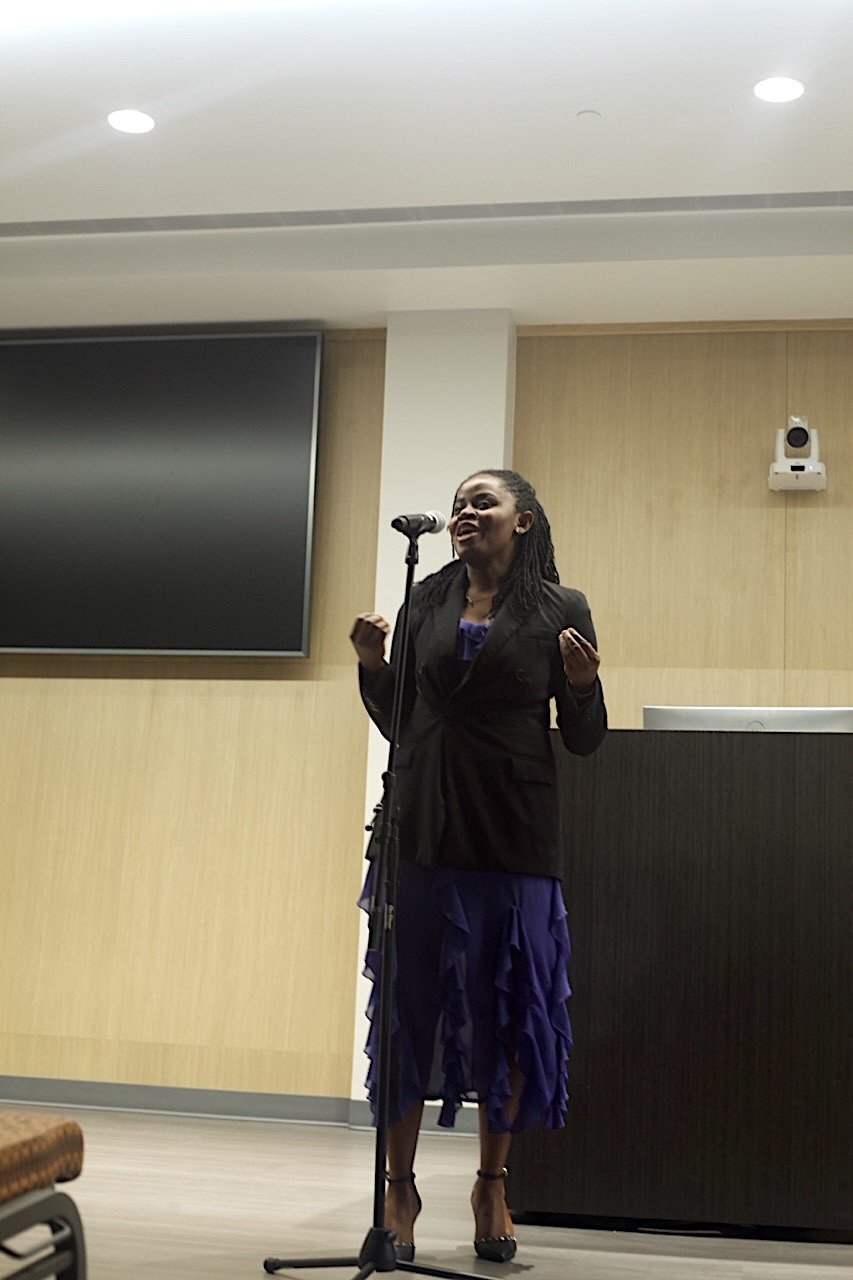
Modesta Nnedinso Abugu shares her story at North Carolina State University in Raleigh, NC in April 2024. Photo by Corey Bellamy.
When I moved to the US, I got the opportunity to tour Eastern North Carolina farms through the Genetic Engineering and Society AgBioFEWS Fellowship course. During that time, we visited a couple of farmers who are growing different varieties of genetically modified crops, including our Bt corn. I remember feeling so amazed at how much technologies these farmers have access to, and also machineries that they are using, and how research is actively evolving to solve the current agricultural challenges that they face.
I think at that point I felt a little bit of new feeling of hope and optimism. Standing on that Bt cornfield in Armstrong farm in Hyde County, that is the morning I felt so hopeful and alive again. At that moment, I imagined my mom and my siblings still in our farm, weeding, but instead of weeding with a blunt‑end cutlass, we are probably in our cute little tractor, maybe probably with my siblings and I still playing with each other and my mom's still yelling at us to focus on our work.
Touring the Bt corn farm really gave me a feeling of hope and excitement, hope that agricultural biotechnology could contribute to improving the food security situation of people in the developing countries. Hope that smallholder farmers like my mom could one day access this tool to improve their farming practices and also their livelihood. And excitement that agricultural biotechnology, although not a silver bullet, could contribute to improving the fate of agriculture in developing countries one smallholder farmer at a time.
Thank you for your time and attention.
PART 2
It's 2006. I'm standing in my mother’s guest bedroom in Ridgeway, Ontario, plush carpets, overstuffed cushions, and I'm pregnant, big belly pregnant. I'm on the phone negotiating the craziest life‑and‑death deal I will ever make. I'm negotiating a kidnap.
We haggle over price, because what’s the going price for a kidnap? I have no idea. So we strike a deal.
I listen on the phone as a man in the South African township of Khayelitsha kicks open the door and strides into an informal shack, dirt floors, corrugated iron, and I hear the muffled moans of a man, a 26‑year‑old man, and he's wrapped and bound tight into a big, woolen blanket. He's lifted outside to the idling vehicle and my waiting accomplice.
Doors slam, they take off, hell for leather, out of the township, and a very tense 20 minutes later, they arrive at a hospice where, as prearranged, the man is stretchered and admitted. We all take a very big breath. It's the first time I’ve ever had somebody kidnapped. I'm a bit anxious.
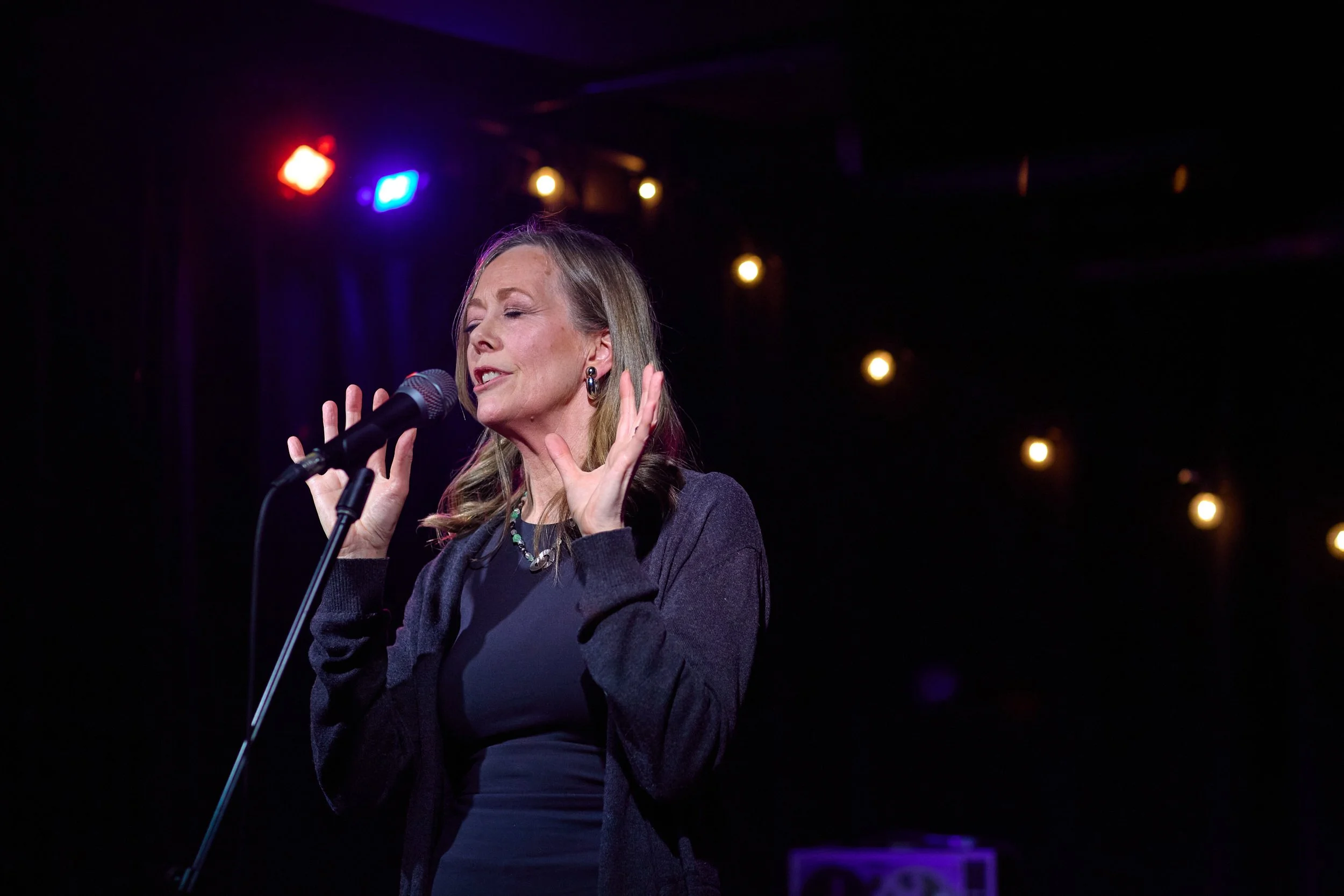
Fiona Tudor Price shares her story at Burdock Music Hall in Toronto, ON in February 2025. Photo by Yanni Tong.
The man that I’ve just paid to have moved to the hospice, his name is David. David has full‑blown AIDS. He is so emaciated, he is days, if not hours from death. Nomsa is a very good friend. It's his wife. I went to her wedding. And Nomsa is so afraid to give him antiretroviral therapy that she prefers instead to give him African potato and vitamins.
And my accomplice is Tandy. Tandy is David’s mother. She and I are very close. She's like a surrogate grandmother to my children. When she approached me and asked me to help her move David to the hospice, there was no way I could refuse to pay for the taxi.
So, welcome to South Africa, the early 2000s in the mid madness and the height of the AIDS pandemic, where hundreds of people, hundreds of thousands of people like David were dying of AIDS and contracting HIV due to science misinformation. That is the country I moved to in 1999 to make wildlife documentaries.
I'd been working at TV Ontario for about five years, making science documentaries, environmental pieces. I just got back from India making a documentary on olive ridley turtles. And out of the blue, my husband was offered a job in Cape Town. This was the glory days of post‑apartheid rainbow nation. Nelson Mandela was president and we said, “Why not?” And we moved to Africa.
This was my dream job, an independent wildlife filmmaker. What did I know of HIV‑AIDS? Nothing. But in South Africa, you learn fast. I learned interesting nuggets like they bury babies on Wednesdays, because it's cheaper.
As I was getting to know sub‑Saharan Africa in the year 2000, there were upwards of 25 million people living there with HIV or AIDS. In that year alone, 4 million people were infected with HIV. Clearly, this was a crisis of enormous magnitude.
The new president, Thabo Mbeki, decided to convene a president’s advisory panel, just to help him track his way forward. I remember standing in my kitchen reading in utter disbelief when he invited two notorious American AIDS denialists to his advisory panel. Wait, what? These people didn’t even believe that there was a connection between HIV and AIDS. Was this some curious strategy that I didn’t understand or did he just not want to license drugs for AIDS victims.
Then the barrage of disinformation began. Thabo Mbeki started to question the science behind AIDS. People genuinely believed that drugs were being shipped over from the west to eradicate young Africans. AIDS denialists were promoting and selling vitamins. The health minister was urging people to eat beetroot, African potato, olive oil and garlic. This seems, in retrospect, kind of comical and pathetic compared to the other piece of disinformation that was being spread around, which was, really, the only way to get rid of AIDS was to have sex with a virgin.
I spent countless days on a bathroom floor with a colleague crying when she found out that her youngest sister had been raped. All these lies had consequences, and people were scared. Talking about AIDS was utterly taboo. Even the mention of lifesaving condoms was met with raised eyebrows and ire. For ages, I was told to sit down and this was not my story to tell.
There were cultural pieces going on, more raised that I didn’t understand. So, for a long time, I was quiet and respectful.
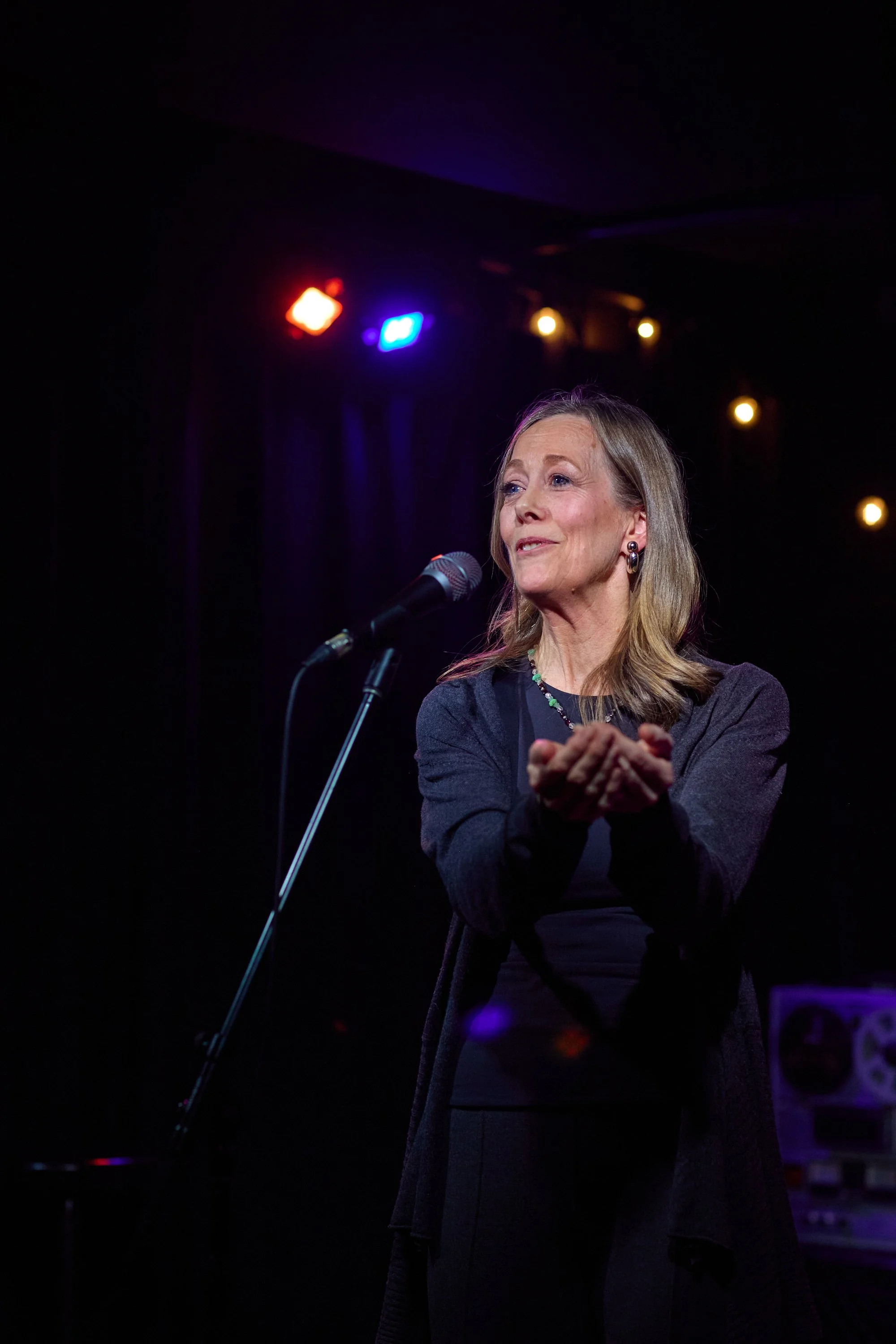
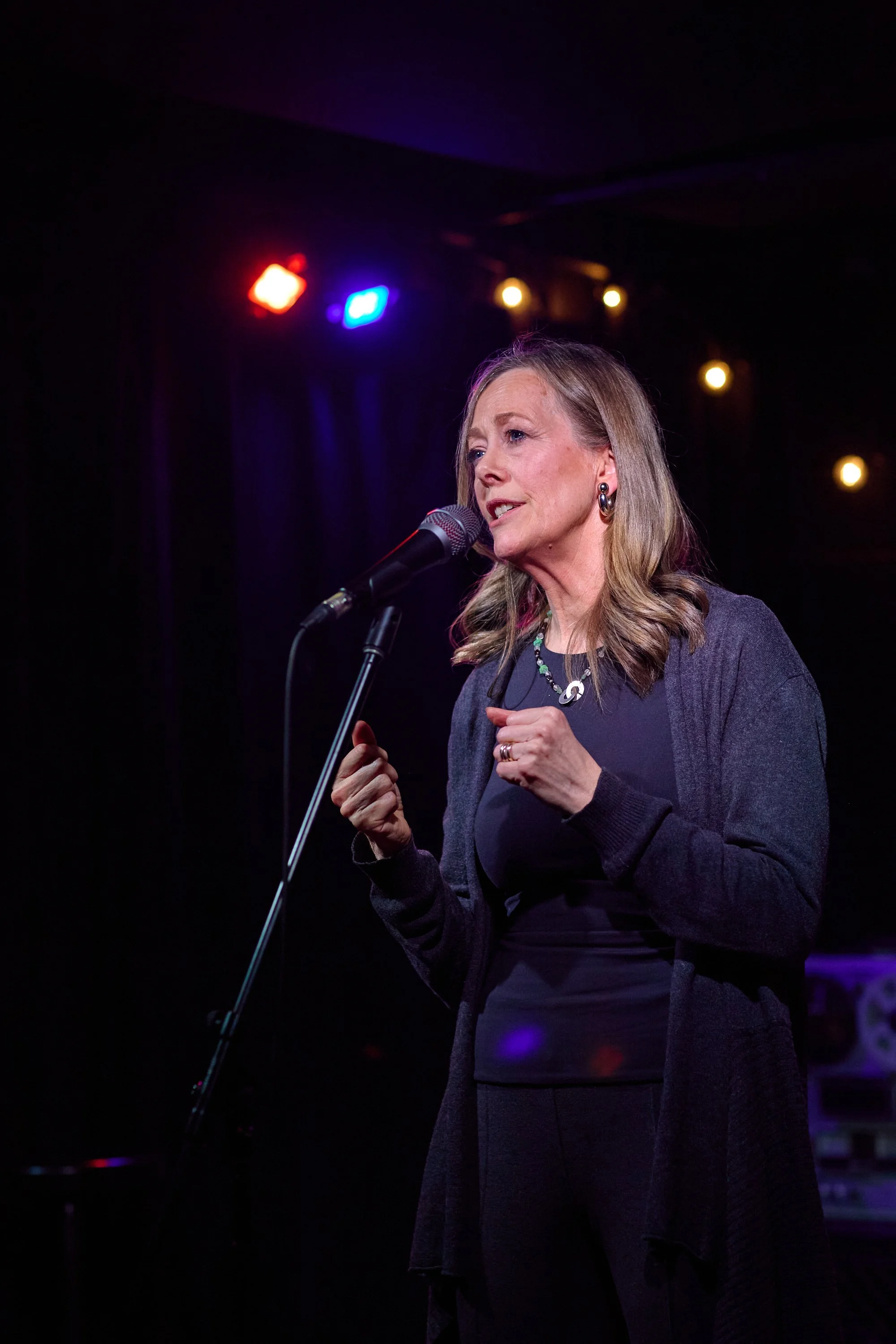
Fiona Tudor Price shares her story at Burdock Music Hall in Toronto, ON in February 2025. Photo by Yanni Tong.
Then after some time watching the suffering of the people around me, I couldn’t stay quiet any longer. I had to do something.
So when I was in South Africa, I started the first ever African chapter of WIFT, Women In Film and Television. At the inaugural launch at a rather fancy television festival, while all the other people around me, all the stalls were handing out these bougie gift bags of expensive chocolates, I stuck WIFT labels to thousands of condom packages. And I would give them out by the handful to all these curious young women who were coming up to talk to me. That was just bloody‑minded mischief, frankly, but it got the ball rolling.
Before David was diagnosed, he and Nomsa had a little boy who was mysteriously ill from birth. I'd go to the hospital. I'd take them blankets, take them food, take them whatever you could do to help. I held that little baby boy just moments before he died, and we were all devastated. It was a huge wakeup call when they showed me the death certificate. It said, “AIDS‑related complications”. He was two months old.
Then this barrage of misinformation, disinformation, it at first bewildered me and then it just shifted to rage. There was no way I could let this suffering of these people around me just go unanswered. I had to do something.
At this point, I stopped chasing animals and I decided to change and make content that could perhaps change lives.
Around this time, the South African government just lost this huge law case to an organization called TAC, Treatment Action Campaign. They had forced this big South African government into licensing AIDS drugs. Medecins Sans Frontieres and others were allowed to trial nevirapine in two clinics in Khayelitsha. Nevirapine is the drug that prevents HIV, the transmission from mother to child during childbirth.
So I started to collaborate with this amazing organization, this charity called Mothers to Mothers‑To‑Be. I picked up my camera and I started to follow three HIV pregnant women around through Khayelitsha, through their pregnancy. At great risk to themselves, these courageous women would let me follow them to the clinic. I'd follow them to pick up their ARVs and follow them, film them taking their ARVs. I got to know them really well. We would chat about baby names, we’d swap baby clothes, we’d go for lunch. And then, one by one, they would call me, often in the middle of the night as is often the case, “I'm in labor.”
I'd get my little camera and I'd drive into some of the most notoriously dangerous townships in the world to go and film the birth of these babies. But most of the time, actually, I'd just end up rubbing their backs because there was no painkillers, no nothing, so I would try and get them through labor.
Afterwards, the editor said to me, “Did you have to be in all of the shots?”
“Okay. I was just rubbing their backs.”
After the babies were born, I watched and I filmed as those lifesaving drops of nevirapine were dribbled into those babies’ mouths. And I watched and I filmed as each one of those babies went for its first HIV test. And I watched and I filmed as those mothers were given the results of those HIV tests. Each one of them was negative.
I made a little film about these tiny, wondrous stories. It was screened in clinics throughout South Africa to build awareness and promote nevirapine to other pregnant women. It was watched by thousands. I don’t think I’ve ever been so proud of making a one piece of science content.
South Africa’s reaction and response to the AIDS crisis in the 2000s was perhaps one of the worst public health failures in modern history. The ripples and the implications of that disinformation that was spread are still being felt today, and there are over 5 million people still reliant on USAID‑funded drugs that keep them alive every day.
After many rocky months on ARVs, David, rose like Lazarus and he returned home to Nomsa. One year later, they had a baby girl and they invited me to her christening, where Nomsa finally forgave me for kidnapping her husband.
Thank you.