In this week’s episode, both of our storytellers find themselves at odds with strangers when their beliefs and understanding of the world collide with someone else’s.
Part 1: As a vegan, Sophie Shrand feels like she’s constantly being judged for her dietary choices.
Sophie Shrand is an award-winning actor, educator, and producer with degrees in Behavioral Neuroscience and Theatre. Sophie is the Creator and Host of Science With Sophie, a Telly Award-winning science comedy series for girls and everyone. She is Executive Producer at Cool Jacket Productions, Host of streaming series Theory of Awesome, and can be found on social channels like the Museum of Science and Indeed. Sophie has brought science comedy to more than 2 million learners worldwide. As a STEM professional, she researched humans and cocaine, held brains in her hands, created three-story lightning bolts, and worked with skunks! Shrand’s work as an actor, improviser, vocalist, and international speaker spans two decades, stage and screen, and crowds of 3 to 15,000. Sophie has performed improv, musical theatre, and Shakespeare across the country, including the American Repertory Theater and The Second City. Sophie is now in post-production on her newest project, a documentary series in which she drives an electric car from Los Angeles to Boston and back on a coast-to-coast, round-trip journey across the USA.
Part 2: Cillian Dunne sets out to uncover the truth about Panama’s dictatorship, but his source has a very different version of what happened.
Cillian Dunne is an Irish author who writes investigative non-fiction. His work has taken him from the streets of south central Los Angeles to interview gang members, to rural Panama to interview members of a former dictatorship regime. For every book he works on, Cillian likes to completely embed himself in the lives of his subjects.
Episode Transcript
Part 1
I went to college in Boston to study two very compatible subjects, Behavioral Neuroscience and Theater. Hear me out. Neuroscience and Theater inform each other. They're both looking at the same thing, essentially, why we do what we do, our relationships with each other, and how we fit into the bigger picture of being humans on this planet.
Here's an example. One of my favorite neuro topics was Theory of Mind. It's a psychological development stage that typically begins around age two or three, when we start to realize that other people have thoughts, and they have thoughts about us. We start to wonder how others see us, how they perceive us, how they are thinking about us, how we are judged. That human awareness of what others think of us, that need to know, is foundational to theater, the art of storytelling.
I love that. And I love it so much that I combine these fields to create a career in science comedy with the goal of creating human connection, curiosity, and compassion.
So all of these things were on my mind when I was back in school and I picked up a new book by my then favorite author. I very romantically took it on the train with me. Picture this, a budding scientist and theater artist riding public transit with a story to read, until page two, when I realized that this was not their next novel but a firsthand account of his undercover investigation into factory farming in America.
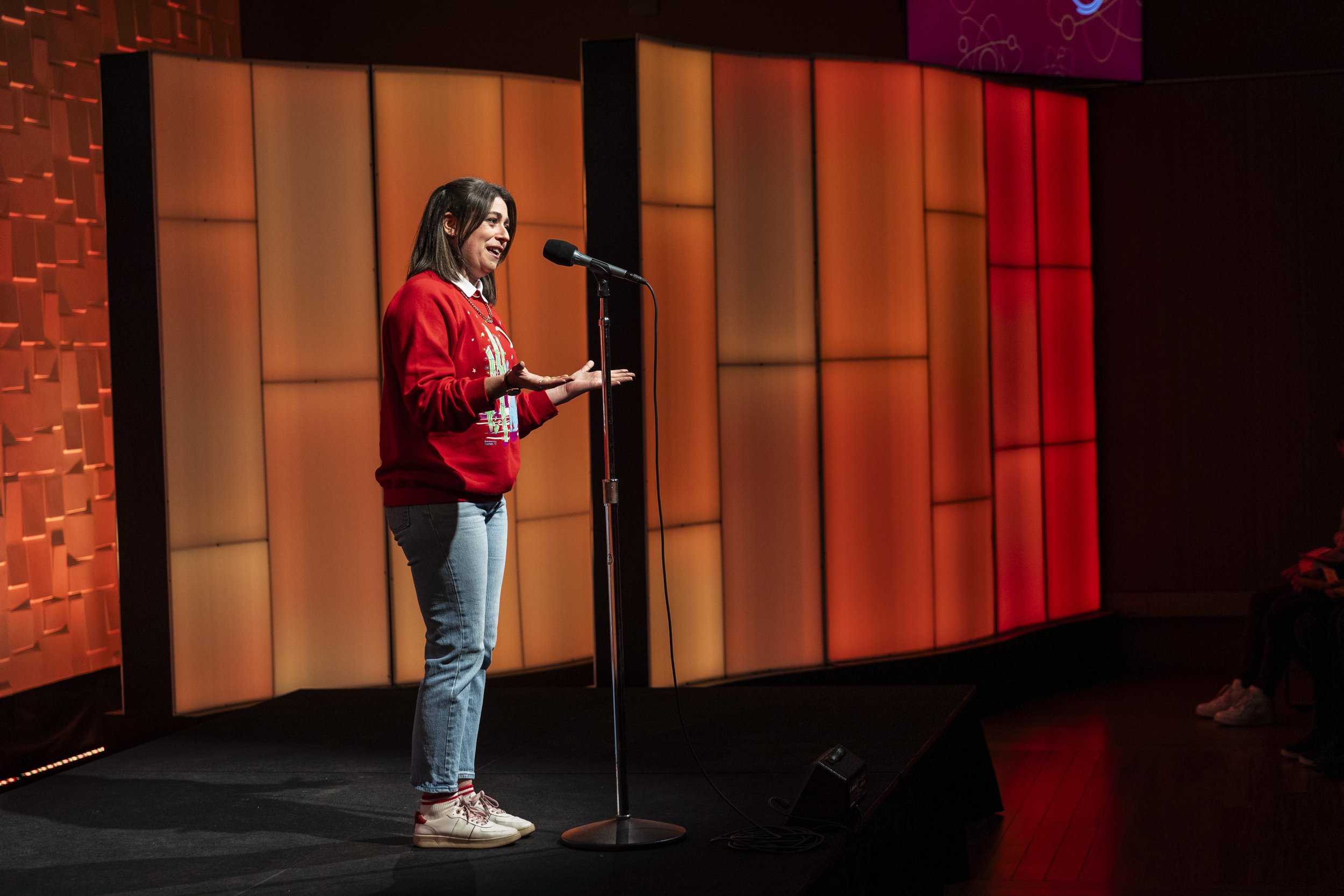
Sophie Shrand shares her story at the Crawford Family Forum in Los Angeles, CA in December 2024. Photo by Louis Felix for LAist.
Right there on the Green Line in Boston, it was like a switch flipped for me. Suddenly, my evidence‑loving brain was flooded with facts about a subject I really hadn't examined, food. It turns out that the way we produce food in modern America has very little connection or compassion to the planet.
So, right there, I looked up from a chapter on industrial cow‑feeding operations, and I thought, “No, thank you.” And that was it.
Almost 20 years later - I know, I look so young - I'm fully vegan, and I've been neurosing about it ever since. Not about being vegan, but about what you'll think about me being vegan, and about what you'll think I'll think about you being or not being vegan. Theory of Mind. Because, for whatever reason, when it comes to what we choose to eat or not eat, people's reactions can vary wildly.
When I tell somebody that I'm vegan, it can go anywhere from full acceptance to complete defense mode or attack mode. Now, most people respect it, but I'll notice the little eye roll or the smirk or the tiny sigh. I've been to weddings where the vegan option was chicken.
My brother, who loves me very much, would eat bacon in my face and go, “Mmm, bacon.” Some people would think that what I choose to eat is an attack on the way they choose to eat, which is all illogical. But the emotional and cultural ties of food are so strong that, sometimes, facts or evidence or science can take a back seat. Food is powerful that way.
Many years later, I move to Los Angeles, a vegan haven, which is not why I moved here. I moved here to keep making science comedy on TV and create human connection, curiosity, and compassion. The food scene was a bonus. But I did move here right before the strikes, which was not a great time for connection or compassion in the industry, and I felt pretty lonely as the new kid. But it was a good time to be an independent filmmaker, which I am.
So I thought, “What can I do to meet the moment here?”
One day, while I was looking for a car, because I lived in LA now, an idea struck me like lightning. I would drive an electric car from Los Angeles to Boston and back and film the whole thing. I would go out looking for the science of sustainable travel and meet people from all walks of life and find reasons to feel hopeful amidst the climate crisis. I would leave LA to connect with the rest of America and then I would film it as a documentary. This would be my biggest experiment yet.
So I gathered my team to map the route and prep cameras and fundraise and book lodging and guest interviews and troubleshoot things, like where we would need to charge and what I was going to eat. Because I lived in LA where there's a vegan burger on every block, but I was about to travel 7,000 miles over 25 states. So who would I meet and what would I eat?
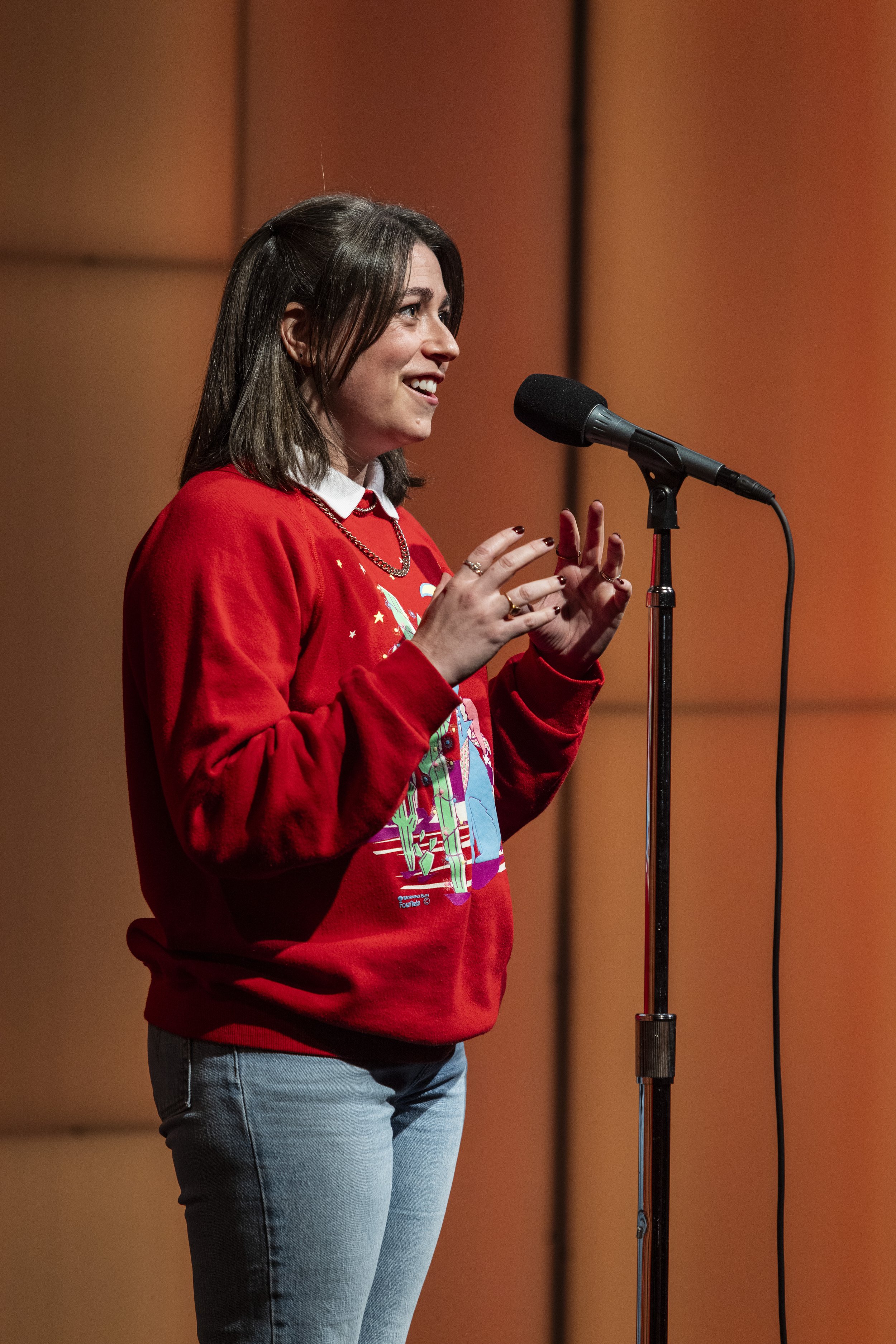
Sophie Shrand shares her story at the Crawford Family Forum in Los Angeles, CA in December 2024. Photo by Louis Felix for LAist.
Over months of pre‑production, I steeled my body and soul for two months of Taco Bell bean burritos, and then we hit the road.
So now, it is day two of this 49‑day journey. After a long day of filming and driving, my team is winding down at a campsite in Bryce Canyon, Utah. I am toasting a little vegan marshmallow as we map out the plan for the next day. When out of the darkness saunters a large, leathery man with a tan and a Texan drawl, and a big old hat and big old boots, and a big gulp full of booze.
He sidles up to the campfire and introduces himself as Cowboy Bit. Turns out, Cowboy Bit and my producer had been planning a horseback ride through Bryce Canyon the following day to film the landscape. And Bit had a surprise for me. He looks up at the night sky, takes a big gulp, and invites me to his authentic reproduction 1800s chuck wagon.
Now, if you've never been to a chuck wagon or lived in the 1800s, a chuck wagon is essentially the original food truck. It is a kitchen‑on‑wheels that followed and fed the cowboys as they boy‑ed the cows.
So here's math. Cowboy plus chuck wagon equals meat. And Bit is cowboy‑est cowboy to have ever cowboyed in my mind. I mean, he's got a steel toothpick in his mouth and he has dust on his hands. He is every inch a cow‑boy. So I'm going to tell this man that I don't eat meat. Yes, this is where I need to say, “No, thank you.”
So I say, “Absolutely. Thank you. So kind. Wow! How generous. Oh, amazing. See you in the morning. Yes. Enjoy the stars.”
The next morning, we set out on a full day of adventure and filming and a full day of opportunities to tell this man the truth. We are riding horses through Bryce Canyon. It's majestic. We're talking about land stewardship and water conservation. That's going pretty well. Maybe I could work the vegan thing in here, or I could point out those trees. Look at those rocks. How old is this horse? Oh my gosh, the air is so clean.
About halfway through the ride, I realize we are behind schedule. Maybe we won't have time to go to the chuck wagon, and I can avoid this conversation entirely. Nope, because Cowboy Bit is prompt, dang it. He's already got his team hitching up the horses to the other wagon that we're going to drive to the chuck wagon in the woods. All I have to do now is dress for the occasion.
Bit hands me a brown muslin frock, which I am voluntold to put on for the cameras. But I'm a theater kid so, yes. Now, I'm an authentic period‑appropriate secret vegan.
Bit offers me a hand and I go up beside him on the reins in the wagon and off we go. If I had an 1800s pocket watch, it would be ticking. We are in costume. Bit is teaching me how to steer. We're talking about environmental science as we clip‑clop closer to a chuck wagon full of meat.
Bit turns to me and he says, “You know, they really had to know Mother Nature back then. They might not have called it science, but it was.”
And I think, “Tell him now. Tell him now. Tell him right now.”
And I say, “Science is everywhere.”
Bit says, “You know, it's inspiring, really, to think that when we can put our minds to something, we can accomplish all things.”
And I think, “Like tell the truth to one person, to a new person that you just met. Just tell the truth like that. We could do that.”
And I say, “So true.”
And Bit says, “And as we say on the chuck wagon, some lessons cost more than others.”
And I think, “Like telling lies. Lies. Lying is bad. A lie of omission is still a lie, so you should just tell this man right now just the simple truth.”
And I say, “Mm-hmm.”
Now, we are getting closer and closer. Bit steers the horses to the right. The chuck wagon is almost in sight. And he turns to me and he says, “Ready to eat? We got everything cooking up on the cast irons right now as we ride. We got some real nice eggs and bacon. How does that sound?”
And I say, “I have a confession to make.”
And he says, “Vegetarian?”
My empty little stomach drops. This man has been offering me something that I really, really want. A heck of a story for this documentary, the different walk of life that I was hoping to find, and something I really, really, really don't want. And I say, “Vegan.”
And that’s it. It's over. Oh, my God. Okay. Show canceled. Experiment failed. Take me home. Just turn the chuck wagon around. I'm going to go back to the lab and forget I ever cared about connection or compassion because, clearly, I cannot do this, and it's, “Mmm, bacon,” all over again. So just take me home.
Which I did not say. I just thought in the fraction of a second before Bit says, “Well, that's all right. I don't look down on that at all. I actually think that's a good thing. I eat less and less meat as time goes on.”
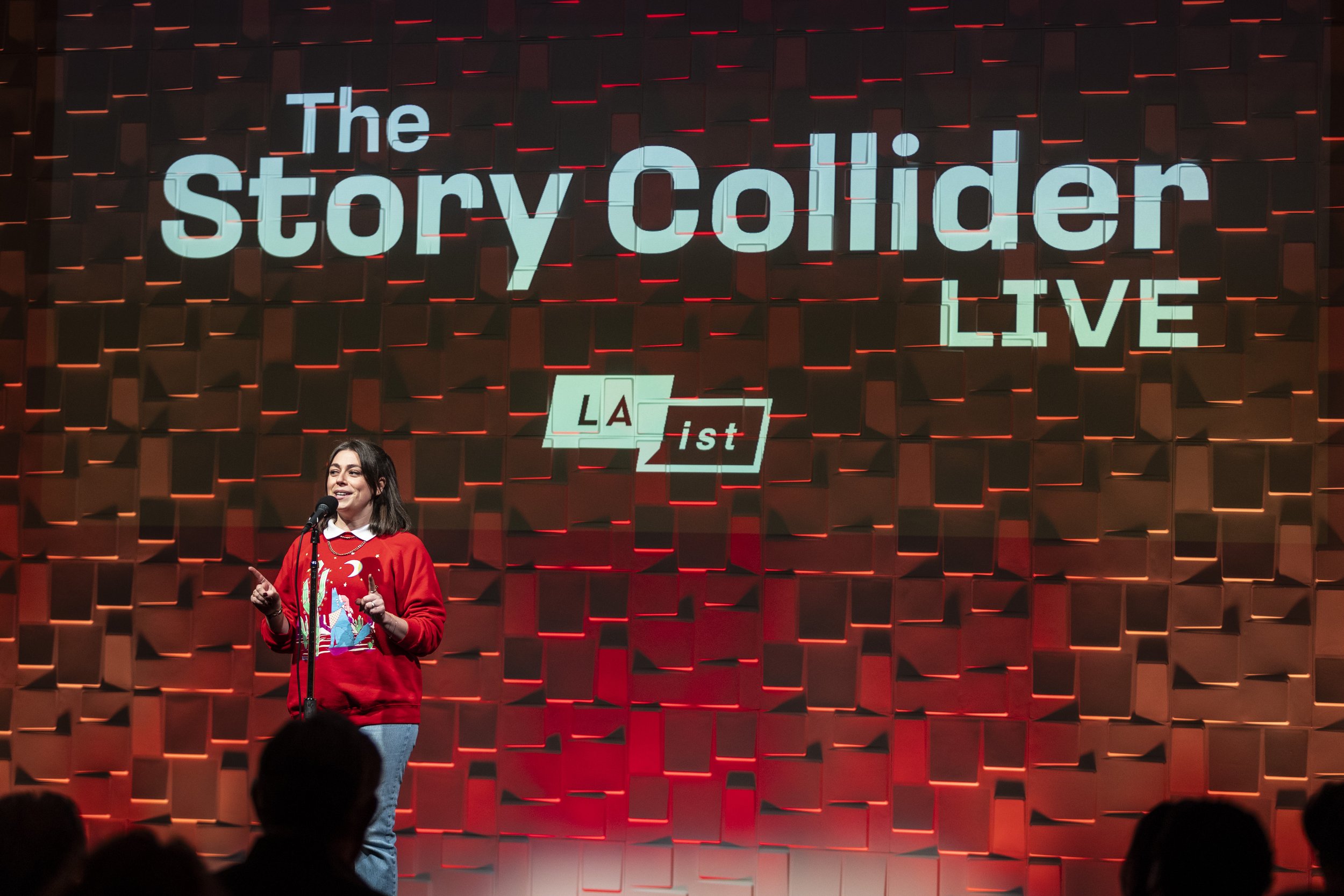
Sophie Shrand shares her story at the Crawford Family Forum in Los Angeles, CA in December 2024. Photo by Louis Felix for LAist.
And I say nothing, because I am stunned.
Bit says, “I just wish you'd told me earlier. I would have made you something different. But I think we got everything we need to make an apple cobbler. How's that?”
Turns out that Bit the Cowboy cooks vegan from the chuck wagon all the time. And more and more people are requesting vegan and vegetarian meals from the chuck wagon. If only I told him earlier.
In a wave of relief, I admitted why it took me so long. I was afraid that he would judge me.
And then Bit says something that I still think about to this day. He says, “Well, you know, ain't that a great point? How often are we all guilty of assuming we know something about a culture that we really don't?”
It led to a really cool conversation. We had different opinions about food. We had different definitions of sustainability. But it wasn't divisive. It didn't even feel particularly emotional. It was a thoughtful and kind, dare I say, fun conversation between two new friends who gently challenged each other. We both had a lot to think about.
I was a country and two decades away from the Green Line there on that wagon, and another switch flipped for me. I had been afraid to say no, afraid to speak up, afraid to say the truth, because I was biased. It was a lesson that I needed to learn on day two of this two‑month trip so that I could let my guard down. Because if my goal was human connection and curiosity and compassion, that meant confronting my own misconceptions. My own theory of mind had gotten in the way.
I sat there on that chuck wagon for hours after we filmed. I stayed way longer than I was supposed to and I put us way behind schedule. As Bit and I shot the breeze, I wondered what else would surprise me on this 7,000‑mile electric journey if only I could be open to others and be open to their openness in return.
So I sat there in delight, deep in the woods of Bryce Canyon, the cast iron is on the fire, with my new friend, Cowboy Bit. And I did the only thing I could do. I took another bite of a dang good apple cobbler.
Part 2
When I was 27 years old, I got a phone call from my friend Jack, who lives in Panama. I was in my apartment when he called. I had my laptop open, waiting to see if anyone had noticed the non‑fiction book I'd just released, Dreams in Incarceration. Almost no one had.
That book was based on interviews I'd done with Bloods and Crip gang members from South Central Los Angeles, and I'd spent time with people who had lived through real violence and struggle, and I'd tried to turn their stories into something honest. I was really proud of the book, but I was also broke. I had about $500 in my bank account and rent was due in three weeks. I kept telling myself I had time, but I really didn't.
Then Jack called. He said he had seen my book on Instagram. He told me that his business partner, Jose, has access to an incredible story about their former dictator, Manuel Noriega, and he asked if I was interested in speaking with him about it.
I said, “Yes, absolutely.”
So I got on the phone with Jose, and for about 30 minutes, we spoke about names like Muammar Gaddafi, Ronald Reagan, and Fidel Castro. But then Jose told me about a man named Carlos Wittgreen He said that he was the right‑hand man to Noriega, and that he was a triple spy, and that he was still alive and willing to tell his story. Jose asked if I would like to meet Carlos.
In truth, the whole thing sounded too big to be real, almost too good to be true. But I remember trying to sound calm on the phone while thinking, “This is exactly the kind of story that I want.”
So I thought about my rent, I thought about my current situation, and I asked Jose and Jack if they could cover my rent while I went to Panama. Without even saying yes, Jose said, “When can you come to Panama?”
So within a few days, I flew down. But before I flew down, I was doing research. I needed to get up to speed with the story. I thought I was going to Panama to write the hidden truth about Noriega. I thought I would interview Carlos, look at documents, talk to people, and figure out what had really happened. I also thought that Carlos would be someone I could come to understand. He would be the source, I would be the writer, he would tell me the story, I would write what was true, where allegedly so many others had not. I thought memory would work like testimony. If I asked the right questions, the past would come back in the right order.
The first time I met Carlos, we were at an Italian restaurant in Panama. Carlos was in his early 80s but he did not seem weak or old in the way I expected. He had a strong face and sharp eyes. He watched more than he spoke.
Jose and Carlos talked in Spanish for most of the lunch. My Spanish was not good enough to follow everything so I mostly sat there and listened. I tried to catch names and understand the tone trying to look like I belonged at the table. Every so often, Carlos would look up at me. I felt like he was sizing me up.
After about 30 minutes, Jose turned to Carlos and said in English, “Carlos, Cillian is a young Irish writer who is very interested in writing a story.”
Carlos just looked at me and said, “You will do a good job.”
I did not know what else to say. Part of me wanted to act like I had done this before, like I flew into foreign countries all the time to interview men who had stood beside dictators, like I was not 27, broke, and trying to hide how nervous I was.
So I said, “Yes, Carlos, I will do a good job.”
That was it. There was no contract. It was a handshake deal.
Soon after that, Jose brought us to one of his beach houses. It was me, Carlos, Carlos' girlfriend Natasha, and Jose's son Diego who helped me translate.
I started interviewing Carlos every day. We would sit for hours. Carlos would talk. Diego would translate. I would take notes and try to keep up. At first, every interview felt exciting. Carlos would talk about Noriega, Castro, the Americans, the DEA, and the old world of Panamanian power. Every name felt so important and every story felt like it opened another door. I believed I was there to find the truth about Noriega and the world around him. I was not trying to defend Noriega. He was a dictator, he hurt people, and he held power by force. But I did think the story had been inaccurately told in the past, and I wanted to understand what the United States had done in Panama, what Carlos had seen, and what had been left out of the official version. It was an amazing story from start to finish.
After about a year of writing, I'd finally completed the first draft of The Right Hand Man. I was sitting in my apartment in Los Angeles when I typed the words, “The End.” And I was excited when I sent the draft over to Jose and Jack for review. I was ready for this book to be out there. I had spent the last year only working on this project. If I was poor when I started the book, I was even poorer now. I had credit card debt. I could barely afford rent still. And the one thing that I wanted was for this story to be out in the world.
But Jose and Jack quickly got back to me and they said that Carlos had not given me the full truth. They told me that, as they were reading, they smelled bullshit. So they proposed something. They said that I should become a character in my own story. I should become a character in the book.
What they meant was I should introduce a new perspective, my perspective, where I'm hearing what Carlos is telling me, and then I am going out there and hunting for the truth. This became the dual perspective that currently exists in The Right Hand Man.
So I went back to Panama with a new goal. Carlos was an old man. He lived through dictators, intelligence agencies, coups, betrayals, and political violence. He had spent his life around secrets. He was not just telling me history. He was choosing what could survive on the page. In a sense, he was trying to protect his legacy. I wanted the truth. Carlos wanted his story remembered.
He did not seem to be lying in a simple sense. I don't want to come across that he was. It felt a lot more complicated than that. It felt like selective memory, or maybe the preservation of legacy. Yet I truly believe that he was a genius, capable of steering conversations in any direction he pleased. I attributed it to his years of training and experience in the intelligence world. I felt like he was not only telling me what happened, but also showing me the political injustices along the way. But it was obvious that parts of his clandestine life were missing.
At first, I thought we wanted the same thing. I thought we both wanted the full story out in the open. Then slowly, I started to see it differently. That was when I realized I had to do more than listen.
I started researching more at night after everyone had gone to sleep. I went through notes. I checked names. I looked at documents. I talked to other people who knew the history. One of them was Richard Koster, an American journalist who had lived in Panama for decades.
He told me that, in my research, I would find many people who lived part of the story, but not one person would be able to tell me the whole story from start to finish in an objective way. In a sense, every single man experienced their own reality during this time. Talking to people like him helped me understand how complicated the story truly was.
The more people I interviewed, the more complicated Carlos became, but the more intrigued I became. I could question parts of what he said and still like him. He could frustrate me as a source and still completely move me as a man. When I first went to Panama, I expected Carlos to be intimidating. I expected him to be guarded. I did not expect to like him as much as I did.
Over the next two years, I went back and forth to Panama. When I was there, I mostly lived with Carlos. I was around him all the time. He wanted to know if he could trust me. At the same time, I was trying to figure out how much I could trust the story and what I could do to ensure, at the very least, that I was publishing something accurate to one man's reality.
I started to understand that his reality had been built over decades. Some part parts had been sharpened by repetition in his life, but other parts had been simply forgotten. Carlos was not an easy man to challenge. He had survived too much to let a young writer come in and tell him what his life story was without having lived it himself. He believed in what he was telling me. I believe just about all of it too, if I'm being honest with myself.
But I knew Carlos was smarter than that. I knew he could have given me more, and in doing so, he might have helped both the overall story and his own. But it was his life. It was how he wanted to be remembered. So I had to adjust the book, splitting our narratives, my side hunting the truth, Carlos’ side telling me his story.
At first, I thought I was writing about Noriega, Panama, and the secret history behind the official story, but the real story became more personal. It was about me going to Panama with no real protection, no money, and no idea what I was walking into. I was sitting across from a man who had lived inside a world I'd barely understood. I had to learn how to interview him as I went. I had to learn when to ask more, when to stop, and when to question a belief he had carried for decades.
There were plenty of moments when I was out of my depth. Carlos had survived dictators, spies, coups, and betrayals. He was an objectively great man and I was trying to prove myself as a writer, following in the footsteps of the greats who had ventured outside their comfort zones for a story. My job was to find the truth. Carlos' goal was to preserve his legacy. By the end, I understood that those two things would always clash.
The book became a story about fact and perspective. It also became a story about memory and loss. Carlos Wittgreen sadly passed in March 2025. The Right Hand Man, my book, came out in November 2025.
I will miss Carlos. In the end, he wanted to be with his family and share the stories of his life with them too. It was his truth and his legacy, and I could not help but admire everything he'd experienced. He gave me one of the most exhilarating experiences of my life. I came out understanding that when you sit across from someone who has spent his life, as Carlos did, being deceived by intelligence agencies, governments, and friends, the truth is not linear and neither is memory.