Valentine’s Day may be all about couples, but this week’s episode celebrates heartbreak, breakups, and proudly being single as a Pringle.
Part 1: Getting dumped is the push psychologist Jiawen Huang needs to step outside his comfort zone.
Jiawen Huang obtained his PhD in Psychology from Columbia University, where he studied how prior knowledge provides a scaffold for prediction and memory. He grew up in China, and did his undergrad at University College London where he scanned people watching movies in fMRI scanner. In his free time, he can be found dancing salsa, practicing Spanish, and whittling wood carvings, all of which he started doing this past year.
Part 2: While completing her PhD in neuroscience, Leslie Sibener is determined to fix her relationship.
Leslie Sibener is a neuroscientist and science communicator based in New York City. She received degrees in Neuroscience and Creative Writing from Johns Hopkins University, and her PhD at Columbia University where she studied movement and motor learning. Now as a postdoctoral fellow at Rockefeller University, Leslie researches the mechanisms that allow specific memories to be stored for long term memory in the brain, while others are forgotten. She has always been passionate about sharing science outside of the lab. This has manifested in being the group leader the science writing group NeuWrite, a team member of Stories of WiN, and founder of Scientist on the Subway. Additionally, she has collaborated with a variety other groups, such as BioBus, Facts Machine Podcast, and the Dance Theatre of Harlem, to engage the public with science.
EPISODE TRANSCRIPT
PART 1
I met him in spring break last year in Puerto Rico. My friend was supposed to go with me, but she ditched me. And solo traveling was way out of my comfort zone that I would have canceled, if not because of a gentle push from science.
A few months before that spring break, I had started learning Spanish because my research was not going well and I wanted to do something that would at least bring me some results after I put in the effort. And then right before that spring break, I had also submitted my second paper of my PhD to a new journal. The paper looks at how we remember events that were not predicted but, in retrospect, makes sense, like the story you're about to hear.
After I submitted that paper, I had some downtime before pivoting to my other projects, and I decided I would go to practice my Spanish. It turned out going to Puerto Rico to practice Spanish was a terrible idea, because people there speak really fast Spanish with a strong accent that even native speakers from some other countries don't understand. But I got something else out of the tour.
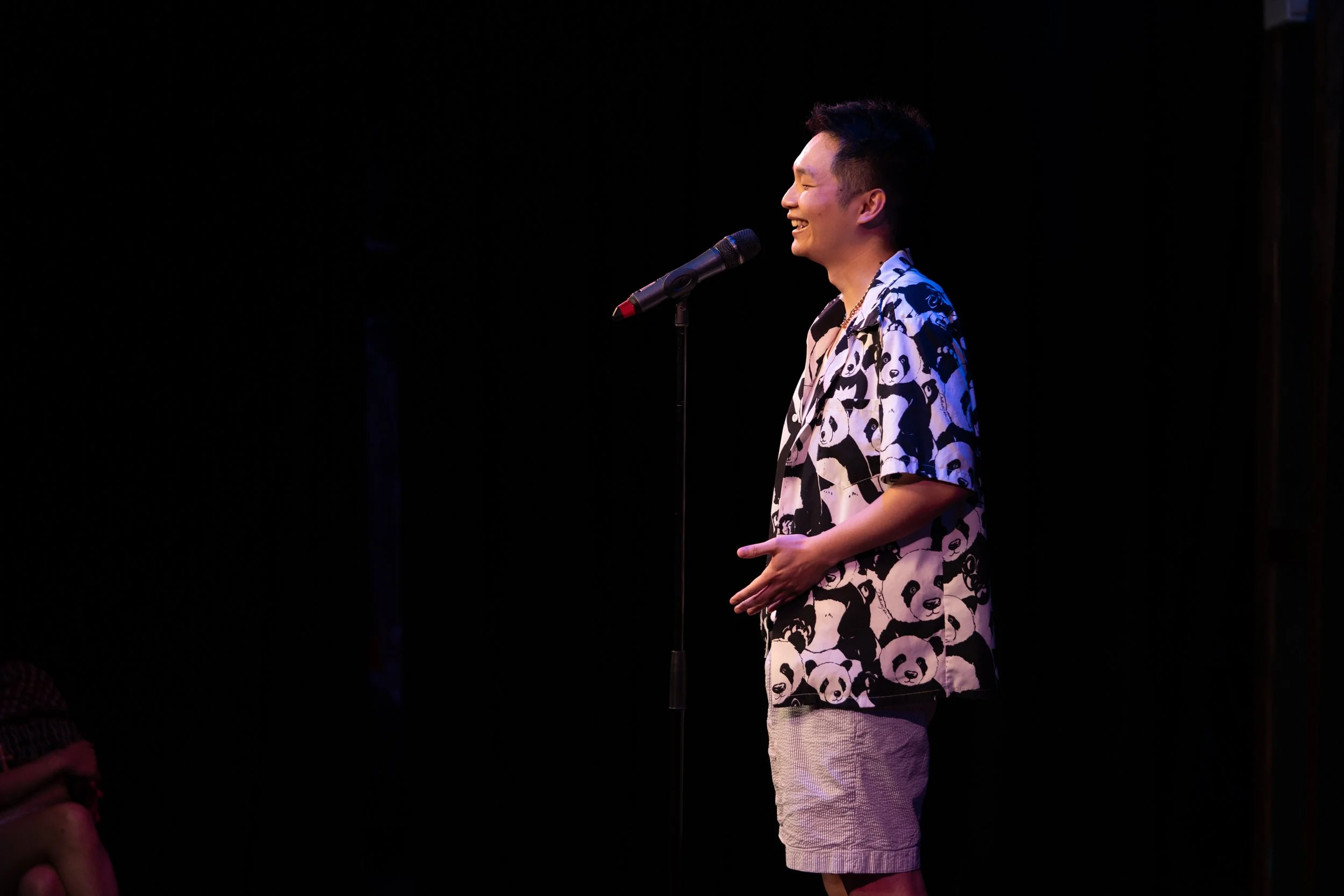
Jiawen Huang shares his story at Caveat in New York, NY in July 2025. Photo by Zhen Qin.
So before one of my tours, I had a really nice conversation with a tour guide in English. We followed each other on Instagram, and then at some point, the conversation became a little flirty. Although nothing happened, it was really nice to know that you can still have this kind of organic in‑person connection with someone, which is rare even for straight people, but super, super, super rare for gay people.
And it was particularly refreshing to me because have you tried dating in New York City? It's hard. And the night I met him, I also found out that the paper I had just submitted went under review in that journal. So all in all, it was a very special night for me.
Then I came back to New York City where we continued chatting. It became a thing that consisted of daily FaceTime calls, watching movies together remotely, and then me visiting him in Puerto Rico and then him visiting me in New York City, some rom‑com stuff. So, after, we talked about we will see each other every month, and we talked about going to Peru and Mexico.
Then on Father's Day last year, on my friend's birthday brunch three days before I was going to Puerto Rico to visit him again, I got a text from him ending our thing. The text felt like what my research was about. It was something that I didn't expect, but, in retrospect, it made sense because I could feel him pulling away the month leading to that Father's Day.
But as I was reading the text, I just sort of felt myself shrinking into the chair. I couldn't finish my food. I took a few bites of what I ordered and I went home. I must have looked so sad because the friend that was having the birthday brunch, who was not a hugger, just initiated a hug with me before I left. That was the first hug we've ever had in our two‑year friendship.
My main activity during that week was going through Instagram reels in my bed for hours every day, which definitely knew that I was just dumped. Because if you're going through a breakup, you'll see a few types of content from Instagram reel, the most ridiculous one being AI tarot reading.
So there will be this clearly AI‑generated video of a woman talking to you saying things like, “This man that you had a connection with is regretting what he did to you.” Common 666. “He will reach out to you.”
Ridiculous, and it doesn't work. I tried.
And the more normal and helpful type of contents are psychology of relationship, attachment styles, about breakups, which I used to dismiss as a cognitive psychologist for being less rigorous scientifically, but they suddenly made so much sense. It explained a lot of our relationship dynamics.
One of the things that particularly resonated was the idea that we fall for people that have qualities that we wish we had, and I could definitely see that. I had been in my comfort zone for so long at that point.
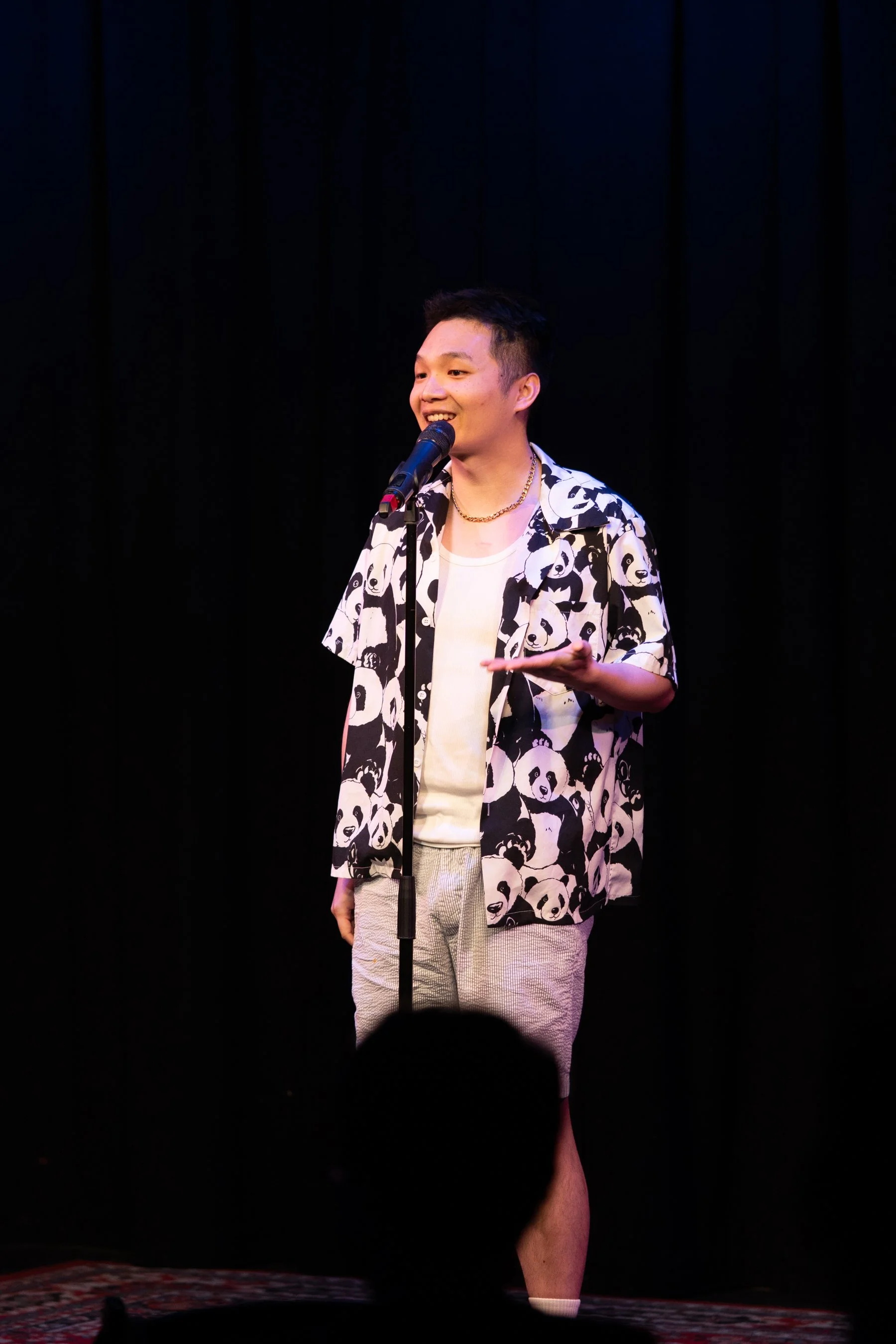
Jiawen Huang shares his story at Caveat in New York, NY in July 2025. Photo by Zhen Qin.
After I started college many years ago, everyone around me was trying to network to find an internship in a consulting firm that will turn into more internships, that will eventually turn into a job once they graduate. That sounded horrifying to me.
And I found peace in learning about the existence of a place called academia where everyone is a professional nerd. I became one of them. I took classes. I did research. I ran experiments. I wrote code. I wrote papers up until now. I was also lucky to be advised by an amazing mentor who is kind, supportive, smart, hands‑on but chill, everything you can ask for. And I like my research. I was having a great time in science, but it was just so easy and comfortable.
But his life cannot be more different from mine. He knows how to hunt. He knows how to ride horses, how to take care of horses. He knows how to fix cars. I can't drive. He can probably survive an apocalypse while I'll be one of the first ones to die. But perhaps more importantly, he had to go through a lot of hardship when he was much younger, which made him independent and capable of thriving and having fun in any kind of situations. Deep down, I knew that this was what I wanted to be if I was more brave.
So after teaching me this important lesson that maybe I just wanted to be more like him, Instagram also offered a solution. Well, kind of. So he used to be in a salsa band, and he likes dancing salsa. So Instagram pushed me an ad for a salsa class.
I have never danced before and I feel extremely self‑conscious about my body movements. But I decided to take a baby step out of my comfort zone and give it a try.
Salsa is hard. I remember when I first started, I would just keep staring at my own step, yet still managed to step on people all the time. In retrospect, I think I didn't give up because I really wanted to feel connected to him in some way after we were no longer talking to each other. And this desire had outweighed any fear or discomfort I had about dancing.
But I was still sad at the time. I was thinking about all the things we had talked about doing, including going to Peru, which I wanted to do even before I met him but I was too afraid to do it myself. So after the baby step of taking the salsa class, it became a little bit easier to leave my comfort zone again to do it.
So I went in August, with my friend's urge not to fall in love with a tour guide again. And it was an amazing trip. While we were in Machu Picchu overlooking the Asian ruins of the Inca Empire, someone from our tour group said that the best year of his life was when he was 26, when he went on all sorts of trips and adventures without getting hurt.
Then I came back to New York City and my 28th birthday was coming up. And the day before my birthday, I went for a postdoc interview and gave the best talk that I've ever given in my career, while still recovering from food poisoning from Peru.
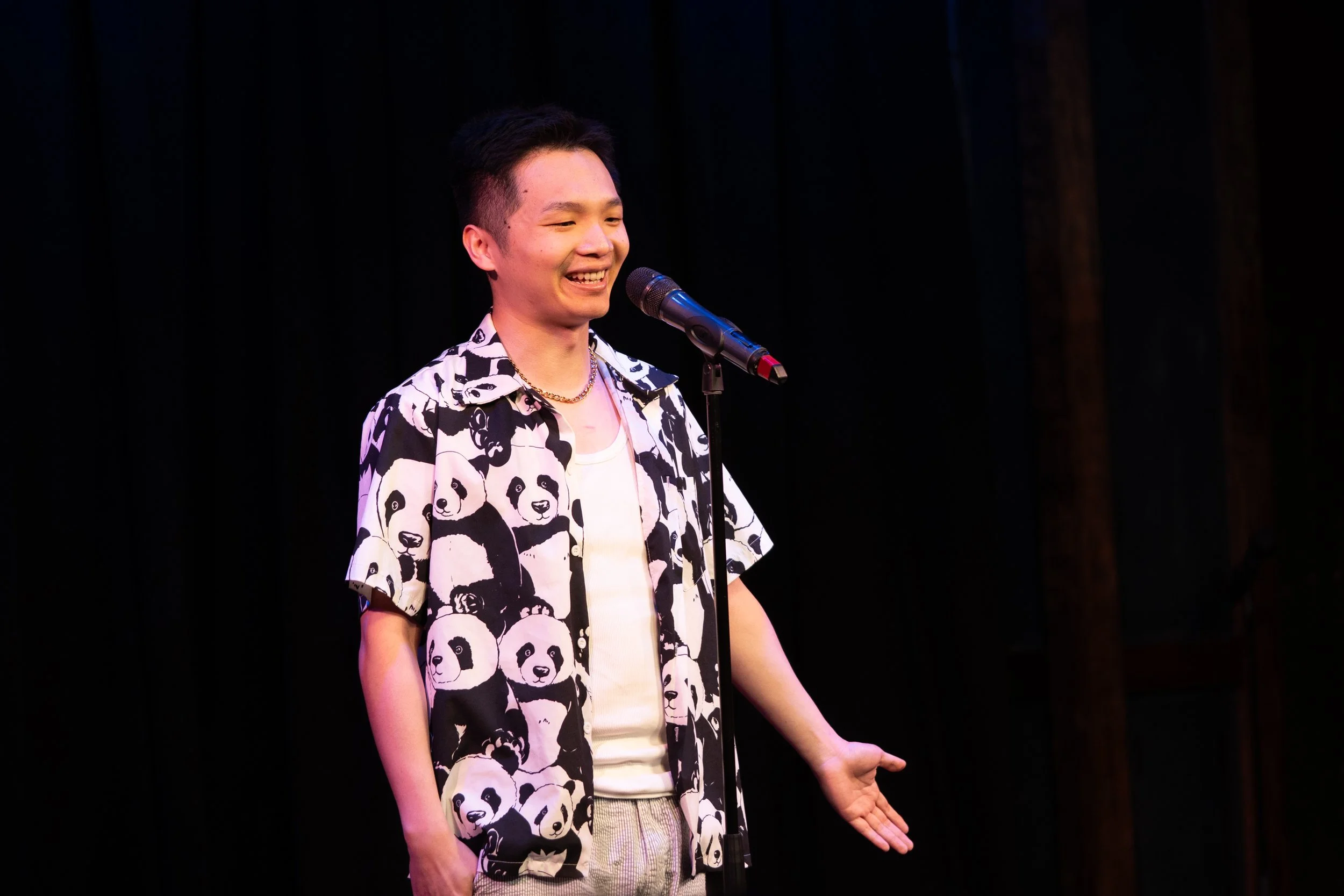
Jiawen Huang shares his story at Caveat in New York, NY in July 2025. Photo by Zhen Qin.
Then on my birthday, I told my friends that 27 had been the best year of my life, and I made a wish that 28th will be even better, and it has been.
I continued dancing salsa. It has become something of my own that brings me joy, instead of something as a way to feel connected to him. I continued traveling. I went to Mexico and Guatemala by myself, after Peru. I made so many friends through traveling and dancing. And going out and meeting people has become one of my favorite things, which I would have never imagined two years ago when I would stay at home and code every day.
I got into science many years ago because I was too afraid to leave my comfort zone. I spent hundreds of hours collecting data from my participants and learned to make sense of them. Then many years later, science gave me a gentle push out of my comfort zone to collect data about myself. And with this data, I feel confident that I'm capable of way more things than I thought I was.
So I had been thinking, after international romance and breakup, after my Spanish grew from knowing “Como estas?” to being able to have full‑on conversations with people, after learning salsa from scratch, my life has completely changed.
But the paper that went under review the night I met him is still not published.
This was going to be my funny little ending to this story but, unfortunately for this story, it was accepted last month. And the acceptance came at a time where I was making a decision about whether I wanted to stay in academia or not.
And with another thing off my plate, it became easier to make the decision to leave, to see what life is like with this new version of myself.
Thank you.
PART 2
In the first year of graduate school, students are looking for a lab to join to do their PhD research in. This process is very similar to dating. You know, you're putting your best foot forward, but also assessing if a lab is the right fit for you.
And in the neuroscience PhD program that I trained in, students are encouraged to do three rotations before committing to one lab for what is, on average, a six‑year relationship. That is no small thing for a 22 or 23‑year‑old like I was.
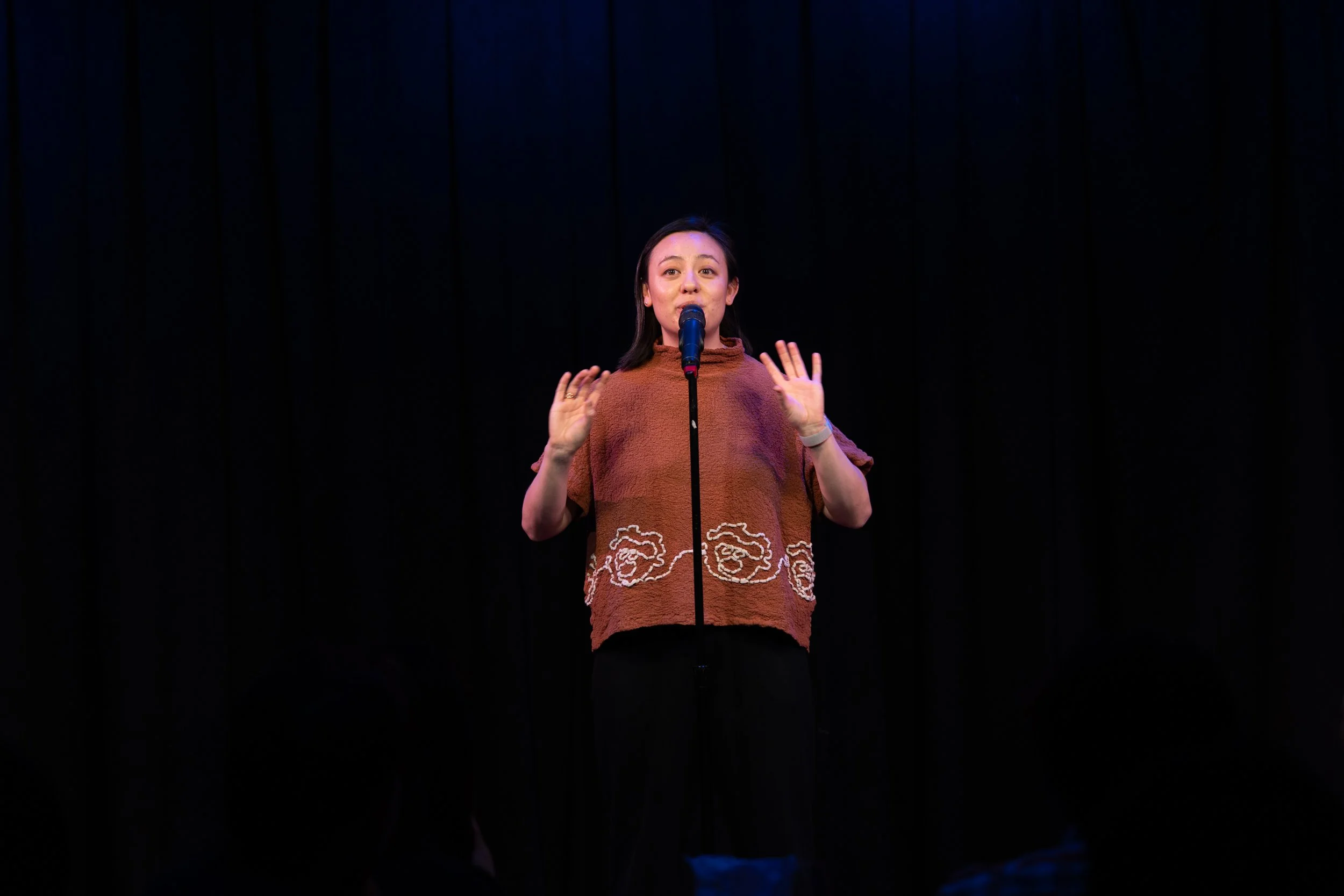
Leslie Sibener shares her story at Caveat in New York, NY in April 2025. Photo by Zhen Qin.
After I did my three rotations, I found the lab that was perfect for me. The community was tight‑knit and welcoming, and the head of the lab was brilliant, but also kind. I was able to do research in movement and motor learning that I was so excited about.
Around the same time that I joined the lab, I also started a romantic relationship with a law student named Mike. Now, Mike, he was just so much fun and outgoing and had a really, really deep voice. So I was interested.
The thing that really bonded us together was going out to see live music around New York City. We would listen to songs and memorize lyrics so that we were ready to scream the songs when we were out and dance until our knees gave out. It was these moments of unrelenting fun that really drew me into him. Soon, we were in an exclusive relationship.
You know, for a PhD student, it is really, really easy to get caught up in going to lab every day and experiments for weeks on end, and his laid‑back Southern California attitude was just exactly what I was looking for. So once we were exclusive, I started introducing him to some of my closest friends.
For me, this is a really important step, because I have this close group of friends that I have been incredibly close with since before puberty. I really consider them more than friends, but part of my family.
So Mike got along with a few of my friends in New York, and we planned this trip to D.C. to visit two of my closest and oldest friends, Rosie and Nathan. I thought that this trip would be an amazing time to integrate Mike into our friend group, and our relationship could keep growing in the way that it had for the past few months.
When we got to D.C., we first went to Nathan's apartment for a party. It was the perfect venue because the living room was big enough so that we could set up this long table for beer pong. Rosie and I teamed up and it was just like the glory days. She was hitting shots right and left, and I am not good at beer pong. I was mostly there just cheering for her and basking in the moment of being together because it had been a really long time since I'd seen her.
As Rosie was lining up to make another killer shot, all of a sudden, I feel Mike come up behind me and put his hands around my waist, lift me off my feet, and start spinning me. Now, I am not someone that likes being picked up in public, and Mike knew this about me. So it was odd that he kept doing this even after I told him to stop. There was this tension that started building between us, but I thought that it would just fade away.
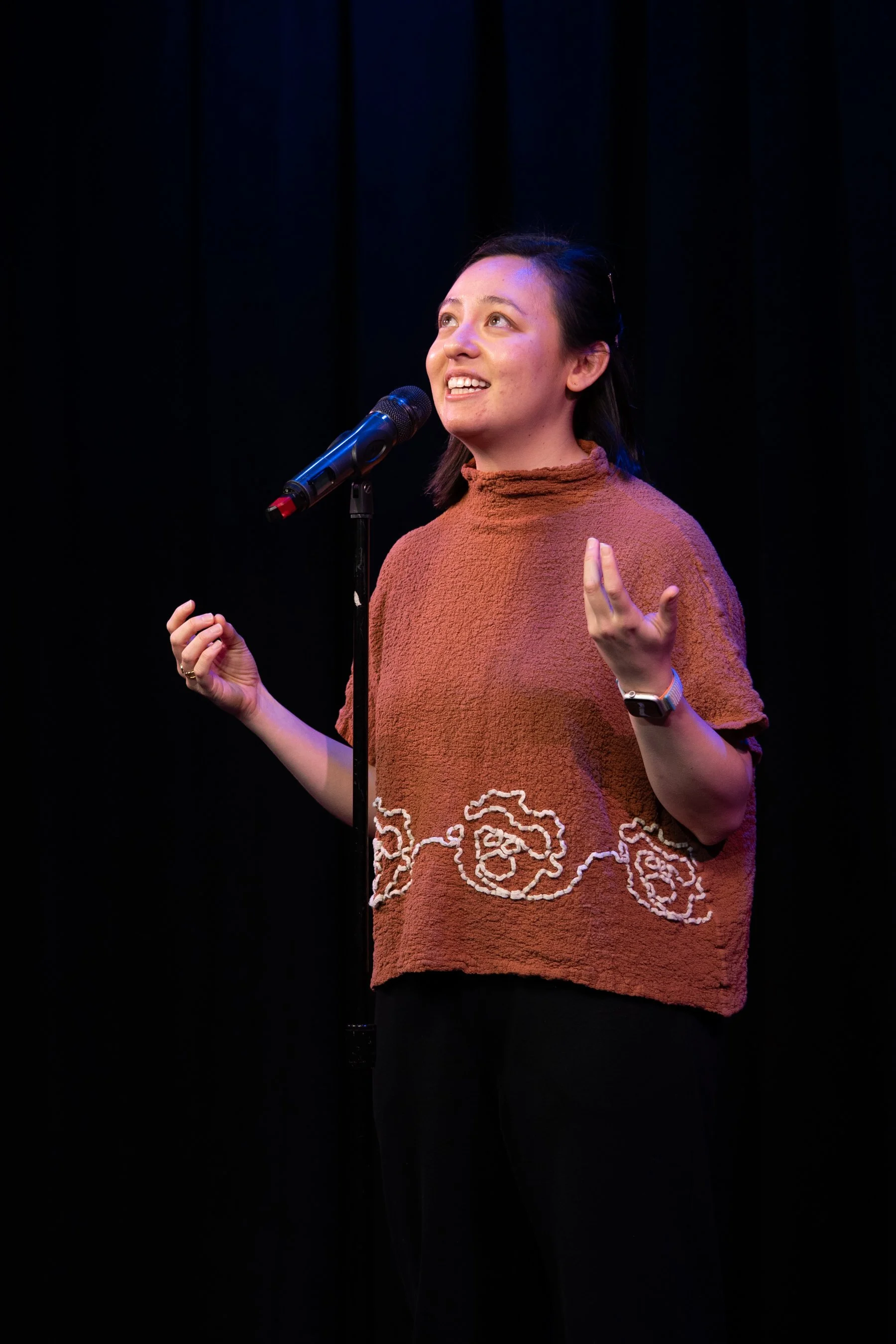
Leslie Sibener shares her story at Caveat in New York, NY in April 2025. Photo by Zhen Qin.
Over the next few days, though, Mike became icy and distant, isolating himself from group activities and literally turning his back in the middle of conversations. He was seething. So Rosie and I, we tried to go up to him and see if there was anything he needed or just encourage him back to the group, but he would not have it.
The more this went on, I just started to become so anxious. Had I done something wrong? Was there something that I could do to fix the situation?
After everyone else had gone to sleep on the last night, Mike and I started arguing in hushed tones. I asked him again, “What is wrong? It is so clear that you're upset.”
That's when it all came out. He said that he hated every single activity that we did and that my friends had deeply disrespected him.
I was shocked because I had not seen any interaction that would have made me think that this was going to happen. Eventually, he fell asleep on the couch and I was just left crying quietly on a deflating air mattress. How had it all gone so wrong?
After that trip, Mike and I started arguing more, and it was always about the same things. My friends had slighted him in some way, and he started becoming more controlling when we went out in public. I started to feel anxious because I never knew if a night was going to be a good one or a bad one.
My friends, they wanted to help. They tried to plan activities that he would like and reassure me before we all went out that, “Don't worry, we're going to be so nice this time. Everything is going to be okay.”
Unfortunately, that just did not help. Every time Mike and I had plans to go out with my friends, my chest would just hollow out and fill with this dread.
I tried to talk to him about how I was feeling but he was quick to deflect and say that my friends were the problem and that everything that I was feeling based off of his reactions was just way overblown. He was always the victim and everyone else were the perpetrators.
I quickly realized that trying to navigate conflict with a law student, and especially an outwardly confident but inwardly insecure one is just not fun. Law students are literally being trained to craft and win arguments, regardless of what side they're on. And Mike was holding on to that role and would not let go, even though I thought I had years of evidence that my friends were kind and generous people.
For me, as a scientist, I am just interested in uncovering the truth, and I really believed that there was something else underneath our arguments that was driving Mike's emotions. If we could just identify it and fix it, we could get out of this problem and move on, just like I would troubleshoot equipment in lab.
But our two approaches to conflict resolution were just at odds with each other. So after about a year‑and‑a‑half of trying to navigate this conflict, I was just getting exhausted. When I was with Mike, I would feel on edge and try to make myself as small as possible so that I wouldn't upset him in any way. And I just started to crave more space for myself.
So one night when I was at home, finally alone, I settled into a cozy routine. A worn out, gray robe, a cup of sleepy time tea, fuzzy blankets in bed, and my laptop for a work session at night. Comfortable and productive is really my sweet spot.
So I pulled up this PDF of a book that I was reading for my lab's journal club titled Reinforcement Learning, An Introduction. Now, this book was a primer on reinforcement learning, which is a machine learning algorithm I was studying during my PhD. The main idea behind reinforcement learning is that there is an agent that learns to make decisions by interacting with the world around it. The agent will use positive and negative outcomes from its own actions in order to update its internal strategy or policy, and the best policy is one that will maximize future reward.
This is a formal way of saying, “Do what you think will get you good outcomes and change what you’re doing if you’re getting bad ones.”
As I stared at my screen, the sounds of New York City outside my window just fell away and there was this soft humming that filled my head and my ears. It dawned on me that my relationship with Mike was never going to improve. No conversation, no compromise would ever lead to a positive outcome. I had to break up with him.
Looking at my relationship within the framework of reinforcement learning was just so clarifying. I had spent almost two years hitting my head against the wall trying to find a solution to our problems, and it was so clear that the only action I could take to get a reward was to let go and move on.
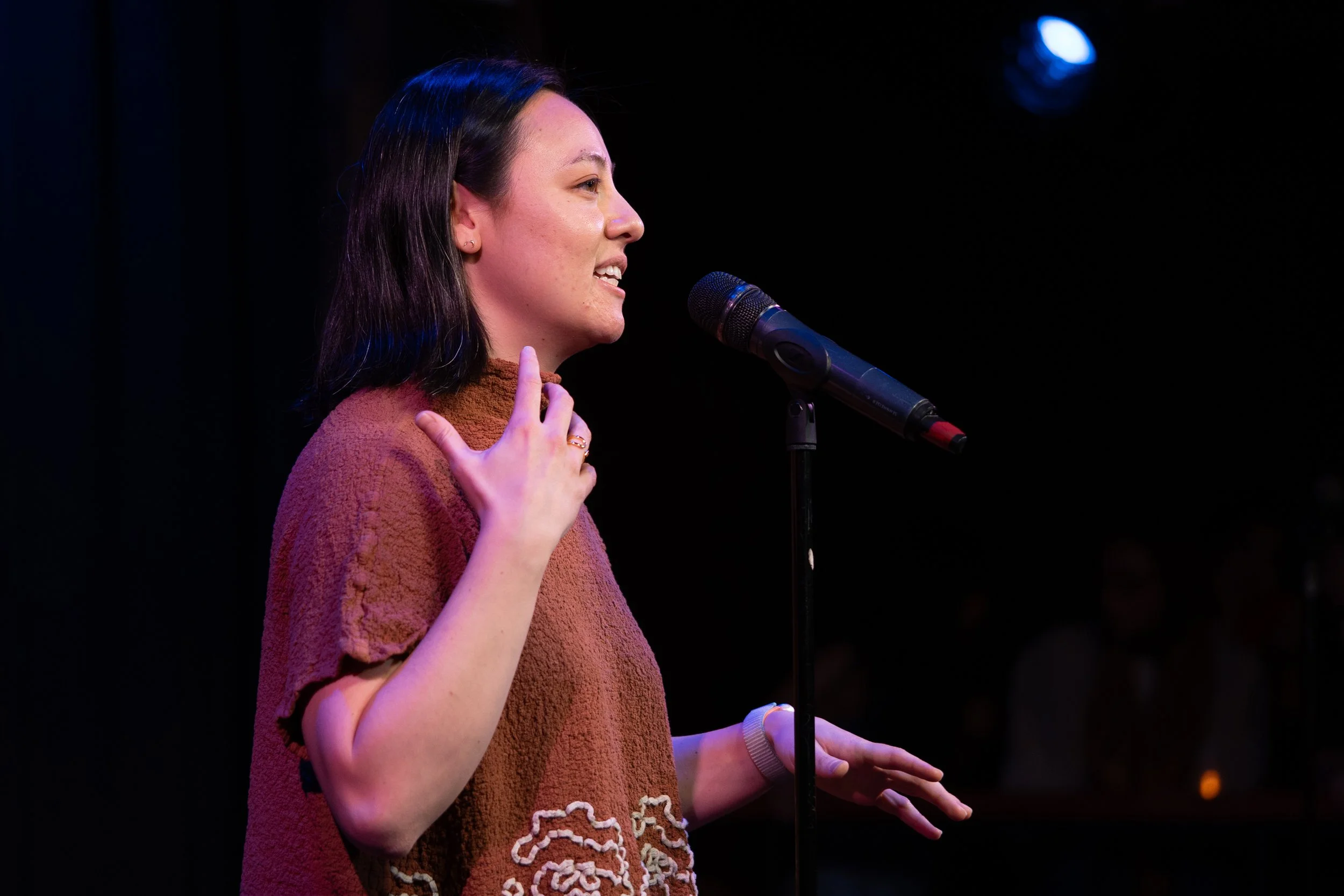
Leslie Sibener shares her story at Caveat in New York, NY in April 2025. Photo by Zhen Qin.
Unfortunately, knowing that and doing something about it are two completely different things. Real life is just not as clear‑cut as machine learning algorithms.
A few weeks later, I tried to have the conversation with him, but it became volatile. I got scared, so I couldn't go through with it. After that, I tried to distance myself as much as I could. But the more distant I tried to be, the more he clung on to me. My saving grace is that law school is only three years long, and I was nowhere near done with my PhD.
So Mike, law school graduation was approaching and he had accepted a job all the way in Alaska. Yeah. I was sad to know that someone I had loved and who used to bring me so much joy would be leaving, but I also felt tremendous relief because I knew that breaking up would be so much easier if there were already thousands of miles between us.
In the weeks before he left, he started insisting to walk me to lab every single day, and even came with me to lab on the weekends while I was working. I felt like there was this weight around my neck every single day and I could never get a breath.
Once he left, though, that weight lifted. The first week after he left, I decided to go out to a concert by myself. It was one of those perfectly sticky August nights in the city, you know, one of those ones where you can almost feel the energy coming off of everyone else.
And so I navigated the subway and every single step felt like it was landing on a cloud. I was boundless. I could go anywhere, do anything. Once I was there swaying to the music with the crowd, a humid breeze went through my hair and I tilted my head back. I closed my eyes and I started crying. I forgot what it felt like to be so free.