Hair might seem trivial, but for many of us it carries history, identity, and meaning far beyond keratin. In this week’s episode, both of our storytellers explore the unexpected power their hair holds.
Part 1: Being half Navajo and half white, Carissa Sherman turns to genetics to better understand her identity. As she questions where she belongs, her hair becomes a quiet but powerful marker of how she sees herself.
Carissa Sherman is Diné (Navajo) and from Arizona. She’s a rising 5th year PhD Candidate in the Human Medical Genetics and Genomics program at the University of Colorado Anschutz Medical Campus. Carissa is a member of Dr. Katrina Claw’s Lab. Her current work has involved community-based participatory research gathering perspectives of genetics research as well as examining population-level pharmacogenetic variation. Her research interests include examining ethical, legal, social and cultural implications of genetic research and learning potential ways to advance inclusivity and equity in public health medicine. She is interested in science policy and/or academia. Carissa and her husband like to craft, draw, go to renaissance fairs, and have two cats; she loves horror movies!
Part 2: Growing up, Ria Spencer believed “good hair” meant long hair but when a medical condition forces her to shave it all off, she’s challenged to rethink what that belief really means.
Ria Spencer is an aspiring world traveler and wannabe foodie who’s spent years belting classic rock and sweet soul music for marginally sober audiences with her band Girls on Top. She’s also delighted to be a grown-ass woman who’s lived long enough to have some stories to tell. Ria produced and hosted Where Are They Now: The GenX Years in the New York Frigid Festival and has also appeared in the No Name Comedy/Variety Show, RISK!, Better Said Than Done, Dead Rock Stars and The Volume Knob.
Episode Transcript
Part 1
“Yá’át’ééh, Shí éí Carissa Sherman yinishyé, Tabaaha nishłį́, dóó Bilagaana bashishchiin Tsinajinnie dashicheii, Bilagaana dashinalí. Akọ́ótʼéego Diné asdzáán nishłį́”
In Navajo culture, we are taught that when we first meet someone new, we share where we are coming from. This is how we build connections and relationships. In Navajo, this is known as K’é. I shared with you all my name, Carissa Sherman, and my four clans that come from my mom, my dad, and my maternal and paternal grandparents. And then I ended it by saying, “In this way, I am a Navajo woman.”
I am mixed. I am half Navajo and half white. My mom is Navajo and my dad is white. In Navajo culture, we are matrilineal, so I was taught that I was Navajo first. And being in a matrilineal culture, growing up, I spent more time with my mom's side of the family.
And my mom always had some trouble seeing, but she started to lose her sight more when I was around 8. I was taught that my mom and uncle were blind because my grandma had done something taboo, something that was against Navajo traditions. While my grandma was pregnant with my mom, and later my uncle, she had looked into the eyes of a dying animal.
I was brought up with several ways of knowing and understanding the world around me. So it was particularly frustrating when people would assume I was full white and would say to me, “No, you're not Navajo. You're white. You look white, so you're white.”
Each time I heard this, I felt part of me erased away. I felt my story, my upbringings, my knowledge denied because I apparently didn't look the part. As I got older, I started to wonder more about why I looked the way I did, why I looked more like my dad.
I remember sitting in my seventh grade biology class, and my teacher is at the front of the room. They're teaching us about genetic traits using those square boxes on the whiteboard. And on my worksheet, for a recessive trait, I mark my boxes, big B, big B, big B, little B, big B, little B, little B, little B.
And as I stare at those numbers, I think about my mom and uncle. Well, I knew my grandma's side of the story. I also knew that my mom and uncle are blind from a recessive condition known as retinitis pigmentosa. There were four siblings, and the middle two are blind. I was like, “The math, it ain't mathing.”
So as I learned about Punnett squares and talked to my mom and grandma about those numbers, my interest in genetics grew. I was also curious about myself. What could genetics tell me about me? Could someone look at my DNA and say, “Yep, she's Navajo.”? Could I have undeniable evidence that I was native?
But I would try to remind myself of my family's words, “Your mom is Navajo, so you are.”
But as I got older, I would look at my mom and her side of the family. Everyone had brown skin, black hair, and spoke fluent Navajo. I felt more aware that I didn't look like my family, and I felt like I didn't belong.
In fact, one time, on the reservation, I'm visiting my grandma and just walking down the highway, listening to my MP3 player. I hear sirens and take out my earbuds to see a tribal cop pulling me over.
He steps out, asks where I'm going, and I tell him, “To my grandma's house.”
And he says he pulled me over because, and he hesitates on how to phrase it, he says, “You didn't fit into the environment.”
I wasn't too surprised by this interaction, but my grandma was furious. I've often felt like I've had to try twice as hard to be an ideal Navajo woman, Diné asdzáán, because I was half and because I was afraid of disappointing my family, especially my grandma.
One way I tried to uphold our customs was to keep my hair long because my grandma said our hair is sacred and it's where our wisdom is stored. Deep down too, though, in addition to being afraid of letting my family down, I was afraid that without the labels of a Navajo woman, of a Navajo daughter, I wouldn't know who I was.
So yes, I was drawn to genetics, see what it could and couldn't tell me about people. But I was also interested to see how genetics could be used to treat genetic conditions. I thought about the potential for my mom and uncle to have their sight back.
But in high school, as I was figuring out what I wanted to do with my life, I found out that the Navajo Nation has a ban on genetics research since 2002. I was a bit sad as I thought about people like my mom who may not have access to genetic resources on the Navajo Nation. I was disappointed in the ban, but I still wanted to study genetics.
And I used to hear how other students would share how important it was to them to have mentors who looked like them and understood them, but I couldn't really.
Before beginning grad school, I did a summer internship with the genome sciences department at the University of Washington, and one of the professors and I were chatting. And when she knew I was Navajo and interested in genetics, she asked me, “Do you know Dr. Katrina Claw?”
And I half joked that not all Navajos know each other, though, funny enough, you probably would find a relative if you talk long enough with another Navajo.
But the professor was like, “No, you need to meet her.”
Now I am so grateful and fortunate to do research with Dr. Katrina Claw and Dr. Nanibaa Garrison, both of whom are among the first Navajo women in genetics. They empower me to bring my whole self to research with our home, the Navajo Nation. When I started having Navajo mentors who understood family dynamics and expectations, the importance of community, the strength of being women, I felt understood.
Even though I was inspired, grad school is a roller coaster. I struggled with imposter syndrome and deep fears, and insecurities of not being enough started to fester again. I was told I was too quiet in my classes, too green, and that I needed to be more confident. So not only did I feel like I wasn't native enough, I was feeling like I wasn't smart enough, just felt like I wasn't enough.
One day, inspiration hit. I'm watching a horror movie, Abigail, if you've seen it, and one of the characters has shoulder length, shaggy hair with bangs. I'm thinking to myself that it looks pretty cute. Impulsively, I go to a Great Clips. After all, I'm on a grad school budget. I'm nervous. I'm pretty sure my grandma is going to yell at me, but I tell myself, “It'll probably be a while before you see her anyway.”
So I sit down in the hairdresser's chair, and I show the picture of the girl from Abigail to her. She eyes me and asks me, “Are you sure?” Is it so clear that I'm nervous? Does she think it's going to look bad?
“Yes, I'm sure,” I say knowing full well I'm not. I feel like I can't breathe as I hear the first snip, but as I feel my head slowly feel lighter, I feel lighter all over. It's easier to breathe. Yes, I carried wisdom in my hair, but I also carried a lot of stress and sadness.
When I finally get my glasses back and I see my reflection with short hair and bangs, I smile. It feels more like me. After that haircut, it's gotten easier to be more confident.
And a little while later, our lab has a presentation on the Navajo Nation at our capital Wind Rock, Arizona. And as is custom, we all go around the room introducing ourselves. When it comes to my turn, I stand, I tuck my short hair behind my ears, and I share my clans, like I did with you all today.
“Yá’át’ééh, Shí éí Carissa Sherman yinishyé, Tabaaha nishłį́, dóó Bilagaana bashishchiin Tsinajinnie dashicheii, Bilagaana dashinalí. Akọ́ótʼéego Diné asdzáán nishłį́”
Ahéheeʼ. Thank you.
Part 2
So, Saturdays are always kind of like exciting days with a lot of stuff that was going on back when I was a little kid at my Nana's house. Aunts, uncles, cousins would be coming in and out and there was cooking to be done, there was shopping to be done. And in the afternoons, typically when all the chores were finished, the girl cousins would go over to Ms. Akitson’s beauty shop to get our hair hot combed into submission, and the boy cousins would walk up the hill to Nathan Dendy’s barbershop where they would get their head shaved and polished to the point where it practically gleamed in the sun.

Ria Spencer shares her story at Caveat in New York, NY in December 2025. Photo by Zhen Qin.
This particular Saturday, there's like something else that's in the air. And even though I'm a little kid, I can feel that something's kind of off because my mother and my grandmother are talking to me in that sugarplum voice that adults use for little children when they're trying to make like there's nothing wrong. And you know when you're good, there is something very, very wrong.
They're talking about a doctor's appointment that I had had a couple of weeks before. I'm six years old and we went to the pediatrician to be able to talk about my owies, because I have these red scabs and yellow pus-sy spots and stuff like that all over my entire scalp. And I know that you're not supposed to scratch them but they're itchy.
So we had gone to the pediatrician. My mother had decided and tried what she knows how to do. So we'd been at the doctor's office, and the doctor's telling my mom that I have something apparently called infantile seborrheic dermatitis, which, in English, is what the old people call cradle cap.
Newborns get cradle caps. You know, babies get cradle caps. Kindergarteners don't get cradle cap. Five , six year olds don't get cradle cap. Guess who has cradle cap? And I got it bad. I am like, call me itchy and scratchy. The stuff is just actually happening everywhere.
And there was this conversation that was taking place. I see my mom getting more and more anxious and she's asking questions. Like, “Are you sure there's nothing else? Is there nothing else we can do?”
And she’s saying, “Well, you know, don't forget that it's really important to have good contact when you're going through, when you're doing this treatment, so it would really be best. And we need to be able to get underneath the hair,” because I'm a little black girl. I got a little black girl fro.
As they were having this conversation, I see my mom become convinced. That's when it is decided that the best way for me to receive the treatment I need is for them to shave my head.
Now, shaving your head, this may be… so let me just take a step back and say, here's the thing about shaving your head. It's like, this is Arkansas. I'm a little girl. This is Arkansas. So we are southern, but not only am I southern, I'm black people southern. So I'm real southern. And your hair is a thing. You hair is your crown. Your hair is this is you calling card. This is the thing that people talk about. People talk about like the good head girl. My sister was known as a child with good hair because she had the thick hair that was down to her shoulders. The longer the hair is, the better. In her pigtails that would, like, flow behind her if she was running or riding a bike.

Ria Spencer shares her story at Caveat in New York, NY in December 2025. Photo by Zhen Qin.
And my cousin Lynette, she had what they call water wave hair, which is you could just sprinkle some water on it and you could twirl it round your finger. And it fell in these little locks in and around her face and framed it perfectly.
I had good enough to not shame the family hair. And now, they were going to have to cut it all off.
My mom and my Nana, in their sugar plum voice, is letting me know that I'm on my way up to Nathan Dendy's barbershop, and I am floored. Five , six year old girls do not go to the barbershop. The barbershop is the definition of Man Land. There is a very, very clear divide, and this is not a place that little girls would ever tread.
My cousins had told me that inside of the barbershop, it's like the men get in there, and they yell, and they talk politics, and they talk sports, and they talk trash. They even use some of the words that I'm not supposed to know what those words actually are, but I've heard them on the Richard Pryor records late at night, but don't tell anybody. They use those words there, too. So I cannot believe that I'm actually going to the barbershop.
As we get there, it's kind of like they can't believe, frankly, that I'm in there either. So you have them, ever walk into a room and it was like, tut tut tut, pause? Like people mid page turn, mid checker drop. They were like, “What in the world is happening here?” Because I come in with my mother, who is a self proclaimed, and rightly so, Southern Belle from her head to her toe. I am in my very best Garanimals with my color coordinated little patent leather purse.
I come pumping into the barbershop, and have you ever been in a room where you can watch everybody looking, but they're trying so hard not to look, that they're actually just staring. We all know what you're looking at and I don't have a real sense as to why.
Nathan Dendy's barbershop is an institution. Nathan Dendy is one of my grandfather's best friends. In a time the phrase is, “You rally to your people,” so Nathan Dendy is the only person that my mom will trust with this assignment.
So there's three chairs lined up. I am in the center chair. So if you can imagine this going along, it's like I am in the center of the barbershop. I am the show.
As I walk up to him, Nathan's like, “Well, you know, your granddaddy already called. You ready to hop up?’
I'm like, “Yes, sir, I am.”
So I shimmy, shimmy, shimmy into the grown up barber chair. I am too young, I'm too small for said chair so I have to, like, jump back down. And then he puts me on those two Yellow Pages, when we had the extra thick Yellow Pages.
So I shimmy, shimmy, shimmy back up. And I sit on the Yellow Pages, and he puts the cape all the way around me. And I'm swimming in it, but I can just see the tip of my Buster Brown shoes. I sit and my mom is leaning forward. And the men, out of the corner of their eyes, are trying not to stare, and it starts to happen.
Cut, fall. Cut, fall. Puffs of hair hitting the ground. The puffs of hair, like in Little Girl Land watching yourself being stripped of all the things that would make you the pretty little thing like they showed you, or like they would always tell you, and it's all falling off my head, my hair. I'm sitting there and all I can think is like I'm looking at my mother and she's smiling back at me, and big girls don't cry. I absolutely positively will not cry.
But then the sound of the clippers begins and it's buzzing and it's loud. I'm trying not to squirm and make it all the way through. The conversation in and around the room, it's almost like it's dimmed a little bit because, as I'm sitting there, Nathan Dendy takes a towel and he's gently wiping in and around the scabs, the rest of my hair going through, hitting the floor.
I'm sitting and I don't really know what happens next. He spins me around in the chair and he gives me a giant hand mirror. I can see myself. You know, all the things that I'd heard about, like the water wave hair, the really, really pretty hair, it's like, I don't have any of that hair anymore. I look a little scrawny but I think I look okay. Do I look okay? Like, I think maybe this is okay, and I smile. And you could feel the barbershop exhale around me. You could feel it. And it was like woof.
And I'm looking and I'm like, you know. I mean, I don't want to look like a boy, but my hair isn't shiny like the boys’ and I know it isn't as long as the girls’, but hair is not the only thing that makes you a girl. I think this is all right.
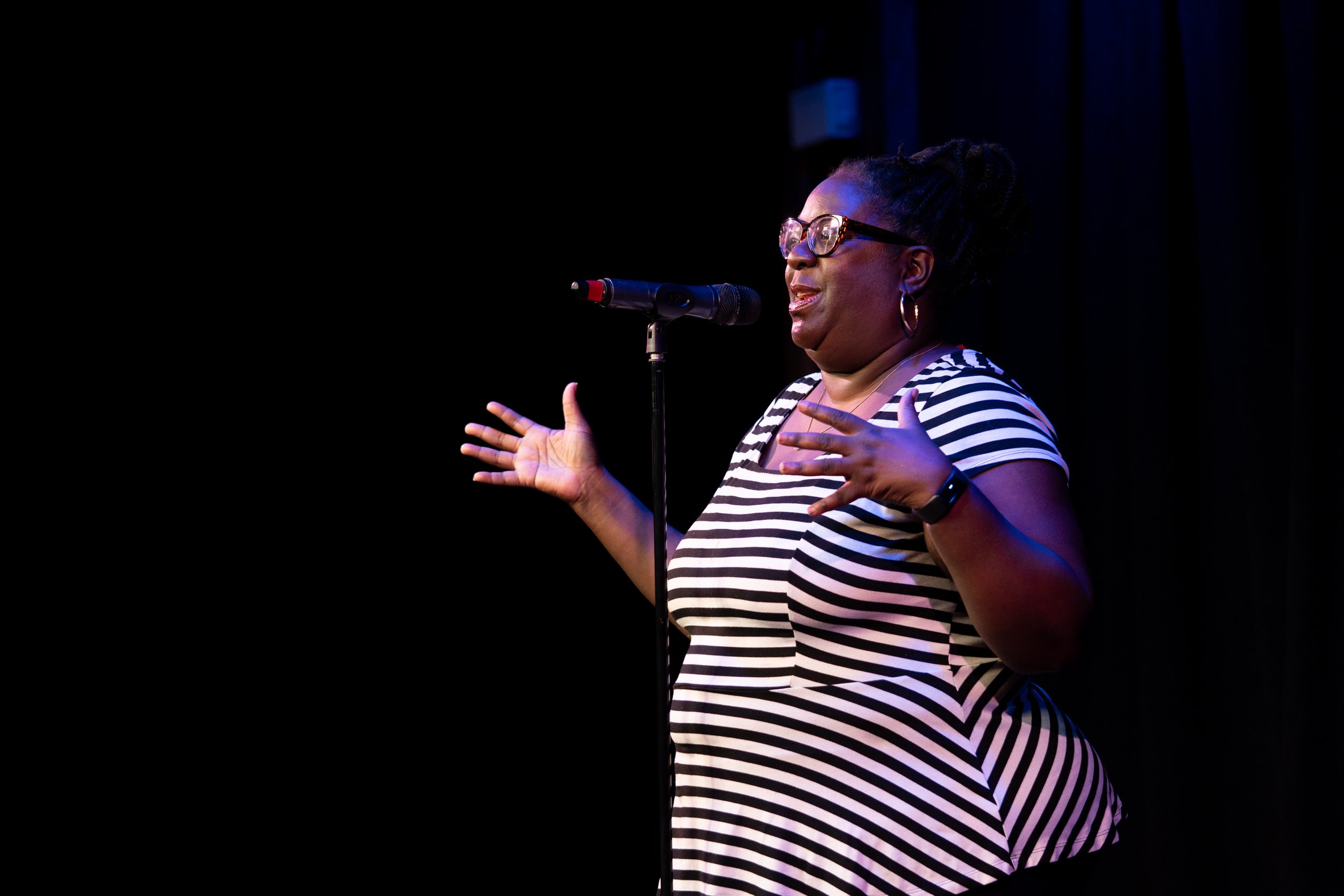
Ria Spencer shares her story at Caveat in New York, NY in December 2025. Photo by Zhen Qin.
And then my mom, from somewhere, she has a scarf. And she ties the scarf around my head, but she ties it around my head and neck with the bow the grown up way, where you have a little strap at the end of it that you could throw over your shoulder, and I look like Tabitha from Bewitched. I am now inspired.
I reach into the patent leather purse that I brought along with me, remembering that I have in my bag Mickey Mouse sunglasses, my white Mickey Mouse shades with the little Mickey's on top. You can't tell me Jack. I am, all other things, in my Garanimals, like, please and thank you. I know, I know.
And the men are now treating me like a granddaughter. One of them even says, “I think you look mighty fine.”
And I'm like, “Well, thank you very much.”
And then from somewhere, miraculously, like, hold up. Is that a peppermint? Is that butterscotch? Nobody said there would be candy. Y'all could have just led with the candy. We had to go through all this.
So as I'm leaving in my shades and my scarf is tied around me, the only thing that I really know for sure is that it's kind of okay. I had to go to Nathan Dendy's barbershop and I had probably the most special day of all of the girl cousins and all the boy cousins all together. I cannot wait to finish my butterscotch and tell them.
Thank you.