Climate change doesn’t happen in the abstract. It happens where we live, work, and raise our families.
In this special Story Collider series, each episode explores a different element of urban climate change — from fire and air to water and earth — through powerful, true stories from the people experiencing it firsthand.
In this episode, our storytellers turn their attention to earth, exploring the ways humans shape the land around us — and how a changing environment shapes us in return.
Part 1: While filming a wildlife documentary, filmmaker Mae Dorricott begins to notice just how profoundly human activity is shaping animal behaviour.
Hailing from Lancashire in the north west of England, Mae - is an underwater researcher for natural history documentaries and is currently based in Bristol. From a young age she was blessed with the privilege to visit her mother’s home of Malaysia where her obsession with the sea began. The coral reefs imprinted onto Mae, and from those first snorkels as a child knew that her life would revolve around the sea. During her time studying marine biology at the university of Plymouth she worked part-time at the local Aquarium, where her passion for communication was ignited. To learn more about how good communication is essential for a healthy ocean, Mae undertook a Masters in Science communication at the University of West England. Then, in 2017 she applied and was awarded the European OWUSS scholarship, which gave her the opportunity to explore the watery world like never before. This opportunity became a springboard into the industry in which Mae currently works, specializing in underwater documentaries.
Part 2: For Christy Marsden, climate change always felt like a distant threat until a patch of ice brought it sharply into focus.
Christy Marsden bikes year-round in Minneapolis, Minnesota. When she's not advocating for climate-forward policies in the city, she's working on helping people develop climate resilience in communities through her work at the University of Minnesota Climate Adaptation Partnership. Christy enjoys helping people craft their experience of climate change through storytelling as a means for science and climate communication
Episode Transcript
Part 1
We were off the west coast of South Africa, speeding towards an island on the horizon and our boat was piled high with 30 cases of camera gear and camping equipment. This was my first assignment on Parenthood, a BBC series exploring the wonderful ways that parents and the animal kingdom raise the next generation and how their efforts are challenged by a changing world.
This was a very timely topic for me as an overthinking millennial who does want children but wrestles with climate anxiety, who’s actually currently very single and is about to spend three weeks on an island of bird poo for their job.
As I tussled between apprehension and excitement for what lies ahead, I lock eyes with a Cape gannet that swoops in beside of our boat, this incredibly streamlined seabird with a beak as sharp as a samurai sword. A yellow golden crest, bright white plumage, which is highly contrasted against these black details around its eyes and the edgings of its wings.
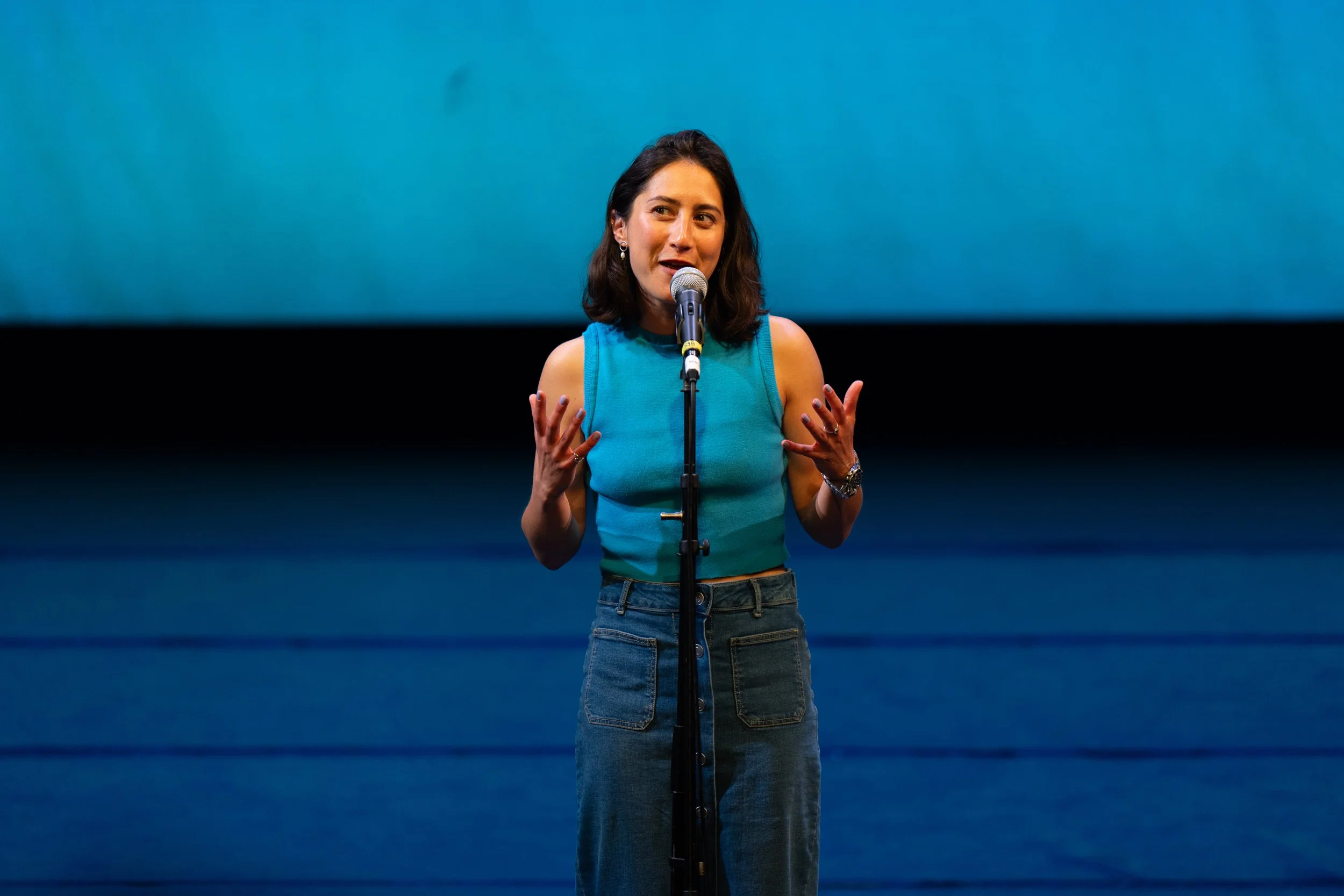
Mae Dorricott shares her story at The Theater at St. Jeans in New York, NY at a show we did in partnership with Our World Underwater Scholarship Society in June 2024. Photo by Zhen Qin.
A friend of mine, Steve Benjamin, and a South African wildlife filmmaker once told me that a Cape gannet looks like someone painted the Concorde yellow, stuck a rocket up its ass and gave it an addiction to sardines.
As this bird flies in tandem with our boat towards the same destination, I wonder where does she come from? Has she just returned from an epic baitball battle where she's been diving with sharks and dolphins for sardines? Maybe a similar experience to us at Cape Town Airport trying to hustle our gear together.
But she looks like she's had a successful day. Her belly is swollen with the fish that she has foraged and she is flying with a mother's sheer determination back to her chick who's waiting for her on her island home with her lifelong partner, and an island that we're now fast approaching.
Our boat pulls up to this rickety pier and, standing atop it, is Dr. Zanri and Dr. Tiaan Strydom, our hosts for the time on the island.
Tiaan is winching down the ladder to us. He is a bushfire ecologist and an easygoing surfer dude. And his wife Zanri is the ultimate gannet fanatic. She's wearing her signature sunhat, one of her many seabird‑adorned buffs, and she's standing there with this grounded demeanor despite her vibrant enthusiasm to see us. She beams down and it's a very warm welcome to Malgas Island, the Island of Mad Geese.
As we lugged bag after bag after bag onto the pier, I catch a glimpse of a swirling tornado of birds but it’s obscured by these derelict buildings, which used to house guano miners and, now, pigeons and the occasional scientist/filmmaker.
As we usher our bags up the pier towards the houses, another feature of the island transpires. Dust, white dust everywhere. And not just any kind of dust, guano, i.e., bird poo. It had accumulated on the island over many generations of birds nesting here and it had been baked hard and dry but the South African sun. It used to be mined by the guano miners as fertilizer, but the practice has been banned because it inhibited the birds’ ability to breed. They need the guano to build their nests.
Zanri now takes us on a tour of our rustique accommodation. There's a mattress on the floor, no running water, a dirty bathtub to have a bucket shower in, and everything has a fine dusting of guano. The restroom facilities are outside, and it was nicknamed “The Thunderbox.” It was a shed where we would pop a bucket down, pop a squat and then pop it into the sea.
It wasn’t the most glamorous but this thunderbox was Zanri's favorite feature. It had a ladder fixed to the side of it.
As she ushers me up, with every step I take, I see more and more of the view beyond. 40,000 Cape gannets. 40,000, and I'm physically blinded by the carpet of white‑feathered bodies sitting atop the guano‑covered landscape. And in the sky, a carousel of birds swirling, toing and froing from foraging trips.
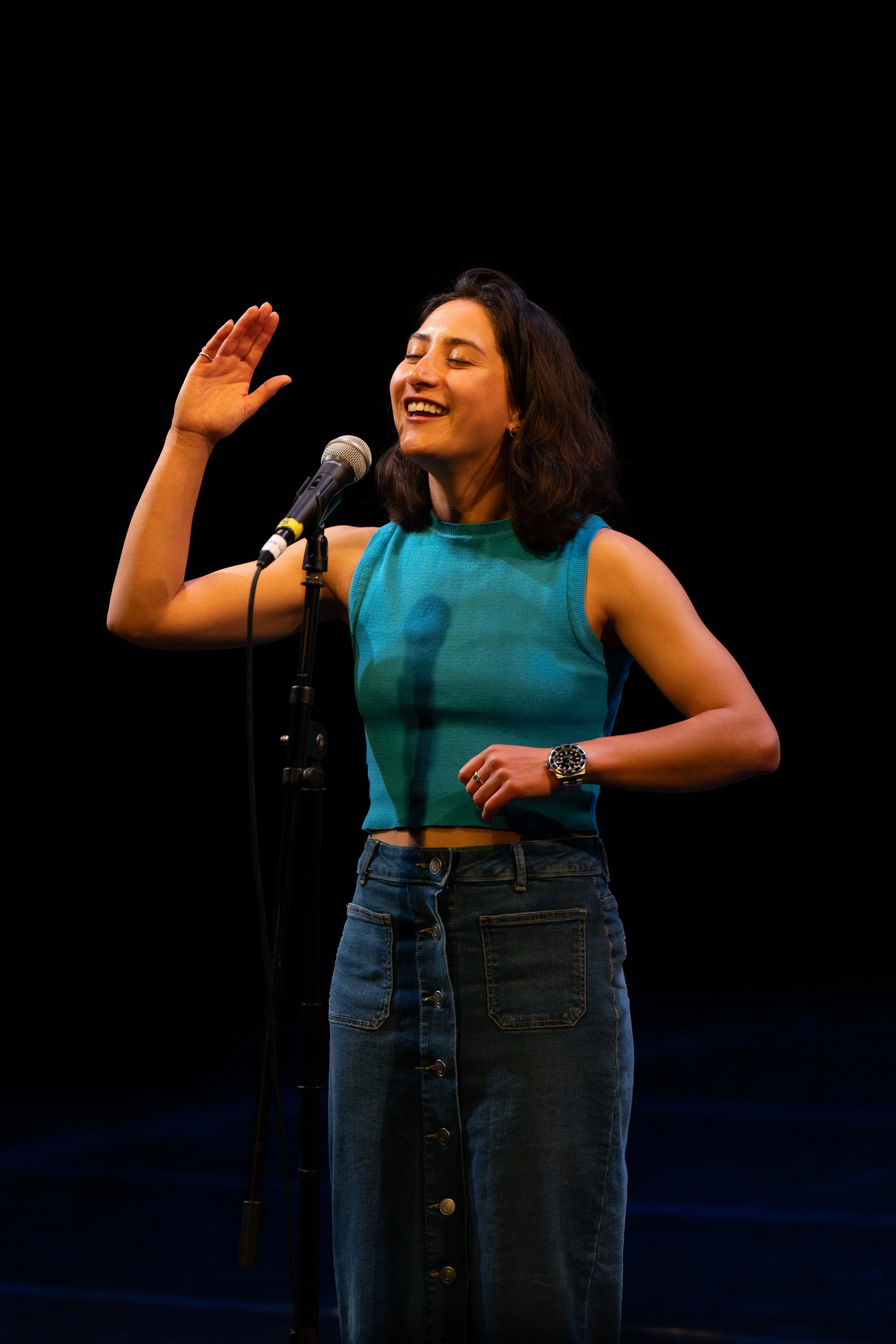
Mae Dorricott shares her story at The Theater at St. Jeans in New York, NY at a show we did in partnership with Our World Underwater Scholarship Society in June 2024. Photo by Zhen Qin.
And then there was the noise, the constant honking that echoed across the island all through the day and all through the night.
This is what we came to film, these epic masters of air and sea raise the next generation.
There were two elements to the birds’ lives that we wanted to film. The first being their family lives, and I was struck by the affection that the parents showed one another. When one returned back from sea, the two would enthusiastically engage in a dancing ritual. They would bow and raise their heads together and nuzzle their beaks in unison. They would do this until they were rudely interrupted by their nagging chick, barging in between them, begging them for food.
And then came the chundering. The parent would regurgitate whatever it had foraged out at sea, maybe some hard‑won sardines, but more often these days it was offal, scavenged from the back of a fishing trawler. This was the harsh reality for these modern‑day seabirds. There's not enough fish in the sea for them. And this was evident by the shrinking colony.
We had to walk through these vast fields of empty nests to reach the colony from the house. My stomach would drop every time we walked through this graveyard of baby‑less cribs.
The second element to the birds’ lives is when the chick became independent. On the south side of the island was Fledgling Rock, a boulder we had dubbed due to the congregation of chicks that had waddled here from the main colony. We would cheer them on from the sidelines as they tested out their wings for their maiden flight. The ones that were successful would soar high, but those that failed would crash into the merciless South Atlantic and be met by Cape fur seals.
The seals were also suffering from a lack of fish, and they would patrol the rolling waves like hungry hound dogs just waiting for any naïve chick to pounce upon.
There's a strange buzz that comes from watching dynamic animal behavior play out in front of you. But after watching chick after chick meet the same fate, have their bellies torn apart by the desperation of the seals just to get to the fish at the belly, it soon became harrowing.
In the last 60 years, Cape gannets have suffered a decline of 50%. We sat there in the sun and the sea spray and filmed the carnage. I was angry. I was angry at humanity's greed for plundering our oceans, and I was scared, scared about the future. I think about my own family and what my parents have been able to offer me. I think about my children, what world will I raise them in? And their children, what will they live to see?
We're walking back from Fledgling Rock one day to charge some batteries at the house when Zanri stops us in our tracks. She spots a chick in the crowd. She slowly approaches it and grabs it skillfully by its head and pins its wings behind its back. She lifts it up and I can see it's got blood running down its torso. It was a survivor from a seal attack.
We quickly take it back to the house and we pop it in a box. She prepares food for it, feeds it through a tube. She arranges for the local hospital to come and pick it up and tends to its wounds.
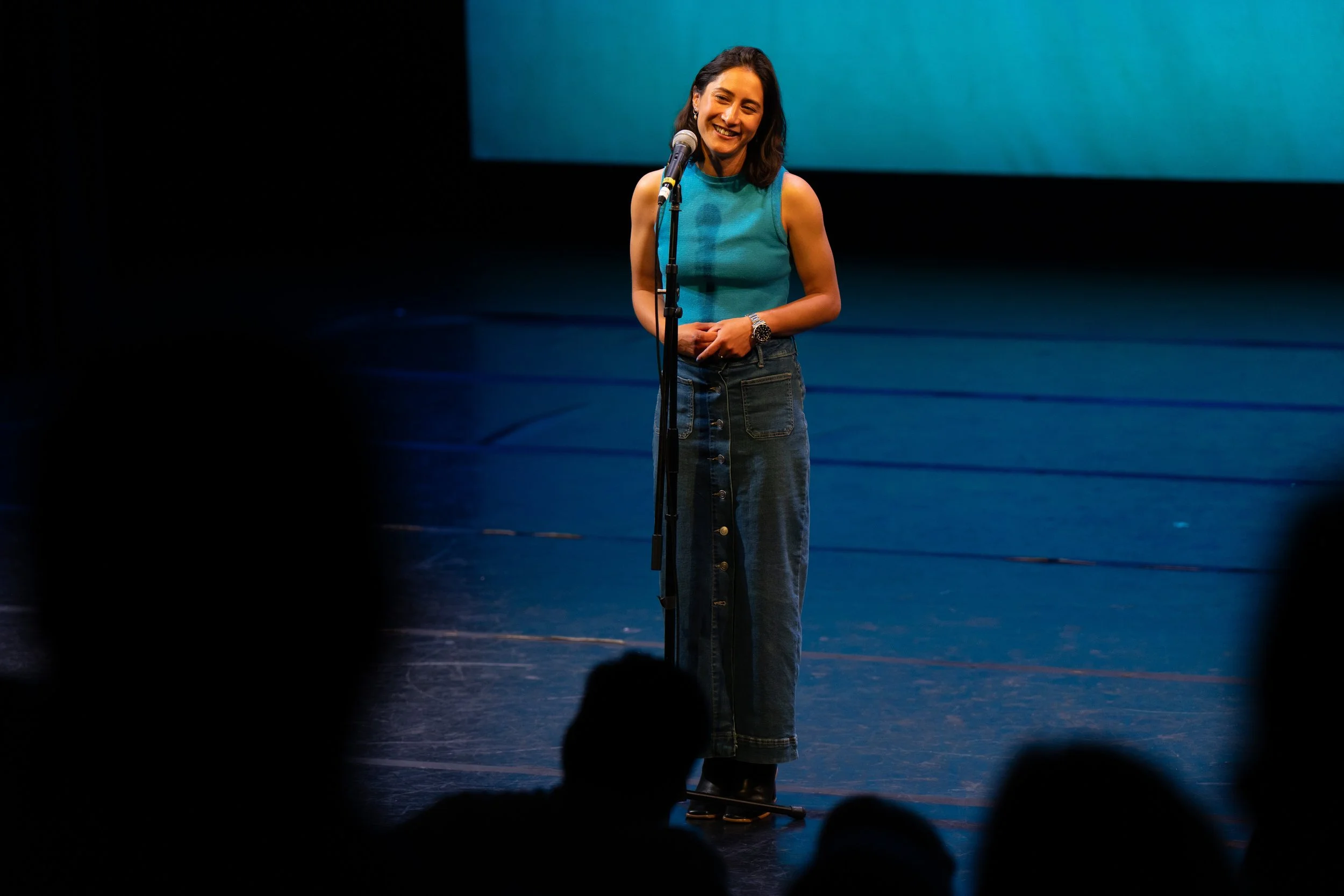
Mae Dorricott shares her story at The Theater at St. Jeans in New York, NY at a show we did in partnership with Our World Underwater Scholarship Society in June 2024. Photo by Zhen Qin.
The cynic in me questioned her efforts. Why bother with this one chick, when we see dozens a day die to the jaws of seals? “Because,” Zanri simply said, “every chick matters. It's not just that one chick that you’re saving but all of the chicks that it could have produced as a parent one day.”
And Zanri didn't just save one chick, she saved nine during our time on Malgas Island. And each and every single one of them she tended to with inspirational maternal devotion. By the ninth chick, she'd run out of food, but her tenacity saw her and Tiaan fashion a fishing net out of a pillowcase and washing line. We joked that we'd spent too much time on Mad Goose Island and turned into a bunch of mad geese ourselves.
I couldn’t help but project onto Zanri. She’d make a fantastic mother, and Tiaan a fantastic father. But children aren’t on the cards for them. Instead, their dedication to the future lied in helping to conserve and help the species that were in need of their help. I was in awe of Zanri, and so grateful that people like her exist.
After it all, all the dust that actually ended up with Zanri and I developing a lung infection from breathing too much of it in, all the empty nests that was encroaching on the colony, and the desperation of the fur seals, I still left the island with hope. Zanri’s teaching showed me that if we could care and value other species as if they were our own, what a wonderful legacy we could leave behind. That would be a future I would be proud of to give to my children.
Thank you.
Part 2
Climate change has always impacted the decisions I've made. I knew it affected the wildfires of where I grew up in California, as well as the droughts. I knew that sea levels could rise from melting glaciers and that things would eventually change, but it never really felt personal. It was just that existential crisis that hangs over all of us and like we should really do something about it.
When I moved to Minnesota in the early 2010s, it felt even less personal. How can climate change affect a state with 10,000 lakes, gets lots of rain during the summer? But it was still that crisis, and so I did all of the right things that you're supposed to. Recycling, I learned to ride the bus, and I also rode my bike as much as I could.
And in Minnesota, riding a bike is incredible. There are hundreds of miles of trails to get anywhere you need to go. I ride my bike to shop, commute, see my friends. I could really get anywhere I needed to go while on a bike, and I love riding my bike. I never have to worry about parking or traffic. I get to move my body to get me to where I need to go. I'm always in nature. And when I'm biking, I really can be alone in my thoughts, which is a really nice way to both start and end my day when I'm going to and from work.
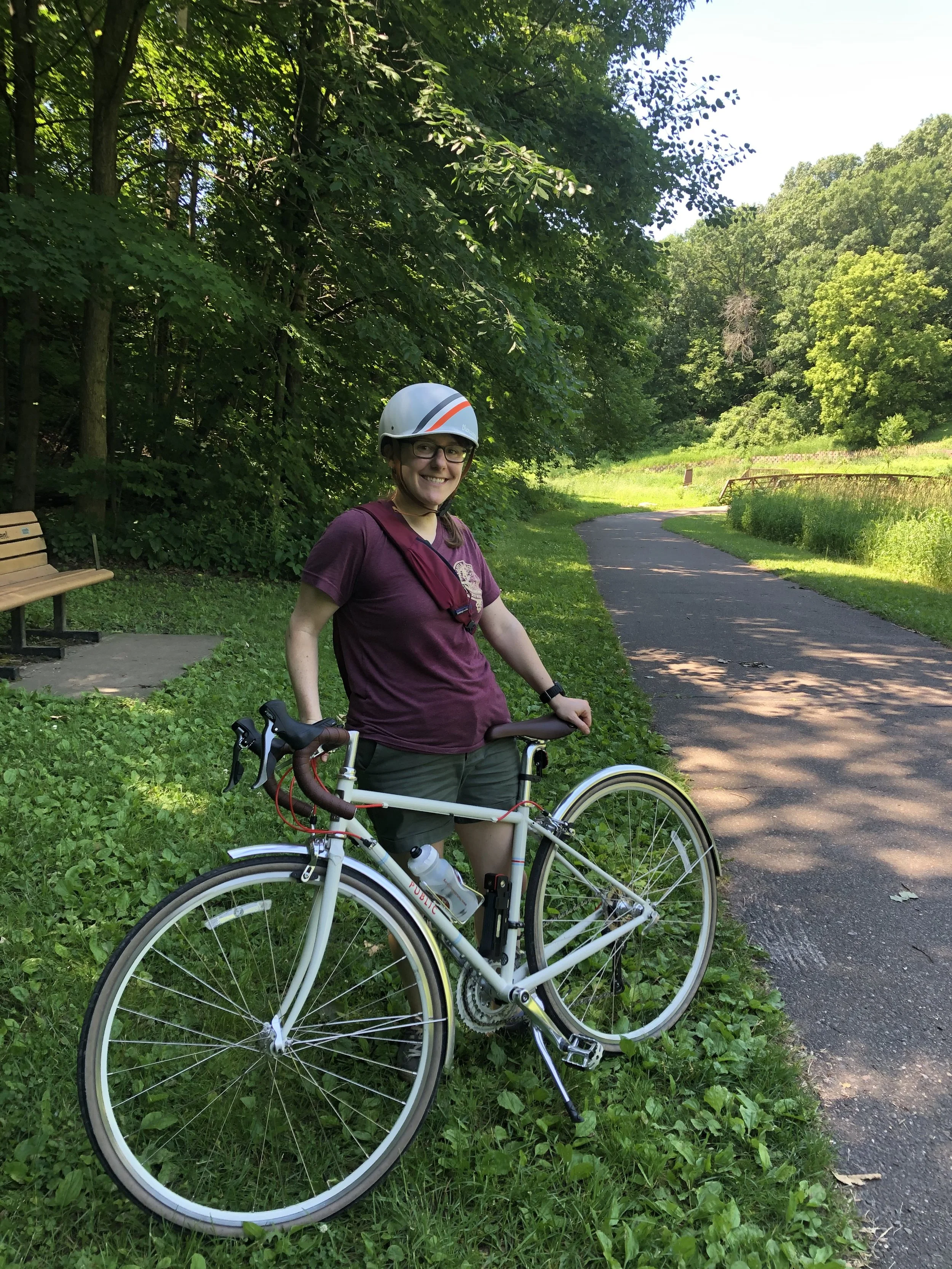
Christy Marsden and her bike. Photo courtesy of Christy Marsden.
As most people think of Minnesota, they think of snowy and cold winters, but for a lot of cyclists, that does not stop us. It only brings a little extra of a challenge. So when winter came, I was very excited to embrace that challenge as well and also bike through the winter. So I got studded tires, I got new clothes, and I modified my routes and tried to be a little safer in where I went, but it never really felt dangerous.
On February 20th, 2023, I'm biking to meet a friend for coffee. I had worked over the weekend, so I had a day off, and I was really excited to be able to meet a friend for coffee in the middle of the day and really kind of take advantage of a gorgeous winter day. It had just snowed the night before so everything was freshly white, and it was one of those beautifully crisp mornings where you can see your breath and your nose, it gets a little red from the bite of frost, but it felt really nice to be out.
I'm riding along the greenway and I have my new winter coat, which I was very excited about. It has pit zips to let out the sweaty warm so you don't overheat and the hood fits over my helmet perfectly. And as I'm riding along, I can hear the crunch of my tires on the greenway. It just was so nice to be out.
Not a lot of people had been out that morning. You could tell by the trail that there weren't a lot of other people who had been there before. And so as I'm riding along, I'm paying attention to all of the beauty of the nature around me.
About 10 minutes in, I notice these weird marks on the trail right in front of me. I can't figure out what they are. It doesn't make sense. There's no footprints or paw prints there. There's nothing really to indicate what happened.
As I'm kind of puzzling it out, like, what is going on here, all of a sudden I find myself falling sideways. I have no time to react. My hands clutch the handlebars, and I remember thinking, “At least I'm wearing a helmet.”
My head hits the ground a few seconds later in my helmet, and I hear that deafening crunch.
I don't remember if I lost consciousness, but I do remember immediately jumping up and brushing the snow off of me. I check my body by moving around my arms and my legs to see if anything was broken or if I was hurt, and it didn't feel like I had injured myself. I felt a little off, but, you know, that made sense. I had just wiped out.
It turns out, under that fresh snow, there was a big patch of ice that myself and likely other cyclists had also followed on, which had created those weird marks in the snow. I got on my bike and I continued on my way, trying to figure out, “Am I okay?” I kept telling myself, like, “I'm okay, right?” But I just didn't feel okay.
After a few days, I went to urgent care and the doctor told me I didn't have a brain bleed. I just had a concussion. That felt like a huge relief. Didn't know that it could have been a brain bleed. And concussions seem like they're mostly common, like my brother had a concussion when he was a kid. So like, how bad could it be?
Problem was, is two weeks later, I still couldn't do anything because I really felt off. My perception was fuzzy. I couldn't really pay attention. I was really struggling to do anything. At that time, I, all of a sudden, had to fill out FMLA paperwork and go on disability because I really wasn't able to work. And the questions started rolling in from everybody asking, how long will I need off? What can I do? What accommodations do I need? How do you feel? How do you not feel? All these questions and it was just too much. Like, I didn't know. I really didn't know because my brain was not functioning normal.
Everything felt really muddled and confusing. I couldn't do complex tasks, like cook dinner or look at a computer. If I ignored how my head would start to hurt or my eyes would start to hurt if I was doing something for too long, I would have this overwhelming feeling of something isn't right inside of me. And then I would end up feeling nauseous and dizzy.
All of this really worried me. Like, how long is this going to last? What does this look like? I just didn't know.
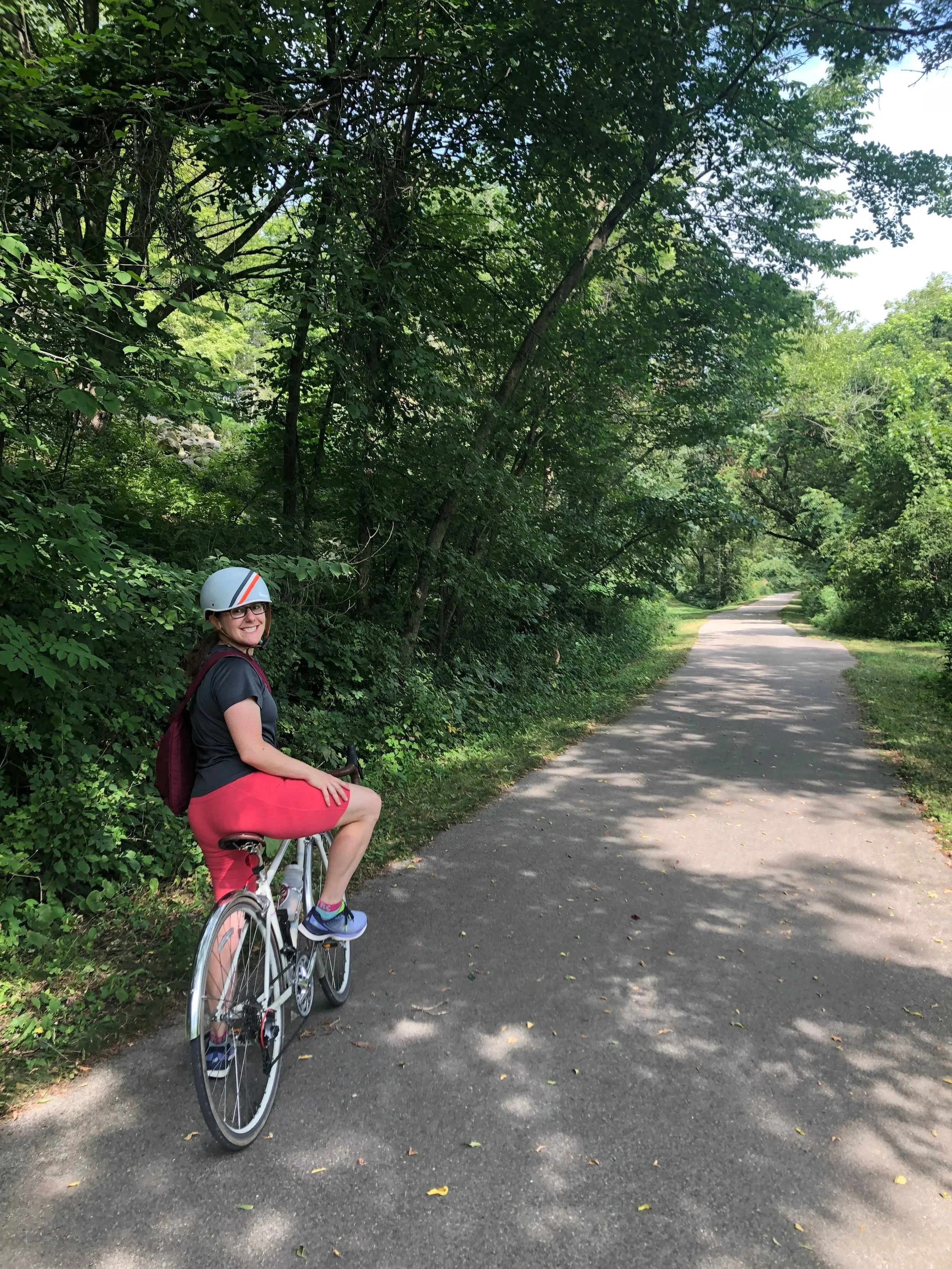
Christy Marsden on her bike in Minneapolis. Photo courtesy of Christy Marsden.
After a month, I was able to see a doctor who was a specialist, and she sent me to physical and occupational therapy. But the problem was, is nobody really has a guidebook for how concussion gets better. So my anxiety was through the roof because I was like, I don't know how long this is going to last for.
Sure enough, my diagnosis ended up becoming post concussion syndrome where the symptoms last much longer than a normal concussion, which meant that I had to continue figuring out how to make myself feel better far into spring, summer, and even fall of that year.
Despite how I was feeling, though, life still continued and I still had to do stuff. So I did cancel a lot of plans that summer. There was a lot of stuff that I couldn't do, but I still tried to do what I could and make accommodations where possible. And one of the things that felt really important for me was to get back on my bike.
I love riding my bike. It's my main mode of transportation in Minneapolis and so it felt really important to not let that be something that became a fear for me. So I asked a friend to join me on a very short ride. I was very anxious. But once I got over the anxiety and realized that I could ride my bike, I was perfectly stable, nothing was going to happen to me, it felt so good. And I was so, so excited I could ride my bike again.
And so I did. All that summer and into fall, and even when winter came around, I still rode my bike. I was a lot more careful in winter. I wore my helmet, obviously, and I avoided the worst of the winter days, but I was still able to get on my bike and it felt really good.
As I got on my bike, I also started to think about climate change differently. The ice that had made me fall was likely due because of the warming winters that had melted the snow and created the ice when the temperatures came back down. It hadn't occurred to me before that climate change could affect me in such a way as that, but after this happened and after I was thinking about it, it became really clear. Like, oh, this is climate change and it is affecting me personally.
Even later that summer when I would try to ride my bike, we had a really bad summer for air quality that year because of all of the wildfire smoke that blew in from Canada causing really bad air quality. That was also like, that's kind of due to climate change as well. So all of a sudden, it became very clear that I can't escape climate change. I used to joke that I moved from California to Minnesota to escape climate change, but it turns out you can't. Like, you can't escape it.
So as I worked through my recovery, I also learned I can't get better by myself. I needed friends and family to help me through. Just like I can't fix climate change by myself. Individual actions alone aren't going to be enough. So I wanted to help people understand what we could do for climate change and how we could all work together to really make a difference.
At the end of that year, in late 2023, I got a job as a climate educator. As a part of the program I built, we learned to tell our climate stories, which help us see that climate change is personal, just like I had experienced it with my brain injury.
Roughly two years after my concussion, luckily symptom free at this point, I'm sitting in a room with about 30 other people of all different ages and backgrounds as we're telling each other our climate stories. We're on a college campus, and even though it was a classroom, it was still cozy because I brought lots of snacks and we all had our tea and coffee, and listen to each other talk about what climate change meant to us.
One of the participants that really stands out, he was this typical Minnesotan guy and he was really hesitant to share. He didn't really think he had anything to offer. But as he's talking, he starts by telling about how, when he was a kid, his favorite memory in the winter was sledding on snow days. Like, just fast as you can, laughing with your friends and your family down the hills. He wanted to be able to give his kids the same experience, but even within his lifetime, he was able to see this change in winter, like a drastic change in winter that really made him mourn the loss of what his winters used to be and really anxious about the winter that his children were growing up in.
And as he's talking, you can see everybody really quiets because they can hear the emotions behind what he's saying, the anxiety of what the future is going to be, the grief of what we're losing and his hope and desire to try to figure it out with all of us there.
And as he's talking, I'm like, “Even a guy who'd rather be ice fishing has something to share about climate change and can see how it's affecting him, like we can all see how it's affecting us.”
And being in that space and sharing all of this, it really made me feel for the first time I was doing the right thing, sharing my hopes, my fears, and my anxieties with these people, all trying to do something together. And maybe a brain injury isn't the best way to figure out a path forward, but in the end, I'm really glad it brought me here.
Thank you.