Water covers roughly 70 per cent of the Earth’s surface and is essential for human survival. But it can also unleash devastating consequences.
In this week’s episode, both of our storytellers share tales about water — from flooding to polluted groundwater. Through their stories, we explore how water shapes our cities, our safety, and our sense of security in a changing climate.
Part 1: While researching flood risk and insurance costs in California, international student Hannah Melville-Rea is shocked by just how unprotected many people are.
Hannah Melville-Rea is a PhD candidate and Knight-Hennessy Scholar at Stanford University, pursuing an interdisciplinary degree in Environment and Resources. Her research focuses on flood risk and examines how infrastructure decisions shape insurance costs and household vulnerability. She works closely with local agencies to translate research into practical tools that strengthen community flood resilience. Raised in Osaka, Japan by parents who hail from Australia and New Zealand, Hannah developed an early interest in how different countries tackle natural disasters. Today, she aspires to work at the intersection of science and policy to minimize the impact of climate hazards on frontline communities.
Part 2: Patricia Schuba is determined to stop coal and waste pollution from contaminating the groundwater in Labadie, Missouri.
Patricia Schuba has been active in organizing and politics since 2000. She founded two political organizations that worked to give voice to working Missourians living in rural areas, and she was a candidate for Missouri State House in 2018. She was a caregiver for her father with Alzheimer's who died in 2018, and she has had T1 autoimmune diabetes since childhood. She has been the president of all-volunteer Board of Directors of Labadie Environmental Organization (LEO) since 2011 and an active member since 2009. She has lobbied legislators, trained community members to find their voice, and led a citizens' movement in Missouri to end coal and waste pollution of our water and air. The pollution related work has been mostly from the heart and has forced her to grow in ways she never thought possible. It included learning media and advocacy skills but, more importantly… showed her how the world really works and how necessary citizens are in the process.
Episode Transcript
Part 1
Let me take you back one year. I am a first‑year PhD student at Stanford. Like today, the sun is shining, the orange poppy seed signals spring. But I am inside my dorm room, which gets no direct sunlight, and I am looking through these records of California's flood insurance. It's really incomprehensible to me. Not because I don't love data. I love data. But I don't know anything about insurance. I mean, I don't own a house. I don't own a car. And until six months ago, I was living in Australia where I had universal health care. So as I read through these terms like “premium”, “deductible”, “claims”, it just means nothing to me.
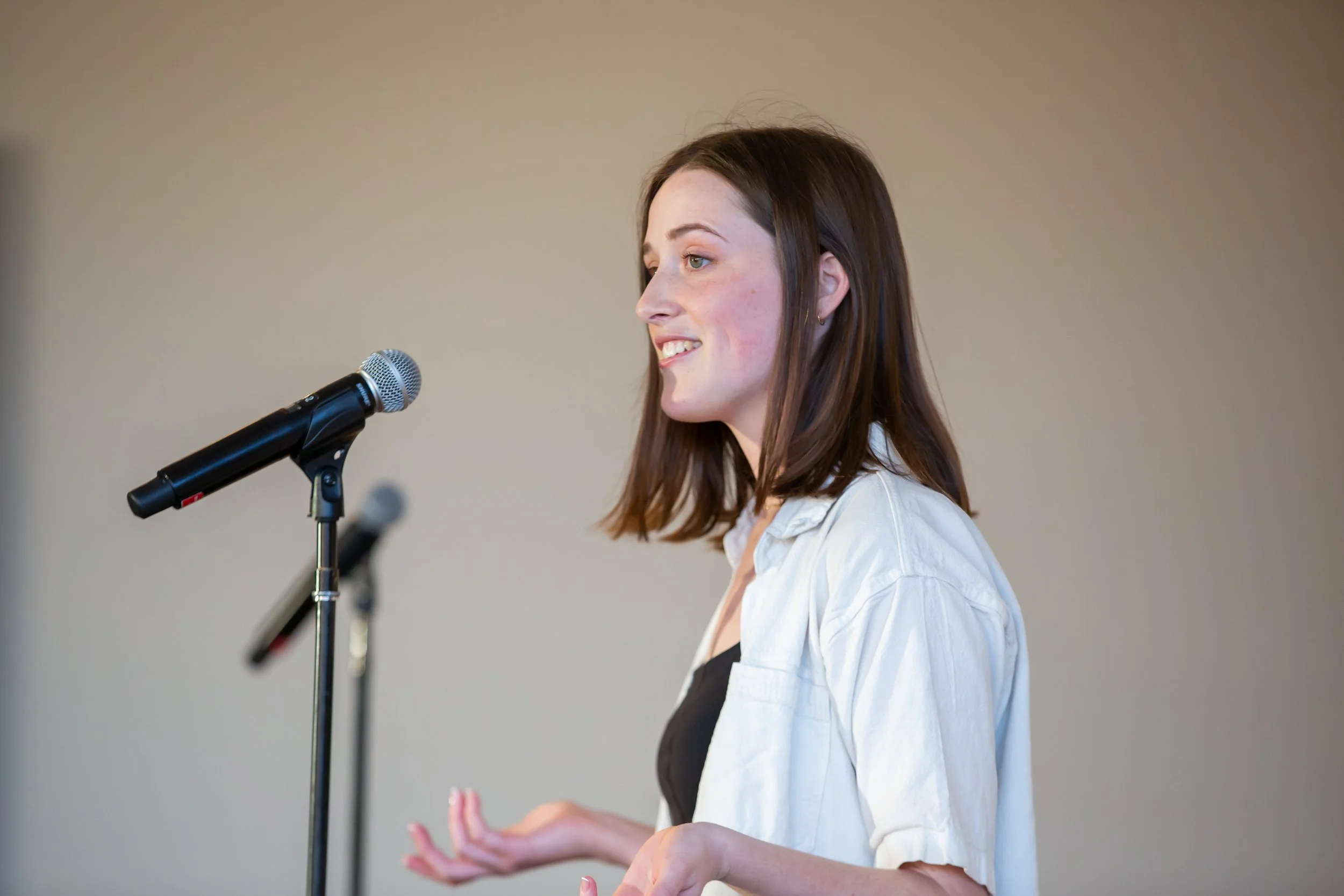
Hannah Melville-Rea shares her story at The Cantor Arts Center in Palo Alto, CA in April 2024. Photo by Christine Baker for Stanford Impact Labs.
But then the universe is listening and sends me a little lifeline. Ping! It's an email advertising a summer position to work on flooding and insurance research for the local county. I think, amazing. This way, I can now carve out a little bite‑size of this national data set, can understand flooding and insurance where I live, and then, at the end of the summer, maybe I'll come back and make some really generalizable insights.
It's now summer of 2023. I am working at One Shoreline, the San Mateo County's agency for sea level rise and flooding. Now, I still don't know all that much about insurance, so when I see that State Farm is going to host a workshop about how to be insurance prepared in times of disaster, I don't even care that it's at 9:00 AM on a Saturday. Like, I am pumped. This is where I'm going to get to ask all my silly questions to someone in the industry.
So it's Saturday. The birds are chirping. I'm biking past a swimming pool and a tennis court. And I arrive to Trinity Church in Menlo Park. There are several shiny Teslas parked outside. There is no bike rack. So I kind of grab the bike, put it on the railings, hook it up, lock it up, head inside.
There are several tables, all with this Tiffany blue tablecloth and some nibbles in the back. I look around the room at the other attendees. Everyone is white. Everyone is over the age of 65. And I think everyone knows each other because they only ask me to introduce myself.
So I say, “I am studying climate impacts at Stanford,” and then they begin to clap for me. Thank you for your service.
Like, I am sweaty from biking over here, and I don't need this kind of attention, right? Thankfully, this woman, a blonde woman wearing a white pencil skirt, comes up to the front, and she's from State Farm. She starts to give us tips on how to make the most of your insurance money.
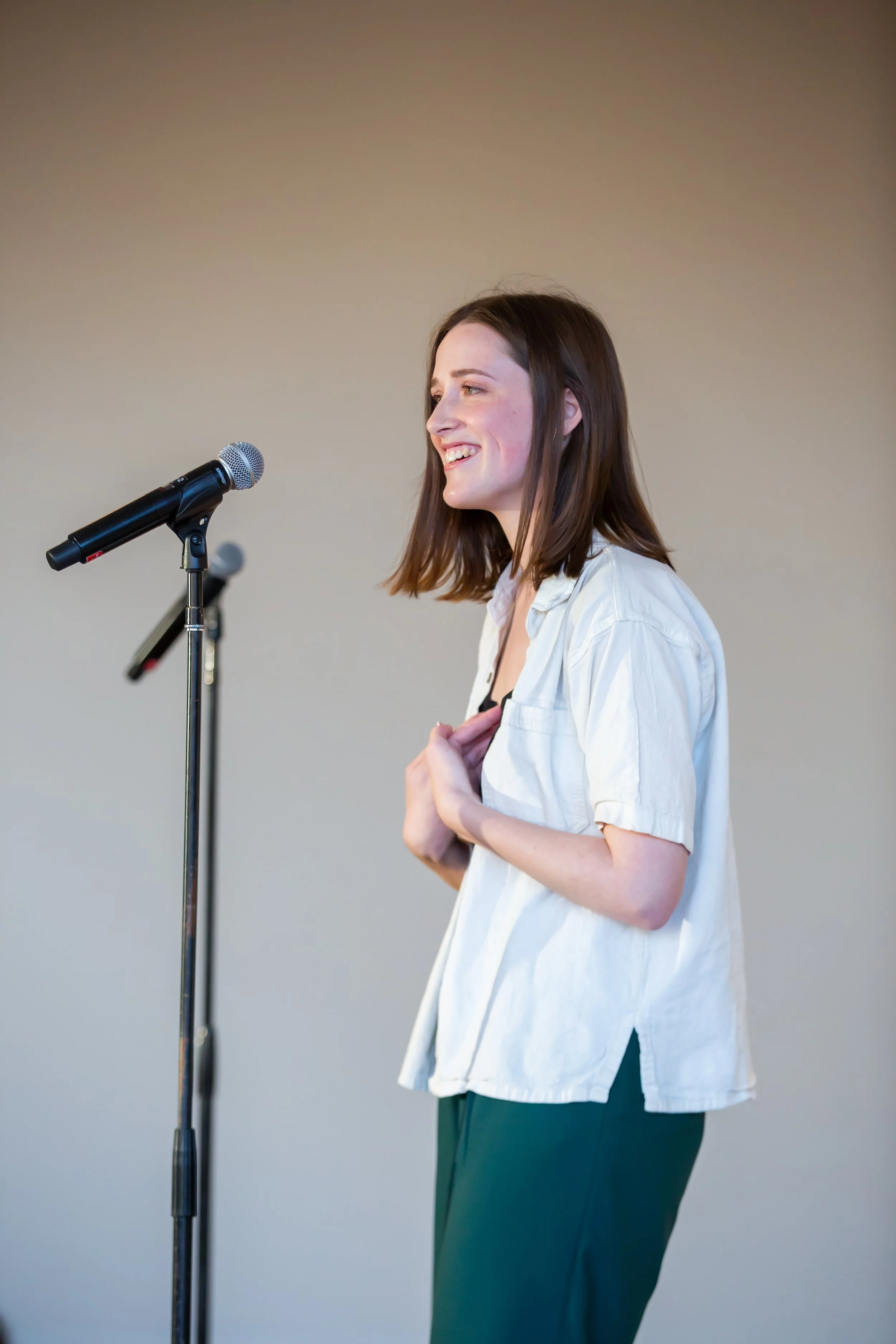
Hannah Melville-Rea shares her story at The Cantor Arts Center in Palo Alto, CA in April 2024. Photo by Christine Baker for Stanford Impact Labs.
I'm taking notes. Then I realize this is only applicable if you're a homeowner with good insurance. So not me or any of my friends in this housing market.
At the end of the session, I ask her, I say, “Well, what can I do as a renter?”
This woman pauses. She looks a little bit caught off guard. But she quickly composes herself and says, “Well, first, you definitely need to buy renter's insurance.”
I say, “Okay. Great. Could you give me a quote?”
She says, “Oh, you know, with the fires and now with California's price caps, it doesn't really make financial sense for us to take on a new client, so, no, State Farm won't do that.”
But she wants to be helpful, I can tell, because she says, “You know, I know this man and he has like a few policies that he can contract out and I could put you in touch with him.”
So, suddenly, this State Farm representative is making it sound like some kind of shady back alley deal of I know a guy to buy insurance.
I'm biking home and I'm disappointed, but also kind of laughing to myself, like, does insurance really not have any options for renters?
Now I'm curious. So I go home, open up my data set on flood insurance, and I wonder how many of these are renters? I look just at San Mateo County, the most flood‑impacted county in the state of California in terms of property prices, and I find out of 120,000 rental units, the number of renters with flood insurance is just 24. So renters just don't have flood insurance.
Okay, cool. I guess that's where the government steps in, right? That there's a safety net to make up the difference.
A couple weeks later, my new friend Cade invites me to a community meeting in East Palo Alto. I jump back on my bike. It's a Wednesday evening, heading over this highway bridge and navigating roads with no bike lanes to arrive at the YMCA. I arrive and I am amazed at how many people have shown up for this. I mean, there are kids, older folks, full families. Cade and the other organizers are literally dragging chairs from other rooms just to accommodate everyone.
I grab a burrito, sit down, the projector flashes on, and the organizers start with a question. “Have you ever experienced a natural disaster? How did it affect you?”
An elderly woman with a slight frame is sitting across from me, and she begins to speak to us in Spanish. One of the organizers, sentence by sentence, translates for us.
This woman says that she was really caught off guard by the amount of rain last winter. That she had heard that the fire department was giving out sandbags, but, I mean, she is not strong enough to fill it or carry it home. So, as the rain intensified, it flooded her garage, flooded her car, and she's still dealing with the mold. She applied to FEMA for assistance, but now it's been six months and she hasn't heard anything back.
At this point, a lot of people in the room are nodding in agreement. I can tell this is not one person's experience. This is a common occurrence.
So as I grab my bike lights, head back home, I cannot get over how different these two community meetings were. Only three miles apart, up the hill, a bunch of homeowners with good insurance who, honestly, probably could weather a storm without it. Down the road, a bunch of renters who we now know have no insurance, who are really at the front lines of these climate impacts, and now they're being ghosted by FEMA.
At this point, I'm thinking, I guess I just assumed as an Australian that the government would be there, but, wow, we live in the Wild West. It is up to the individual. Everyone needs their own safety net, and we urgently need to get everyone insurance.
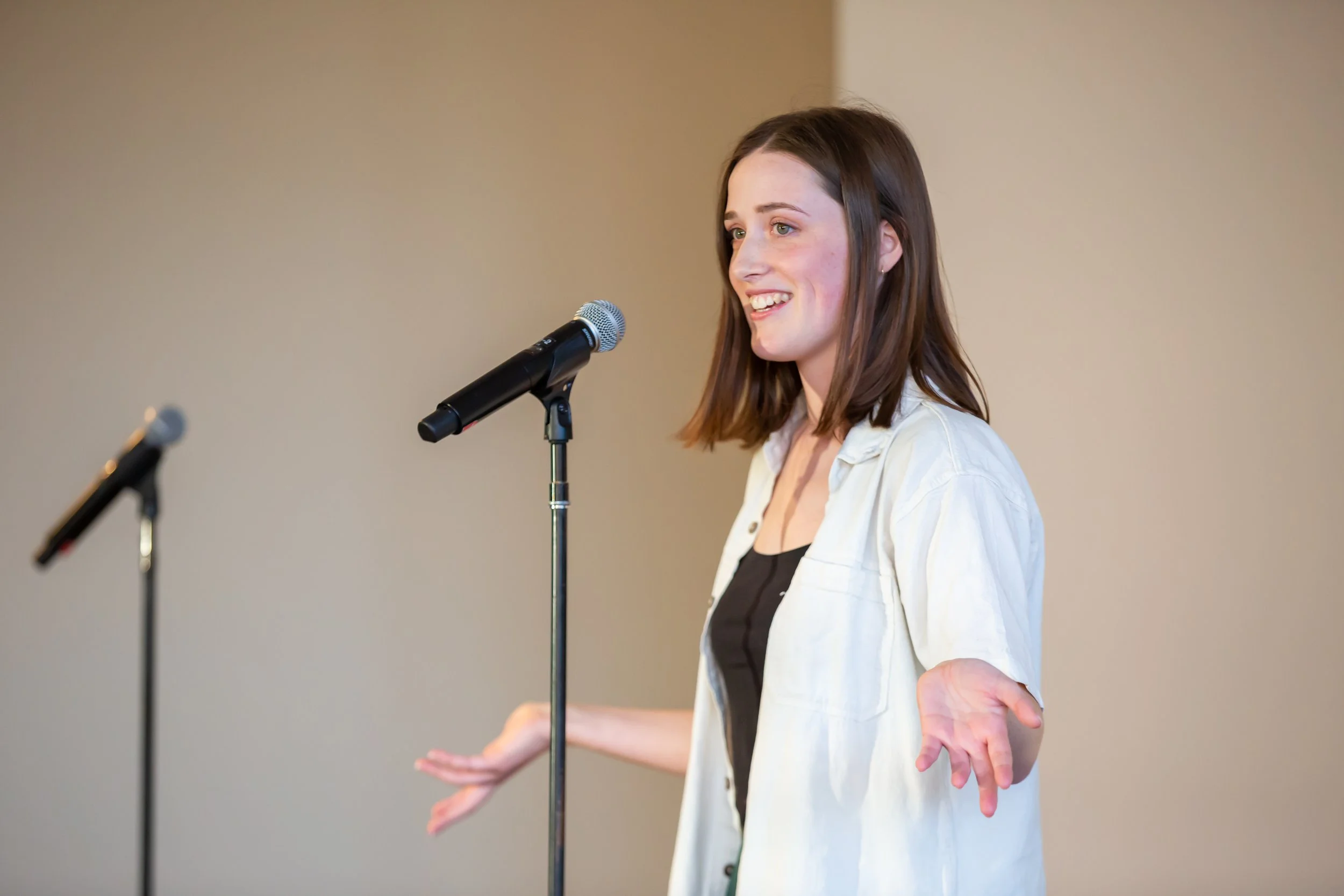
Hannah Melville-Rea shares her story at The Cantor Arts Center in Palo Alto, CA in April 2024. Photo by Christine Baker for Stanford Impact Labs.
It's now August of 2023, and my colleague at One Shoreline, Makena, invites me to join her on a site visit. We drive out to a neighborhood by the San Francisco airport, and this neighborhood has flooded every winter for the past four or five years. On my left is an elevated highway bridge. On my right is Highway 101. In front of me is a PG&E substation, and then I just hear this thundering sound of a plane above me. We're here to meet a resident named Raul. He emailed the agency last week, and it was titled “Inquiry from a Concerned Resident.”
As we walk up to his house, the first thing I see is that there are about 30 sandbags beautifully laid outside of his garage. But there is no rain on the forecast. I mean, the sky is blue. So this is a permanent barricade that he's built for himself.
Raul comes out to greet us, and we walk over to the back of his house. There's another wheelbarrow with 20 sandbags, ready to go. I know Raul is a homeowner, so I ask him, “Do you have flood insurance?”
He says, “Yeah. My bank requires it because of my mortgage.”
Honestly, I'm relieved at this point. And I ask him, “Has it helped?”
He says, “In 2021, when I had horrific flooding, I made a claim, but it didn't cover everything.” Then what he saw was that his insurance premium went up. And year on year, the cost is going up. So now on top of paying for his mortgage, every month he's also paying for a flood insurance bill. So now when it rains and it floods, he doesn't even want to make a claim.
And so maybe I take it all back, that flood insurance isn't always the best way to go. But I have learned from myself that I never would have known any of this if I had just stuck to my data set.
So my second year at Stanford looks markedly different. I've now decided I want to be a community‑engaged researcher. So Makena and I head back to San Bruno, and now we're collecting information from residents like Raul, getting them to document their experiences with flooding so that I can combine that with my data and actually have insights that are helpful, directly helpful to a community.
I also go to my fire department and do training with them so that next time there's a flood, I can be the one to fill the sandbag for someone who can't.
It is that beautiful time of year again when Stanford is in full bloom, but this year, the way that I'm spending my time feels right.
Thank you.
Part 2
I remember that first day well. It was a warm fall day, and it was in 2009, and I had gone with my sister to pick up my nephew at his grade school in Labadie. Labadie is a small Missouri town. It's west of here along the river. We had my little niece in the back seat. She was a toddler at the time.
So there we were, sitting in the pick up line in front of the school, and out comes my nephew's teacher. So I roll down the window. We're used to chatting. And she said, “Patricia, I need your help with something.”
I said, “Certainly.”
Of course, she knew we had in common that we were both science people. I had a degree in biology and I had worked a little while, a couple decades in health care. Decided I didn't want to do that anymore.
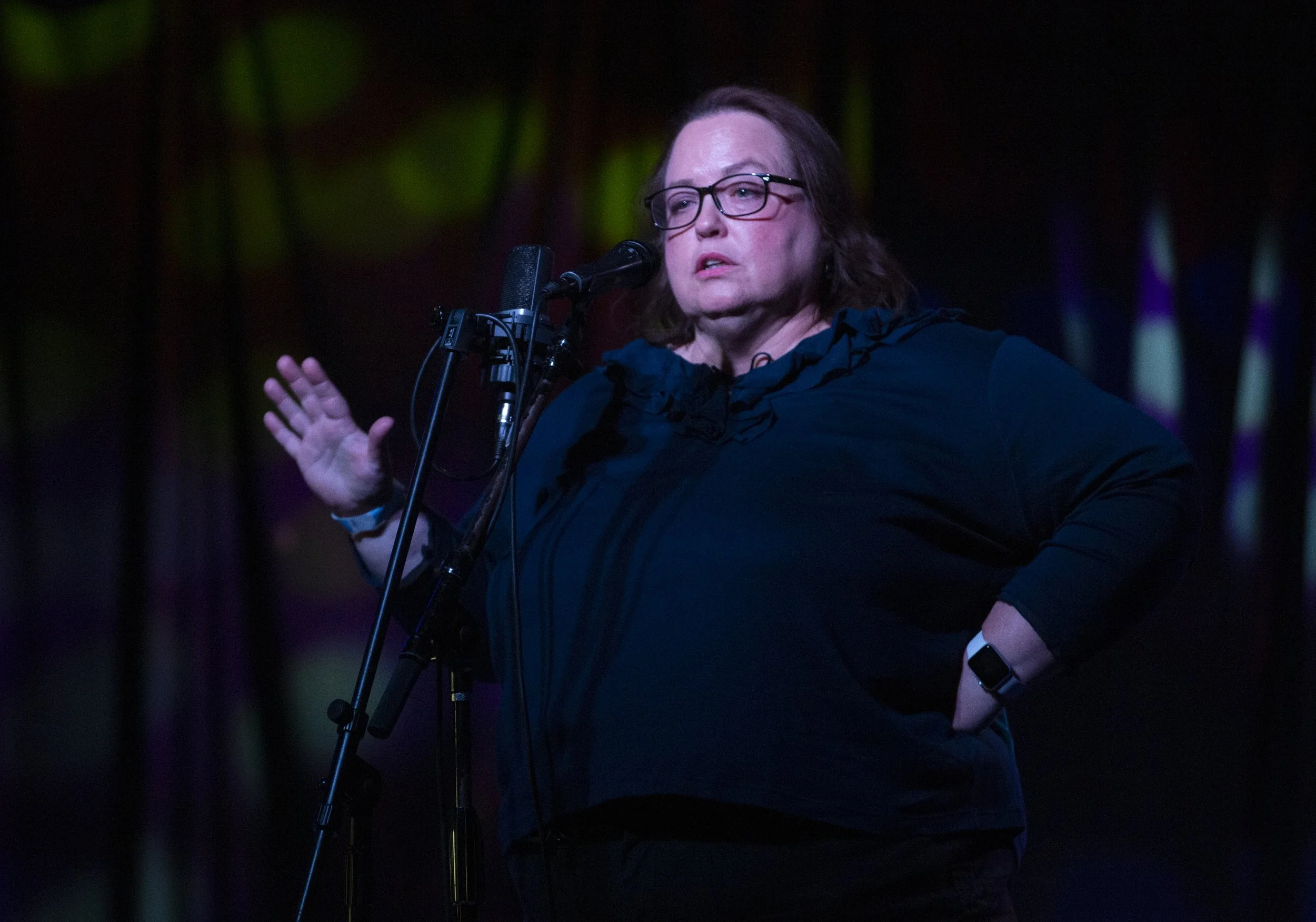
Patricia Schuba shares her story at The Ready Room in St. Louis, MO in July 2019. Photo by David Kovaluk.
So she said, “Hey, I found something out, and I need your help to take a look at this.” She said, “You know that utility, that largest one in the state, and it's got that big power plant in our town in Labadie? Well, some of us heard that they planned on buying up a bunch of land, and they wanted to build an 800 acre landfill in the floodplain right next to that river.”
I'm thinking, “Floodplain, landfill.”
We all know that most people drink water, right? In rural Missouri, often, we have our own wells. What we do is we drill them down, and they're below this level where this floodplain is.
I thought, “That's crazy.” And I said to her, I had to ask, “So what do they plan on putting in this landfill in the floodplain?”
And she said, “Something called coal waste.”
Well, you know, I'd been around the block and I knew what coal was, but I really didn't know what coal waste was. Well, coal waste is what is left after you burn up the coal to make the energy. Evidently, we make a lot of it.
So that night, I went home. Like any good person, I did a Google search first and all these articles popped up. And they said coal waste is pretty nasty stuff. It contains chemicals, heavy metals like arsenic. Arsenic and these other chemicals are very soluble in water.
I knew as a biologist that that floodplain was really a wetland, and that if they were putting this material there, that could be very dangerous.
I wasn't prepared what I found next, and this is when I went on the EPA's website. I actually saw that they had been dumping this material in open pits in the floodplain prior to this idea of having a dry landfill. Open pits dug into the floodplain, and they were dumping it there. So all of a sudden, my eyes started welling up. I got real emotional. I usually don't do that because I'm a sort of scientist.
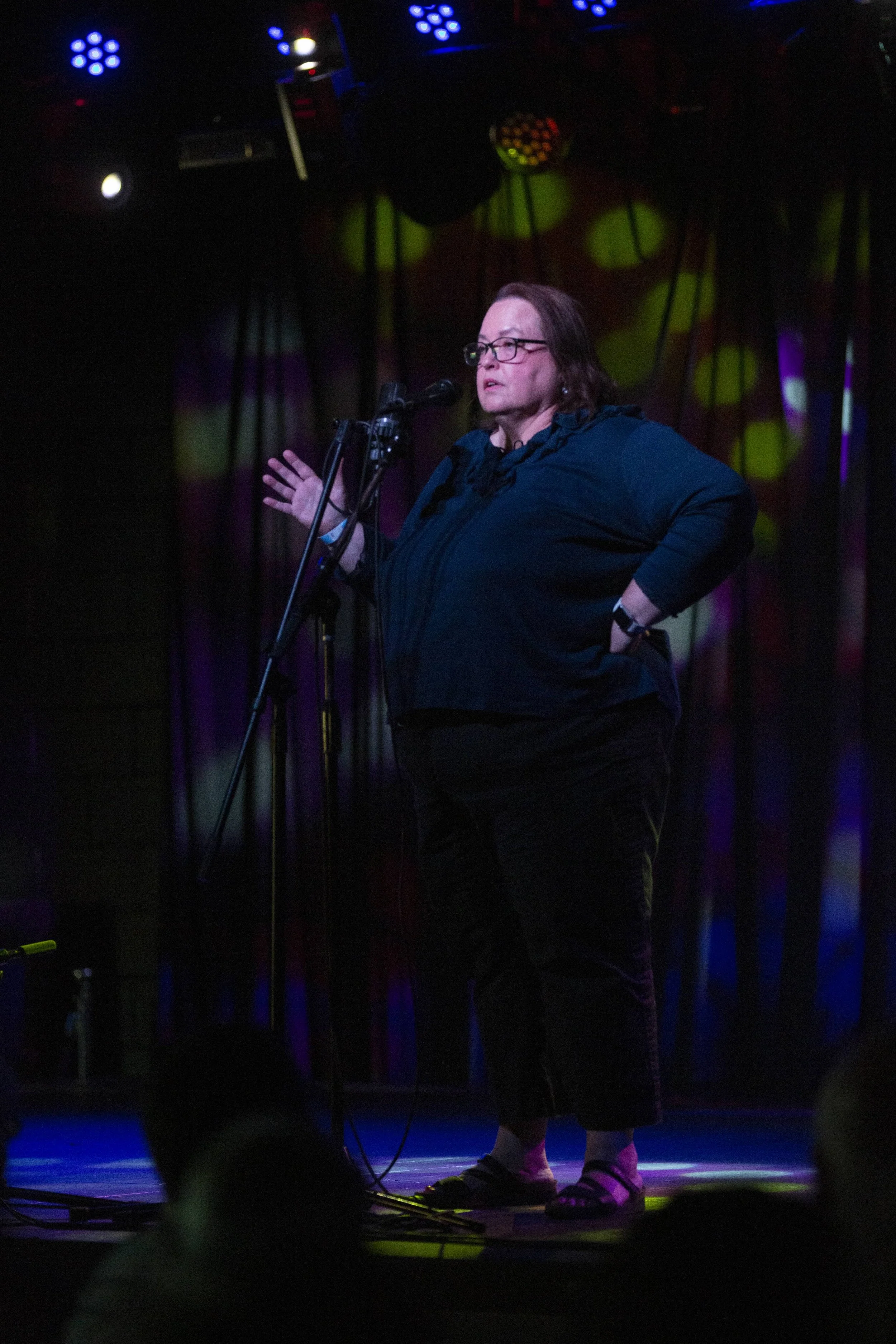
Patricia Schuba shares her story at The Ready Room in St. Louis, MO in July 2019. Photo by David Kovaluk.
And I said, “40 years ago, they started doing this.” That was 1972, and I'm going to date myself here. I was nine at the time. My entire family drank well water that we thought was pure and clean, so it was unfiltered. In the 1990s, they built their second pit, and that pit was built around the time that my sister was planning on getting married. She was talking about her first kids, she was excited to be a mother. And over the time that she had her two kids, my niece and my nephew, who I love, she was drinking that unfiltered well water.
I got really mad. I was fixated on that screen in front of me, looking at the tons of waste that contained these heavy metals, that they actually admitted to the EPA that they release to the environment every year. And I thought, and this is from my health care days, I could think of all the people that I knew who had cancer. I had to realize that this is how it happens. We talk to patients and we say, “We don't know how you got cancer, or MS, or type 1 diabetes,” but here it was. We're talking hundreds of thousands of pounds of this material, and it's in the environment so we're exposed to it.
Then I got really mad thinking about the experts at that power plant that had dug those pits, had looked at the groundwater bubbling up through the bottom of the pit, and thought it was okay to put that material there. They knew what that stuff was.
Then I got mad at myself. And I said, “How did I not know what that stuff was and that they'd been doing this for decades?” I had to question why had I never asked what happens at a power plant. I never had to.
I knew I had to do something. I had to be responsible to do something because everyone I knew and loved drank groundwater. I worried about them, and I worried about us.
So, there I was. Within weeks, I was engaged with this small, fledgling group of people in our town. We called ourselves the Labadie Environmental Organization. Before we knew it, we were doing all kinds of activities to prepare for this first big event that we were trying to turn out people for. It was a local hearing of our county elected officials. And at this hearing, they were going to decide whether or not we would allow this landfill in the floodplain to go forward.
So here I am. I walk into that auditorium at our local college. There were 500 people there that night. I was so excited. Then about 30 of us got up and we each testified one after another. And in that group was my sister. She went up on stage and she had my mom at her side, and she had my little niece, that one in the car, on her hip. She spoke passionately that night about why they shouldn't do this.
Well, I was circulating around the room that night, and I heard a lot of things that nobody should have to hear. The power plant had told their employees to get there that night and to be engaged. Well, I heard that. I heard the things they said about us. And I also read the comments by one of our commissioners who obviously felt a little overwhelmed by the outpouring of love from his constituents that night. He called us troublemakers, outsiders, people who just wanted to shut down the plant and take those good jobs away. I knew there was a lot of anger there, and I knew that wasn't good.
Then one morning, I was on the way to get the mail, walking down my driveway. I see something in the distance. It's about the size of a volleyball, round. It wasn't the color of a volleyball, though.
As I got closer, I walked slower, and I noticed it was something that should not be there. About that time, I called to my mom to come over and take a look at it. We're both staring down at it, and she confirmed it. It was a severed pig's head, laying there in my driveway, dirty and decaying. It was shocking.
So what does my mom do? She picks it up, she walks over to the trash can and dumps it in there. And she's coming back, and it was almost like she was reading my mind. She said, “Don't worry. We're going to be okay.” I wanted to believe her, but I was afraid.
So then a group of us from that LEO group, Labadie Environmental Organization, we decided we would go meet with our commissioners and present to them our plan of why they should stop this landfill. Before we got started, the commissioner in charge, he started waving around his cell phone. And he said, “I have some evidence that Patricia Shuba was out in a public venue with a friend and they were talking and they were slandering me and my son.”
I said, “Really?” I was shocked. I knew I had to respond to this ridiculous claim. Actually, in a way, I was more threatened by that than the pig's head because this was about my character. And we were at a public meeting. My neighbors were there. The people from our board were there. And I'm thinking, “People are just going to run from Labadie Environmental Organization.”
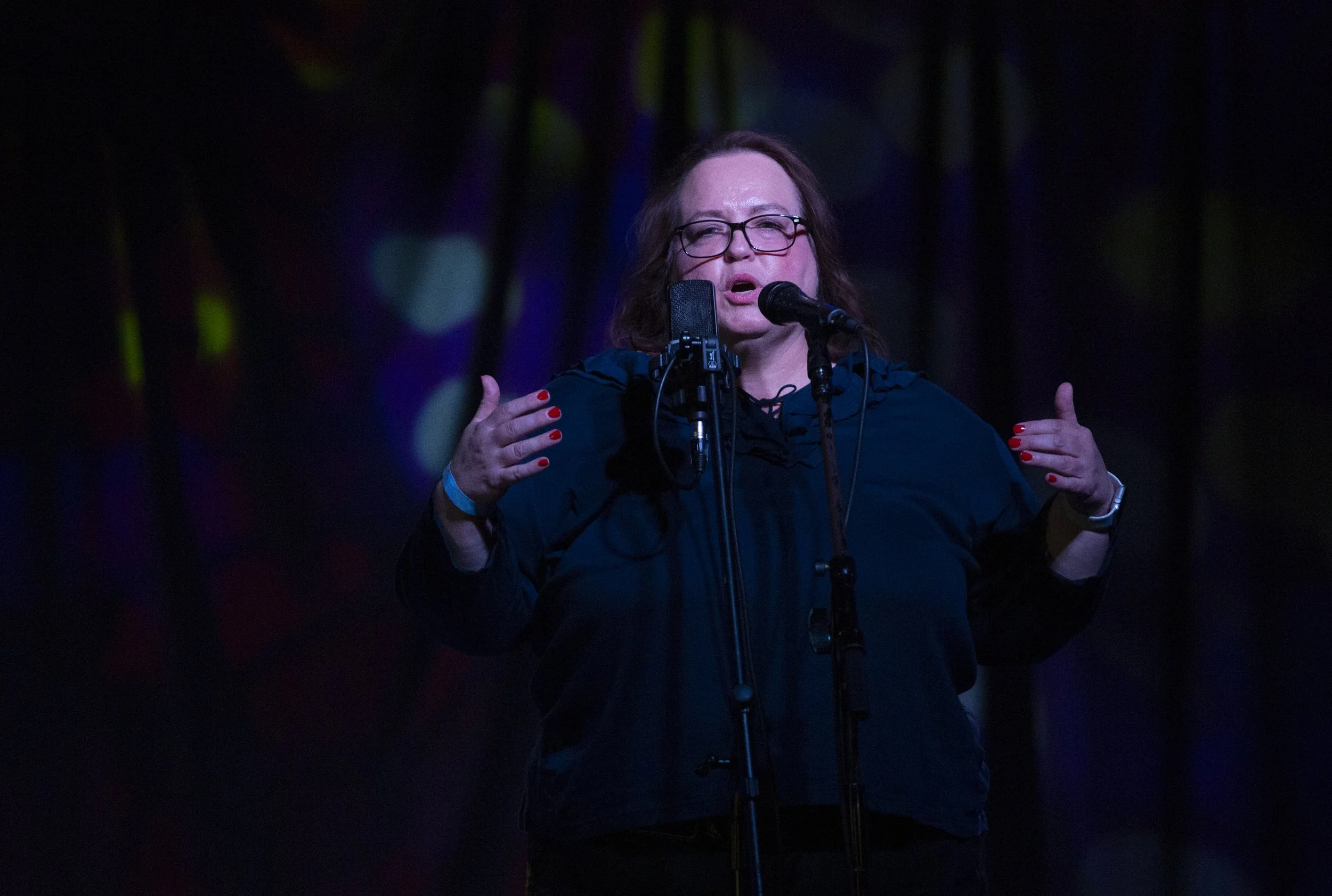
Patricia Schuba shares her story at The Ready Room in St. Louis, MO in July 2019. Photo by David Kovaluk.
So I got up on my feet, walked toward the podium, stared up at those guys on the commission, and I began to defend myself. And as words were coming out of my mouth, I'm thinking, “You know what? They would only do this if we were a threat to them. This had nothing to do with good policy. This was about politics.” As I was defending myself, I thought, “You know what? We can actually win this thing if we just hang on.”
You're right. So it wasn't the last of those trials and tribulations. We went through a lot as a group, even internally. But you know what? By 2015, we had brought the most powerful corporation in this state to the negotiation table.
You might think that was our most notable moment, and it might have been as an organization. But for me, the most powerful moment, the moment that I took the most pride in and I felt the most hope for the future of our community, was when I saw my niece, that little girl. Remember her? She was in the back seat that first day. She was on my sister's hip at that first county meeting. Well, in March, we had to go before state regulators to actually argue that these utilities shouldn't be allowed to leave this mess in our floodplain forever, capped and polluting our groundwater.
And my niece, she had grown up to be a pretty bright and certainly very kind young woman. Her teachers had all said how she had such great leadership skills. Her and her brother both are the same. They speak out on issues that they care about.
So here, she said to her mother, my sister, she said, “I really want to go with you to that hearing.” And then she offered to actually give testimony on a petition that we were collecting. So we said, “Sure.”
So there she was, 12 years old, about my height. Actually, she's taller than me. But she was standing in front of the mic being sworn in. And here were the regulators, a really intimidating position to be in as a 12 year old. And as she proceeded to speak, she said what she cared about and that she wanted these regulators to protect her and her family, the workers who were going to have to clean up the mess, and the generations that would come later that would be dependent on that water.
And you know what I saw? Those regulators who had been looking down the whole time when I spoke, looking down and taking notes, they looked up and watched her. I remember filming her at that moment, because I was going to use it on Facebook, and I noticed that they were moved by her testimony. She was truly powerful in that moment.
It was only a couple days later and we found out, against all odds, those regulators dropped those horrible regulations. They were gone. I thought, “Oh, my God, we actually won this fight.” This really impossible chance of winning, we did.
And if you'd asked me how did we win, I'd have to say, first, we believed we could win, and then we decided that we had to speak up to these people and sort of let our fears go by the side.
Then when we do those things, we actually motivate other people to do the same thing, to share their stories, like my niece did that day. So on that day, that little girl who spoke to those regulators told her story with no fear. And when she did, we won.