In this week’s episode, storytellers share stories about carbs, control, and the unexpected ways bread shapes our lives.
Part 1: When everyone in Rich Tackenberg’s family is diagnosed with celiac disease, he’s forced to confront a terrifying possibility: life without his emotional support carb.
Rich Tackenberg has now lived in Los Angeles longer than he grew up in New York. He is a Managing Director in executive search, specializing in media, entertainment, and nonprofit placements. He has been married to an amazing woman for almost twenty five years and is most proud of not screwing that up. At least not yet.
Part 2: During the pandemic, Aditya Surendran sets out to conquer making a 36-hour baguette.
Aditya Surendran is a lawyer, comedian, and storyteller. How stories explore the mundane suburbs in search of laughs and deep meaning—though deep meaning is optional. A successfully launched Kickstarter now means you can get his book, CheeseDosa: The Book! on his site and through most national retail chains.
Episode Transcription
Part 1
This is about 15 years ago. I am driving home from work and I am annoyed because there is an empty plastic bag on the passenger seat. I am annoyed because 10 minutes earlier, that bag contained a three‑foot baguette of French bread. I had eaten the entire loaf while driving again.
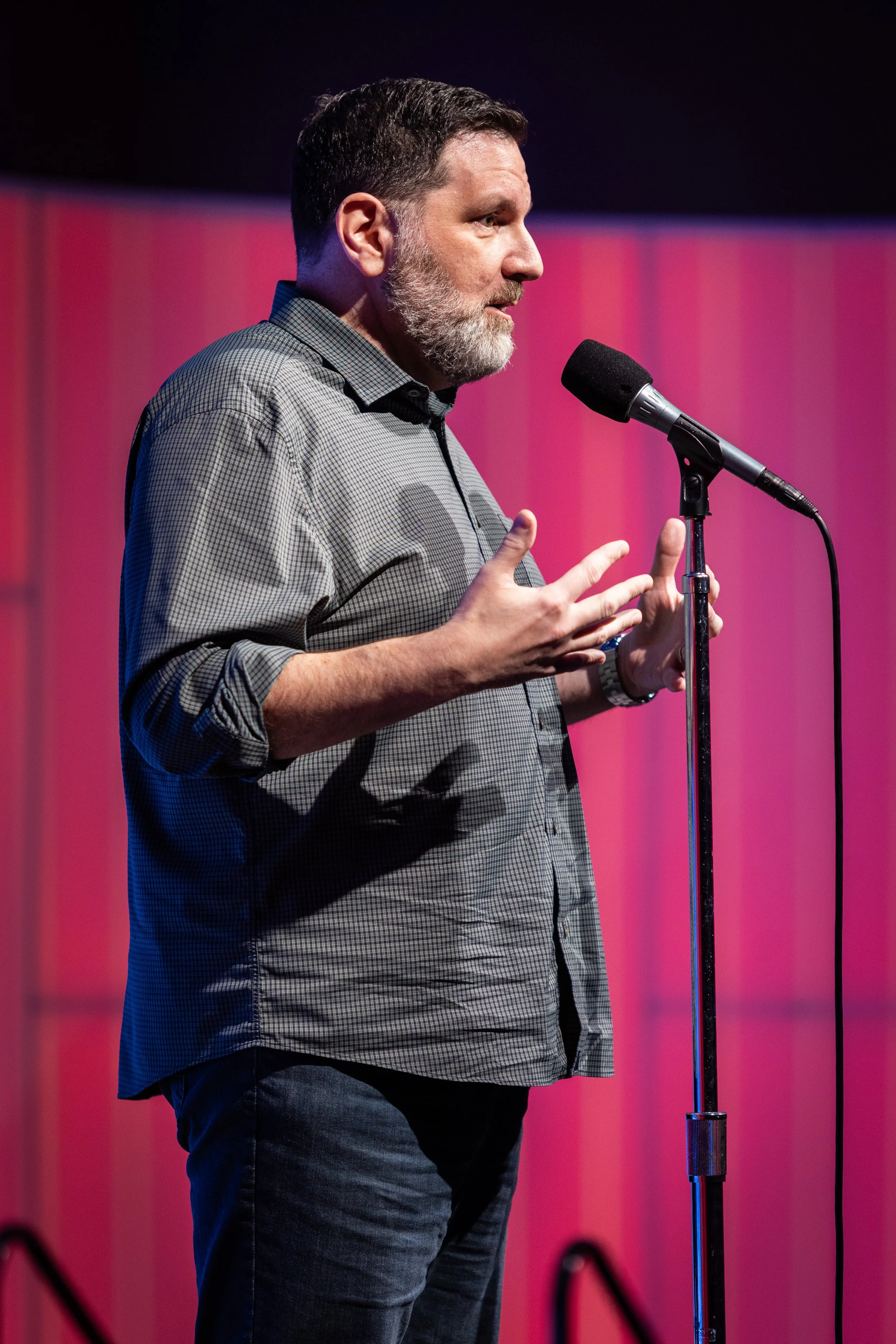
Rich Tackenberg shares his story at the Crawford Family Forum in Los Angeles, CA at a show in partnership with LAist in February 2026. Photo by Louis Felix for LAist.
Now, let me explain. An hour earlier, I was at work, and my boss yelled at me for the way I worded an email. This filled me with anxiety, but that's okay. I have a system for dealing with work stress. I get in my car after work and I drive directly to my go‑to French restaurant bakery, Le Pain Quotidien, which is French for “the daily bread” and I get my daily bread.
As I drive and eat, I immediately feel better, like, “Ahh.” It absorbs all that anxiety. It's like the baguette absorbs the stress like Italian bread sopping up marinara sauce. And then I'm good. The only issue is, once I start eating, I can't stop. So as I drive, I consume a loaf of bread the size of a baseball bat. That is too much bread.
But I'm happy that at least I can still eat bread. Because four years earlier, we found out that one of my two sisters was diagnosed with celiac disease, which we had never heard of. It's explained that she has to stop eating any food that has something called gluten in it, which we find out is a protein that's found in wheat, barley, and rye. So she has to immediately stop eating all foods that are fun.
I feel terrible for her, but not for me, because we are also told that the major symptom of celiac is being malnourished and underweight. I'm easily 20 pounds overweight, so I'm good.
A year later, we find out the other of my two sisters is also diagnosed with celiac. Now I feel kind of guilty. I'm now 30 pounds overweight. For the first time, I'm actually happy about that.
And then a year ago, we find out that my dad is diagnosed with the disease, which is crazy that this has now become, celiac is like the family disease, which is so odd because when I was growing up, our love language was carbs. If I had a bad day, we got bagels. If I aced a test, we made brownies. If I failed a test, we made walnut brownies. When I lost weight on a diet that my family encouraged me to go on, we celebrated by baking and eating a cake.
Now, why am I telling you all this? Because a week after the car where I ate a yard of bread in 10 minutes, I get a call from my parents. They're on speakerphone, and they tell me that my mom took the test. She also has celiac. That's crazy.
And for some reason, as we're talking about it, they're insisting that I should get tested. I have no idea why. I don't have any symptoms. And by the way, if something's going on in my body, I don't really want to know about it, because I don't want medicine taking away my bread.
So I stall and I stall, but for weeks they won't let it go. This is how I end up in the office of a gastroenterologist, Dr. Shaw. He's great. He starts by explaining to me what is celiac disease. He says that in the small intestines, there's millions of these little fingers called villi that line the walls. Their job is to catch the nutrients as the food passes through the small intestine. That's actually how food gets absorbed into our body. That's how it goes from the digestive system into our bloodstream.
And he says, “For reasons we don't fully understand, for people with celiac, the gluten tells your immune system to attack those villi and they become very weak, and they can't really do their job as well. That's why people become malnourished and underweight.” He says to me, a guy who is now 40 pounds overweight.
And I said, “Look, I would love if the side effect of eating too much bread was being thin. That has not clearly happened.”
And he says, “Yes, you would be very atypical. But given your family history, I just want to check. Let's do a colonoscopy and some bloodwork. Let's just see.”
“Okay, fine.” But we won't get the tests back for 30 days. I won't know what the results are for a month. Which means, in the next 30 days, I am going to eat all of the bread in Los Angeles.
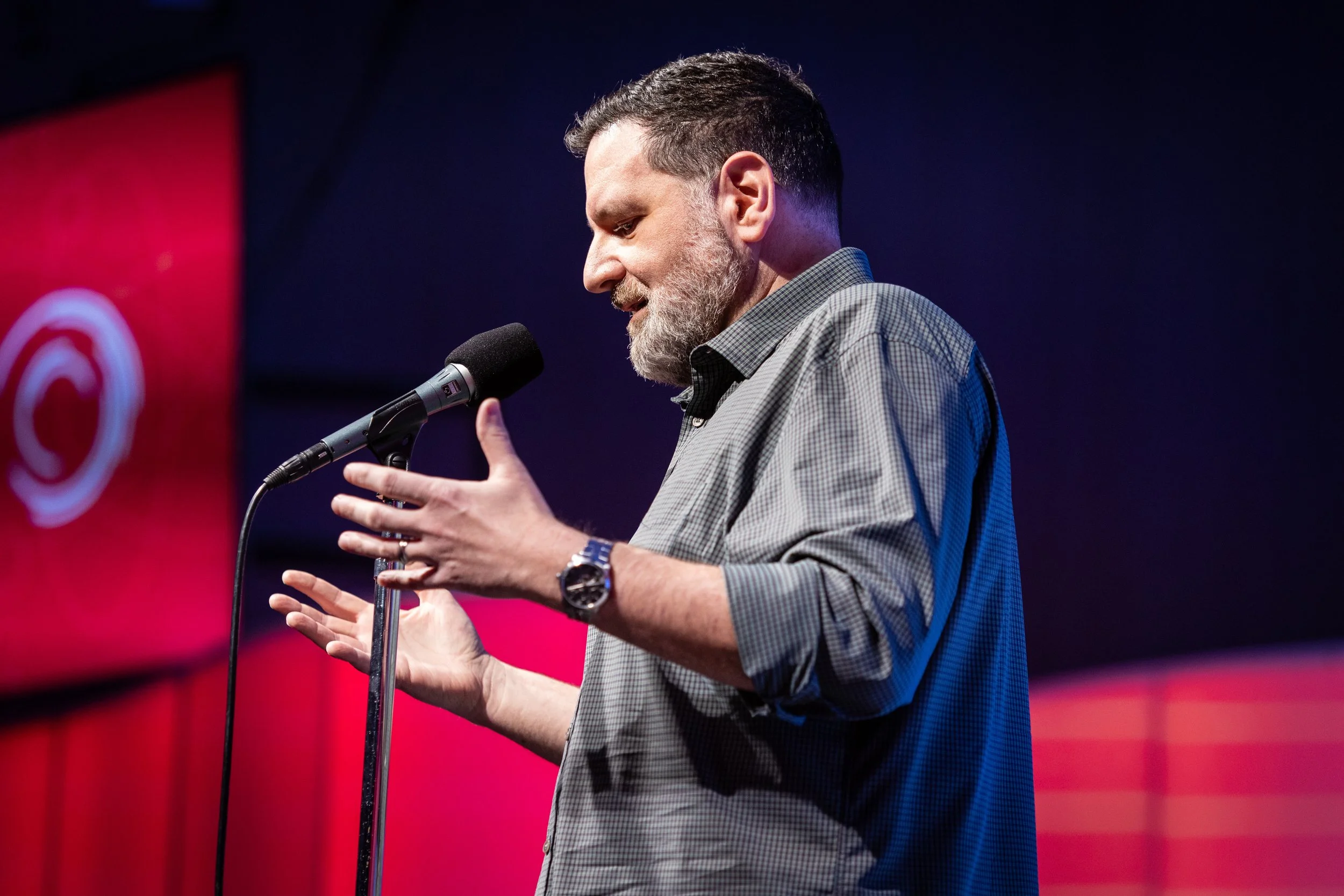
Rich Tackenberg shares his story at the Crawford Family Forum in Los Angeles, CA at a show in partnership with LAist in February 2026. Photo by Louis Felix for LAist.
On the first day, I happen to wake up early and I look at my phone and I see I already have four voicemails from my boss. So I eat four almond croissants before listening to the messages. On day 10, when I get in trouble because I was laughing with a co‑worker, because you can't laugh and work at the same time, I don't get upset. I get a sheet of baklava. Fine.
By day 18, I'm standing in our office parking garage eating a bag of mini baguettes like they're being fed into a wood chipper. I have learned a culinary tip. If you want to intensify the flavor of pastry, just be terrified you're never going to eat it again. It really makes the flavors pop.
We're getting close. Day 24, I accidentally send a client presentation to the wrong client. And as I'm walking to my boss's office to tell him, I make a pit stop in the kitchen and quickly eat six bagels, two cheese. I'm carbo‑loading for a race. And it works, but ultimately, time's up.
It's day 30. I'm in Dr. Shaw's examination room. I'm sitting in the chair next to the examination table. He comes in. He's holding a purple folder. He sits on his little stool and he rolls right next to me. He doesn't open the folder.
He just says, “Well, I actually thought we were going to see weakened villi. I was wrong. Because, no, you have no villi at all. Your celiac is so bad, worse that I've ever seen, that the walls of your small intestine are completely smooth.” Okay.
And then he opens up the folder, and he says, “But here's the thing. Your bloodwork is fine. Your body is somehow compensating and getting all the nutrients it needs. I have no idea how.”
I start peppering him with questions like I'm trying to get out of a traffic ticket on a technicality, and he's answering all my questions. But he closes the purple folder and he finally says, “Look, I believe that the celiac is doing significant damage to your body in ways that we just don't yet know how to look for. But I don't know. Because the test of your bloodwork is coming back normal, I can't tell you that you have to give up bread. You have to decide.”
And I leave reeling because a medical professional just told me that I can eat all the bread that I want. Thank God. I am a miracle.
I go the next day to Le Pain by myself. I go in, sit down, and I order the family‑size baker's basket for myself. The server brings it and I look at it. It's just so beautiful. I'm just looking at the light glistening off the egg wash of the semolina, and I'm just staring at it until I see the server staring at me staring at the bread. I'm like, “This is a little creepy,” so I just start to stare at other things so that maybe he just thinks I'm like generally inquisitive.
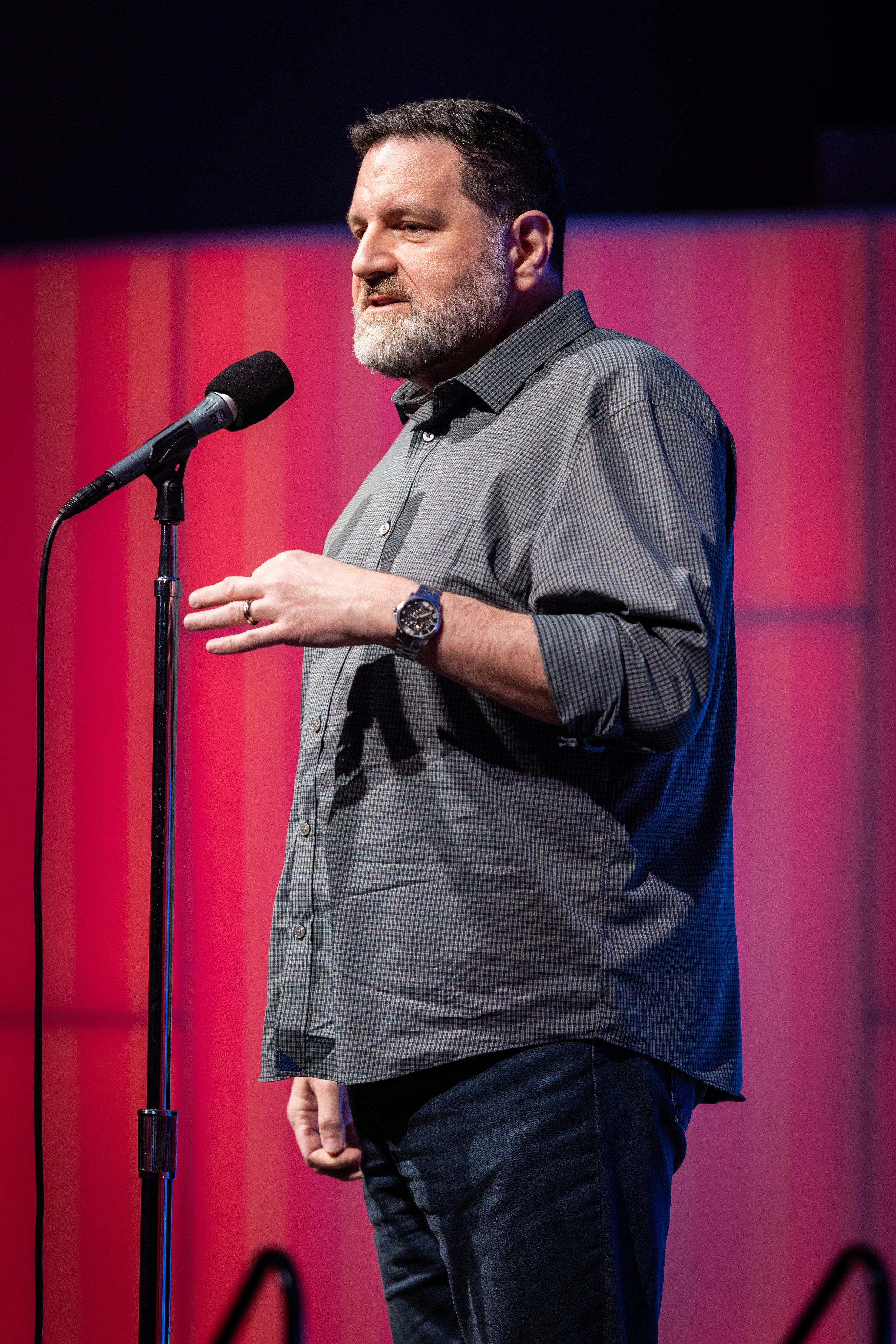
Rich Tackenberg shares his story at the Crawford Family Forum in Los Angeles, CA at a show in partnership with LAist in February 2026. Photo by Louis Felix for LAist.
And I see there's a tent card on the back of the table with the logo of the restaurant that I have seen a thousand times, but I'm looking at the words, and I'm looking at the second word, which is the French word for bread. It's “pain”. And if anyone here knows French, it's pronounced pan but it's spelled P‑A‑I‑N.
And for the first time, I go, “It's pain. This whole time, I've been eating pain.” It kind of makes me giggle a little bit, and I start eating my baker's basket of pain. And it's a silly thought, but because of that, I'm thinking about the last 30 days. I ate all of this bread, which actually did what I wanted to do. It numbed me out from all of the stress. But as I thought about it, I'm like, “Well, you know, because of that, I was never in enough pain to deal with the things that were causing me stress in the first place. I was treating the symptom but never the cause.” So in a way, the bread was keeping me in pain. That's a little disconcerting.
The basket of bread doesn't look quite as good. I mean, I keep eating it but I actually stop before it's done and I pay the check when there's still bread in the basket, which feels very confusing and disorienting to me, but I put it out of my head.
Two days later, I'm leaving work. My boss is furious because of a font that I used, and I'm just so annoyed as I'm driving home. I'm just gripping the wheel and I am driving directly to Le Pain. Now I know what I'm doing. I want to be numb, and this is going to take five dinner rolls and one pistachio tart.
And I know what I'm doing, but as I'm driving, I'm thinking about that stupid baker's basket of bread and I can't get that idea out of my head. So at least while I'm driving, I call an old friend of mine. When he answers, I force myself to say, “Hey, I need your help looking for a new job.”
We start talking and he's asking me questions, and I realize I had always assumed that I never looked because I was procrastinating, but it was actually because of fear. I had never felt that before.
So we really start talking about it, like really having a real conversation about my feelings. And as we're talking about it, I see out the windshield coming up on my left, it's Le Pain. And for the first time in a long time, I keep driving.
Thanks.
Part 2
This story is called “My Pain”. And before it starts to bring you guys down, it's just like a pun for French bread. I thought I'd start with that because, like any good story about French bread, I thought it might be worthwhile to maybe start with a little verse from Les Mis.
"I had a dream of times gone by when hope was high and life worth living. But the tigers come at night with their voices soft as thunder. They tear your hope apart. They turn your dream to shame.”
Thank you. And that's my story. No, I'm kidding.
January 5th, 2021. A baguette costs $2. $3 from Whole Foods. But if you get an organic baguette, God help you. They will make it much smaller and keep it at $3 so that that unit price just skyrockets way into infinity.

Aditya Surendran shares his story at QED Astoria in Queens, NY in September 2021. Photo by Zhen Qin.
The reason I mention this is because I've been baking a lot of stuff during the pandemic, and a baguette never crossed my mind. It makes a lot more sense to maybe make a cake or, however you pronounce, a macaron.
But the reason I'm bringing up any of this is because I feel like the world, during the pandemic, has been divided up into two major categories in my worldview. One is the doom scrollers. People that are jumping onto YouTube and watching every tornado, racist person, racist tornadoes, whatever they can find, to basically satisfy that feeling of, “Oh, my goodness, I know everything. And even though it may not be great, at least I'm aware of every possible danger that's out there.”
That's not me. Every time I see those YouTube videos, I will, like a bonsai tree, start disliking them to make sure the algorithm will keep those kinds of stories away from me. It's important because the other side of that coin or the other part of the world are the bakers. So many of us during the pandemic baking all kinds of stuff we don't know how to bake.
But thanks to people like Josh Weissman and those beautiful bagels, or Alex, no particular last name, from France, making his perfect mozzarella balls, I eventually realized that I am team baking and this is my tribe. So I started to like more of those videos and more of those wonderful things about how to bake and get a flour mill that my wife and I have at our home on our perfect little kitchen island. And we started figuring out that it's not just whole wheat and white flour, that there's a whole world, a cornucopia of things that you can get more specific about when it comes to that.
So there was this particular YouTuber who changed my mind about baguettes. It was a 36‑hour recipe, and that sounds ridiculous. When you think about it, it only cost you $2. But there was something about the end of that 15‑minute video when that bread cracked open and I saw those wonderful little holes and a little bit of steam coming out that I thought, “Ooh, I want to do that.”
And it was January 5th when I saw that video, so I made a plan. 7:30 PM tomorrow, we'll have wine, a little balsamic vinegar on the side, draped inside a little olive oil, some cheese, and of course, the centerpiece, this beautiful baguette right down the middle.
So I went to sleep. There was a step way early in the morning, about 6:00 AM. So I went to sleep, set the alarm. I knew this was a weekday, and my wife would not be happy that the alarm would go off, but the baguette must come first. So I went to sleep, and sure enough, woke up to that alarm. Walked out of my room, went into this kitchen.
Now, we've moved during the pandemic and so, for us, it was extremely important to have a little space. We're going to be working together now, not just living together. It turns out working together with your spouse is just as hard as living together with your spouse when you realize, wow, I have to see this person every single day.

Aditya Surendran shares his story at QED Astoria in Queens, NY in September 2021. Photo by Zhen Qin.
But I went out to this particular island that we had created. Not created, obviously, but it was the first time we'd gone into an apartment that we've lived in that has one of these things. I'd only seen it in, I don't know,Stepford Wives and all these other TV shows. But I thought, “Oh, wow, this is nice. I can really set up.”
So I set up, and had already the night before created something called poolish, which is a one‑to‑one ratio of flour to water. And by the next morning, it was kind of this murky, swamp‑like material. So I added a little bit more flour, a little bit more water and went to sleep.
When I got back to bed, sure enough, I saw my wife. She was wide awake. The alarm had woken her up and she was not pleased. But I let her know, “Don't worry, this is for the baguette.”
She grunted and went back to sleep as well.
Later that afternoon, at around 3:30, I get a text. It's from my mom. It says, “What is going on?!?” With a question mark, an exclamation mark, and then a question mark. I was sitting there watching a video of this particular YouTuber, learning how to make the first kneading and the first proofing of my bread, and so I didn't really make much of it. My mother is the same woman who will often write me things like, “Please call me,” with a period at the end of a text message, making me assume that that period could be someone has gotten cancer or a family member has died. Usually, when I call her up and respond back, what's happened, she'll just ask me what did I have for lunch that day? So I wasn't too particularly concerned when I saw, “What is going on?”
So I just continued forth, slid that little text message up, and continued watching this wonderful YouTube video about what happens between the first kneading and the first proofing. Right around after the first proofing of the bread, that's when I see, “OMG, they've gotten in.” I don't know what that means, but I know it means that the TV is going to explain this all to me eventually.
So decide to make that move from that beautiful island to my couch. When I sit down on the couch and I turn on the TV, my poor little bonsai of a YouTube channel has completely changed. The floodgates have broken open. All of this stuff about people charging the capital is all over there. All of my Josh Weissmans, my Alex No‑Last‑Name, my every single YouTuber that I've fallen in love with has been completely set aside.
And so I find one that says “live” in caps, click the button and start to watch this horror. My wife starts hearing some crazy noises that she usually doesn't hear when I'm watching my baguette videos and so she comes outside, she looks at the screen and it was a moment that helped me realize who this person is.
When she sees something and when she feels something, she feels it with her entire body, with her entire face and expression and emotion. And she says, “Why are they doing this?” Tears are just rolling down her face.
And obviously, I'm not a political scientist or any kind of scientist, Story Collider, but I look at her and words like “anger” and “treason” and “Trump” just start to roll out of my mouth. And somewhere while I'm trying to explain this to my wife, I realize I'm coming up to some pretty critical moments in my baguette's journey.
But how could that possibly matter right now? How could something like bread matter at a time like this? So I stopped making my baguette and continued to watch all of this happen.
And around 10:30 PM., my wife went to bed. I kept watching these miserables foment. “I had a dream my life could be so different from this hell I'm living.” But around midnight, something changed. All that evil was cast out of that building and these congresspeople decided to continue the vote.
Something in me changed as well. I know I'm no Jean Valjean, not even a particularly good singer, but something clicked where I thought, “This baguette absolutely has to be made tonight.”
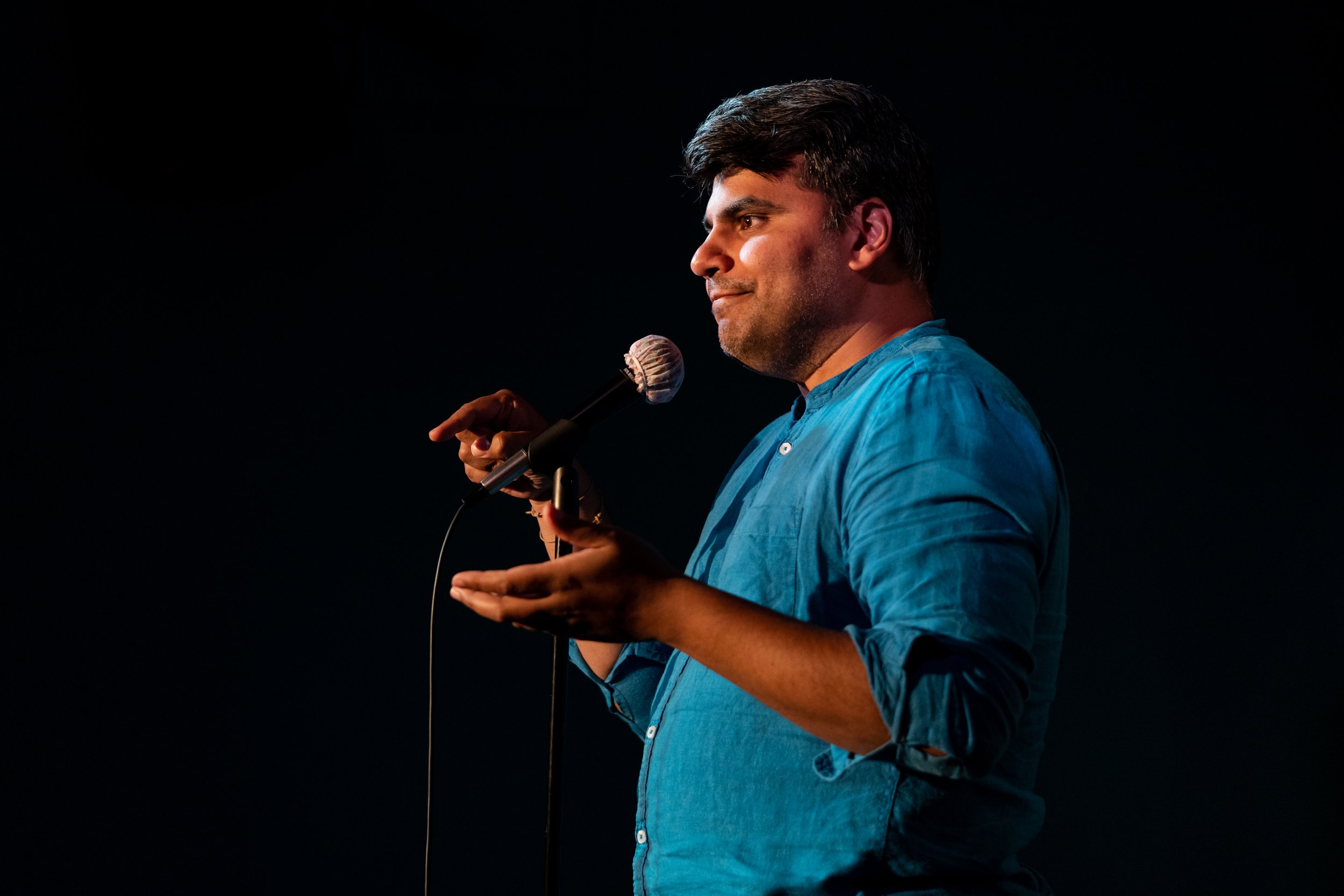
Aditya Surendran shares his story at QED Astoria in Queens, NY in September 2021. Photo by Zhen Qin.
So I walked to this sad‑looking pile of dough that had been probably crusted by the oxygen that had been hitting it throughout the entire day, and I slapped it once. Twice. And then started forming those perfect little circles and then turning those circles into perfect little ovals, which would probably not turn into very perfect baguettes.
But I made those shapes, preheated the oven to 465, and once that got heated, put out a tray where, as soon as I put that tray into the oven, I threw two tablespoons of water. That created an enormous amount of steam immediately in that oven while the little baguette balls were in there. This phase rises the bread insanely. I guess the steam just causes an immediate rise.
And then I, about seven to ten minutes later, took out that tray of steam and started wafting out the steam and closed the oven. This phase crusts the bread.
It was about 1:30 AM when I walked into our bedroom. And maybe it was the smell of all of that warm baking bread, or maybe it was my wife's and I's cosmic connection, but if I'm being honest, it was more likely the fire alarm that had been set off several times during the baking of that bread, but she was awake. And she knew exactly what was going on and what she was ready to try out.
She got out of bed at about 2:00 AM, walked with me. I handed her this piece of bread that, hopefully, would taste good. The balsamic, the cheese, everything was laid out, and she cracked that bread open and it rang through the entire apartment. Then steam started to billow out and then I saw those perfect little holes, and I myself started to cry.
It's a strange thing, baguettes. They're not soft on the inside because you, like a steak, cook them a little bit less or don't add a lot of heat. They're soft on the inside because they're hard on the outside. That crusting promotes and encourages the inside to be as soft as possible. They're delicious.
And speaking on behalf of team baking, like myself and, hopefully, a lot of you here, they're not to be messed with. Don't you dare tread on us.
Thank you.