In this week’s episode, both storytellers discover just how far people will go for the ones they love.
Part 1: When Bailey Swilley’s dad goes into cardiac arrest, she watches her mom care for him and starts to reevaluate what love really looks like.
Bailey Swilley is a writer, comedian and storyteller from Memphis, Tennessee. She is a Moth StorySLAM winner and hosts the monthly storytelling show We ❤️ a Theme at Pete’s Candy Store in Brooklyn. In 2026, she is performing a new show, A BABY FOR ME? NO THANK YOU, PLEASE!. Follow her on Instagram @heybailay for future show dates.
Part 2: At rock bottom, Pam Stepansky turns to her dad for support with her alcoholism.
Pam Stepansky is a writer, stand-up comedian, and actor who splits her time between New York City and Puerto Rico. A mostly-Jewish millennial from Long Island, she blends snark, sincerity, and joie de vivre into a creative perspective that’s as dazzled as it is befuddled by the facts of life. She lives with her husband, Adam, and their spirited tuxedo cat, Gumbo.
Episode Transcript
Part 1
It is summer 2014, and I've got that summertime, summertime sadness. I am having a really hard time. I hate my job, and I hate my roommates, and they definitely hate me too. And I hate my boyfriend.
Okay, I don't hate him. He's nice. He's good on paper. He's a little bit older than me, which I love, because he's from New York and he knows all the best bars and restaurants. But he actually doesn't like our age difference and he begins to hold it over my head.
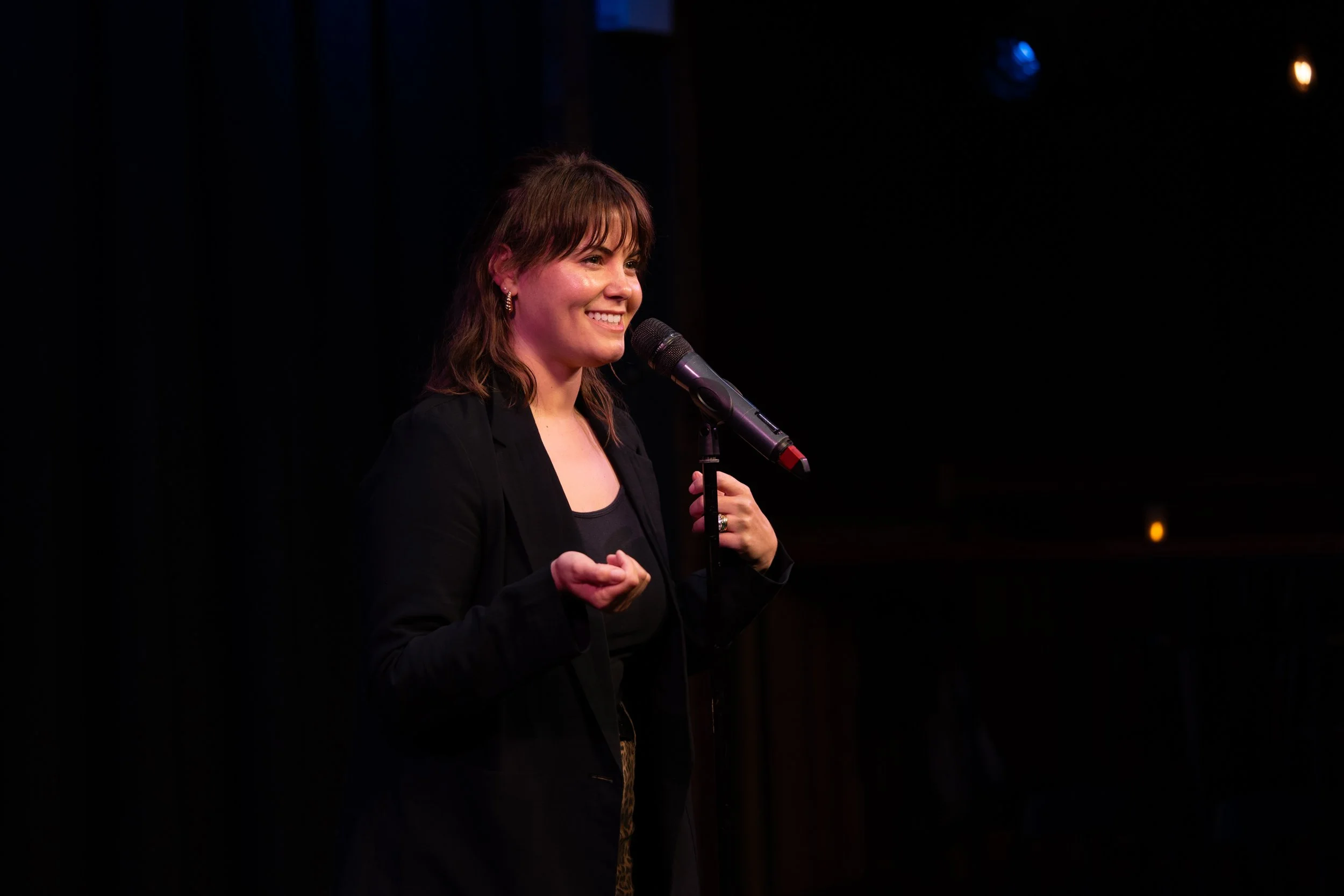
Bailey Swilley shares her story at Caveat in New York, NY in October 2025. Photo by Zhen Qin.
He's the oldest kind of millennial that you can be. That means that he's obsessed with the raw food movement and the 2008 housing crash and 9‑11. I'm just not. He has all these friends in finance, and he's always talking about how far ahead in life they are than him. And he's always talking about all this money that he missed out on and all these missed opportunities. I really do feel for him. I do.
He's really, really nice on the outside. I think you would all like him a lot. But there's a sort of vacancy on the inside. He's like Casper, the friendly ghost. And I try to break up with Casper many times. I do. But every time I do, he tells me that, “Look, you just need to wait for me to learn how to love myself, and then I can love you too.” So I don't break up with him.
And I think, “Maybe this is just what relationships are. Maybe this is what my parents' 30‑year marriage was, and I just didn't know. And maybe I'm just scared, because I've never broken up with anybody before.”
But one night, Casper and I, we go out to a bar, and while we're at the bar, there's a man sitting next to us and he looks just like “Big Pussy” from The Sopranos. And when Casper goes to the bathroom, Big Pussy leans over and whispers something in my ear. He says, “You know, that little guy is never going to be strong enough for you.”
And I think I know what he's talking about. I think he might be right. I think if anything bad were to come my way, Casper isn't going to be able to handle it.
So in the fall, I start making some positive changes. I get a new job and I get a new apartment with new roommates and there's only really one thing left to do.
So now it's Friday, September 26th. I'm getting into bed, and I'm psyching myself up to break up with Casper in the morning. I'm just going to call him up to get coffee, and it's just going to be like ripping off a Band‑Aid. I'm going to say, “It's not working out. Let's be friends,” and it's going to be fine. It's honestly a genius plan. Why didn't I think of it sooner?
I go to sleep that night very, very confident. At 4:00 AM, my phone starts ringing over and over and over. It's my mom. She says, “Hi. Dad went into cardiac arrest tonight, but he's going to be fine. Also, Gina and Gary across the street are getting a divorce. Go back to sleep. Go back to sleep.”
I know what cardiac arrest is, okay. That's what killed Michael Jackson, among other things. I know that my mom is downplaying this. I know that it's serious. And a few hours later, she calls me again and she says, “You need to come home right now.”
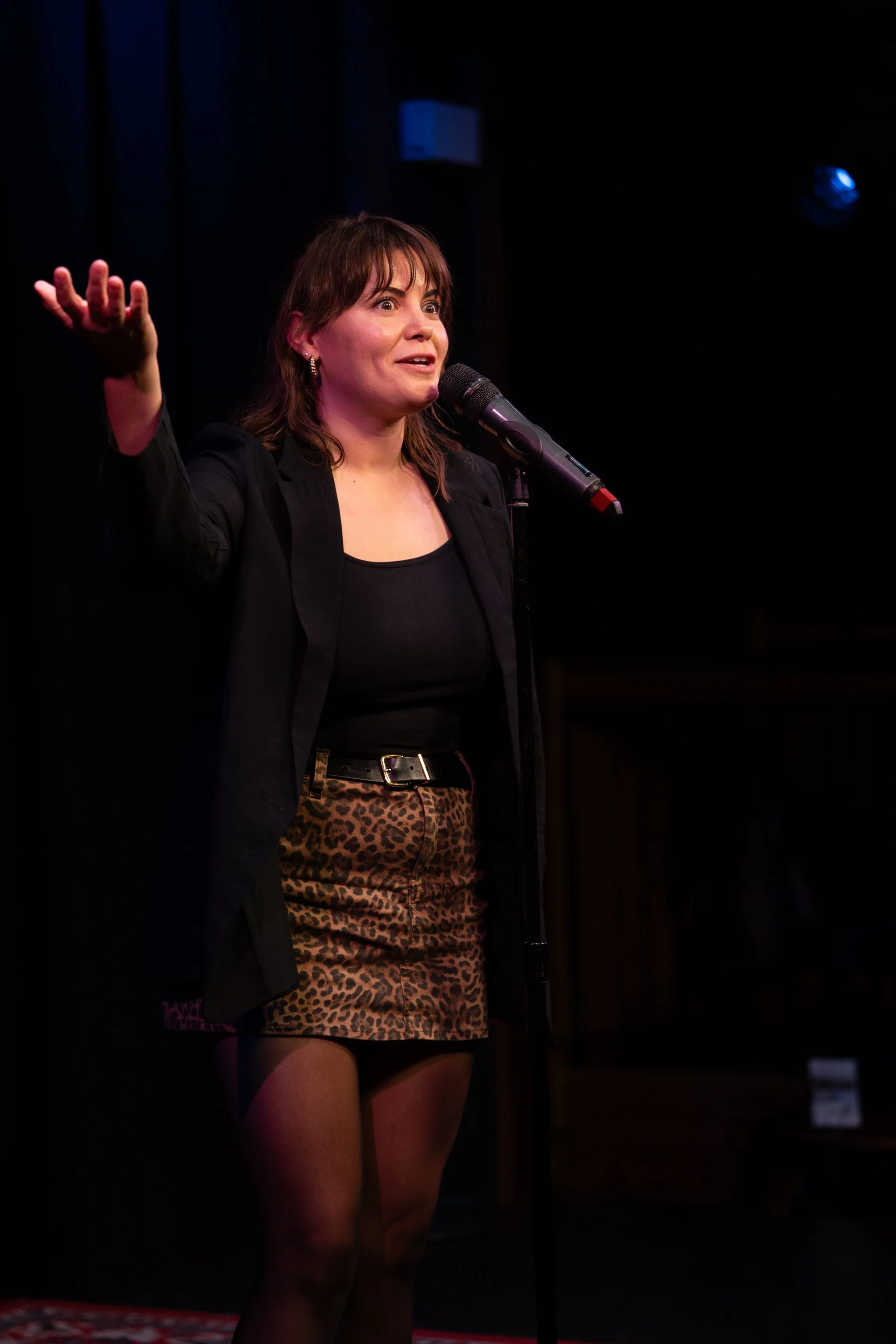
Bailey Swilley shares her story at Caveat in New York, NY in October 2025. Photo by Zhen Qin.
So I pack up my bag and Casper asks me if he can come too. I tell him, “No, please don't.” Because I don't want to worry about him. I know that I can't worry about Casper right now. I have to worry about my dad.
So I get on a plane to Memphis, Tennessee, and I walk into the hospital, and I walk into my dad's hospital room. There's a man in the bed, but he doesn't look like my dad. His skin is like a very strange shade of pale yellow that I've never seen before, and he's attached to all these machines that help his heartbeat and his lungs breathe. And he's got these suction cups on either side of his mouth that hold breathing tubes in his nose. And he's got these earbuds in his ears that are playing a James Taylor Pandora station, with ads.
We all take turns sleeping in my dad's hospital room so he's never alone. And when it's my turn, I stand over his bed and I feel this urge to start apologizing. Apologizing for every time that I had failed to make him proud. I say, “I'm sorry that I was a bitch on the car ride to college. And I'm sorry that when you helped me with that Peter Pan audition, I told all the neighborhood kids that you can't sing when you actually can sing. I was just lying. I'm sorry that when you came to New York and you said, “We got to get Papaya Dog because that's what Anthony Bourdain likes.” I said, “We can't have hot dogs. They shorten your life.” Now I know that that doesn't matter.”
I think if I keep apologizing. that he will sit up in his bed and look at me and say, “It's okay. I'm here.” But it's not going to happen this time.
When my dad went into cardiac arrest, he was without oxygen for several minutes, for way too long. So even though I see that he's attached to all these machines that are helping him breathe and helping his body work, I know his mind is not there. That means he's not there. He's really gone.
Now, my dad's mother is also at the hospital, and she's handling things a little bit differently than me. My dad's mother is 4'9", 80 years old, from Taiwan, and she's very mean. In fact, her defining quality is that she's mean. She's very, very hard on all of us. And she spends all of her time sitting in the waiting room and just staring at all of us. Every now and then, she'll let something out like, “Ugh, everybody's got big boobs.”
She'll stare at my dad's youngest sister, studying her face. And then when she's done studying, she says, “You got two chins. Pretty soon, you're gonna have three.”
Eventually, she tires of this, and she stands up and announces, “I'm a healer, and I'm gonna heal your dad.”
Now, we have never heard her say this before. We've never heard her call herself a healer. So what this means is that she is running out into the lobby and she's spending a lot of time on the phone with this woman.
Now this woman, she's another Taiwanese lady that she met on a carnival cruise. She lives in Texas. She works at Piggly Wiggly, and she's a witch. Now, this witch is giving my a‑ma spells for us to revive my dad into consciousness. And I don't know if we really believe in the spells, but we agree to help her because maybe she'll stop calling us all fat.
So first, what my a‑ma asks us to do, the first thing we do is we take a computer paper and we print like lucky symbols on the paper and then we hang it up in the windows of our house. And then we take my dad's clothes and we hang them up in the trees of our front yard. And then we take more of his clothes and we send them to Taiwan to be prayed over in Buddhist temples. And then we go back to the Mexican restaurant where he collapsed and we take water, and we sprinkle water all over the floor.
Now, we're doing all of that and we're also still meeting with all of my dad's various doctors. His liver doctor, his kidney doctor, his brain doctor, his heart doctor. We're meeting with all of them and we're also kind of like entertaining people. So there's like people coming in and out of the hospital to see my dad. We're all just saying hello to them and taking care of them. And on top of all of that, we're still doing witchcraft. So it's exhausting being a witch.
And so my mom goes to my a‑ma and she says, “I don't think we can do this anymore. I think it might be time to make decisions.”
Now, a‑ma looks back at us, and she looks so upset. She had walked into the hospital that week, a mean old grandma, but in this moment, she looks like a scared little girl. And she says to both of us, “You're not giving miracles the time that they need,” which is a great point. Who knows how long witchcraft takes?
As it turns out, a‑ma has one last spell. And in order for this spell to work, only my mom can do it. She tells us that this spell is going to be the game changer. This spell is going to be it, all right? This is going to work. What my mom has to do is take my dad's urine and bury it in the backyard with some broken glass.
I look at my Irish‑Catholic mother and at my Taiwanese‑Buddhist a‑ma, and I am so sure that there is going to be a clash, a huge fight. But instead, I watch my mom calmly get up and ask my dad's nurse for the urine from his catheter bag.
She goes home, she puts the urine into a mason jar and then she takes a light bulb. She breaks the light bulb and she puts that into the mason jar. Then she goes to the garage and she gets a shovel, and she digs a hole in the backyard all by herself and buries the pee and the broken glass all together.
She comes back to the hospital and we wait three days. And, of course, nothing happens. At this point, my dad's muscles have atrophied. His organs are showing no signs of improving and there's still zero brain activity. So we all agree that it is time to make decisions, and we take my dad off of life support.
On October 4th, we all stand around his bed and we watch him struggle to breathe on his own. And we see the line on the ICU monitor dance until it goes straight. The nurse calls the time of death and it's exactly the way it is in TV and movies, except it kind of feels less real because it's happening to us.
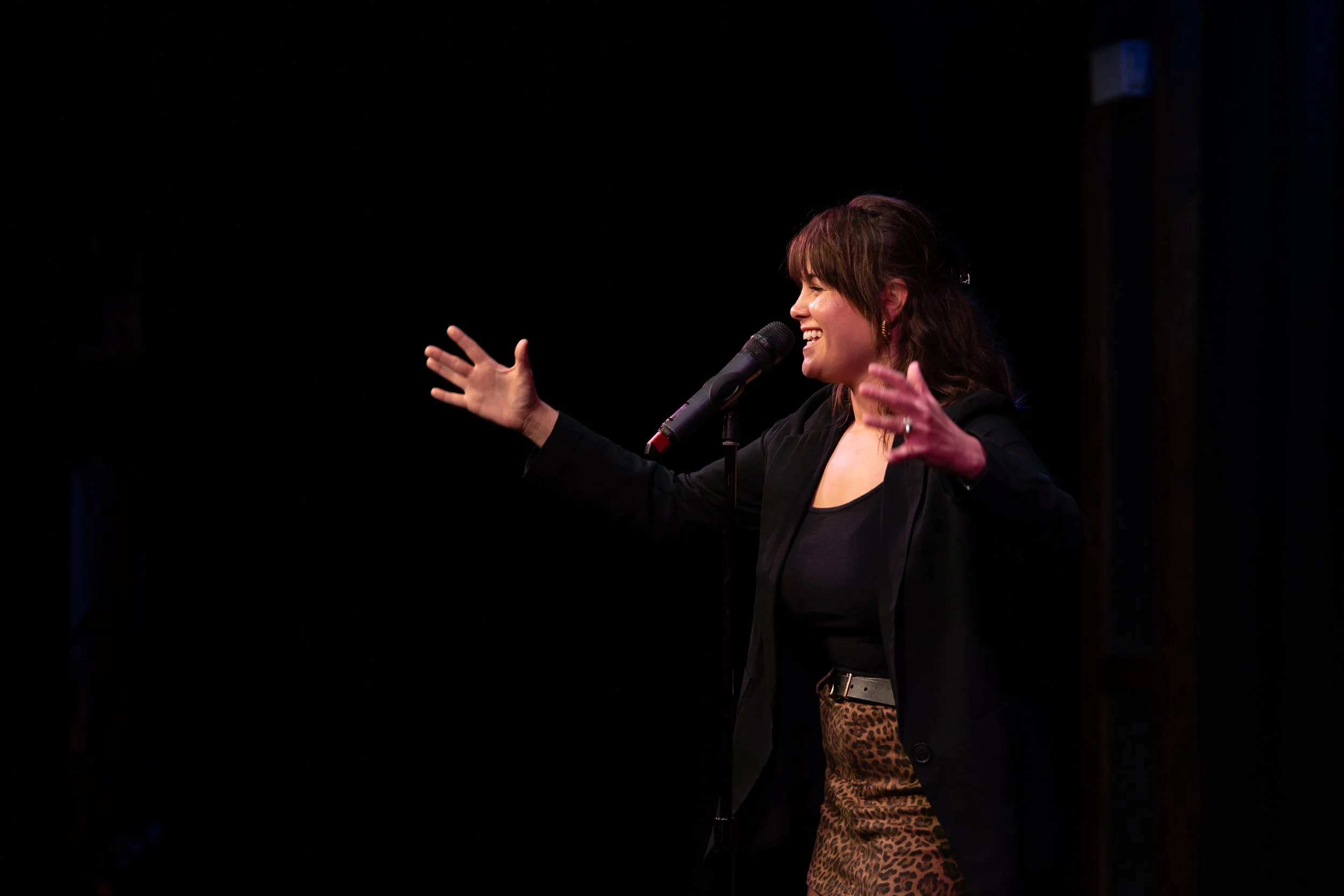
Bailey Swilley shares her story at Caveat in New York, NY in October 2025. Photo by Zhen Qin.
I let about 10 minutes go by and I stare at my dad's lifeless body. And all of the hairs on my arms start to stand up and it feels like somebody is tapping on my arm. I'm sure that it's my dad as a ghost. I'm sure it's my ghost dad. And I know it's him because I feel this immediate urge to jump up and start getting things done just like he would. I have this immediate urge to start planning his funeral.
It's at this point in the story that you may have forgotten that this is actually about a breakup. So I call Casper and I tell him, “My dad has died. Please don't come here.” I don't want him to come to the funeral, because I know if he does, everyone in my family is going to really like him. Because, like I said, he's nice.
And he does show up and come to the funeral. He's not a total monster, just a friendly, empty ghost. So he shows up, and I'm right. Everybody does love him, especially a‑ma, because he's so skinny. And a‑ma says, “Being skinny is the best thing a person can be.”
So then I think back to Big Pussy, and I wonder maybe if Big Pussy was wrong. Maybe I've been wrong about Casper because here he is, standing right beside me at this funeral in my lowest time, in my darkest time of need. He's here. He's here standing right next to me.
But then I just couldn’t let go of what I had seen that week, and I'm not even talking about watching my dad die. I'm talking about the pee thing. What my mom did for my dad that day, what she did for my a‑ma, that is real, true love.
The funeral ends. We get on a plane back to New York. And we're in a cab. And the whole drive in the cab, I'm like, “I can't wait. I can't wait until we get inside.” As soon as we get on the sidewalk, I just do it. I break up with him.
And it is really easy. It is just like ripping off a Band‑Aid. Because I've finally figured out the truth about love. And that is if you are not willing to engage in just a tiny bit of magical, potentially life‑saving piss play, then they just aren't the one.
Thank you so much.
Part 2
The day after my last drink was December 27th, 2013. I awoke in the midday at a friend's apartment, very groggy and disgusted with myself. The night before was hazy at best, but I didn't need concrete memories to know that I wasn't returning to that world. I could never, would never drink again.
A few days later, I went to my dad. I broke down in tears and I told him I couldn't stop drinking. He gave me a really big hug and took me out for pasta, and he promised that we'd get through it together.
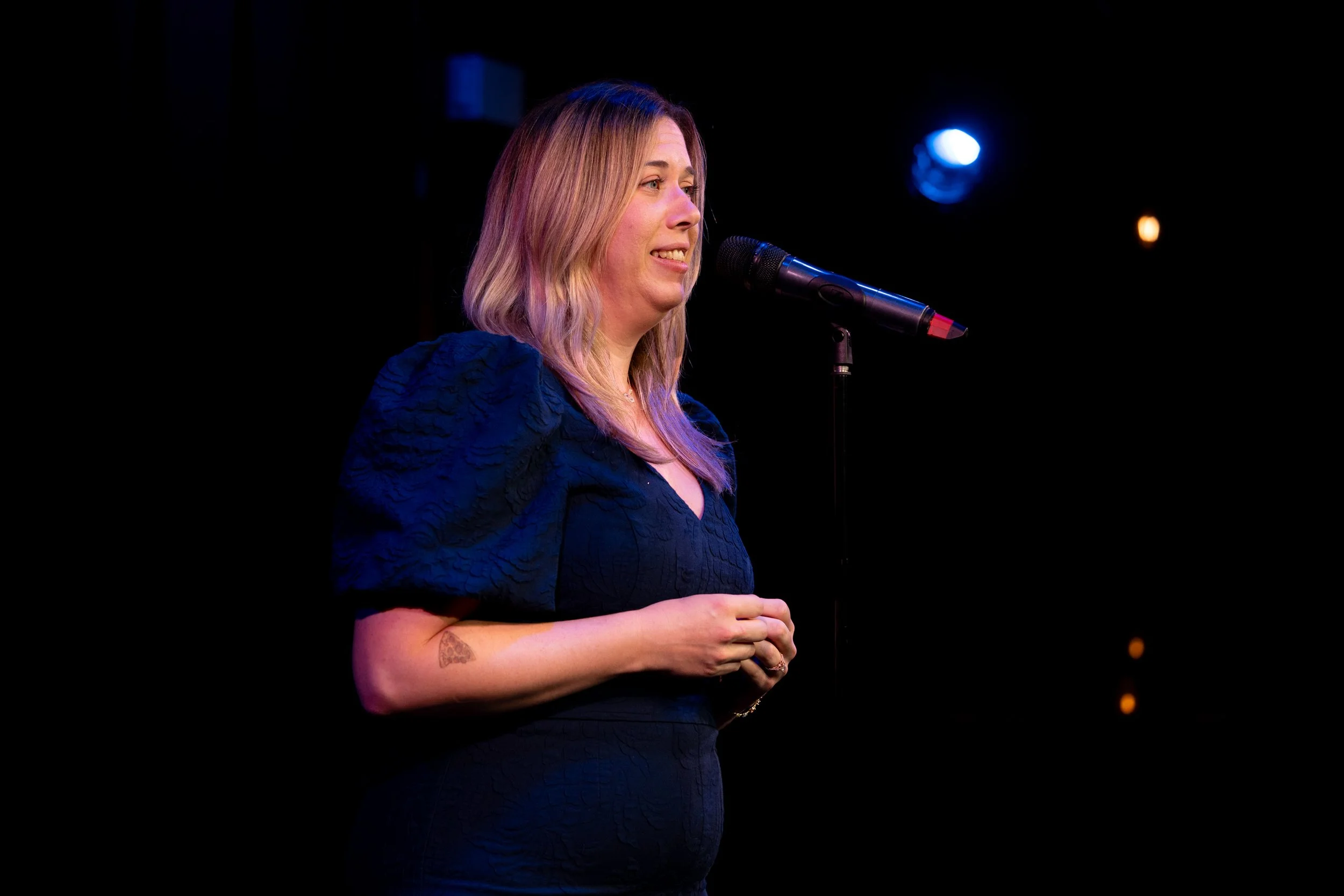
Pam Stepansky shares her story at Caveat in New York, NY in December 2025. Photo by Zhen Qin.
By the next morning, he already had a counselor lined up to help me. At this point, I'd already been living with him for about a year. After I broke up with my boyfriend, lost my jobs, plural, and got kicked out of my apartment, my dad was there to cushion my fall, which is kind of his forever MO. So I lived with him for the year leading up to my last drink and for the next two years as I pursued recovery.
Aside from sleeping on the couch every night, I liked living with my dad. I mean, we had lived together from the time I was 12 until the time I was 19, just the two of us, and we'd always been close. He's the person who bought me my first box of tampons. Still, I was a 27‑year‑old woman, so I wanted to get back out into the world on my own.
For the first time in my life, I contemplated starting a career. I kicked around some ideas, and I thought being a massage therapist would be a cool way to help people. I never dreamed of being a massage therapist. As a kid, I always thought I'd end up a creative, like an author or maybe an actor. I was born with this writer's spirit. As a child, before I could even read or write or even say the alphabet, my favorite toys were my grandpa's old‑fashioned dip ink pens and his old typewriter.
But in recovery, people push this idea of being of service to the world. So to prove that I was serious about my sobriety, I enrolled in massage school at night, got a new day job, and moved back out to Brooklyn, which is where, after some time, I developed sciatic pain.
The pain was intense. It was electric and wiry. It ran from my right butt cheek all the way down through my right foot. And I just muscled through it as long as I could. But eventually, I had to see a doctor.
So I met with an orthopedic surgeon. He sent me to physical therapy. You know, it's not what you do at physical therapy that matters so much as what you do the other 23 hours of the day.
Recovery had also inspired me to exercise. I was on my way to a spin class, even though the moment I left my apartment, I knew it was a bad idea. My back was really acting up, but I'd already paid for the class. I wanted to be the kind of person who shows up when she says she's going to show up, which is like another tenet of recovery.
So I got to the studio and I just called my dad quick before I went in. I was like, “Hey, my back is acting up but I have this workout class. What do I do?”
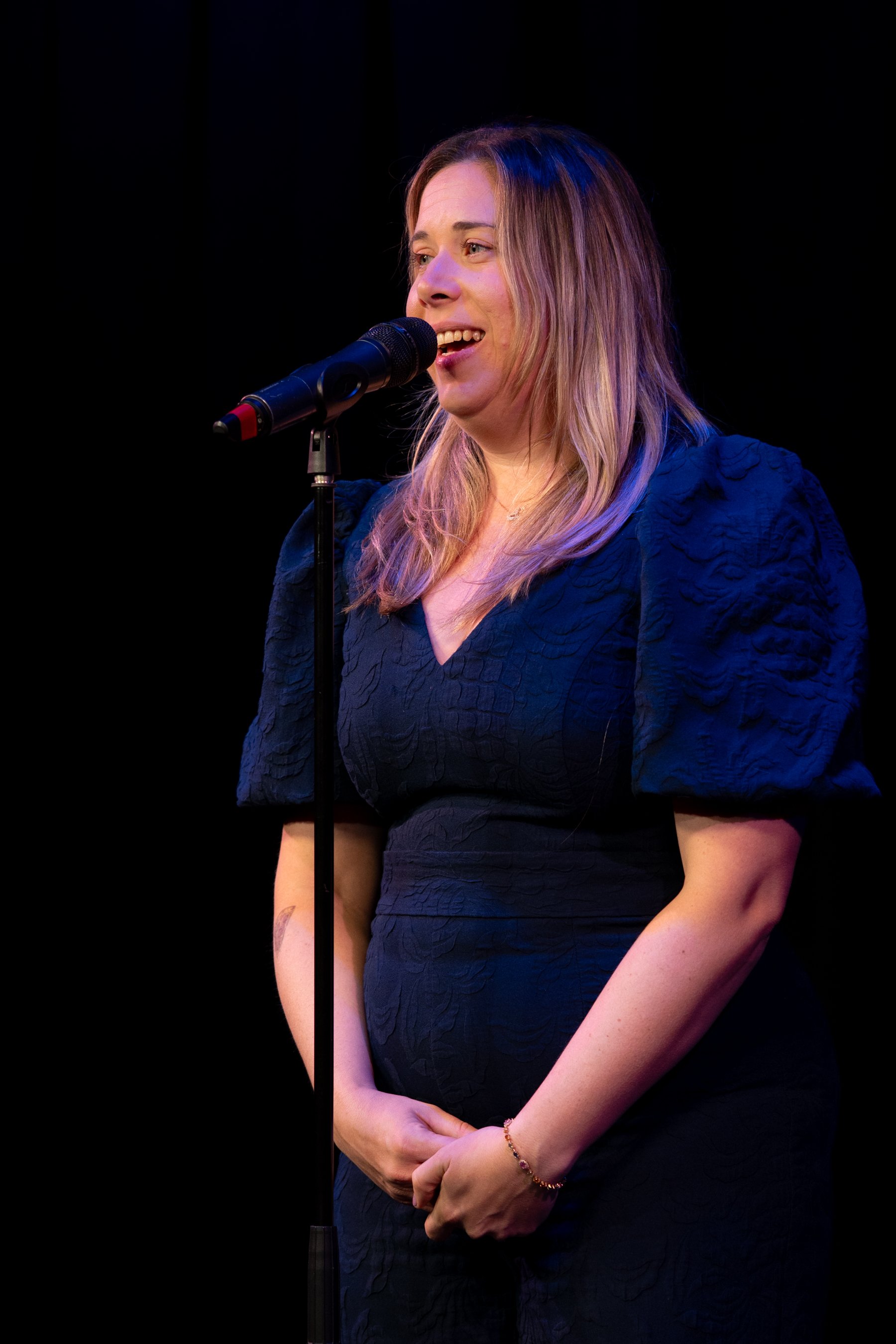
Pam Stepansky shares her story at Caveat in New York, NY in December 2025. Photo by Zhen Qin.
And he told me to just go in and take it easy. If it started to hurt, back off. Easy peasy.
So I went into the class, and a few minutes in, the instructor guided us out of the saddle. As soon as I stood up on that bike, I felt it. Something in my spine unhinged. But I didn't back off. I kept going. Endorphins carried me through the whole class and back to Brooklyn, which is where the excruciating pain really set in. I couldn't move without screaming.
I didn't know what to do, so I like barrel rolled off my bed and army crawled to my phone to call, of course, my dad. I was like, “Dad, there is something so wrong. I can't move. You got to come get me.” So he did.
He brought me back to his apartment on Long Island where I laid in bed as still as humanly possible. I wondered if this pain could maybe be worse than childbirth, which is when I remembered the worst thing I could remember in that moment. I had my period, and it was not a light day.
I called my dad over to the bedside, and I said, “Dad, I have my period.”
And he said, “Okay. What does that mean?”
And I said, “I think I need your help.” So we hobbled over to the bathroom together, and I said, “Go get my purse. I need you to change my maxi pad.”
This is not a directive I ever thought I'd be giving my father, but I knew I couldn't bend over. I could not perform the task. I was defeated.
He came back rummaging through my purse and he pulled out this orange square and said, “Is this what you need?” I nodded, and I closed my eyes, mortified. I sent my pants and underwear down, revealing a blood‑soaked pad and, of course, my vagina.
My dad knelt down. His head was just inches from my pubic area, and I heard the sticky release of the used pad. I peeked down with one eye open to see him very gently opening the new one, like a delicate present.
He held it up and said, “This way?” I nodded. He stuck it on and pronounced that he was done.
I swallowed, looking down and said, “You have to do the wings.”
He cocked his head to the side and I explained that you had to peel the tab off and then wrap the wings around the sides of the underwear. His eyes just lit up in understanding as my mouth curled downward in a frown.
He finished the task and helped me pull my pants back up. We got back over to the bed, and that is where my screaming continued relentlessly due to the ongoing pain.
Around 2:00 AM, my dad called 911 after a neighbor came by to see if someone was being murdered. The EMTs came and they kept trying to shove me in a wheelchair, even though I told them my body wouldn't bend that way. We got into the ambulance. They gave me a shot of morphine and delivered me to the ER, where a nurse came by to give me a second shot of morphine.
I told her, “No, thank you. I'm a person in recovery from drug and alcohol addiction. I want the least amount of narcotics possible.” She told me I couldn't refuse medication, shot me up, installed a catheter, and admitted me to a room.
The hospital was ready to move forward with the spinal surgery, but I didn't want them to do my spinal surgery. It's a terrible hospital, and it's not where my surgeon was affiliated. But I got stuck there for five days. They had graduated me from morphine to Dilaudid, which is basically one medical step below heroin. And I just felt like I was living underwater. Like, had no one heard me when I said I didn't want more narcotics and that I wanted to be transferred to my hospital of choice?
Recovery had taught me to be like water, to go with the flow. But in me, a tsunami was rising. Five days of watching these hospitals point fingers at each other while I was drowning in these unwanted narcotics and becoming irate. For the first few years of my recovery, I was a very meek and damaged version of myself. I didn't have a lot of strength to find my voice and to advocate for my needs. But there in that hospital, too much was at stake.
I started yelling at the hospital administrators to get me out of there. I also had been requesting a laxative for days on account of all the opiates and had been refused time and again. So by the fourth night, I had had enough. I mustered the strength to get out of the bed. And standing on my own two feet with my catheter dangling, I wrapped my hand around the canula and yelled at the nurse in front of me, “I will rip this fucking IV out of my arm if you don't get me a laxative.”
She never got me the laxative, but the next day I was delivered to the correct hospital. It was like night and day. The OR was bright and clean. My surgeon was peppy and listening to ‘80s synth pop. I told him that I was going to go to Peter Luger's as soon as he was finished.
I don't remember anything else until I woke up in the recovery room hours later in a whole new type of pain, which was a surprise to me. I had never had surgery before and I naively believed that cutting my spine open wouldn't hurt after.
So my steakhouse dream quickly became my hospital French toast reality. I was back at my dad's house for the next six months, except this time it was my dad on the couch and me in the bed so I could recover. At this point, I was five years sober and my dad was doling out my Percocet, as prescribed, and he would stay with me in the night when the pain was the worst. We'd be up together around 3:00 in the morning talking about the Beatles or something he heard on Stern that day.
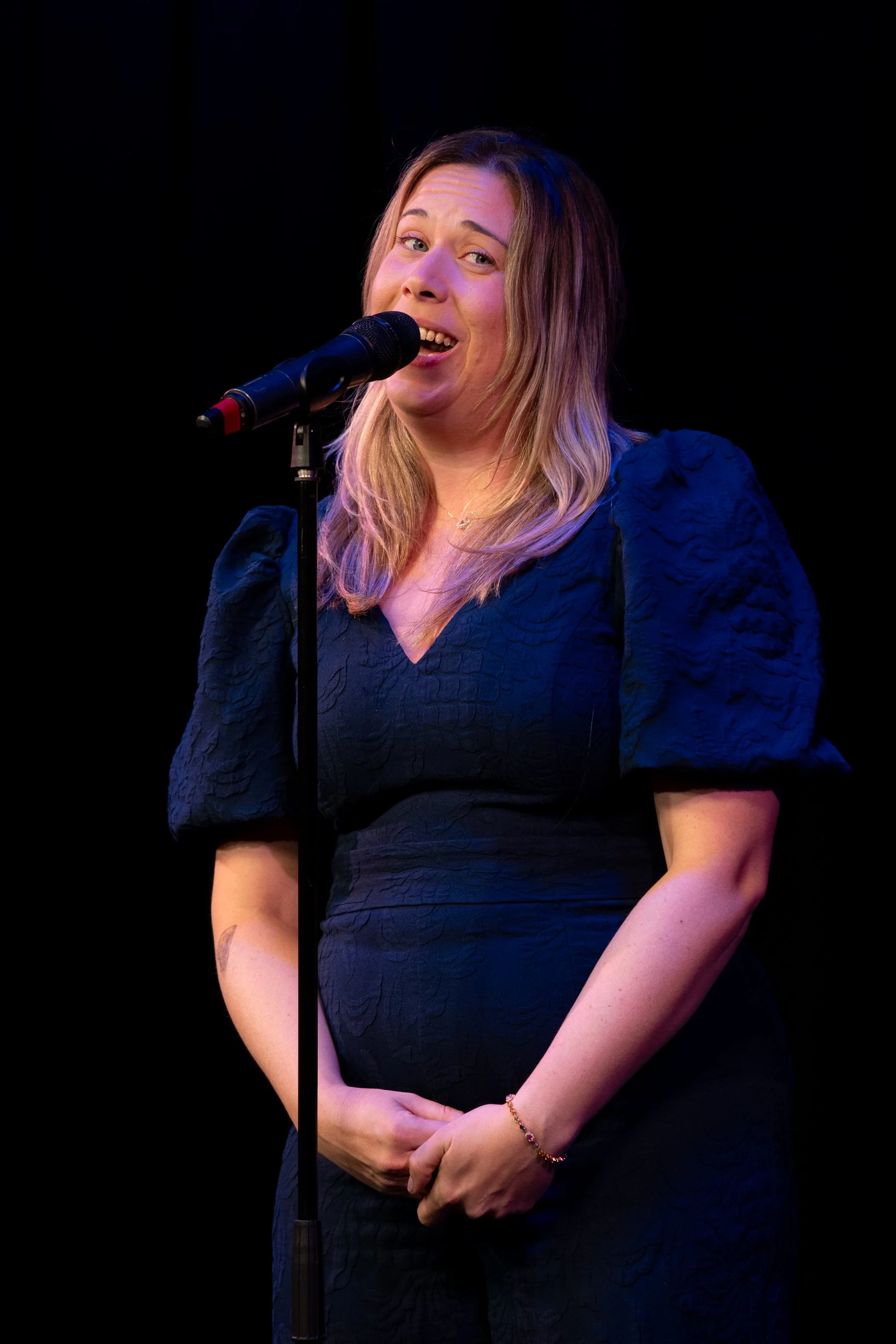
Pam Stepansky shares her story at Caveat in New York, NY in December 2025. Photo by Zhen Qin.
Living with my dad in early recovery, he was a sense of comfort, protection, and safety. And now, he was still all those things. But in the glow of the late night television, I realized he had also become one of my closest friends.
I could only handle so much movement each day, so a lot of my time was spent staring at the ceiling wondering what the hell I was going to do with my life. I could not go back to a four‑floor walk‑up in Brooklyn, and I could not go back to massage school in my condition. I wasn't permitted to twist my spine for an entire year. It was time to figure out who I was and who I wanted to be in the world.
So I took a long, hard look in the mirror. I felt really powerful in the hospital, using my voice to demand what was right. And that's when it came to me. I was a writer. I've always been a writer. And it was time to learn how to write and use my words and my voice for my livelihood and beyond.
I moved into my mom's vacant studio apartment on Long Island and sought out a part‑time job just to keep the lights on. I interviewed at a pelvic floor physical therapy office. When I was asked why I wanted the position, I explained that I knew a lot about being in physical therapy, and I also only wanted a part‑time job because I was building a career as a writer.
The therapist said, “Oh, I hate to write. You can write for me.”
So writing blogs about pelvic floor physical therapy is how I got my start as a professional writer, and I've been a professional writer ever since. My dad and his underutilized journalism degree couldn't be prouder.
And I am still amazed that people pay me to put words on the page, but in some ways it's not a surprise at all. After derailing my life with drugs and alcohol and then putting it back together in recovery, my mission became very clear. It was always to stay rooted and connected to that little girl inside me, the one who likes playing with typewriters and dip pens. It just took one crazy spinal surgery to find my way back to her.
Thank you.