In a perfect world, getting the health care you need wouldn’t require fighting for it. But in this week’s episode, both of our storytellers discover just how hard they have to push to get the treatment — and validation — they need and deserve.
Part 1: Cooper Joslin is determined to get a hysterectomy to finally stop the debilitating symptoms of endometriosis but all the doctors won’t seem to let them make decisions about their own body.
Cooper Joslin is a web developer, artist, and activist. They made their DC theater debut at Capital Fringe 2022 with their solo performance, Atemporal, earning a "Best of Fringe" designation from DC Theater Arts. Cooper has also performed at the Kennedy Center with Story District and off-broadway at Joe’s Pub in New York City with Generation Women. Their visual art has been featured in collections at the DC Commission of Arts & Humanities' I Street Gallery, the Rhizome, DuPont Underground, the DC LGBTQ Center, and As You Are. With a background in journalism, Cooper now uses their expertise to document the modern history of the transgender community through their growing oral history archive, The Trans Guide. Originally from Central Florida, Cooper now resides in Baltimore, with their wife, two cats, puppy, and a cherished queer chosen family.
Part 2: As a PTSD survivor, Adrianne Frost assumes her dissociative episodes are simply part of living with trauma.
Adrianne Frost is an awarding winning storyteller and performer. Most recently, she performed with Generation Women at Joe’s Pub, and has performed in Awkward Teenage Stories, Rejected, Two Truths And A Lie, Just One More Thing, and is a Moth Slam Champion. She began her own storytelling show in 2022 that runs every month at QED in Astoria called “New Tricks Stories”, in which all of the storytellers are over forty. @newtricksstories Originally from Louisiana, Adrianne Frost has been acting and performing for over 30 years. She has been seen everywhere from The Daily Show and Late Night With Conan O’Brien to the Law and Order franchise and the occasional independent film. Her true love is live performing and she has performed solo improv and her award-winning monologues all over New York City and at the Boston, Chicago and Orlando Improv and Comedy Festivals. Adrianne has written one book, I Hate Other People’s Kids (Simon & Schuster) and is featured in two anthologies, including the 2004 Signet Book of American Humor. She has written for several humor websites, including Mc Sweeney’s.
Episode Transcript
Part 1
I think, personally, one of the worst times to realize that maybe you don't actually feel like a woman after 21 years of life is when you're looking up at a light pink ceiling and your doctor's saying, “Scooch down just a little bit more for me.”
This is my third pap smear of the year, which is two more than is usually recommended for people with cervixes. But I'm there and my doctor is taking the sample, putting it away, and sitting back in her chair.
“You can sit up now,” she says. “There's nothing obviously wrong with you, but that kind of tells me what I think this is.”
I'm sitting up, and I'm feeling that awful paper they use on the exam tables. I'm feeling that crinkle at an ungodly volume. It is deafening.
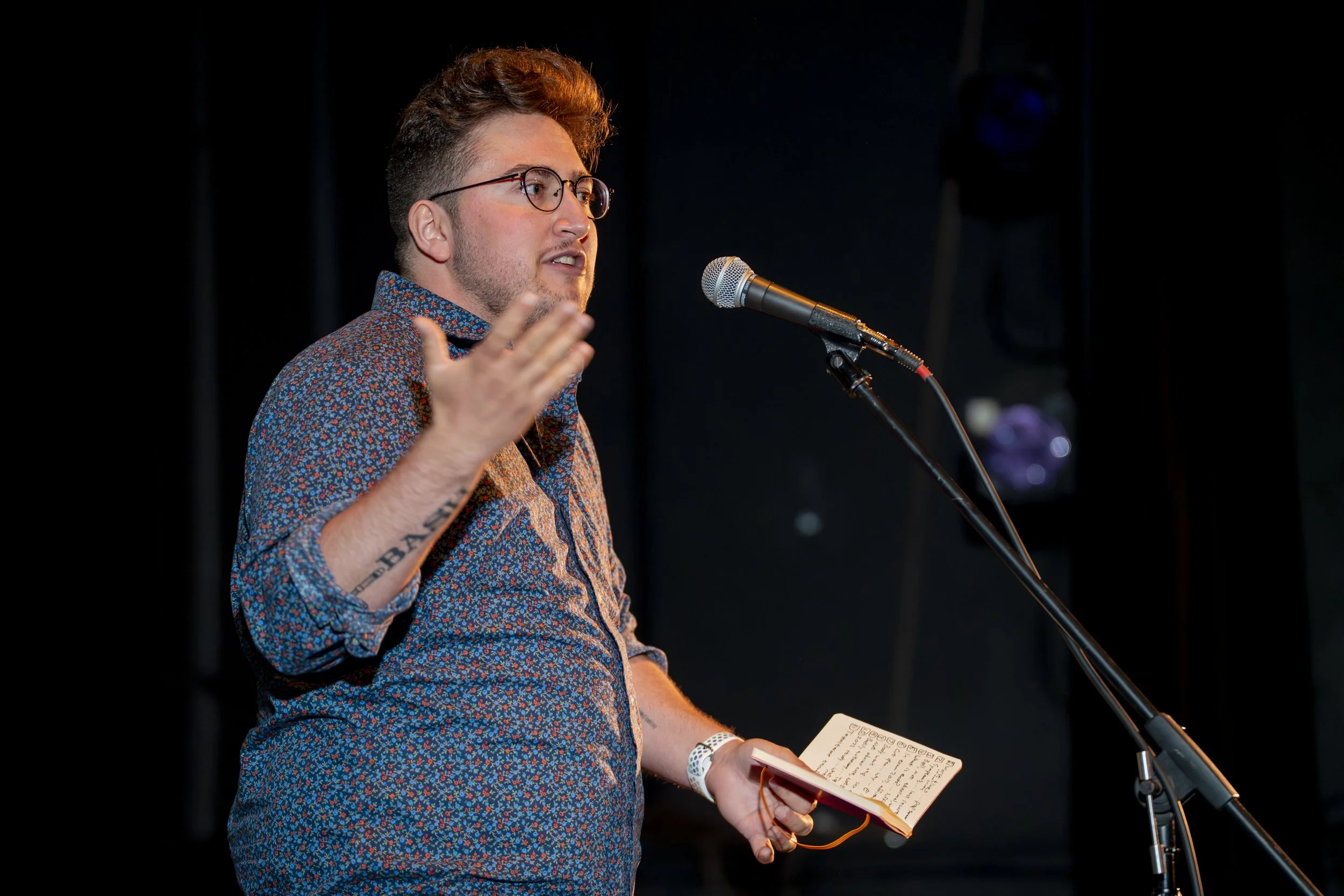
Cooper Joslin shares their story at Baltimore Theatre Project in Baltimore, MD in May 2025. Photo by Laurie DeWitt.
“For somebody with the symptoms that you're experiencing,” which, for the record, included heavy, painful periods bordering on hemorrhaging and pain with even the thought of sex, “the sort of diagnosis of last resort is endometriosis.” That kind of struck a faint bell with me.
I got my first period at 11, and, by then, all I really knew about them was that my mom was in pain for two weeks out of every month, and my older sister was in and out of the ER all the time for stuff like this. It wasn't abnormal for us. I got used to having these painful periods for years. We also just never really talked about it, and I was okay with that. I guess in retrospect, I wonder why that would have been,
But back in the exam room, I hear my doctor say that, and I remember my sister talking about her personal experience with endo or endometriosis. I ask, “What is that? What is endometriosis exactly?”
I'll give you the kind of Cliff notes, the less gory, disgusting version of what she said. Essentially, in an ideal world, what should happen is the tissue comprising the inner lining of the uterus should thicken and bleed and exit the body once a month. In the body of a person with endometriosis, something really similar to that inner uterine lining grows outside of the uterus. It breaches containment. And it still tries to do those things. It still thickens and bleeds, but it can't exit the body so it just kind of makes the surrounding tissue really angry, and it causes pain. It can even adhere pelvic organs together.
Sufferers of endometriosis tend to experience severe pain. Check. Ovarian cysts. Check. Pain with all of the things. Pain with sex and urination and bowel movements. Check, check, and check. Infertility. Never got there. And a myriad of other gastrointestinal symptoms. Check.
But in that exam room in 2017, I didn't quite know what to say. My doctor just kind of ended up saying, “Well, there's no way to make a good affirmative diagnosis of endometriosis without doing some form of exploratory surgery.” They want to cut me open, take a look around, say, “Oh, well, there's your problem.” Sew me up, pat me on the belly and tell me to leave.
So I asked what felt like the obvious. Like, “Why don't you take out the endo tissue while you're in there?”
And my doctor just kind of goes, “Well, you know, it's not that simple. As long as there's estrogen in your body, it could come back.”
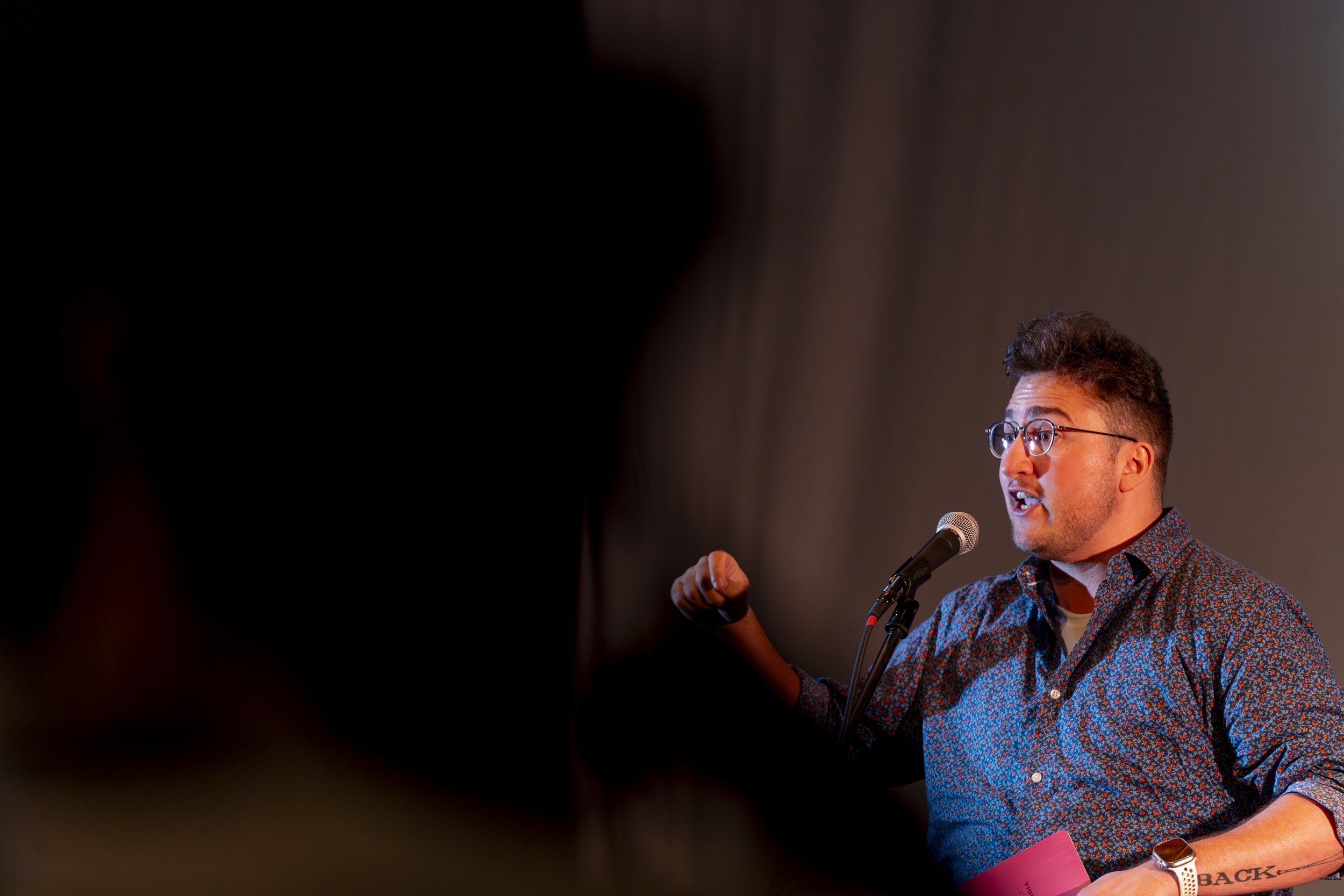
Cooper Joslin shares their story at Baltimore Theatre Project in Baltimore, MD in May 2025. Photo by Laurie DeWitt.
At this point, my brain is kind of trying to piece together whatever remained from central Florida's sorry excuse for sex education. If I remember correctly, the estrogen is connected to the ovary, so I say what I feel like should come next, which is, “Can't I just have a hysterectomy?”
She kind of takes a step back and she's like, “Well, you see, if you don't have estrogen, you're going to go into menopause at 21. You're young. You don't want to do this. You will never be able to carry a child. You're going to lose bone density. And of course, the endo could still come back. It's not the obvious cure we would hope it to be.”
And again, I am mentally taking another huge step back. Like, wait, I don't feel particularly attached to my ovaries beyond the physical sense, I suppose. I didn't really feel like I really needed to carry a child for my life to have that sort of purpose, you know? And as anybody with a uterus can tell you, in a lot of doctor's offices, it doesn't matter. It is not your opinion that matters in that moment.
The next few years, I just kind of white‑knuckle it constantly. I also ended up taking another crash course in lack in bodily autonomy. I came out as non‑binary and I started transitioning. I got top surgery. I started weekly testosterone injections. All of those things people tell you is evil but really just made my life worth living.
Something really strange happened when I started talking to other trans people. I realized that my experience was very common. I found a study, a 2022 study, that said 32% of trans men are diagnosed with endometriosis, compared to 5% to 10% of cisgender women. Obviously, yes, sample size is very different, but also that's wild. That is nearly a third of transgender men. I'm not even a trans man. I'm non-binary, but I couldn't find any studies on people like me experiencing what I went through.
And as the testosterone started doing some minor terraforming of my pelvic floor, I just had to kind of keep going. I kept trying to find a doctor who was cool about things. And every single time I met with a new doctor, I asked, “Could a hysterectomy be on the table?” They unilaterally said no. Either the true but annoying, “Hysterectomies don't cure endo,” or the thing I most dreaded hearing, “But you might want kids someday.”
It goes on and I reach a breaking point. It's 2023. I am doubled over in pain on our tiny, tiny love seat. And my wife drives me to the ER. We waited for hours, and by the time I got through to go up to the triage line, the nurses couldn't seem to decide whether they should call me a he or a she, as if the right option was one of those two. And before even getting treatment, we left.
I followed up with my regular gynecologist and I just kind of broke down. I just begged, “Please, could we talk about a hysterectomy? I know it's not a silver bullet but I need to do something.” And she wouldn't do it. Neither would the next guy or the next guy. I went to one doctor who wouldn't even examine me once he learned I was trans.
I was tired of explaining and just cycling through doctors constantly. It felt like it was a never‑ending cycle of pain. I had to keep going because there had to be a resolution for this.
I finally found somebody who cared. Right here in Baltimore, actually. We lived in DC at the time and we were like, “Yes, we'll go anywhere. We'll go anywhere. Oh, Baltimore, that's so close. Let's do that.”
This doctor ended up being amazing. I was sitting in her exam room and explaining my 15 years of previous medical history with this. I felt listened to for the first time. I felt like I wasn't lying about my pain for the first time.
She walked me through all of my options, what would happen if I kept one ovary or two ovaries or no ovaries. If there was endo tissue on the bowel, then she couldn't remove it herself. She would have to have another specialist come in. I would have to have a second surgery.
Honestly, at that point, I would have let her have at it with a pocket knife and some electrical tape in the parking lot, but to experience that sort of informed consent in a medical setting was so beautiful and so refreshing.
My day finally came. It was a few days after Thanksgiving 2023, and I was so excited. The nurses kept skirting around mistakes with pronouns and using my legal name instead of my actual name. But then the doctor came in and she set the record straight. “This is Cooper. They are here for a full hysterectomy.”
The last thing I remember was seeing the bright fluorescent lights start to fade and the beeps of the machinery, just spacing out a little bit further as I was counting down from 100. I'm pretty sure I only got to 98.
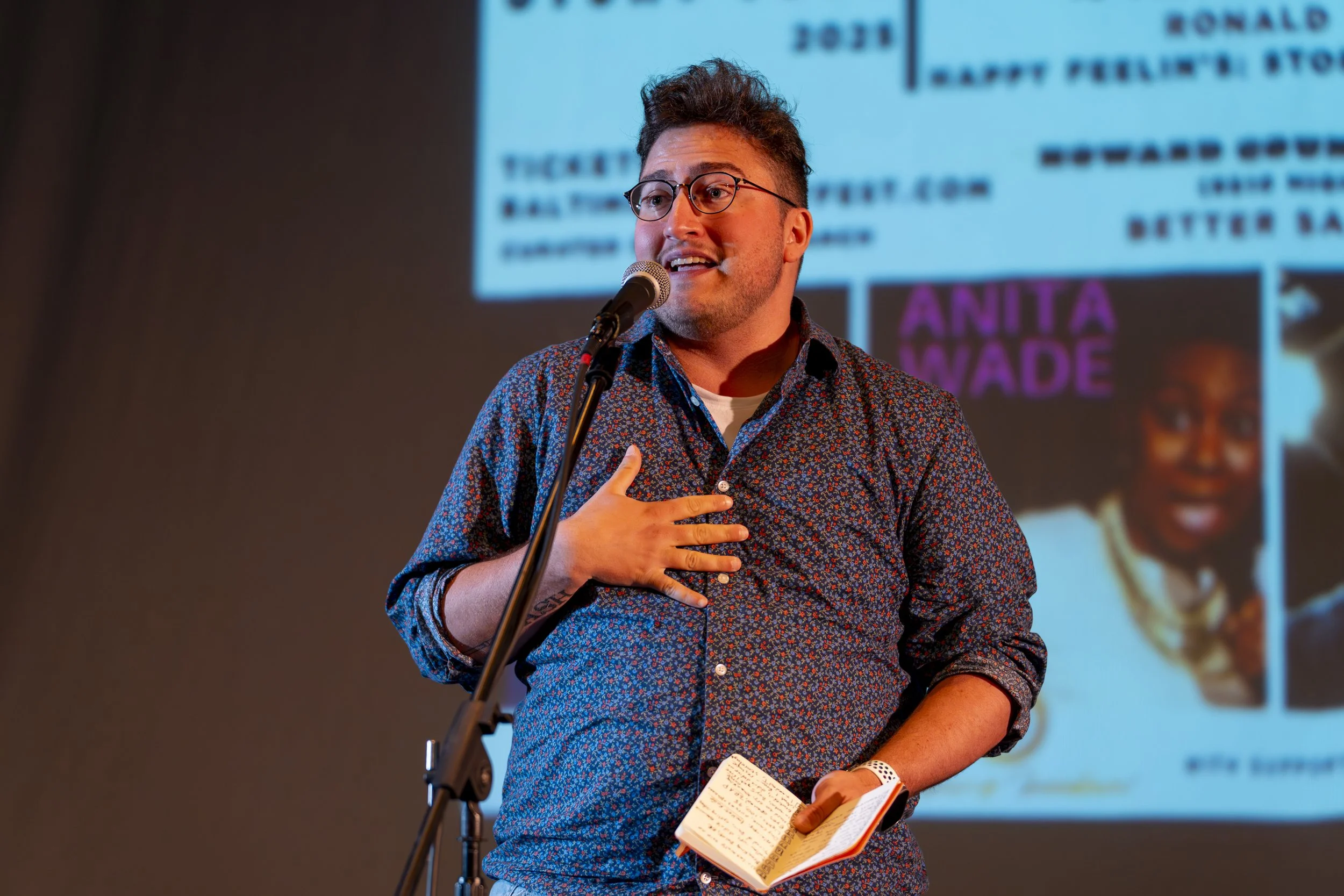
Cooper Joslin shares their story at Baltimore Theatre Project in Baltimore, MD in May 2025. Photo by Laurie DeWitt.
When my eyes opened next, before I remembered my name or where I was or what had happened, I noticed it. A beautiful, resounding absence of pain. It is very, very hard to cry when you're taking testosterone and I was so close to crying. It's the closest I've been.
I could not stop thanking my nurse. She was not even in the OR, but she was there. She was begging me to pee so that we could make sure everything still worked, and then she can clear the bed and somebody else could come in. But she was an angel.
In total, they found endo tissue on and removed my uterus, both ovaries, fallopian tubes, cervix, and as part of a buy‑five‑get‑six‑free deal, the appendix.
I am so grateful every single day of my life to no longer be in this pain. I am also so grateful to know now that the organs that caused me so much pain, but supposedly defined me as a person and my identity and my gender, I didn't need those. They didn't define me. None of that needed to happen.
What I know now, after 15 years of endo, is that people should be allowed to reshape their body in the way that suits them, reshape themselves in their own image. Not every person with a uterus is a woman and not every woman has a uterus.
Personally, I did not need estrogen as my primary sex hormone. I could use testosterone. That's totally fine. You just need a sex hormone that's great. And of course, as they say on the Food Network, if you can't make your own, store‑bought is fine.
Thank you.
Part 2
I always stop to pet dogs. I'm that person. I did it earlier today, out here. A guy had a dog and I invaded his space. He was reading a book, actually, and I was like, “Is he friendly?” And I could give a shit that he's reading a book.
Anyway, the dog's name is Baxter out there. It's a big dog. Anyway, so I always stop to pet dogs. I'm that person who has stopped to pet dogs. And my husband's always like, “You know, we have a dog at home.”
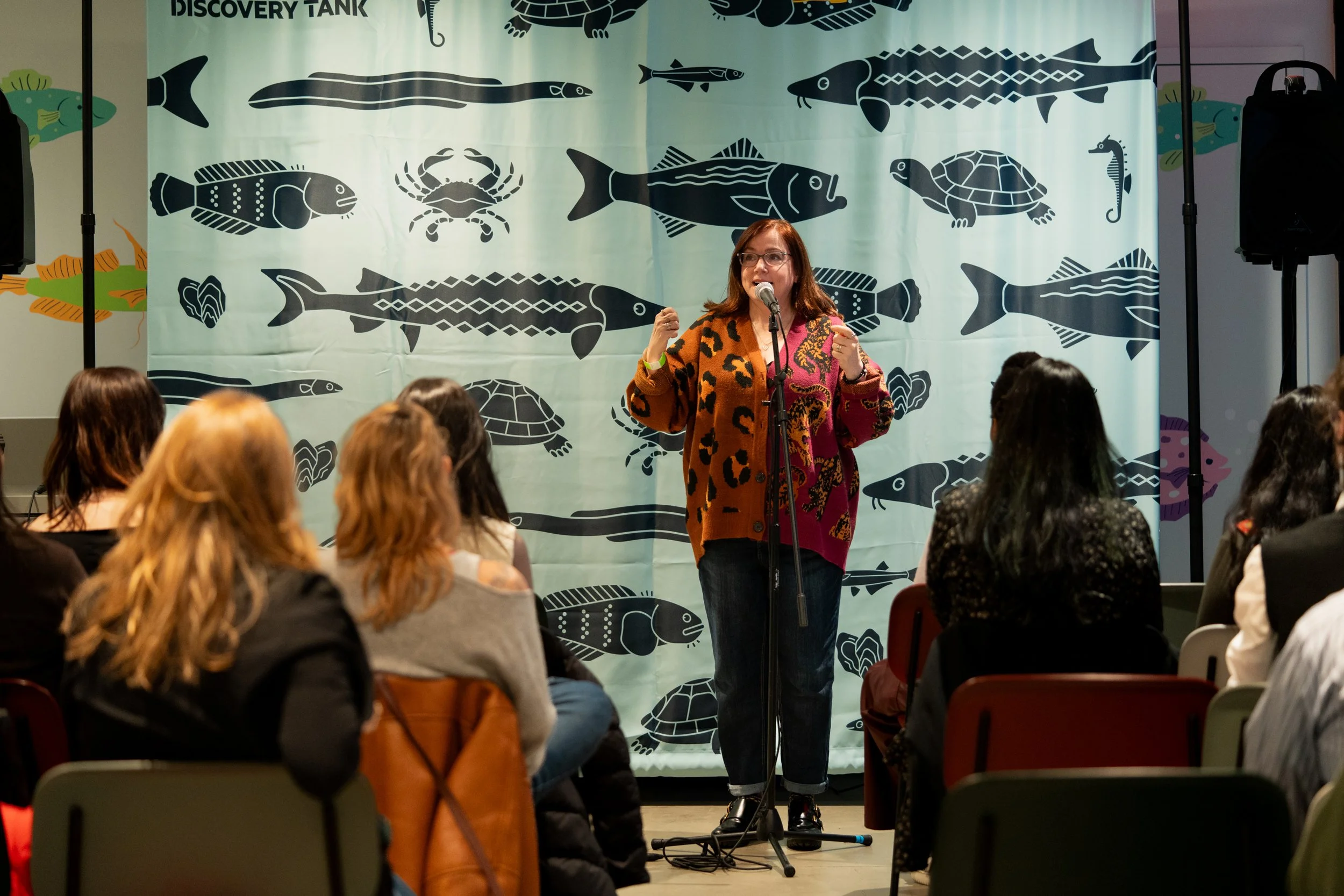
Adrianne Frost shares her story at Hudson River Park Pier 57’s Discovery Tank in New York, NY in March 2025. Photo by Zhen Qin.
And I'm like, “Yes, but he's not this dog.” I'm that person all the time that invades people's space to pet their dog.
There I was, about 2020, walking home from work on 9th Avenue. I was working at a dog grooming salon as a receptionist where I spent all my time around dogs. I was walking past Magnolia Bakery where there was a line, and I see two dogs that I have to pet.
So I go up, and I'm scritching one of them under the chin, and I'm asking what is the dog's name. And as the mother is telling me, it starts.
Now, I'm going to try to explain this to you as best as I can. It's a tingling sensation that starts in the back of my neck and crawls over my skull, and is what my psychiatrist at the time would call a dissociative episode.
Now, what I do, what I would do to try to stop it is I would put my arm out like this and I would go, “No, no, no, no, no, no, no.” And whoever was with me at the time, a stranger or not a stranger, would go, “Are you okay? Are you all right? Are you okay?” And I would try to act as natural as possible, which I would imagine would scare the bejesus out of anyone because I was putting my arm out and going, “No, no, no, no, no.” So trying to act normal was already out the fucking window.
By that time, it was too late because it had already started and it had taken over. I was in a dream state. Not a good dream or a bad dream, just sort of a strange dream. I will try to explain it.
It's like a memory. Like a memory that you've never had. Like a surreal moment situation. The only one that I can actually recall is rats dressed up like The Honeymooners, but not as engaging.
And I'm standing on the outside watching, but I'm not part of it. It's mine and I remember it, but I'm not a part of the production. I know it, but I don't remember it. It's mine, but I don't own it. It's scrambling my brain. It's like emotional eggs scrambling my brain.
Then I come out of it. I come out of it and everyone's gone. The people are gone and the dogs are gone, and I'm just standing there.
I text my husband, Kai, some kind of gibberish, which I think is sensical. And he comes to meet me. I think everything is fine, but my tongue is thick and I can't make complete sentences. Everything is not going to be okay for one or two days. I'm not going to remember certain names or numbers or who people are or where I am, and I'm going to have terrible headaches, and I'm going to be very tired, very sleepy. That's the end.
And it sometimes happens in public, it sometimes happens at home, and it's always the same.
So I would call my psychiatrist again. He would have me come into the office again. He would say it was a dissociative episode again, and he would up my antidepressants, usually Wellbutrin and Zoloft again. And he would ask me if I was in therapy working on my trauma again. I would say yes, again.
Then we would call it a dissociative episode again, and I would say, “But is that really what it is, Mr. Psychiatrist?” Because, I don't know, I was supposed to trust him, but I also kind of wanted to trust myself and what was going on. This was more of like a journey in my brain, it felt like.
The one thing about having PTSD and having been abused and having trauma is that you learn not to trust anybody but yourself. So there is a bright side to trauma.
So, I went on about my life, and then in 2020, a little bit later, one night, Kai woke up and I was in bed with my arms straight out like a wooden soldier and my eyes were open. He started talking to me and I wouldn't respond.
Then I put my arms down and I sat up. He started calling my name and I wouldn't respond. And he kept saying my name. Then I stood up and he touched me and I started to fight him.
Now, he is strong. He works out with kettlebells and I work out with nothing. So I start fighting him and I'm trying to get out of the room and I'm trying to fight. He's calling 911 with his good hand. I mean, this guy is strong. Finally, the police came and zip‑tied me like idiots.
Then the dog is in the bathroom barking. The EMTs come and they shoot me with something to knock me out. They get me on a gurney and Kai is crying, the dog is barking. They're wheeling me out on a gurney and they're saying, “Do you know what year it is?” And I got it wrong. They said, “Do you know what month it is?” I got it wrong. They said, “Do you know who the president is?” I said, “Fucking Donald Trump,” and they said, “She's coming out of it.”
They did an EEG on my brain, which showed nothing, so we decided at that point to get a neurologist.
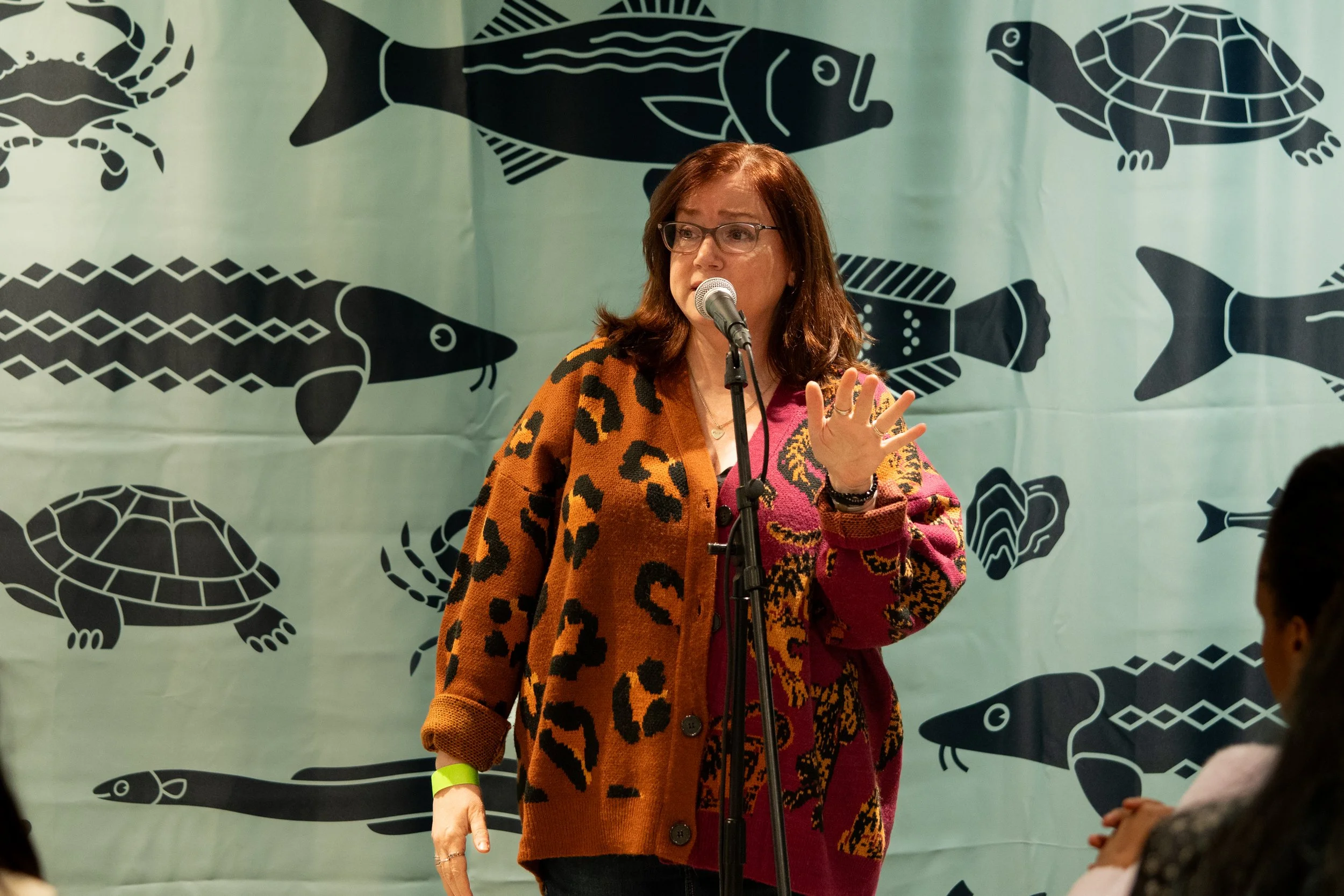
Adrianne Frost shares her story at Hudson River Park Pier 57’s Discovery Tank in New York, NY in March 2025. Photo by Zhen Qin.
We got a neurologist who was probably the most cantankerous neurologist that you've ever met in your life. We got to the office, and the girls at the front desk had just gleefully ordered Chinese food. They were very happy that it had arrived. We got into the office, and Dr. Grumpy was like, “Well, I don't know what it is. It could be seizures. It could be dissociative episodes. I don't know. But why don't you take this medication for whatever this is?”
I was like, “Well, what is this, Dr. Grumpy? Do you know? Because I don't know.”
There's nothing worse than not knowing what something is when you know that it's something, but you can't stand up for yourself and say, “I know that this is something.” And we figured maybe he was just pissed because he couldn't get his General Tso's chicken.
So we left and we were like, “You know what? This was just a one‑off. This was just a freak accident. This guy is an idiot. He's pissed off about spring rolls. We're not going to fill this prescription. We're going to go home. We're just going to forget about this. We're going to move on.”
A couple months later, we're watching television, and I start to put up my hand, and I go, “No, no, no, no, no, no, no, no.” I fell over and I started convulsing. My eyes rolled back in my head and my lips turned blue and foam started coming out of my mouth.
Kai started saying my name and I didn't respond, and I didn't respond. He's trying to figure out what to do, and then I sat up. He tried to say my name and I started to fight him again. Once again, he's kettlebells and I'm not even soup cans. I mean, nothing.
So I start fighting him again and I'm trying to get out of the apartment, and he's fighting me. The dog was sleeping by this point. He was used to it. Luckily, Kai had the sense to record this on his phone for whoever the next neurologist was going to be.
This went on for 90 minutes. And I'm calling for my mother and I'm calling for my brother. Then I came out of it and I didn't remember any of it.
I found Dr. Lara Marcuse, head of epilepsy neurology at Mount Sinai.
You know her? No shit. Yes! She's fucking amazing, right?
I get on a call with her. We do FaceTime. She didn't seem to need food of any kind. She wasn't waiting for anything. She ordered an MRI, not orange beef. She had the kindest face in the world. Is she awesome? 100%, 110%. She doesn't even want a burger when you're talking to her. Forget Chinese food.
So then about a week or two later, I'm in Louisiana seeing my family. I'm in the parking lot at Poupart’s Bakery in Lafayette, going to get some King Cake to relieve my stress over being home with the family. My phone rings and it's her on FaceTime. I swear to God, she's like the glorious dynamo of neurologists because it's like she's standing up for me as a woman, she's standing up for me as a person with PTSD, she's standing up for me as a person with something wrong with my brain, and as a binge eater about to go get King Cake.
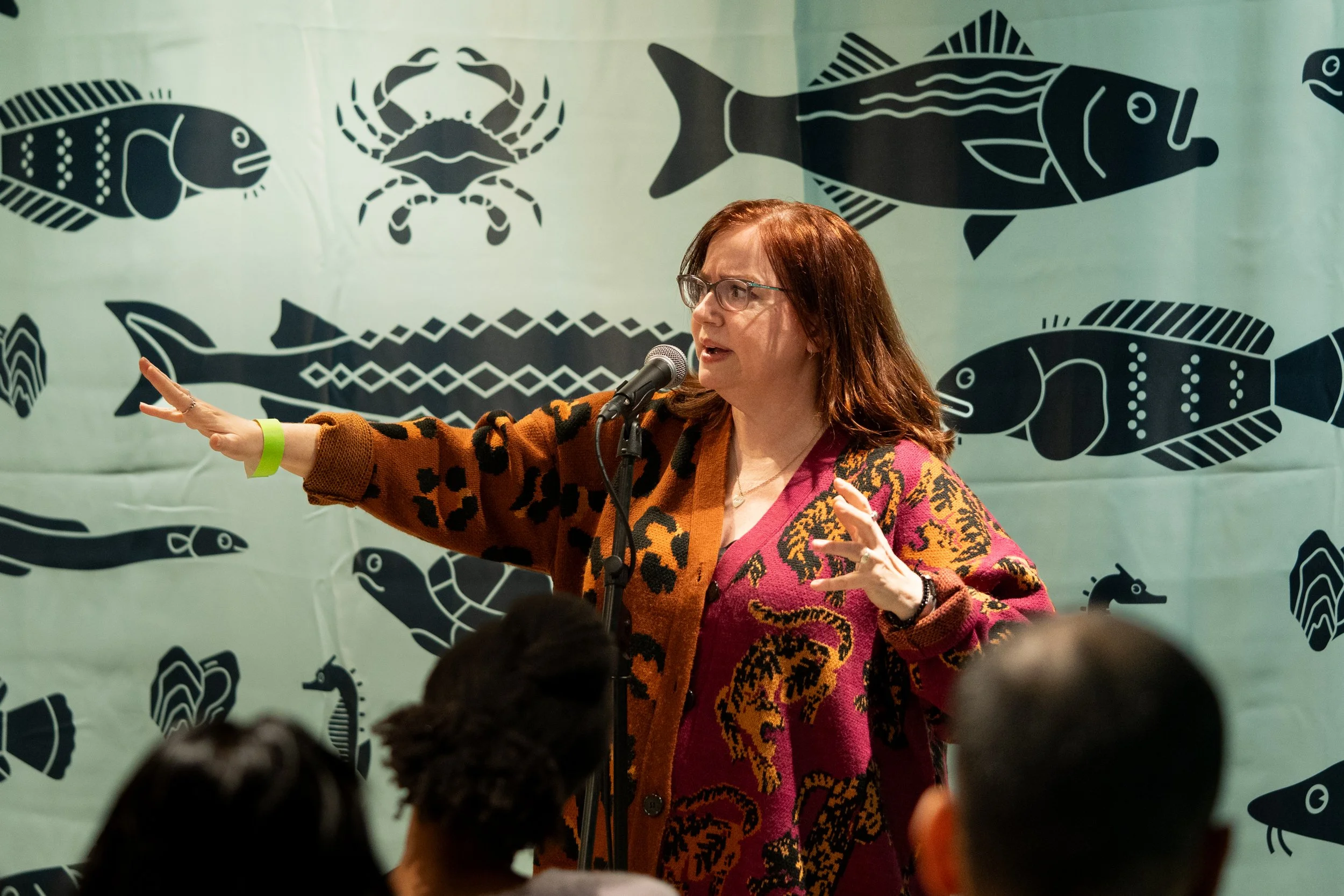
Adrianne Frost shares her story at Hudson River Park Pier 57’s Discovery Tank in New York, NY in March 2025. Photo by Zhen Qin.
I'll never forget it because her face was so kind. She was so confident. And I got a lump in my throat. And I remember that my head just hit the headrest in the rental car when she said, “You have epilepsy. We saw it on your brain. In a small part of your brain, you have epilepsy and you've been having focal seizures. The big seizure was a tonic‑clonic seizure, but you've been having focal seizures.”
Focal seizures, also known as partial seizures, are a common neurological disorder that affects only one side of the brain. They occur when electrical activity in the brain is limited to a specific area. The symptoms called auras can cause motor, sensory, autonomic, and psychic symptoms.
And that King Cake was like a reward. It wasn't for stress anymore. I was just glad that I didn't feel like it was psychosomatic anymore. And I was thinking to myself, again, there's an upside to trauma because you learn to trust yourself and listen to yourself and you come through that muck on top. I'm just glad that I trusted myself and my heart and that little piece of my brain that said, “No, no, no, no, no, no, no, no, no.”
Thank you.