In this week’s episode, both of our storytellers come face to face with one of their deepest fears: the ocean.
Part 1: When the children’s TV show host Carly Ciarrocchi is assigned a scuba diving episode, she’s forced to confront a lifelong fear of the ocean.
Carly Ciarrocchi (she/her) is an Emmy-nominated host, writer, musician, and producer. A true multi-hyphenate, she has spent most of her career in children's media, making and hosting TV shows and podcasts with collaborators like Universal Kids, Disney+, Nick Jr, Nat Geo Kids, Sprout, Tinkercast, Sesame Workshop and the LEGO Foundation. She's a Moth Story Slam winner and has told tales with Stories from the Stage (PBS), Generation Women, the Artichoke, The Tell, Soup and Stories and more. She teaches clown-theatre classes at the Brooklyn Comedy Collective. In everything she does, she hopes to create the conditions for people of all ages to access their most authentic state of play. www.carlyciarrocchi.com
Part 2: Growing up, Darcie Little Badger was wary of the ocean. But when she takes an oceanography class in college, she begins to question her fears.
Darcie Little Badger is a Lipan Apache writer with a PhD in oceanography. Her critically acclaimed debut novel, Elatsoe, was featured in Time Magazine as one of the best 100 fantasy books of all time. Her second fantasy novel, A Snake Falls to Earth, received a Newbery Honor and is on the National Book Awards longlist. Her third novel, Sheine Lende, is the prequel to Elatsoe and has received six starred reviews. Darcie is married to a veterinarian named Taran.
Episode Transcript
Part 1
So there are lots of things that scare other people that don't scare me. I am not afraid of heights. I am not afraid of being alone. I am not afraid of public speaking. But I am afraid of the ocean. It is very vast and incomprehensible, and I'm just not into that. You know what I'm saying?
I've been afraid of the ocean since I was a kid. When we would go to the Jersey Shore in the summer, I would wear aqua socks on my feet, like little water shoes. I wore them until I was like 14, and I only stopped because people were making fun of me. But I just did not want my plain toes wandering about. I don't know what's down there, you know?
A couple years ago, I was hired to co-host a children's television show for Disney Plus and National Geographic Kids called Weird But True. And throughout the course of the series, we went around the country exploring things that were weird but true.
So we went to Utah. We dug up prehistoric fossils. We went to California, and we tracked scorpions. We went to the NASA Mars Habitat and spent the night there.
About halfway through the season, they said, “We need to change what we're doing for the final episode of the show. We want to do a scuba diving episode. And everybody else is scuba certified except for you. So, are you willing to get scuba certified?”
My first thought was, “I am absolutely unwilling.” I'm afraid of the ocean. Also, I have anxiety. Like, I can barely breathe on land, let alone from a metal tank on my back. What?
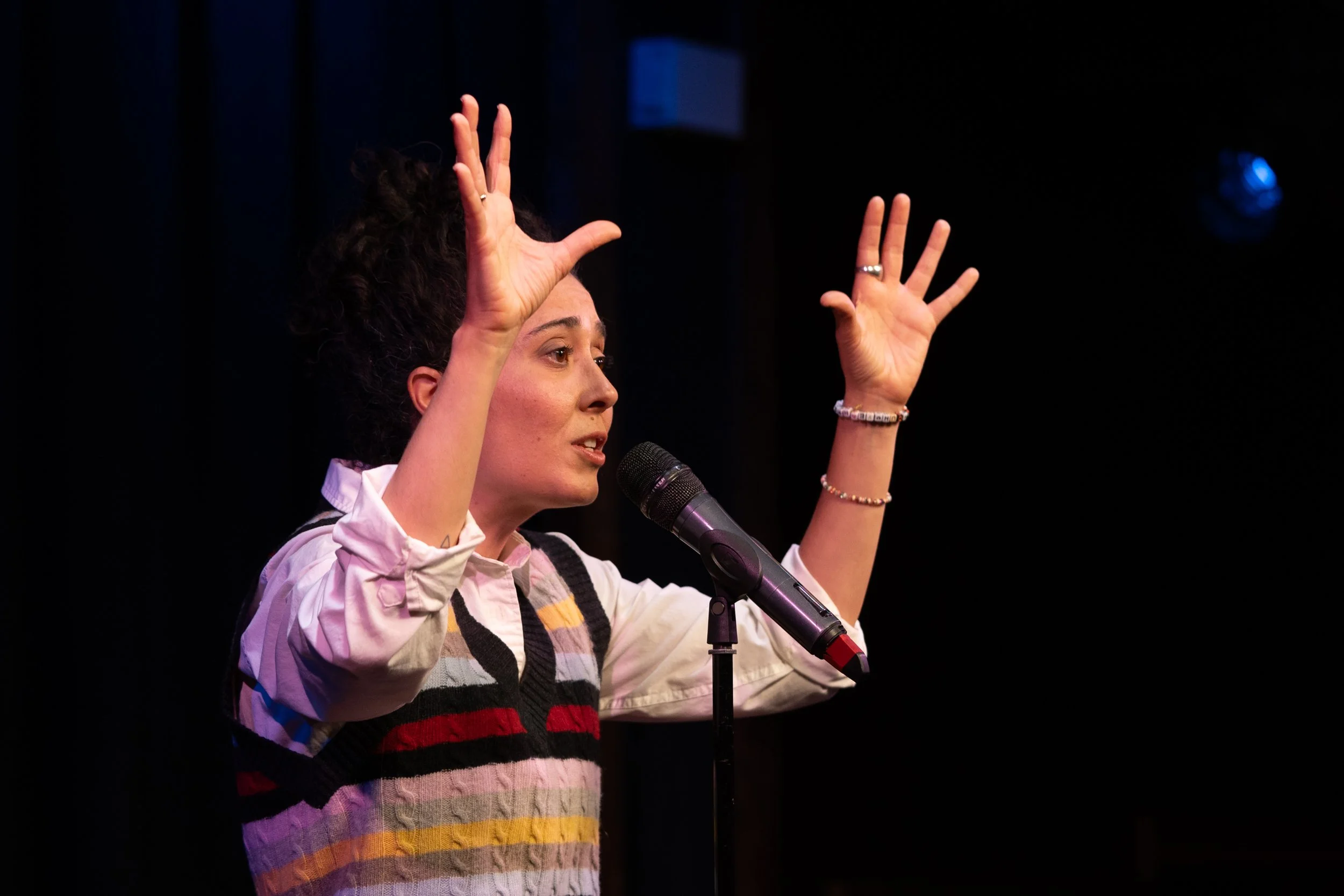
Carly Ciarrocchi shares her story at Caveat in New York, NY in October 2025. Photo by Zhen Qin.
But they were really under pressure from Disney to deliver an episode that was adventurous, so if I said no, it would derail the whole episode. So I said yes.
I immediately start my training at a pool in New Jersey. And scuba training involves a lot of gear. You've got your mask. You've got your air tank that you wear on your back. You have your regulator, which is that circular thing that you put in your mouth and you breathe from.
I remember the first day I took a breath underwater with all of that gear. We were in the shallow end of the pool. Yet, somehow, I was still scared. Everybody else had gone. I went last. And there's kids in the class who are totally fearless. It gets to me and I put my mask on.
I got my air tank, my regulator is in my mouth, and I sink under the surface approximately three feet. I breathe in through my regulator underwater, and I breathe out. The whole thing just feels so unnatural and uncomfortable. I think the last place I want to do this is the wide open ocean. Like something could get me. Something could go wrong.
But there's no time for that. I somehow finished my training in the pool. The next thing I know, we are off to Hawaii to shoot this episode. And I will say that if you have to do something that scares the living daylights out of you, do it in Hawaii. Because that helps.
So I'm on the deck of this diving boat with my co‑host, Charlie. It's the day of the shoot and I am so nervous. He is trying to, like, talk me off the ledge whilst on the ledge, I guess. He's done a lot of diving. So he's like, “Listen, you have all the preparation. You've done your training. Also, it's beautiful in the ocean. Once we get down there, you're going to forget how afraid you are because of how beautiful it is.”
That actually, that reaches me. Because the only stuff to look at when training in the pool in New Jersey, it was the occasional floating hair. So I'm like, “It's probably going to be better than that. You're right.”
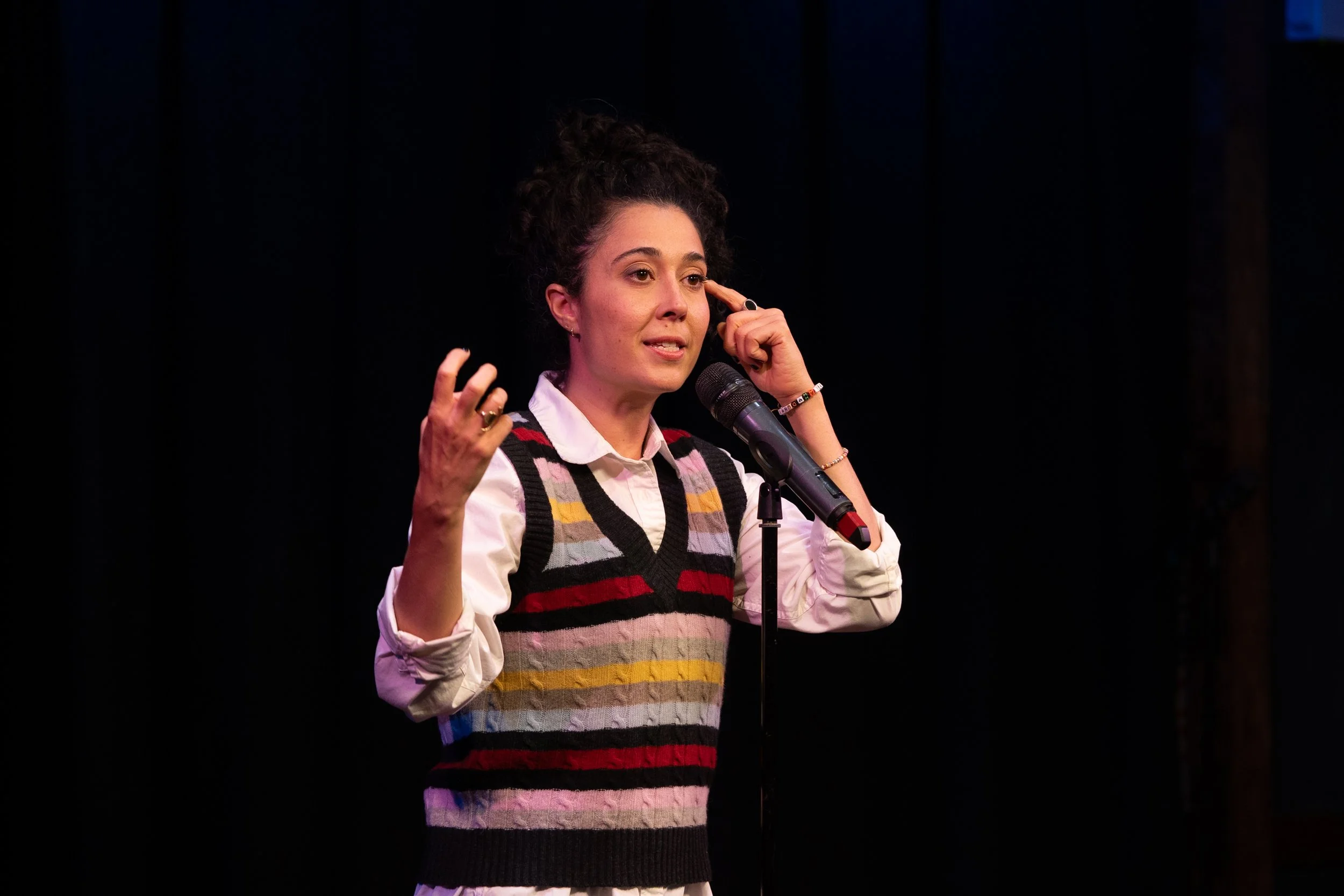
Carly Ciarrocchi shares her story at Caveat in New York, NY in October 2025. Photo by Zhen Qin.
It's time for us to do the shoot. We're suiting up on the edge of the boat, and I take my last breath on land. I get my mask down, my regulator in, and I walk off the edge of the boat. And I descend into the water. Five feet, 10 feet, 20 feet. I'm now past the depth of the pool. 30 feet, 40 feet underwater. I am breathing from a metal tank on my back.
And I start taking in my surroundings and it is more magical than I ever could have imagined. There are literal schools of fish passing in front of my face. There's like an eel coming out of his colorful coral habitat to say hello. There's this one little shrimp that looks like it's like a shrimp wearing a polka dot dress. I find out later that's actually a rare thing to see. So I'm loving it. I'm giddy all of a sudden. My anxiety has turned into astonishment. And I think I thought my fear of the ocean this whole time was keeping me safe when, really, it was denying me the wonders of the world.
So I'm feeling so confident. We get a lot of the footage we need, and we get ready for the last scene that we need to shoot underwater. They want to show on camera, they want to demonstrate one of the skills you learn in your training, which is breathing from your diving buddy's extra regulator. Because each diving suit comes with two regulators. In case something goes wrong, you can breathe from your buddy’s.
So the instructor comes over to me. We're facing the camera underwater. My instructor swims over and turns off my air tank. That's part of it. And I turn to Charlie, my co‑host, and I go to grab his extra regulator. I put it in my mouth, I breathe in and it's all bubbles. And I breathe in again and it's bubbles, it's water.
I start to panic. I'm like, “Is this regulator broken? What's going on?” I toss it aside and I look up. We're 40 feet underwater so I can't just shoot to the surface immediately. My lungs will explode. I actually have the thought for a second, like, “Am I going to die on camera?”
The instructor is swimming towards me because he realizes something is wrong and I reach out for his extra regulator. So I rip it off his diving suit. And as I'm bringing it to my mouth, I remember my training and I realize I have made a mistake. When you put the regulator in your mouth, you're supposed to press the button on the outside to clear the bubbles. It's called purging.
So I remember this. I purge the regulator. I put it in my mouth and I take a breath. And I'm okay. We're all okay. And I float to the surface.
The cameras are still rolling. We get back on the boat and the instructor commends me on remembering my training and announces me officially scuba certified. Awesome.
I feel good. I feel relieved. But I also feel empowered because the worst thing that I thought was possible happened. Something went wrong and I made it through.
So we're done shooting the episode for the day. The sun has set. It's dark out. And we have the boat for a couple more hours. So our crew and our instructor decide they actually want to do one more dive. They want to do a blackwater dive.
For the blackwater dive, they take the boat a couple miles offshore. The lights from land, we can't quite see any light anymore. And we're no longer above a grounded, sandy floor. What is beneath the boat now is a one‑mile drop-off. It's called an abyssal depth, because it's the depth of an abyss.
So they drive the boat out there and the rest of the group is getting ready for this really intense advanced dive. Everybody is like, “You stay in the boat. You've had a big enough day. Don't worry about it. Just wait for us.”
And the instructor is like, “Listen, yes, the prerequisite for this dive is 25 dives. But you did really well today and I'm with you. I'm here. So if you want to do this, you're ready. You can do it.”
And I look up into the poetically full moon. I'm not kidding. And I think to myself, “There's no chance I will ever, ever be in this situation again. I'm never going to have the opportunity to do this again.” And I'm floating a little bit high from what happened earlier.
So, to the surprise of everyone, including me, I say, “I'm down. I'm down for the blackwater dive. Let's do it.”
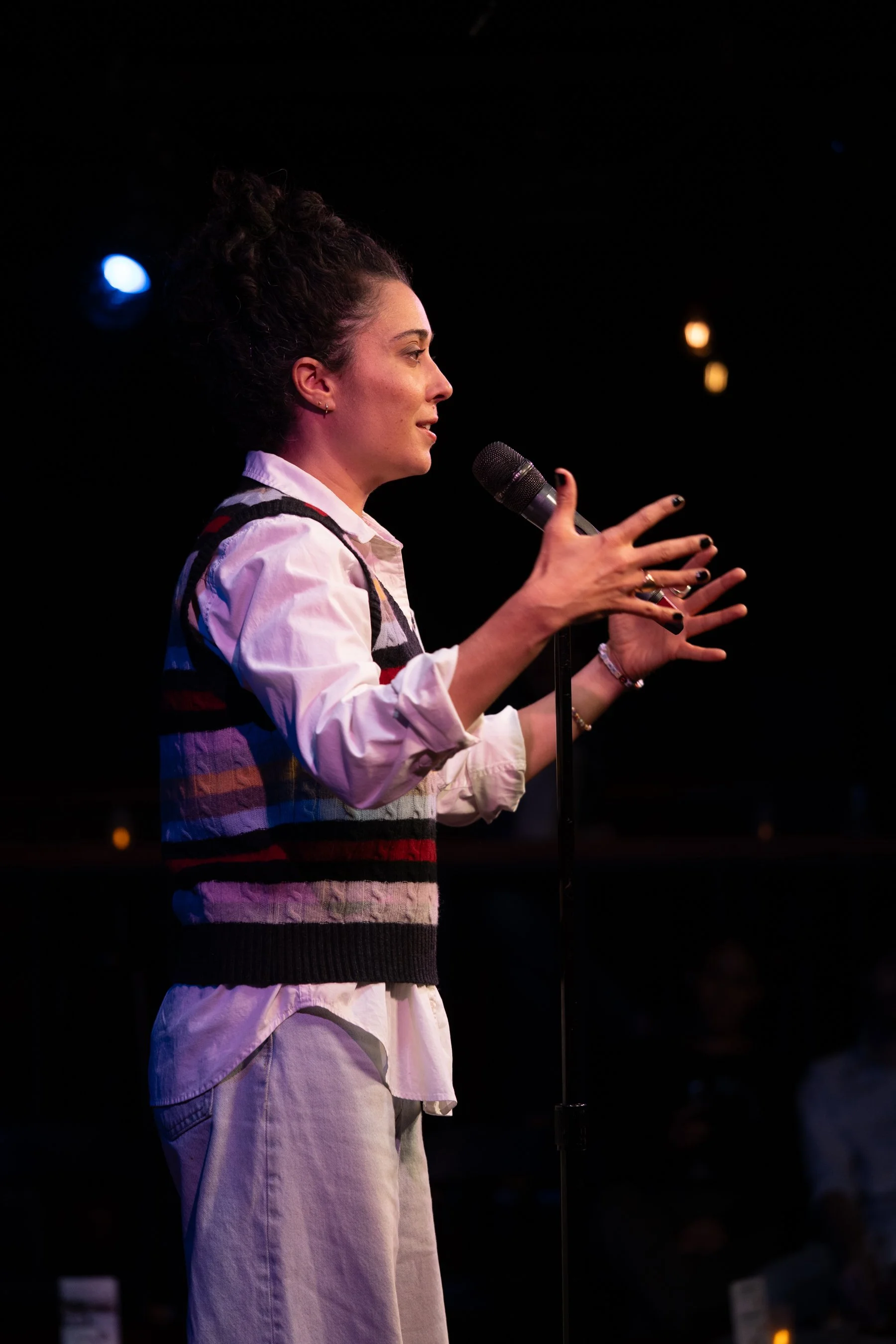
Carly Ciarrocchi shares her story at Caveat in New York, NY in October 2025. Photo by Zhen Qin.
So they start passing out these 40‑foot ropes that we're going to put around our waist, because when they drop us underwater, it's going to be so dark that we're not going to be able to see the boat above us. And the boat isn't anchored anywhere, so it could just be drifting.
“Cool, cool, cool, cool, cool, cool.”
So I suit up again. My mask is on. My air tank is on. I take a real big breath above land and I put this regulator back in my mouth. I step off the boat again.
I descend again. Five feet. 10 feet. 20 feet. But this time, it is pitch black underwater. They've given us a tiny flashlight that lights up like maybe two feet in front of us, and I can just barely see the other divers in the distance with their kind of soft glow. But for the most part, it's like being in a sensory deprivation tank. I can't see what's above me or below me.
So I get down to 40 feet and I get out my flashlight, and I start to see the little bioluminescent creatures that have come up from the abyss to feed in the shallow waters at night. It's these like translucent seahorses that are iridescent. It's incredible. It's even more amazing than the daytime dive. And I start having fun.
I start to realize I'm safe enough between the rope that's tying me to the boat and the instructor close by. I feel safe enough to play a game. I turn off my flashlight and I swim away from the boat into the pitch black darkness. And I can feel the panic of, like, “Is a shark going to come out of nowhere? Is something going to go wrong?” I feel that rise up and I let it go for as long as I can stand it and then I turn the flashlight back on again, and I breathe. I'm giddy again, like, “Oh, my God. I made it through something hard.”
So I start doing this again and again, like this edge of fear that I feel in the darkness, and then I turn my flashlight on. I'm in this loop of fear to giddiness and it feels good. And when we get back on the boat, everybody's high‑fiving and hugging each other like, “We did it.” And they're like, “You did it.” And I'm like, “I don't know how.”
The show wraps a couple weeks later completely. We're done with the series. And a couple weeks after that, it's March of 2020. The whole world descends into this proverbial darkness. And I use that experience of that blackwater dive as this touchstone, this really visceral memory of a time that I literally swam into darkness and was still safe.
Since then, I've kind of used that experience as coins in a bravery bank that I can redeem in the face of anything that scares me. So since then, I made it through the pandemic as a freelance creative. I hiked Angel's Landing. I came out to my parents. I drove across the country alone. I froze my eggs. It was scary. I'm still afraid of things, but my relationship to fear is totally different.
Thank you.
Part 2
My first memory of the ocean is not actually my own. It's a story that my mother told me about her childhood, 1967, when Hurricane Beulah crashed onto southern Texas. The rains were so intense that the rivers overflowed and the dams could not really hold it all. So my mother, her eight siblings and my grandparents, they were in their house thinking they'd survived the worst of the storm when there came a knock on the door and this frantic call to evacuate.
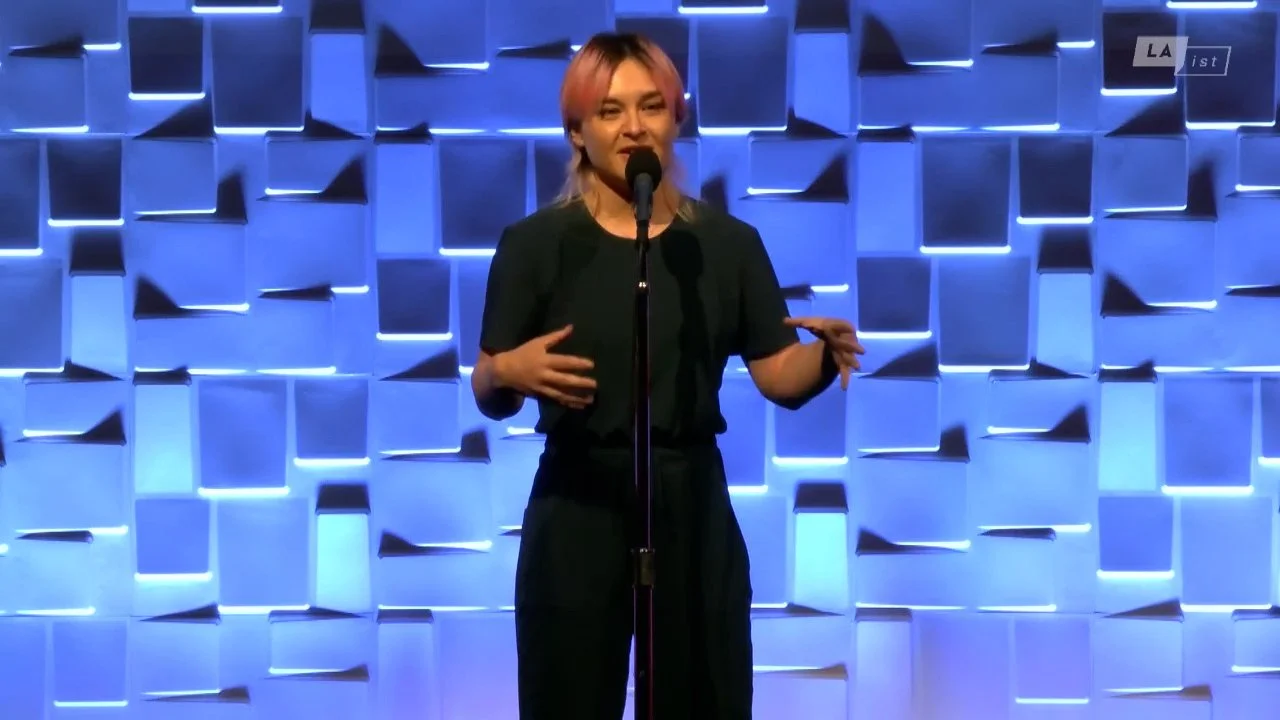
Darcie Little Badger shares her story at the Crawford Family Forum in Los Angeles, CA in August 2024.
The little family didn't really have time to pack their stuff, so they left with their clothes on their back. And as they were leaving, my grandpa saw the cows were mooing and stomping their feet. So he went over to the gate of their pen and opened it, hoping that they could save themselves. Then the family evacuated to high ground.
When they came back to the house, the floodwaters had reached the rooftop, essentially destroying almost everything, things like toys and clothes and documents and photos. My mom still talks about the memories that were lost to the muddy waters. But there is one silver lining. The cows were on a nearby hill. They managed to escape and were waiting to be rescued.
In the months, the years that followed, there's this domino cascade of hardships triggered by this storm. Stuff like displacement, poverty, illness resulted in my grandfather, he died.
So what this story kind of taught me is that the ocean, you know, I lived in landlocked areas when I was a child. I didn't have much experience with the ocean to build my own memories, so I carried this story. It taught me that the ocean could swallow a city. It could destroy a life, and that was scary.
I really didn't know much else about the ocean until I was in college. Now, when I was a freshman, sophomore, I thought I was going to be an English major. I wanted to write stories, and I figured I'd go there, I'd do my dissertation, a collection of short stories, or maybe I'd write a great American novel. But my freshman year, I applied to the creative writing program, and I was rejected. So in my sophomore year, I applied again, and I was rejected again.
It was around this time of this second rejection that I had to take a science course, because in this Ivy League institution, they wanted their students to have an interdisciplinary education. So even though I wanted to focus on English, I had to take a science course, a history course, a philosophy course, and so on.
I was just scrolling through the course workbook, seeing what they were offering, and I asked my friends what would be a good science class that's accessible to people who maybe don't have the strongest background in science.
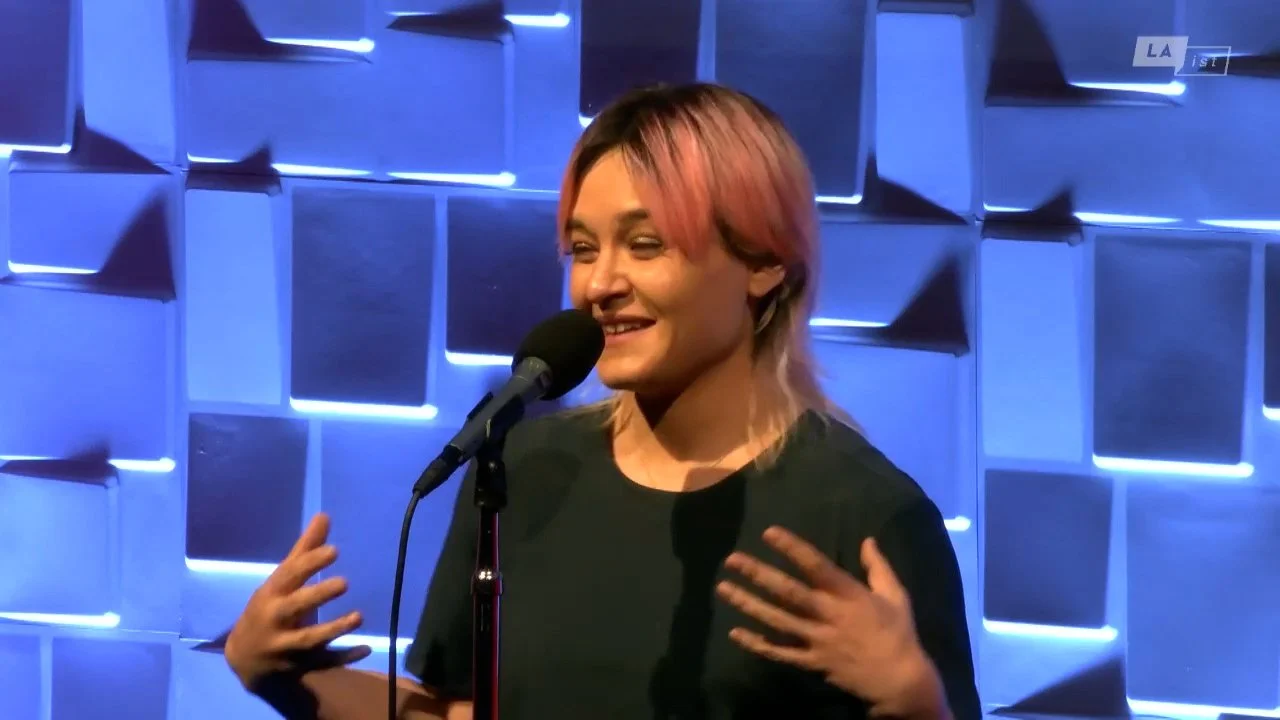
Darcie Little Badger shares her story at the Crawford Family Forum in Los Angeles, CA in August 2024.
Now, don't get me wrong. In high school, I had aced my science and math classes. I enjoyed them. I found them to be fun and interesting, but I didn't have the best confidence because I was this kid who'd bounced around in public schools, you know, Iowa, Vermont, Texas. And I was surrounded by students, some of them had gone to these intensive private institutions that had world‑class laboratories and STEM tracks and even robotics clubs, which I thought was amazing. Plus, my school did something called grade deflation, where only about 30% of a class could receive an A, so I really just wanted to give myself a chance. And the answer I kept getting back was Intro to Oceanography.
Now, I was wary of the ocean itself, but this class, we weren't going to be jumping into the Atlantic and going swimming or anything like that. We were going into a lecture hall that was kind of shaped like a coliseum and listening to the professor talk about concepts. So I wasn't stressed out when I applied and when I started attending classes.
And something really cool actually happened because, for the first time, I was learning facets of the world that I'd never known before. Things like how the ocean is associated with atmospheric circulation, how phytoplankton are just as important photosynthesizers as the trees that surrounded me on land. I even learned how hurricanes are born and grow and they crash onto the land and sputter off and die.
So one class became two classes, became three classes. The next thing I know, I'm on an airplane flying to Bermuda with my oceanography class to visit a marine research institution.
I sat near the window seat. And as we were approaching our destination, I looked out and down. I saw that the water was this sapphire blue. It was so clear and calm. As we got closer to the island, these pale patches of coral turned the Sargasso Sea into this quilt of life. This was a face of the ocean that I didn't know from my secondhand memory.
As the days passed and we did this field trip, I learned more things about the ocean. I witnessed fireworms spawning and their bioluminescence was more delicate and rare than that of lightning bugs. I smelled waves crashing. I felt the warmth of the shallows and little silver fish that were tickling at my toes. I even witnessed the birth of coral in these little nurseries.
Eventually, the professor gathered us around and said we were going to get some field experience. And by field, I mean the open ocean. So at dawn, all of us students gathered there on the docks. And there was this research vessel that was just large enough to hold my entire class on deck.
As we boarded, I remember the ship was bobbing. It was kind of like a mechanical bull at the lowest setting. As I was stepping on, it was not enough to knock me over, but I felt a little bit unbalanced, a little unsettled. So
We sat on these benches, and the ship started going off to the open ocean. We were vrooming over these low waves and the spray was crashing into my face, cooling me down, while the sun was beating on the back of my neck, and it was so warm. And there were these flying fish disturbed by the boat. They were gliding alongside us, and some of them were going as far as paper airplanes would, which I thought was really cool.
Eventually, we were far out there that I could not see the land, not even a smudge on the horizon. We were like hundreds, if not thousands of meters of water beneath us. This was the open ocean, the Sargasso Sea.
So everyone, we learned how to do scientific things such as collecting phytoplankton using these really fine nets. Or we checked the clarity of the water by lowering this black and white disc down and down until we couldn't see it anymore, and then we pulled it back up again.
We divided into teams, took water samples. I was on Team Phosphate. And as I was eating my granola bar, a professor stood up and he said to us, “Who wants to go for a swim?”
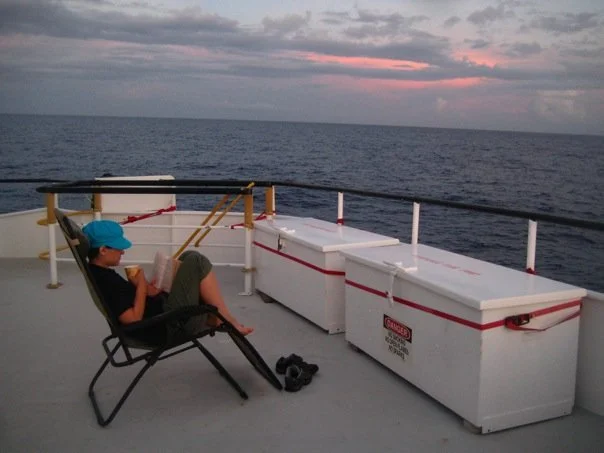
Darcie Little Badger on RV Atlantic Explorer. Photo courtesy of Darcie Little Badger.
I want to make it clear. I did, as a child, learn how to swim in public pools. And I'd visited beaches, especially that week. I'd seen several in Bermuda. But I never had a chance to swim in the open ocean and thought this might be the only opportunity to do so. Because of that and because my peers were really excited, and because the professor was there and he wouldn't let anything happen to us. But if something did happen, there were lifesavers on board. So all these things I was like, “Oh, yeah, sure.”
But none of us were dressed for swimming. We were in our plainclothes. I was in my jeans and my T‑shirt and I had a windbreaker. I took off the windbreaker and stored it with my sunglasses and then went over to this ladder at the back of the boat.
Now, a lot of my peers they were just jumping into the water, cannonballs and the like, but I wanted to take things more slow. So, first, I dipped my toes in and the water was warm, kind of like a bath, which I found to be very pleasant. Then I dipped my feet in and then I dipped my knees all the way up there.
Then suddenly the ship bucked and it kind of like pushed me forward. Before I knew it, I was floating, swimming alongside the ship. And that first moment was, it's almost indescribable. Floating above hundreds if not thousands of meters of water. You feel weightless, almost like an astronaut on Earth.
But I was wearing, unfortunately, bell‑bottom jeans. So here's the thing about denim when it gets wet. It actually gets pretty heavy. So it took a couple of seconds before gravity reasserted itself and I realized that my pants were going to be a problem. They were getting heavier and heavier and trying to drag me down at Davy Jones' locker.
These small little waves that seemed like nothing from aboard the ship, they were splashing over my mouth and my nose. I was sputtering and spreading my arms and trying to remember everything that I'd learned in beginning swimmer classes, like how to fill your lungs, take a deep breath, and then float on your back. But the pants were really making it difficult.
And the ship, it was farther away from me than it had been when I first jumped in, so I was like, it's either caught in a current or, more frighteningly, maybe I am and I'm being pulled away. I realized I had to make a decision, a choice. Take off my pants in front of all my peers or just let them drag me down.
So in a last-ditch effort to save my dignity, I just doggy‑paddled with all my might towards that ladder, and I reached out and I grasped the lower rung. I pulled myself rung by rung, just like shedding droplets of the Sargasso Sea, until I flopped onto my back on deck looking like this wet cat, all bedraggled.
I stared up at the sky and it was blue, as blue as the ocean and as eternal, it seemed. That's when I realized this is what I wanted to do with my life. I wanted to not be an English major. I wanted to study the ocean. Because that was a scary moment, yes. But more than that, I was just fascinated that everything below me that I couldn't see in that darkness, all the life forms, all the biological, physical, chemical processes, the unknown, and yet it could be known.
So we returned to the U.S. a couple days later, and I went to the geoscience department. I got my junior advisor cementing my decision to major in geosciences and study the ocean. I even returned to Bermuda the next summer. I went on this two‑week research cruise, which is a story in and of itself because I do get seasick. And while I was there in Bermuda, a hurricane actually was sweeping towards the island. Fortunately, it downgraded to a tropical storm right before it hit.
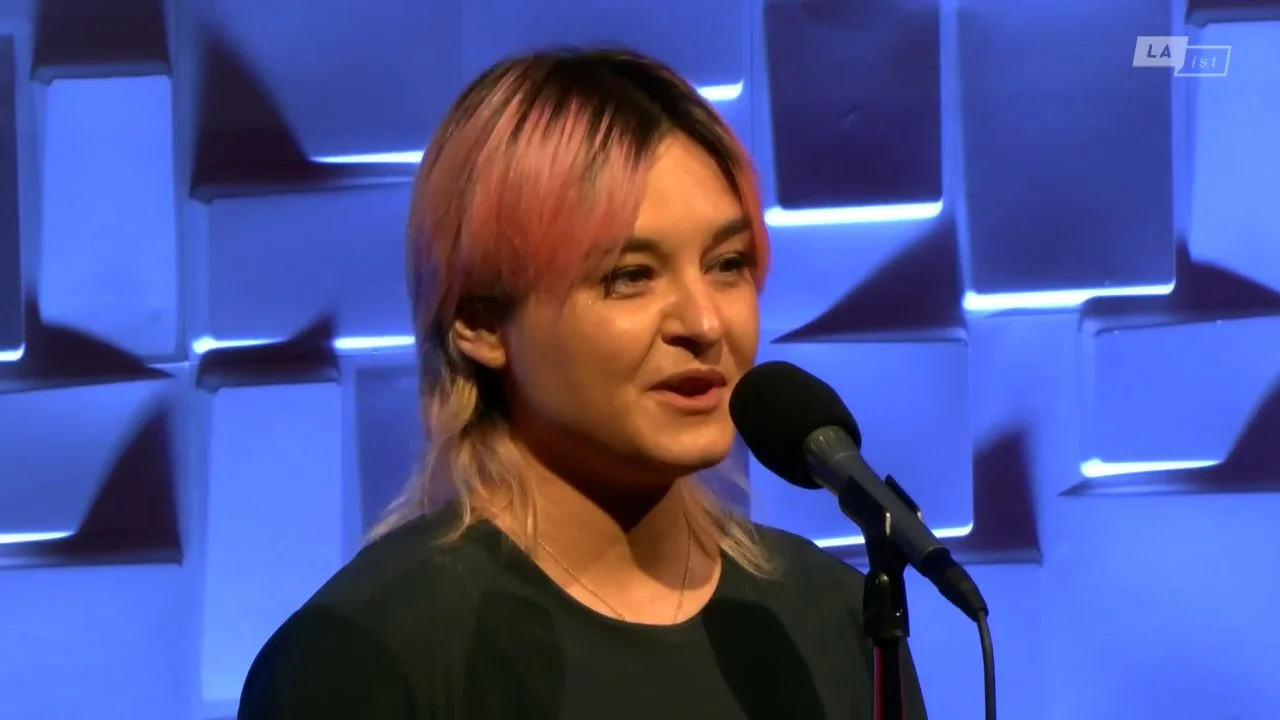
Darcie Little Badger shares her story at the Crawford Family Forum in Los Angeles, CA in August 2024.
I remember hunkering down in the research station with some of my friends, the people who worked there, and the wind was rattling the windows and pressing the doors shut. And the water was drumming on the roof and blowing sideways against the walls. But I did not feel a trace of fear. Because I had predicted this storm, understood it and I respected its danger. I wasn't going out swimming during the tropical storm. I just waited there for it to pass, and then calmly went out and helped clean up the damage and destruction that it left behind. I hoped in that moment that my mom, my grandparents would have been proud.
I still had a lot to learn. I mean, I still do have a lot to learn. But what I knew is that the ocean had so many faces. It seemed so alien to me, and yet it was every bit a part of the world that I grew up in as Texas and Vermont and Iowa.
So I went and I got my Ph.D. in Oceanography. I studied Karenia brevis, which is this type of plankton that produces red tides in the Gulf. And now, I live just a short walk away from the Pacific Ocean where I go sometimes to work. Writing my stories, I'm inspired by those waves crashing ashore.
So I guess if there's a takeaway to this story, it's probably this. It's that, sometimes, the best way to confront our fears is to understand them.
Thank you very much.