What does it actually mean to “be a man”? In this week’s episode, both of our storytellers grapple with masculinity and are forced to confront what manhood means to them.
Part 1: As a teenager, Mike McFadden realizes one part of his body isn’t developing like the other boys his age.
Mike McFadden works in the television industry, based out of NYC. He is also indie arts producer intersecting storytelling, clown, and film.
Part 2: Ricky Ortiz believed that to be a good husband, father, and provider, he could never show weakness.
Ricky Ortiz is a founder, husband, father, and avid storyteller. As a firm believer in the significance and the power of vulnerable stories, Ricky aims to speak to the heart and build connection with others to help them think deeply about what they believe, why it matters, and how it impacts the world around them.
Episode Transcript
Part 1
I come up for air, but I don't see anyone around me. I look over to the side of the pool and the seven‑year‑old me starts to panic. I look over and I see my swim coach, who's furiously windmilling his arm towards the end of the pool.
I'm like, “Okay, is there something wrong? Is somebody hurt?” I look back in the water and I see, “Oh, there's the rest of the kids.” They are struggling by the starting block still in the water. I'm like, “Oh, I'm just really far ahead. Okay.” So I start swimming again and I make it to the end of the pool.
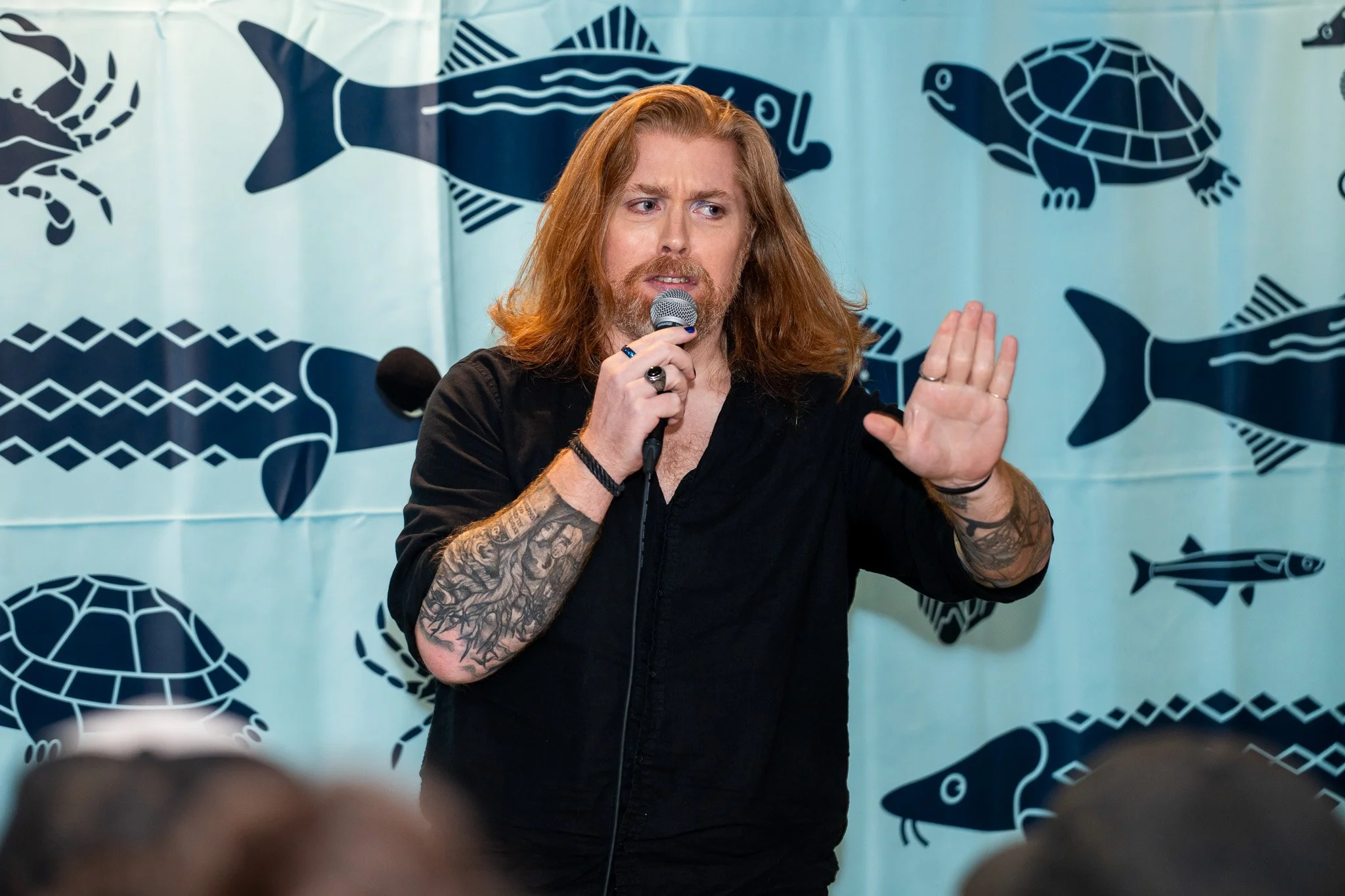
Mike McFadden shares his story at Hudson River Park Pier 57’s Discovery Tank in New York, NY in September 2025. Photo by Jason Serrano.
Of course, I got disqualified, and it was the only time, by the way, I've ever been disqualified, at least in the water. But by the end of that meet, the coaches, several people told my parents that I was on track to be one of the fastest swimmers of all time. It's a bold statement, but at least now in hindsight, I know they weren't kidding. Because the people that I then trained with and raced against for the rest of my youth are now the fastest swimmers of all time.
That is what I eventually started calling my “Ferdinand the Bull” moment. If you don't know the story, Ferdinand was this little bull who loved sitting under the tree. And like Ferdinand, I was this awkward kid and I just really loved being in the water. And like how he accidentally sat on a bee, it turns out that I was just really big for my age.
So from then on, I had a special schooling and schedule and diet. I traveled and I went with these expensive coaches and training camps. I spent most of my years traveling and competing all up and down the East Coast. That was most of my youth.
By the time I was age 12, I was fully grown, the height that you see before you now, and even bigger in some ways. Although I was sort of revered in the pool, not so much elsewhere, and especially I'm a kid. You can't get kids' clothes, like JNCO jeans. This is the ‘90s. JNCO jeans in a size 40 or Airwalk skate shoes in a size 15.
Actually, the shoes was an interesting point because that was part of their athletic prophecy for me. I was getting that, you know, “Hey, you know what they say about kids with big feet, right?” Long before I ever understood what that meant.
Speaking of which, this was also the time when I was training with mostly older boys. I was in the locker room with them and I started to notice that part of me wasn't growing like the rest of me. My penis still looked like a child's penis. Suddenly, the thought that I now had to spend every day of my youth in Speedos gave me unbearable anxiety.
From then on, I changed in the corner and I found the last locker. I hid when I changed and I wore extra layers. I sometimes would cover up with a towel the way that they depict the teenage girls in films. That was my youth, basically. The few times that somebody else did get a glimpse of the grapes that I was smuggling, it was more of like a confusion than ridicule.
This is also in the ‘90s before the Internet and terms like “micropenis” or “grower not a shower” were ever circulated. I also came from a heavily Catholic family, so my only outlet was sort of like relying on the few trustable boys in the back of the classroom.
After asking about it and going in a sleepover one night, it just turns into a show‑and‑tell, and then finally, okay, there's something there. Finally, it's like a glimpse into puberty and a very latent pansexuality, but that's another thing.
But now I feel like I've got this jacked up, hormone‑filled body that I don't think anybody wants. I'm desperately finding ways to get it to grow.
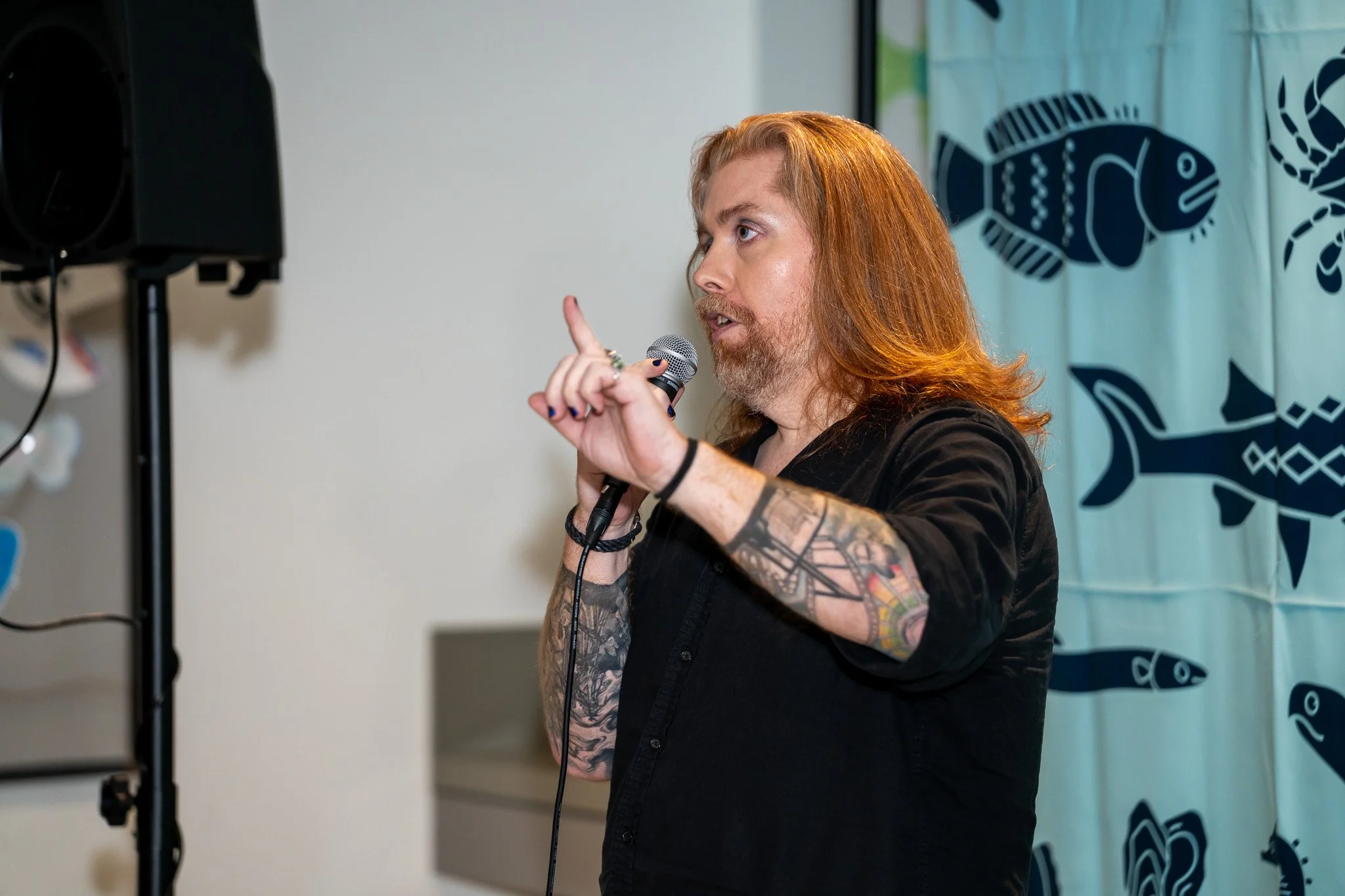
Mike McFadden shares his story at Hudson River Park Pier 57’s Discovery Tank in New York, NY in September 2025. Photo by Jason Serrano.
So I'm touching myself and tying things to it and putting weights on it or stretching it. I even, under bad advice, tried the thing with the family dog and the peanut butter. But I was interrupted. It's okay. I was interrupted by my dad.
And his only reaction, again, Catholic family, was sort of like the Hank Hill’s, “Whoa-oh-ah,” and nothing else. That was it. That closed the door on ever having a real discussion about any of this.
It's good timing because this was also right at the start of middle school where it is now time to send Ferdinand, young Ferdinand, off to the bullfighting ring that is school sports. In this case, though, the matador in the bullfighting ring is called the Tanner scale.
In New York, if you want to move up to high school athletics, you have to pass two tests. One is a physical fitness test. It's all this standard running, jumping, climbing tree stuff. But the second part is called physical maturity. It is represented on this little IKEA man pictogram chart of five little pictures. It's called the Tanner scale.
On one, it's basically a Renaissance cherub. Just nothing there. Three is kind of like an eroded Greek statue. You see there's something. And then five is John Holmes or Lenny Kravitz, depending on your generation.
And I'm staring at this. I'm like, “I've been training for everything. This is like the one test I can't train for.” Even the few wispy pubes, I'm a ginger, by the way, if you're listening, the few wispy pubes, you can barely see that they're there. Even today when I go to the beach, I don't look hairy. It's just blurry.
So middle school starts and testing day comes. Obviously, the physical fitness stuff, easy. I passed with flying colors, including swimming, which, if you're swimming, you do that instead of running. And then they walk me down to the hall to the nurse's office.
I'm sitting there and they close the doors. “The doctor will be in.” Now I'm like, “All right, now's the time. Now's the time, little dick.” And I start kind of rubbing it like a genie lamp, like half wishing for something to come.
Then I'm like, “Oh, wait, no. I can't. If they see me now like that, I'll be labeled a pervert forever. Oh, shit.” Also, I just spent 20 minutes in the pool so my balls are self‑tucking at this point.
Then I get a knock. In comes the doctor, the one shambolic, aged school doctor that I'd only ever seen for a scoliosis test once before. He says, “All right, Michael, seems like we just need to take a look at your bathing suit area for this test here.”
I'm like, “Oh, fuck, of all the things to say.”
“Okay. ”So down it goes and I'm staring at him, and he's looking. He's looking up and down at his chart and he's just kind of like, “Okay, I just need to scoot in a little bit farther,” because he's having a hard time.
I'm like, “Oh, my God. Oh, no.” Like a painter trying to figure out their first assessment. Like they're nervous, but like here it is.
I got a two. And if you want to qualify for varsity, you need a four. In fact, I didn't even qualify for junior varsity. And in the same breath I was told this, I was also told that my school was going to contest it because not only was I faster than most of the older kids in the team, but I was also kind of getting protested from other parents going in other sports, because I was just so much bigger. It was a worry.
After a couple weeks of limbo, the school convinced the state to make an exception. Part of their argument was that, well, they understood the Tanner scale is supposed to be for growth plates in kids when their bones are growing, but this is a non‑contact sport. But the Tanner scale applies to all sports and so I was given the exception.
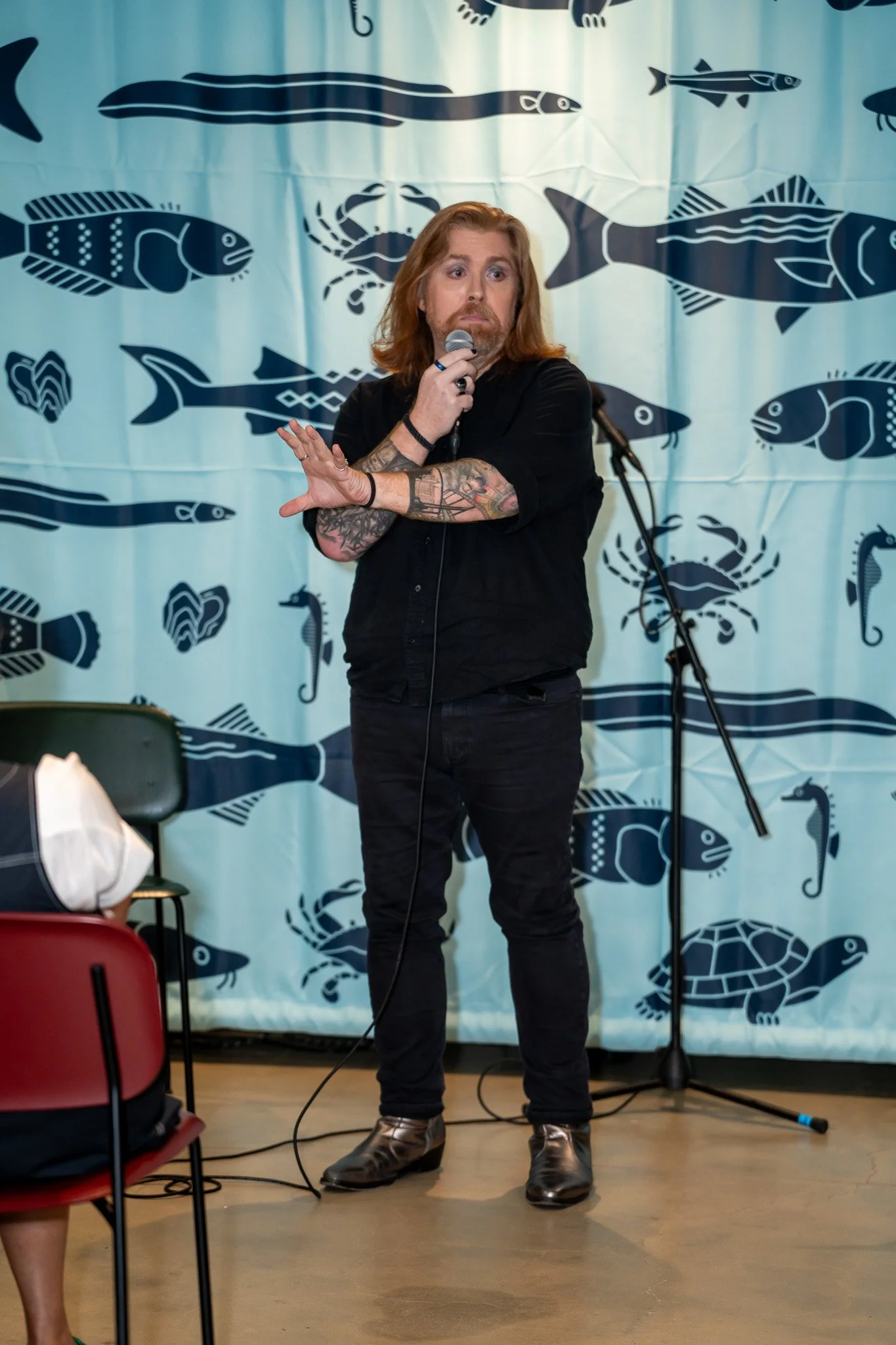
Mike McFadden shares his story at Hudson River Park Pier 57’s Discovery Tank in New York, NY in September 2025. Photo by Jason Serrano.
The results of that were never disclosed publicly, thank fuck. But, unfortunately, that wasn't the end of me being betrayed by my body. See, obviously, the reason why I'm not a famous swimmer, I'm standing before you now, is because I was just a fluke. Me and my little Irish curse there, we stopped growing and everybody else kept getting bigger and stronger and taller. I was spending years to shave even a few seconds off of my time.
By the time I was 18, I was basically a has‑been. My coaches were retiring. In fact, the nail in the coffin was they replaced one of my retired coaches with a guy that I used to race against who had just graduated college. So that was it. That was Ferdinand being cast out of the arena.
And through a decade of metaphorical floundering, not literal floundering, obviously. If you threw me in the Hudson, I'd be fine, I think. I do have to give some credit to that Tanner scale, not for what it is, and it still exists, by the way. It's fucking crazy that it does. But I give it credit because, for me, it became a signifier of superficial standards. So anytime I was getting ridiculed or somebody would go for that not‑so‑low‑hanging fruit, then I would see like, “Oh, that's, oh, you're just, you're superficial. I don't…” whatever.
Instead, I was gravitating towards theater and burlesque and Rocky Horror, which I did for many years, and this whole queer community of people that didn't care what was in your Speedos. So much so that I also developed this kinship with trans people. Because as a few friends of mine put it, they fully understood that their body does not define them. That was so aspirational to me.
After all that time, I hadn't ever heard really of any other news stories about this. There were maybe a couple, but almost nothing with boys. And I figure if I'm up here like this, then there must be other people like that out there that just can't talk about it.
As for me, after 20 years, I can finally enjoy the pool again. I can even go to the beach, and I even wear a Speedo. I can even tell my friends, and now, of course, all of you, all about my little dick. I suppose that is real growth.
Thank you.
Part 2
In February of 2013, my wife, Krista, our one‑year‑old daughter, Gia, and I said goodbye to our family and friends in Portland, Oregon. We sold our four‑bedroom house and moved across the country into a one‑bedroom railroad‑style walk‑up on the Upper East Side of Manhattan. I was 26 years old and I had just accepted a position at a prominent Christian nonprofit, and I was determined to prove myself to anyone watching. I was young, incredibly ambitious, and highly driven.
I threw myself into my work doing everything possible to succeed. To me, success was strength. Failure was weakness. And weakness was to be avoided at all costs. Truthfully, it paid off. At work, I couldn't miss. But at home, it was a different story.
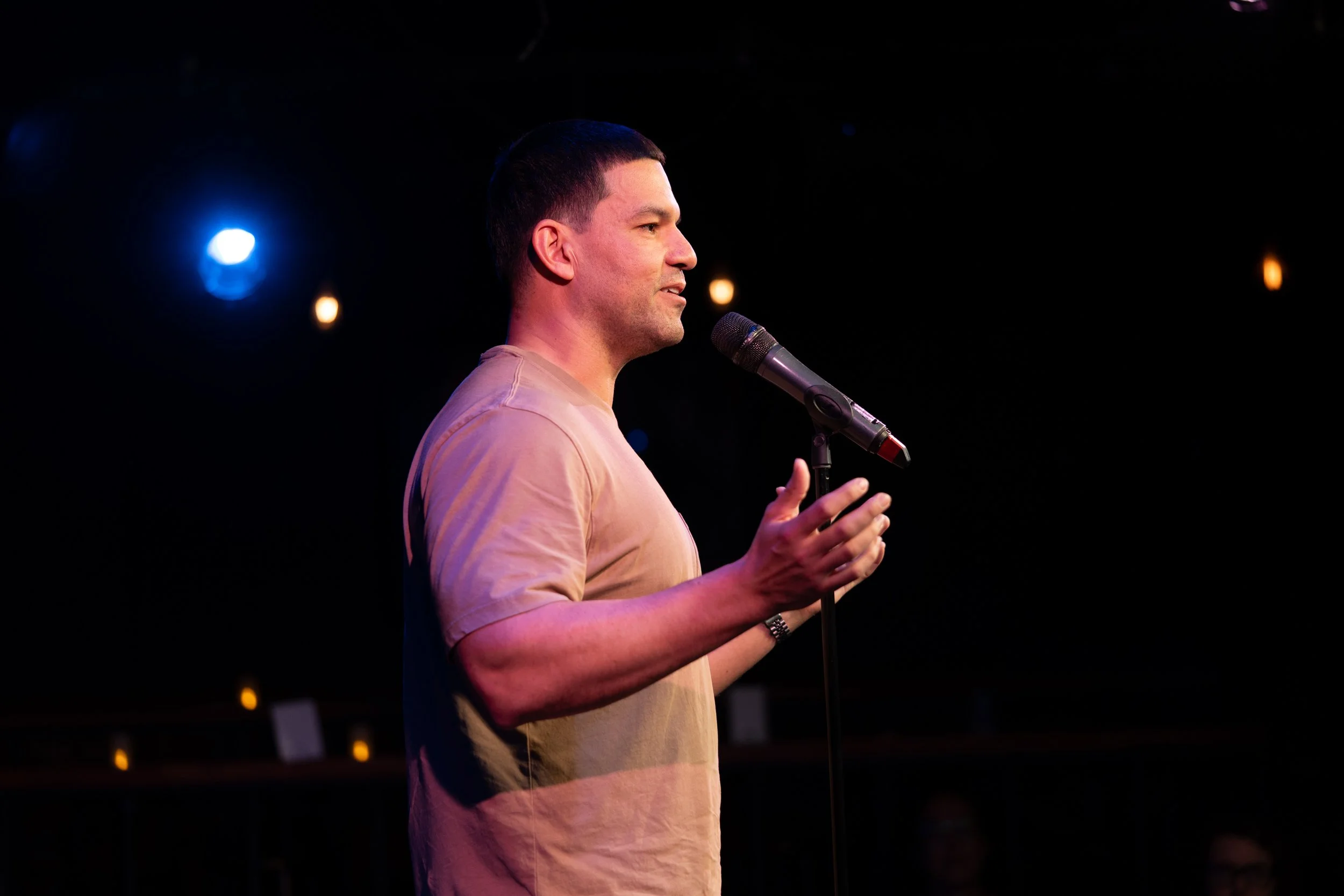
Ricky Ortiz shares his story at Caveat in New York, NY in April 2026. Photo by Zhen Qin.
Most evenings followed a similar pattern. Leave the office late. Get home later. Eat dinner in silence. Veg out on the couch watching TV or doomscrolling on my phone. I was tired, I was stressed, and I was emotionally disengaged.
Whenever Krista tried to address my behavior, I would often minimize it or dismiss it, saying things like, “I don't know what you're talking about. Everyone at work thinks I'm amazing, so, clearly, I'm fine.”
But in reality, I knew that I wasn't holding up my end of the relationship as a husband or as a father. I just couldn't bring myself to admit it. I thought, “I'm the father. I'm the husband. I'm the provider. I'm supposed to be the strong one that holds all of this together,” rather than admit my weaknesses.
I decided to rack up thousands of dollars in credit card debt to compensate for my absence and my distance. Dinners out, ordering food in, buying clothes, going shopping. rental cars for the weekend, going on vacation. Of course, none of this helped things get better. I was failing, and I wanted to escape.
So I turned to pornography. I didn't want to turn there, but I did. It just felt so easy to access, and it was kind of like an emotional escape. I just was drawn into a different world. The more I engaged in porn, the more addicted I became, and the more humiliated and ashamed I was of my actions and of myself. I was violating my Christian values and dishonoring my wife.
I kept this hidden for nearly a year until Valentine's Day 2014. That evening, I stepped out of our bathroom and into the hallway where I was confronted by my wife. She said the words to me that no one ever wants to hear. “We need to talk.” She had seen something suspicious on my phone and she started questioning me about it and asked me to explain myself.
Immediately, my heart sank. Then it started pounding, trying to figure out how I could respond. It was as if time had simultaneously sped up and slowed down all at once. I was panicking. What did she see? What did I even look at? How much does she know? Do I have to tell her the truth? What if I told her part of the truth? Could I just get away with that?
No matter what I said, I knew Krista would have more questions. How long has this been going on? When were you planning on telling me? You think I'm an idiot, don't you? This has been happening all along and you've been hiding it, haven't you?
Before I could even say a word, her eyes told me that she knew there was more to the story than I wanted to disclose. I was horrified and yet somehow relieved. Horrified because I knew that what I was about to share was about to be a bombshell of dishonesty, deception, and betrayal with no good path forward. At the same time, I felt relief because this charade of strength that I had projected had become a burden too heavy for me to continue bearing.
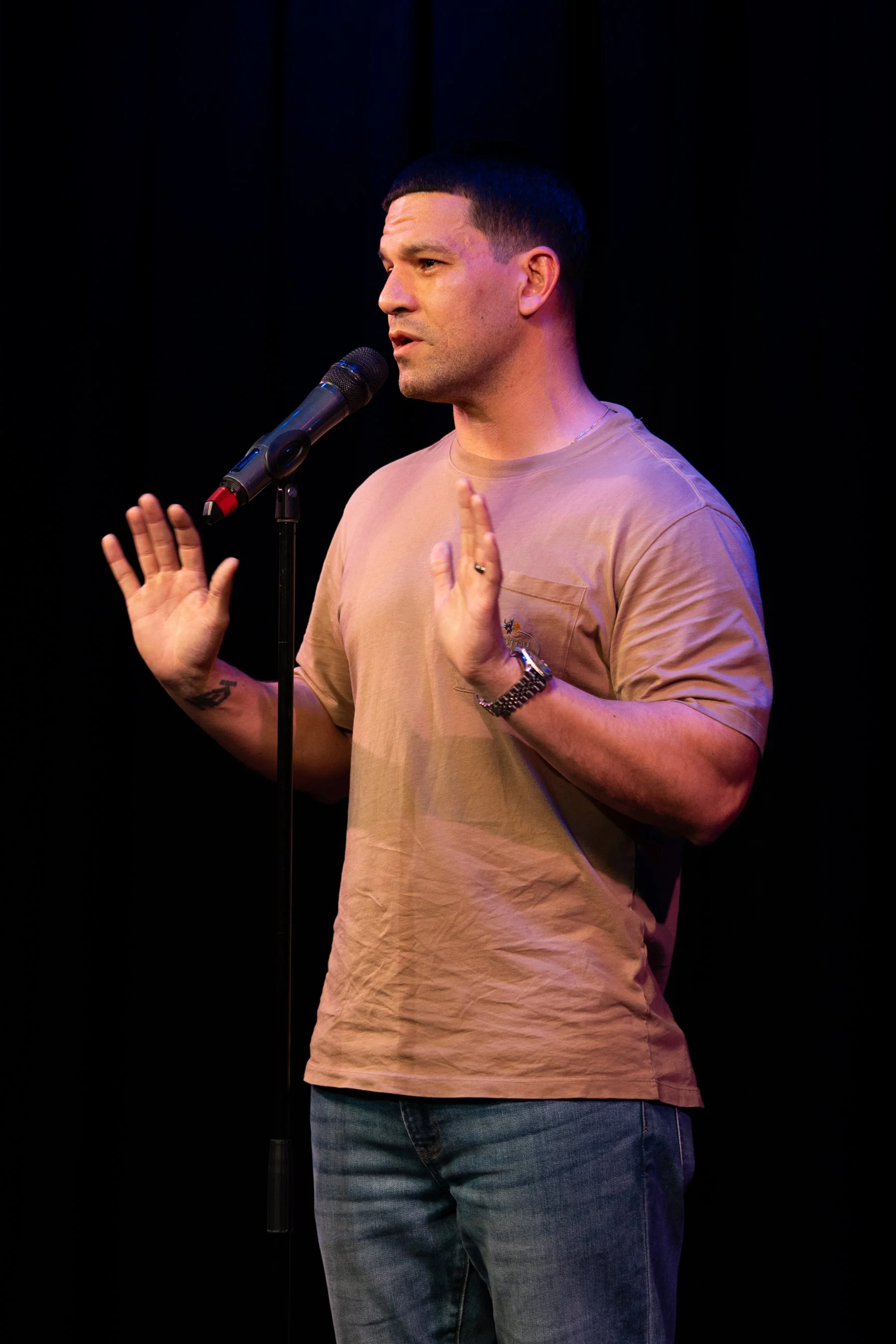
Ricky Ortiz shares his story at Caveat in New York, NY in April 2026. Photo by Zhen Qin.
As we stepped from the hallway into the room, I confessed to her that for the better part of the previous year, I'd been concealing a pornography addiction. Krista was in disbelief. She knew things were off between us, but she had no idea about the finances or the pornography. She was just beyond speechless. I mean, her eyes, once filled with hope and joy, now filled with tears and pain.
Watching her weep and cry herself to sleep that night, I knew I effed up. My relief quickly turned to chaos as fear flooded my heart. I was exposed. Everyone I loved and everything I had worked for was now in jeopardy. Just as Krista had confronted me hours before with no room to flee, my weaknesses had now confronted me. No more hiding. No more running away, Ricky.
As fate would have it, Krista had already booked a two‑week trip back to the Pacific Northwest to be with her family. Left with the uncertainty of our marriage looming over me, I decided to reach out to a professional therapist. I was terrified that I would spend the rest of my life trapped in addiction and deception and a destructive cycle of hurting the people that I loved.
As a Christian, I no longer wanted my life to be a violation of the virtues and the values that I publicly professed. I wanted my life and my faith to be congruent. As a husband, I wanted to do whatever I could do to save my marriage. And as a father, I wanted my daughter to grow up, knowing that her dad wasn't a total disaster or humiliation, even if my marriage couldn't be salvaged.
On March 14th, just one month after that Valentine's Day conversation, I began meeting with my therapist, Dr. Cha, to try and get to the root of my addiction to pornography, my spending problems, and my dishonesty. Six months in, after meeting with him nearly every other week, I asked Dr. Cha, “Why do I keep doing things that hurt the people I love the most so deeply?”
Without hesitation, Dr. Cha responded and said something that fundamentally altered the course of my life. He said, “Ricky, I think your whole life has been driven by the fear of abandonment. You're afraid that if people see or know the real you, they will leave you. This fear has driven you to incredible success, but it has also caused you to hide and conceal some destructive behaviors.”
As soon as he finished speaking, I looked him in the eyes and said, “Damn, you're right.”
You see, at 10 years old, my dad walked out on my family. He was there in the morning and gone in the evening without explanation. That experience both wounded me and affected me in ways that I didn't even know were possible. I convinced myself and told myself that if my dad could leave me for no reason, then anyone could leave me for no reason.
As the eldest child in a Latino family, I believed that I needed to be strong for my mom and strong for my brother and for my sister. They need me right now. I can't let them down.
Over time, those two beliefs morphed into this toxic combination of be strong for everyone or they will leave you. Strength for me meant never showing your emotions or opening up about your weaknesses. Naturally, I walled off my feelings and didn't let anyone in, including my own wife.
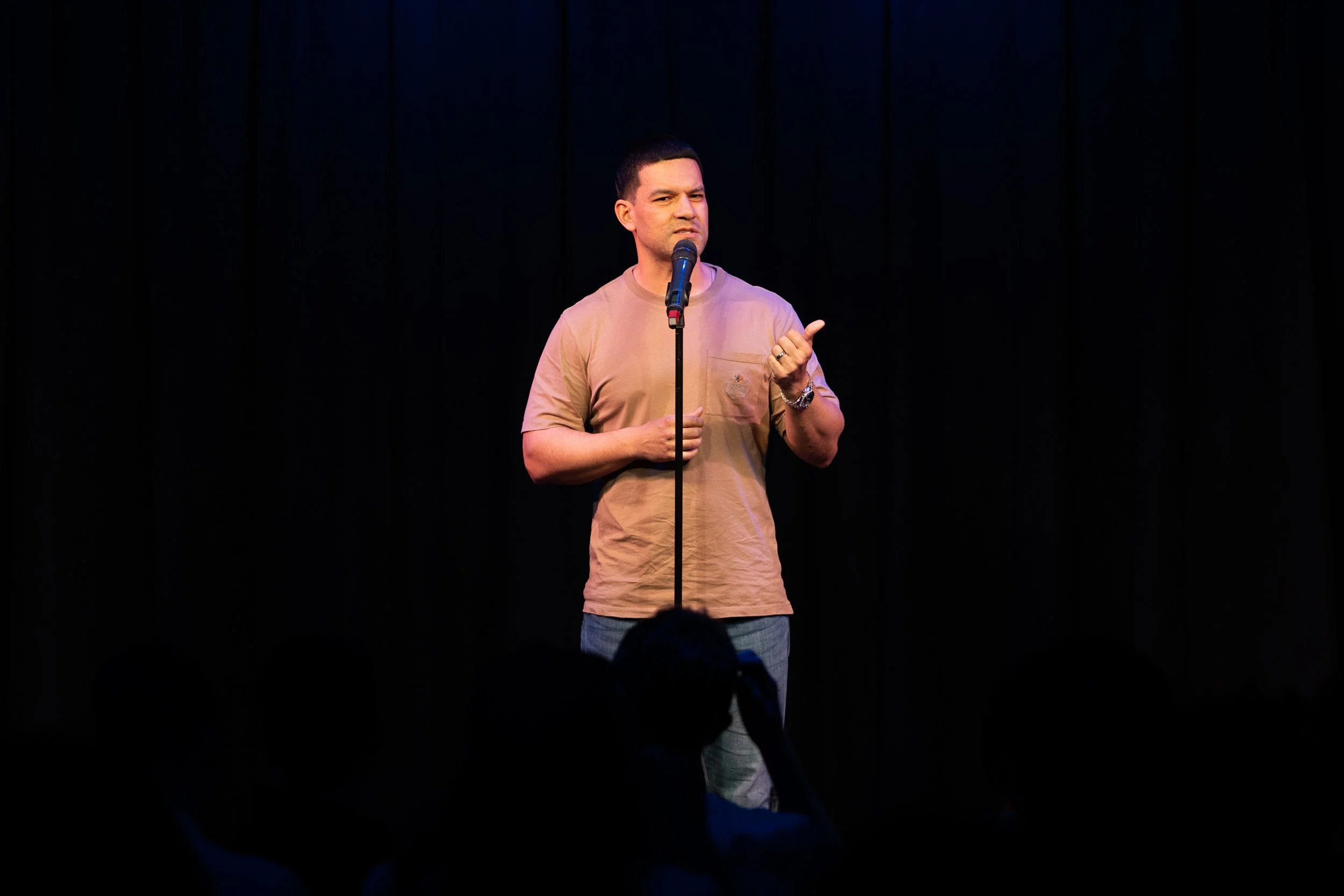
Ricky Ortiz shares his story at Caveat in New York, NY in April 2026. Photo by Zhen Qin.
But I realized that if I was going to change, I needed to be honest about who I really was. This was both new and intimidating to me, because honesty required vulnerability and vulnerability felt like weakness. I mean, how could I ever admit that I feel incapable or inept or that I want people to like me or, worse yet, that I'm afraid of people leaving me?
With Dr. Cha's help and Krista's support, I began practicing vulnerability in small batches. Statements like, “I feel anxious today because of the amount of work that I have to get done.” Or, “I feel this pressure that I need to be everything for everyone, including my wife and my daughter.”
I started writing these statements down in a journal and then speaking them out loud, first with Dr. Cha and then with Krista. As I did that, I sensed that I started to feel lighter, like a sense of relief and stability.
Shortly after learning to exercise this new muscle, I was recruited for my dream job at one of the largest and most influential churches in America. But I knew I had to be honest with them, no matter how brutal it was.
So I told the senior pastor everything, and I concluded by saying to him, “Listen, you're making an A‑plus offer, but at best, I'm an F‑minus player.”
To my surprise, he simply leaned forward and said, “That just makes me want to get you guys here sooner. How can we help?”
This newfound acceptance was so radical and so compelling. It motivated me to press in further to honesty and vulnerability because everything I ever longed for, to be accepted, to feel safe, to be loved fully, was on the other side of my honesty and vulnerability. The more I practiced honesty and vulnerability, the more I found freedom and healing.
But it wasn't just freedom and healing. Vulnerability began to reshape my understanding of strength. You see, I used to think strength was found in things like performance or achievement or appearing impenetrable, but that couldn't be further from the truth.
Strength is not me pretending I have it all together. Strength is not me stuffing down my emotions. Strength is me wrestling and grappling with my feelings, identifying what's caused me to feel this way, articulating it out loud to others and then inviting them to be a part of my journey and my story.
Real strength is the ability and the willingness to engage the whole of who I am, the good and the bad, the highs and the lows, the presentable parts as well as the messy parts, and say to the world, “This is me, all of me.” That is the kind of strong that I want to be.