In this week’s episode, both of our storytellers reckon with what happens when success doesn’t come so easily anymore.
Part 1: After years of academic achievement, newly minted professor Stephanie Rowley is caught off guard when every paper she submits is rejected.
Stephanie J. Rowley is the William R. Kenan Jr. Professor of Education and dean of the School of Education and Human Development at the University of Virginia. Before returning to UVA, where she earned a Ph.D. in developmental psychology, she was provost and dean at Teachers College, Columbia University. Rowley has won numerous awards for her research, teaching, service, and mentorship. Among her most valued awards have been those received for her outstanding mentoring of students. She currently lives in Charlottesville, Virginia with her husband, Larry, whom she met when they were graduate students at UVA.
Part 2: Growing up, Kate Schmidt always thought of herself as the “smart kid,” but that identity is shaken when she gets to university and receives her first C.
Kate Schmidt is an early childhood educator and planetarium pilot at the American Museum of Natural History who specializes in teaching 8 year olds astrophysics. She has worked in the museum field for over a decade, is on the board of the New York City Museum Educator Roundtable, and has finally figured out that her job is just: Museum. Outside of work, she is the host and producer of Astronomy on Tap and Biology on Tap - monthly events that bring scientists and the public together at the bar. Most importantly, Kate is a deeply unserious person who firmly believes in the power of whimsy. Oh, and her favorite planet is Jupiter.
EPISODE TRANSCRIPT
PART 1
In 1992, I was a doctoral student here at UVA, and I was in my very first doctoral course with Bennett Bertenthal. The class was Intro to Cognitive Psychology. I love this class. I have to say, I aced the first exam, and that exam led to a great conversation with Bennett, where he was just trying to get to know me. I was sharing with him how I ended up at UVA and some of the things that brought me here.
I'll never forget, he said in that conversation, "You know, Stephanie, you've lived a charmed life."
And I thought, "What does that mean exactly?" Even now, I think back to this so often. I think that what he was referring to, given the context, was really that I had been very successful in my applications to graduate schools and getting fellowships and just lots of opportunities that were open to me. So I could kind of see his point that I had been successful and had been very fortunate.
Even after that class was over, I continued to meet up with Bennett from time to time as an informal mentor. So toward the end of my time at UVA, he came to me and said, “Stephanie, I have just the job for you. UNC Chapel Hill is looking for someone who does exactly the type of research that you're doing and I think that you should apply.
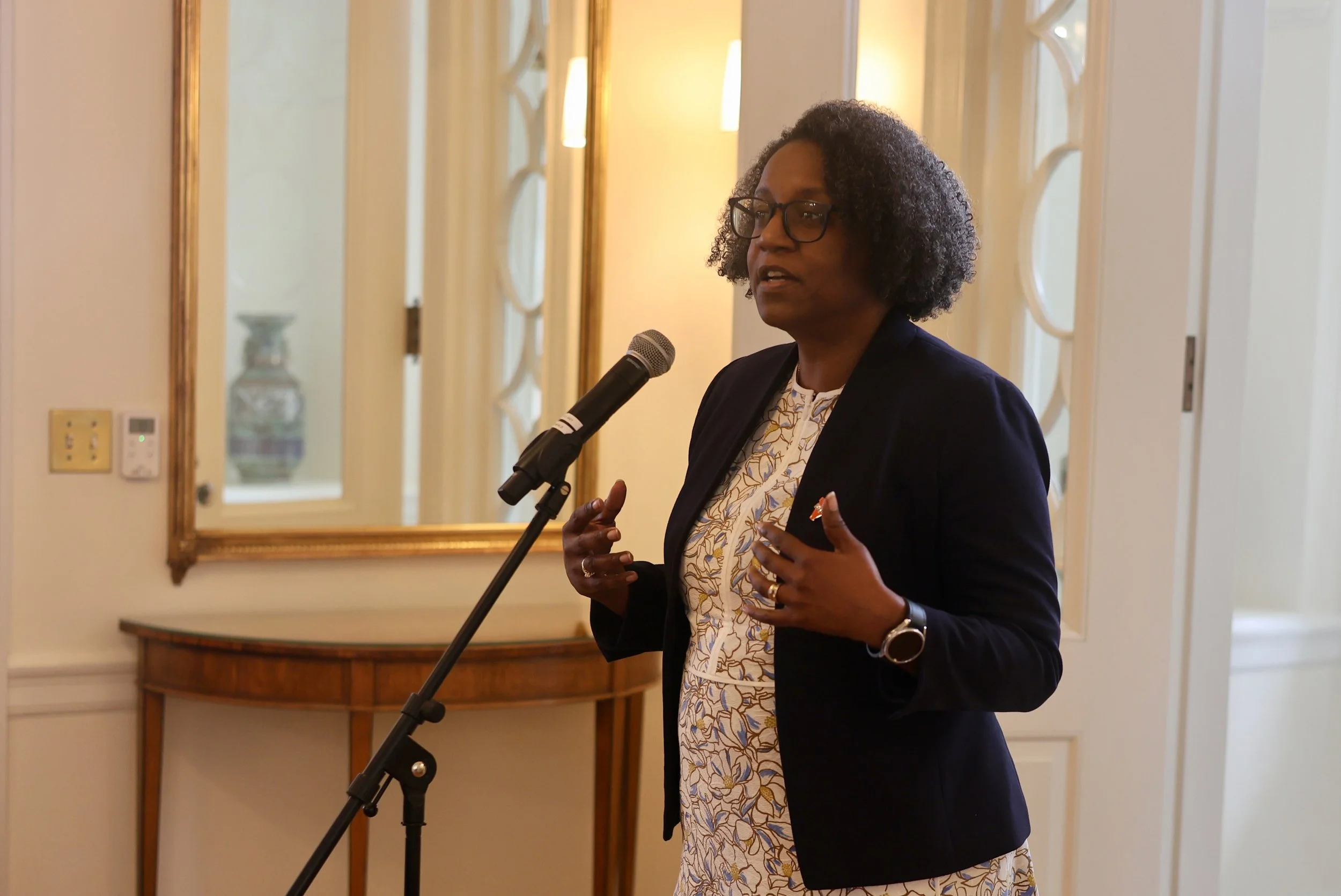
Stephanie Rowley shares her story at Carr’s Hill at UVA in Charlottesville, VA in April 2025. Photo by Meredith Cole.
So I did apply, and I got the job and it was amazing. So exciting because this was really the dream, to get a tenure track job at a top institution right out of graduate school. To be honest, I felt really well prepared for it. I had lots of publications, I had taught my own courses, I just felt like I was ready for this tenure track position.
In addition, I was able to negotiate this really sweet deal where I didn't have to teach for the first year. I could just focus on my research and getting it kind of launched in the first year. So, I decided to take advantage of the opportunity. Send out a bunch of papers, write a grant proposal to the National Science Foundation, and that's exactly what I did.
So I got several papers out the door in that first year and was feeling good. This was the ‘90s and the publication process was incredibly slow because, of course, we used snail mail, if you can imagine. You would print out the manuscripts, multiple copies, send them off to an editor. The editor then would distribute them to expert reviewers who would then write down all of the strengths and weaknesses of the paper, send that back to the editor, and then the editor would make a decision. Accept the paper, reject the paper, or maybe kind of the sweet spot was revise and resubmit. So they were inviting you to fix the paper and send it back and probably get it published. All of this took like six to 12 months, because of the snail mail.
And so I sent these papers off and then turned to my NSF grant, wrote the proposal. Didn't think much of it. Then one day, I went to my mailbox in the psych department and there was this very ugly envelope. I don't know what happened but it looked like a truck had rolled over it a few times. All of these postal markings on it and I saw the return address.
I said, "Oh, this is the review from my first paper."
So I was on my way to a meeting. I took the envelope with me. I opened it just before I got in the room. I scanned the letter very quickly. I didn't read any of the detail, just looking for the bottom line. Were they going to publish it or not? And I saw the words, "Unfortunately, I cannot publish this manuscript in its current form.”
Okay. Not terrible.
“And because it's doubtful that even a major revision would make it publishable, we're not even going to invite a resubmission.”
This is my first paper. I was devastated.
I'm headed into a meeting, and so I get into the meeting and my hands are shaking. I was super nervous. I just put everything back in the envelope and put on a big smile and pretended like nothing happened.
Got back to my office, stuck it in a drawer, walked away.
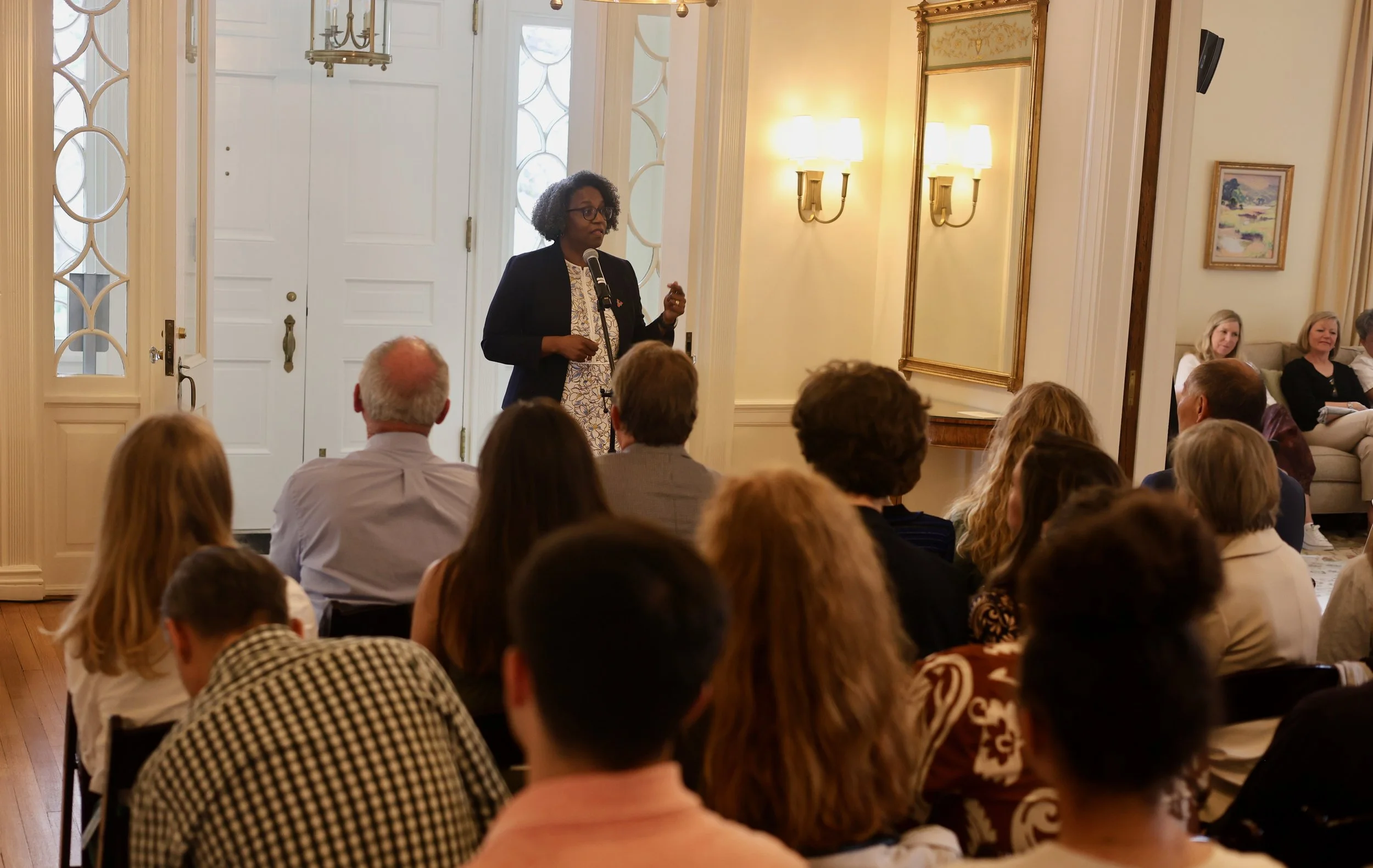
Stephanie Rowley shares her story at Carr’s Hill at UVA in Charlottesville, VA in April 2025. Photo by Meredith Cole.
Then two weeks later, I thought, “You know, I should probably know what's in the letter. I should probably think about whether or not I could do something with this paper.”
So I read the letter. Basically, it said I hadn't done a very good job of motivating the paper, of describing why the questions were important, of showing why this would add to the scientific literature that was out there, or how people might apply it to help people live better lives.
It also said things like, my writing was clunky and a little disjointed. And the real killer, it reads like a dissertation.
I thought, “Oh, my goodness, they know. Here I am in this fancy job and I don't know what I'm doing. I just got here, and they know.”
So I thought, “But yeah, it's the first paper. I'll keep going, I've got two or three other things in the pipeline.”
But then they came back. Not revise or resubmit but reject. Reject, reject.
And I thought, “Okay. I'm in trouble. I've got this fancy job and I've told everybody I'm doing this really important work, and I've got a ton of publications. So how in the world had I been so successful?”
I had this fatal flaw, which was that I was not a very good writer, apparently. So then I had to think, what happened?
So I went back over my graduate school years here at UVA. What I realized was that the thing that was my strongest asset was actually my biggest weakness. I was amazing at statistics, loved statistics. I was the statistics girl. I took every statistics class we had. I actually TA'd our advanced graduate level statistics. I spent four years as a statistical consultant at the help desk, which means that I was actually a consultant to many of the faculty around campus grounds, and yet I was not a great writer.
So what I realized was that in my version of science, I was the statistics person and other people in my team were writing the conceptual parts of the paper. That meant that I had underdeveloped that particular skill that is so critical to helping people understand the importance of the work that I was doing.
Now, I had to figure out what in the world do you do about this? So, fancy job, charmed life, the whole nine, and I had to get some help, which means that I had to be vulnerable. I had to tell somebody.
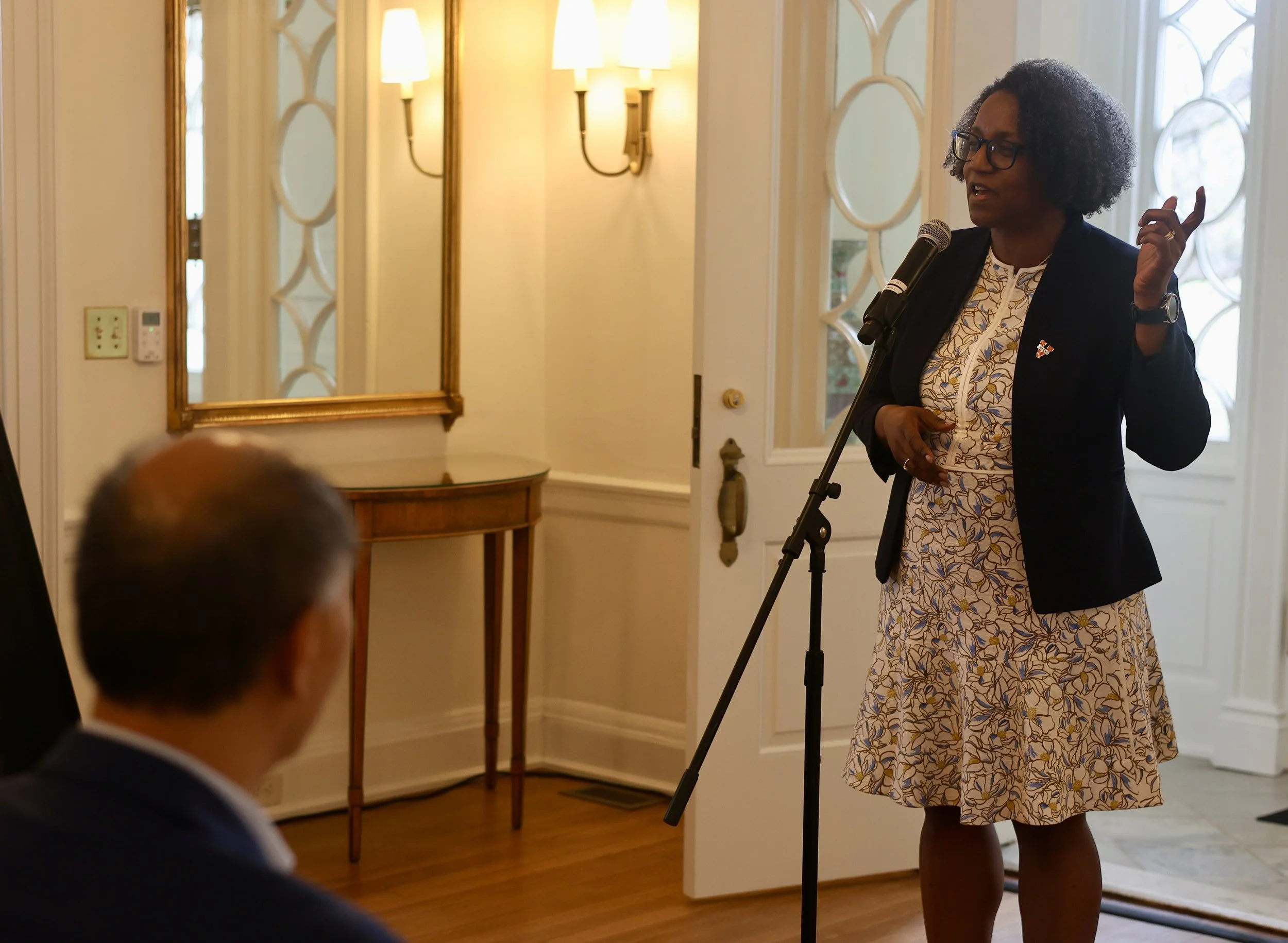
Stephanie Rowley shares her story at Carr’s Hill at UVA in Charlottesville, VA in April 2025. Photo by Meredith Cole.
So I thought, “Well, I'm not telling these people who just invested in me and hired me. I'm going to tell my friends from graduate school,” which was also difficult, because I was the oldest, most senior in my lab and people looked up to me.
But I told them, “I'm not a good writer and I need some help. Could you read my papers for me before they go out for publication?” And my friends agreed.
So we had this sort of exchange program going where I'd send my papers to them and they'd send theirs to me, and they would give me the harshest feedback possible. It really helped me to understand where I was going wrong and how to improve my writing. Certainly, it added a lot of time to the publication record. So if you look at my CV, don't. Don't look.
But if you look, you’ll see there was a very, very slow start because I had this extra step. But, over time, over two or three or four years, those editorial letters started coming back with acceptances. I was on my way and I felt pretty good about it. So eventually, I got tenure.
Now, I feel pretty confident about my writing here 25 years later. I still think about those weaknesses from the beginning and I go through that mental checklist when I write a paper, and I still remember my 2000 single‑authored paper that was published that wasn't the best paper or in the best journal, but I knew that it reflected a lot of hard work and a lot of humility.
PART 2
From the day I was born, I was told I was special. My mom had a very rough childhood, which meant having a kid was both physically and emotionally difficult. I was her only child and she was my only parent.
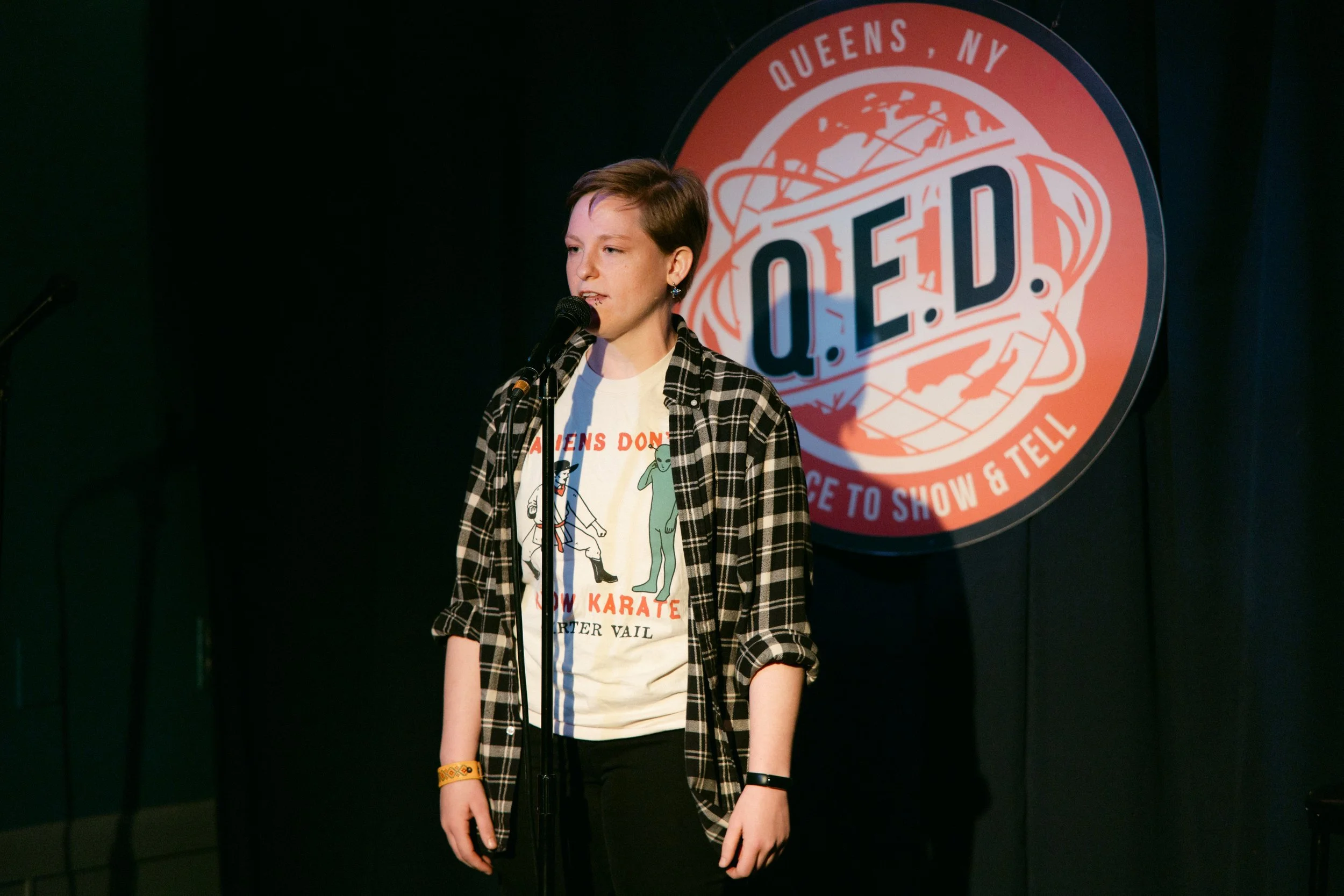
Kate Schmidt shares her story in May 2025 at QED Astoria in Queens, NY. Photo by Arin Sang-Urai.
I grew up in Southern California in a suburb of Los Angeles. And because I was special from a young age, I was put in a gifted and talented education program. I was actually really lucky in elementary school to have excellent math teachers, particularly Ms. Rock, who was not just a good math teacher but was really good at telling me that I was good at math, which I don't think a lot of little girls get to hear.
I was also a highly competitive kid and constantly vying to be the smartest person in the room. See, my mom didn't just want me to be special. She needed me to be special. I was her lifeline. We struggled a lot financially when I was a kid and you kind of internalize that, and you see yourself as the financial burden.
The other thing is when you're an only child of a single parent, you're kind of the only other adult in the room, whether you're 5, 10 or 15. So, I grew up being special.
California was hit with a little recession long before the 2008 crisis. Our family would be hit hard and, in 2006, we would move to a place that was more southern than Southern California, to the middle of Arkansas. I was 12 years old on the verge of being a teenager.
Moving to Arkansas was insane. It was a massive culture shock. I went from being a minority in my class, to going to a school with two black students in it. I went from living in a place that had mountains and deserts and oceans nearby to a flat landscape. I went from living in a place where it rained once a year to a place where tornadoes were a regular occurrence.
But there were two things that were the same. The first was the night sky. When I first moved to Arkansas, I soon learned that I could push the screen out from one of my bedroom windows and I could sit out on the roof and I could see Orion. He was the same Orion that I had seen in Southern California. Instead of peeking over mountaintops, he peeked over a flat landscape, but he was still there. He still rose higher in the sky as we got closer to winter. He still chased towards the bowl with his bow and arrow, his dog Sirius still followed him.
As I sat on that roof, I wanted to know everything about Orion. More than that, I wanted to be a part of Orion. I wanted to be a star in Orion's Belt, because I wanted to be off this planet. I wanted to be away from this stupid state with its stupid flatness and its stupid mosquitoes.
In high school, my mom needed me to be special more than ever. My mom ended up having a surgery and, like many Americans at the time, was prescribed painkillers and one ended up addicted to opioids. Then more than ever, she needed me to be special.
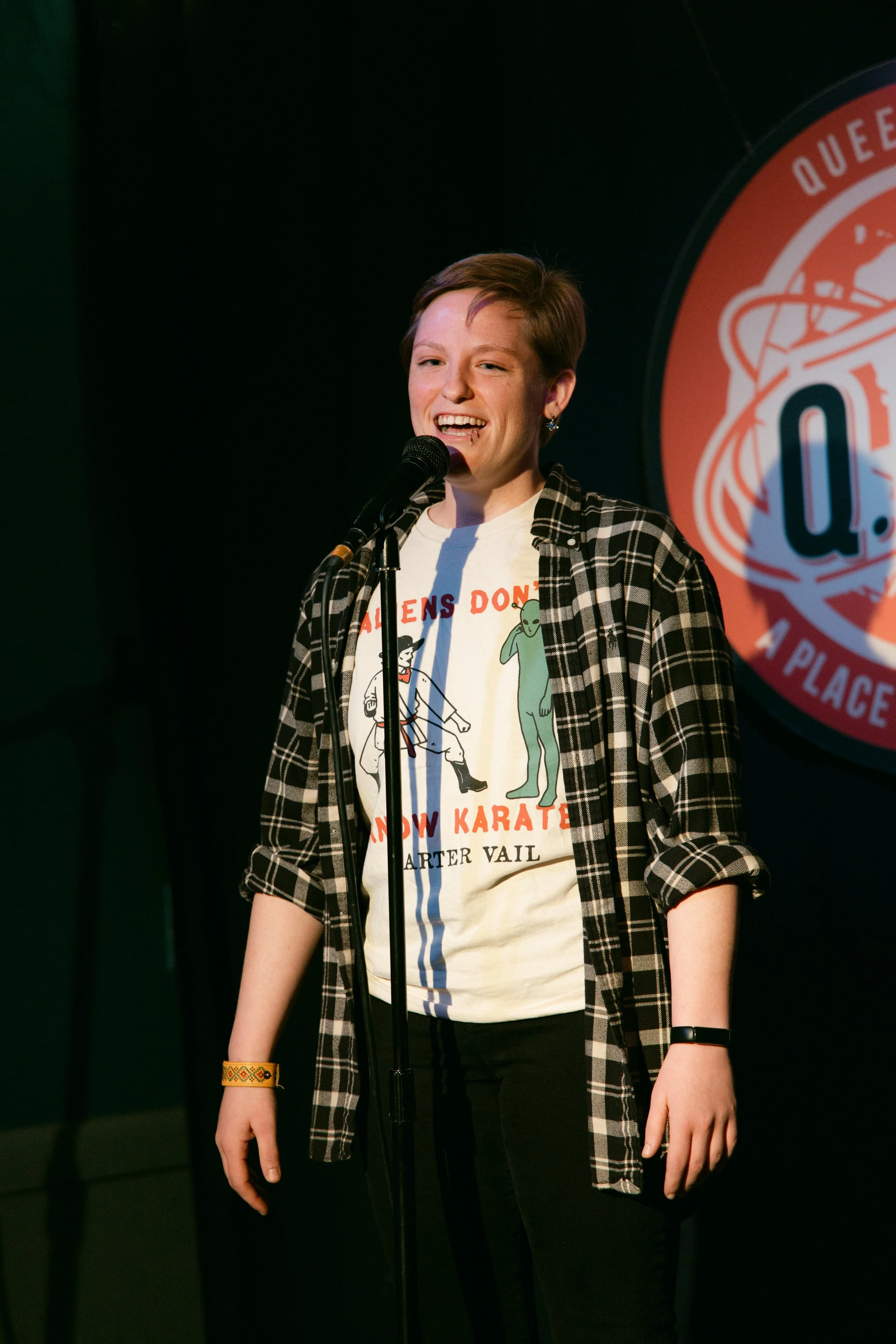
Kate Schmidt shares her story in May 2025 at QED Astoria in Queens, NY. Photo by Arin Sang-Urai.
I took every AP class my high school offered, I got straight A's, and I would graduate high school valedictorian. I would then move a thousand miles away from Arkansas, two thousand miles away to from California to Rochester, New York to study physics and astronomy at the Rochester Institute of Technology.
Now, the first thing I'll say about Rochester is I do not recommend trying to study observational astronomy in one of the cloudiest cities in the country. There is a reason I did not go back there last year for the solar eclipse. But even when the clouds parted, Orion was still there. And as I went through my degree, I started to learn more about the actual stars that made him up. Betelgeuse was this dying red star, Rigel is this bright, hot OBA star. The middle star of Orion's belt is a stellar nursery. Within one constellation, you could track the entire life of a star.
But something had changed when I got to college, something that was pretty evident in one of my first classes. See, many physics students take a class called special relativity, which is all about the relationship between space and time and how the speed of light is kind of the bridge between the two. The speed of light is denoted by the letter C, which is the grade I got in that class. It was the first C I had ever gotten. It was average. I was average? No, that can't be.
I cried. I was devastated. I remember walking to my professor's office finding some way of bargaining with him. Yeah, that would work. I ended up being too afraid and just walking home.
But that C would set the stage for much of my physics degree. All of a sudden, I was in a place where I was not the smartest person in the room. In actually most of my physics classes, I got C’s or D's. I wasn't even average, I was below average. And I was in a highly competitive room.
Physics, to this day, is still heavily male dominated. I was one of two women in my entire program. I was the only queer woman in the program. And when you're surrounded by a bunch of men trying to be the smartest person in the room, there's no room for weakness. This is a culture that did not allow for asking questions in class. This is a culture that did not allow you to be wrong. This was a culture that was incredibly unkind to women.
I remember one time, we were in this place called the Physics Activity Center, which was supposed to be like a little physics community hub. It was really just a competition room. We were all sitting around working on a homework problem and trying to solve the same problem, and we're all stuck in the same way. I suggested a possible solution and everybody in the room, who were all men, brushed it off.
Then Ryan Scott, who was sitting right next to me, about five minutes later suggested the exact same thing. And I called him out on it. I said, “Hey, man, I just said that.” What I was expecting to hear from the room was something like, "Oh, I'm so sorry. Oh, we didn't hear you. I wasn't paying attention." And what I got was, "Stop being so bitchy, Kaitlin."
At the time, I internalized that. Looking back now, I'm like, "I was not being bitchy." But at the time, I thought I was. I was stupid. I was bitchy. I was below average. I was no longer special.
I stopped answering the calls from my mom because I couldn't tell her I was failing. I stopped answering the calls from all of my family, because my whole family saw me as the smart kid and I was no longer that. I had lost an entire identity in two years of school.
There was one night I was thinking about it a lot. I sat on my shower floor crying, thinking about how I wasn't who I was anymore. And if I wasn't special, if I wasn't smart, then who was I? I was nothing but a burden, a burden on my mom, a burden on this school, a burden on the idea of physics. Honestly in that moment, I wanted to be nothing rather than a burden. I seriously thought about ending my life that night.
I ended up crying in the shower most of the night and eventually went to bed and woke up the next day. For the rest of my junior and senior years, though, I didn't go to many of my physics classes. I did, however, go to my electives, which were astronomy and math classes. These were classes that were taught by women. These were classes that had other women in them. These were classes I felt comfortable raising my hand and being wrong. These were classes I actually got A's in and I could feel some semblance of that special identity back in me.
I was really lucky that my university astro professor, Dr. Jen Connelly, ended up being my mentor at RIT. I would spend many nights at the RIT observatory with Dr. Connelly studying a cataclysmic variable star and, eventually, I would get to go to Kitt Peak, Arizona and use the 0.9‑meter WIYN telescope to study the same star.
Dr. Connelly would even help me get an internship at the Rochester Museum and Science Center in the planetarium there. I felt like an Apollo astronaut in that planetarium, fussing with dials and twiddling knobs and moving this giant ecliptic arm that crossed the dome. And people would come up to me after my planetarium shows and ask me questions, and I actually knew the answer to them. I was starting to build a new identity, one that wasn't wrapped up in being the smartest person in the room, but one that was wrapped up in just teaching people about space.
I quickly realized I liked talking to the general public a lot more than I liked talking to my peers. I would end up running a program called the Night Skies Program and we'd put telescopes up on the roof of the museum. There was one night we had this eight‑inch Celestron and we're looking at Jupiter. We were lucky that the great red spot on Jupiter was facing us that night.
There was this 70‑year‑old woman who came up and she looked through this telescope and she asked me what that red spot was. I told her it's this massive hurricane, about one‑and‑a‑half times the size of planet Earth that's been raging for hundreds of years. And what you're doing is looking at weather on a different planet.
I watched her eyes grow wide in astonishment. She told me it's one of the most amazing things that she had ever seen. And that moment sticks with me.
A lot of observational astronomy students take a look at Jupiter and it eventually becomes mundane, but to that woman who had lived a lifetime it was amazing. And I had the power to show her that.
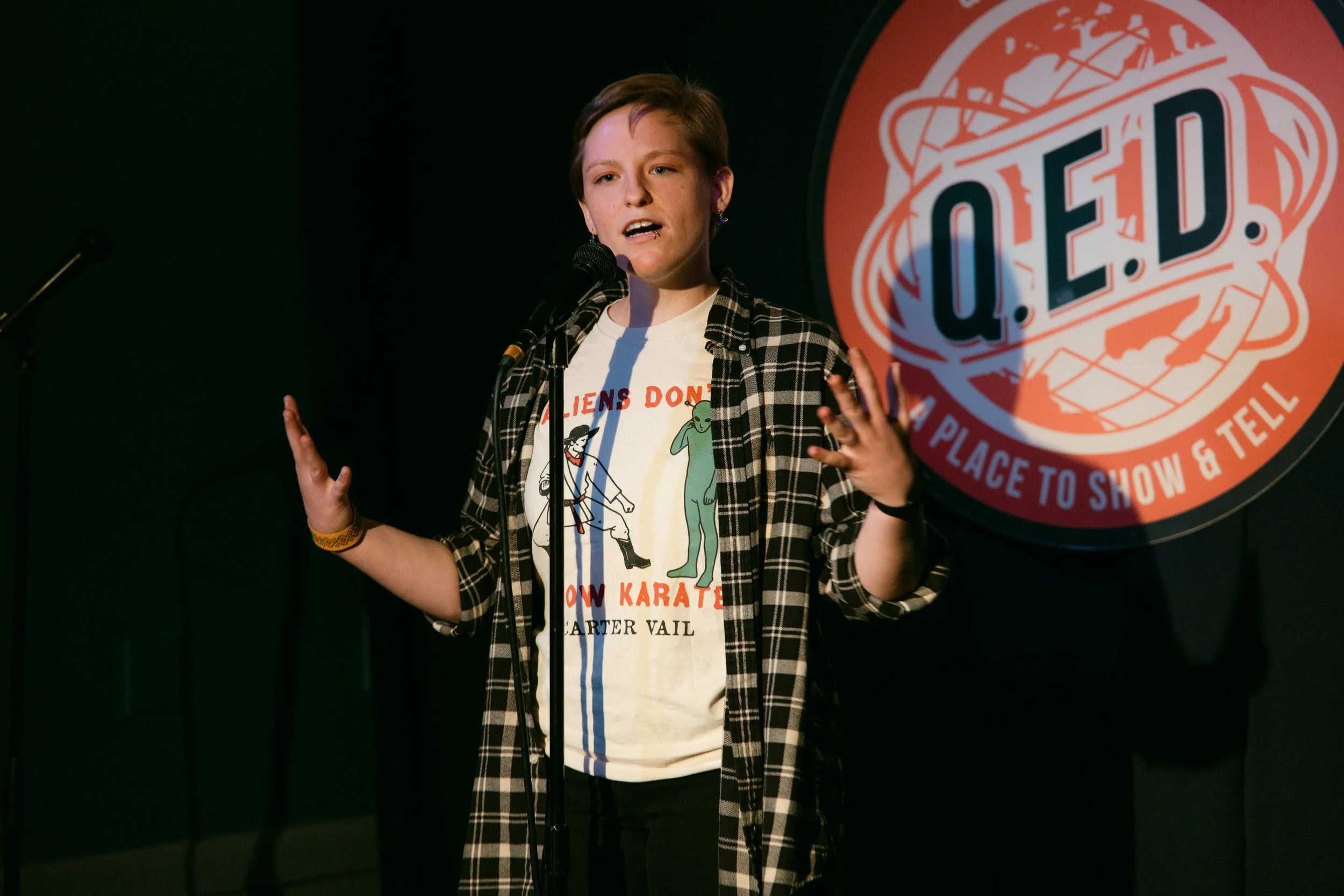
Kate Schmidt shares her story in May 2025 at QED Astoria in Queens, NY. Photo by Arin Sang-Urai.
I would eventually get a job at The Franklin Institute after I graduated college, barely. It was my job to go on stage in front of a bunch of children and blow stuff up and make them happy with science. There's nothing quite like the ego boost of 100 fourth graders all chanting, “Kaitlin, the science guy,” to the tune of Bill Nye.
I had started to build a new identity for myself, one that was not wrapped up in being the smartest person in the world, one that didn't need to be special, but one that was a science communicator, one that was a crocheter, a Lego enthusiast, an avid fan of the Philadelphia Eagles. My identity now contains more than just one thing. It is multifaceted and changes and morphs as the world changes and morphs around me.
And, in my time, I've come to learn that I am pretty special. See, when you study astrophysics, one of the first things you learn is scale and distance. The universe is really big, like one of the biggest things out there. In fact, the closest star to us in Orion is Bellatrix at 244 light years away, which means it takes the light from that star 244 years to reach us.
Our universe is really big. And as far as we know it, planet Earth is the only part of the universe that has life. We are the only part of the universe that can think about the universe. To me, that's pretty special.
Thank you.