In this week’s episode, both our storytellers come face to face with the growing power—and pitfalls—of artificial intelligence.
Part 1: When AI takes over comedian Kyle Gillis’s job, he takes it personally.
Kyle Gillis is a Brooklyn-based comedian, musician, and Guinness World Record holder from Atlanta, GA. His stand-up highlights the contradictions of modern life—work that feels meaningless, a culture obsessed with productivity, and the absurd ways people cope with both. His act blends grounded emotional honesty with controlled chaos.
Part 2: While researching an AI model, engineer Omiya Hassan discovers one major problem: the amount of energy it’s consuming.
Dr. Omiya Hassan, born and raised in Dhaka, Bangladesh, is an Assistant Professor in the Department of Electrical and Computer Engineering at Boise State University. She is also the principal investigator and director of her research lab, "LPiNS: Low-Power Integrated Circuits and Embedded Systems," where her team's primary research focuses on solving the energy-demand problem of Artificial Intelligence (AI) accelerators and high-computation hardware. She completed her PhD in 2023 from the University of Missouri, focusing on building power-efficient AI hardware architectures for biomedical applications. Dr. Hassan also holds a professional degree in Music majoring in Vocal and Classical South-Asian Music. If you tune in to the national radio and national TV of Bangladesh, you might hear or see her sing the songs of Tagore. Besides teaching and researching at Boise State, you can find her hiking in the mountains, sharing cold sandwiches with her friends, or trying to ski but falling miserably with no shame during weekends.
EPISODE TRANSCRIPT
PART 1
My name is Kyle. I am the dumbest person in my immediate family. I come from a family of geniuses and scholars, and I am a professional comedian. But I am uniquely qualified to answer the question, “What do I do when an AI takes my job?” I was one of the first, I think, and I can tell you what to do when it happens to you.
Our story starts in about 2017. I am working for what we could describe as a non‑essential business. I work for a business that makes novelty socks with people's pets on them, and it is ruining my life from the inside. You ever wake up in the morning stressed about just how many people's Christmases you're going to fuck up this year? That was my 2017. It was just pulling my hair out thinking there's going to be a lot of people with a blank spot under their tree because of me. It was just eroding my mind.
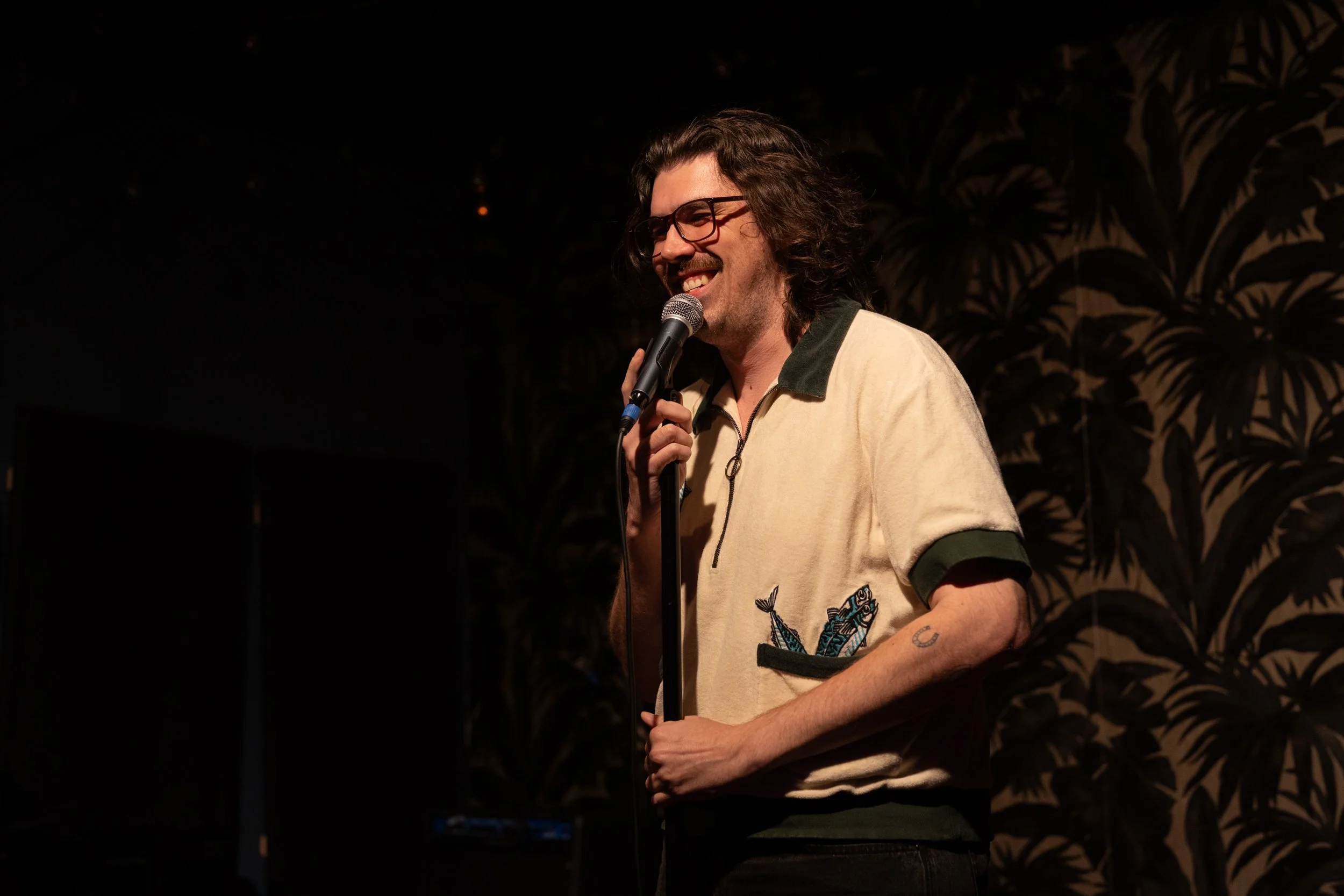
Kyle Gillis shares his story at Young Ethel’s in Brooklyn, NY in October 2025. Photo by Zhen Qin.
And I got called up to this meeting to take a look at the future. They wanted to show me the future. So I come into my boss's office, and the thing you got to understand about my boss is that I love this man almost as much as I fear him at the time. I am terrified of this man. I met him at the worst point in my life and we bonded over being young guys who had dropped out of college around the same time. I didn't realize that we were more different than we were alike. See, he had come from a background of old money and so he was raised with the mentality of when you see a problem, just throw money at it until it goes away.
And I was raised middle class with the idea when one of these people like you, you sink your claws into that so that you could be stable for a while.
So I'm getting called in to see the future, which usually means, “Hey, here is some idea we have that’s not going to work and it's about to be your problem.”
So, I get in there and this is different. What I'm seeing is the future. And what I'm about to be s the past. I'm looking at an AI that can do my job supposedly very well. It doesn't even have to do it that well to do it better than most of the people in my department, to be honest. At this time, I'm head of quality control, which is the department of looking at dicks, not recreationally, like, for a purpose.
So we had this program where you could email us any picture. We'd print it on a sock. And some guy at some point was like, “Any picture?” I had to be the one to say, “Not any picture.”
And I didn't have creative control here, mind you. If they left it to me, we would have printed all of those. I give the customer what they want. But there is this idea on the internet where once people know that you're the company that puts dicks on socks, then you pretty much only do that for the rest of your lives. They would have had to pay us more for that, I guess. So we were the brave, the few, the dick checkers.
I come in and they have trained this, I guess, this neural network of sorts to tell the difference between dogs and not dogs. And it's doing kind of bad. It's doing it to a degree of proficiency that in 2017 you're seeing the computer doing it, you're like, “This is going to threaten me some day.”
But if like a human child went, “Dog,” you'd be like, “Oh, sweetie, no. Not that one.”
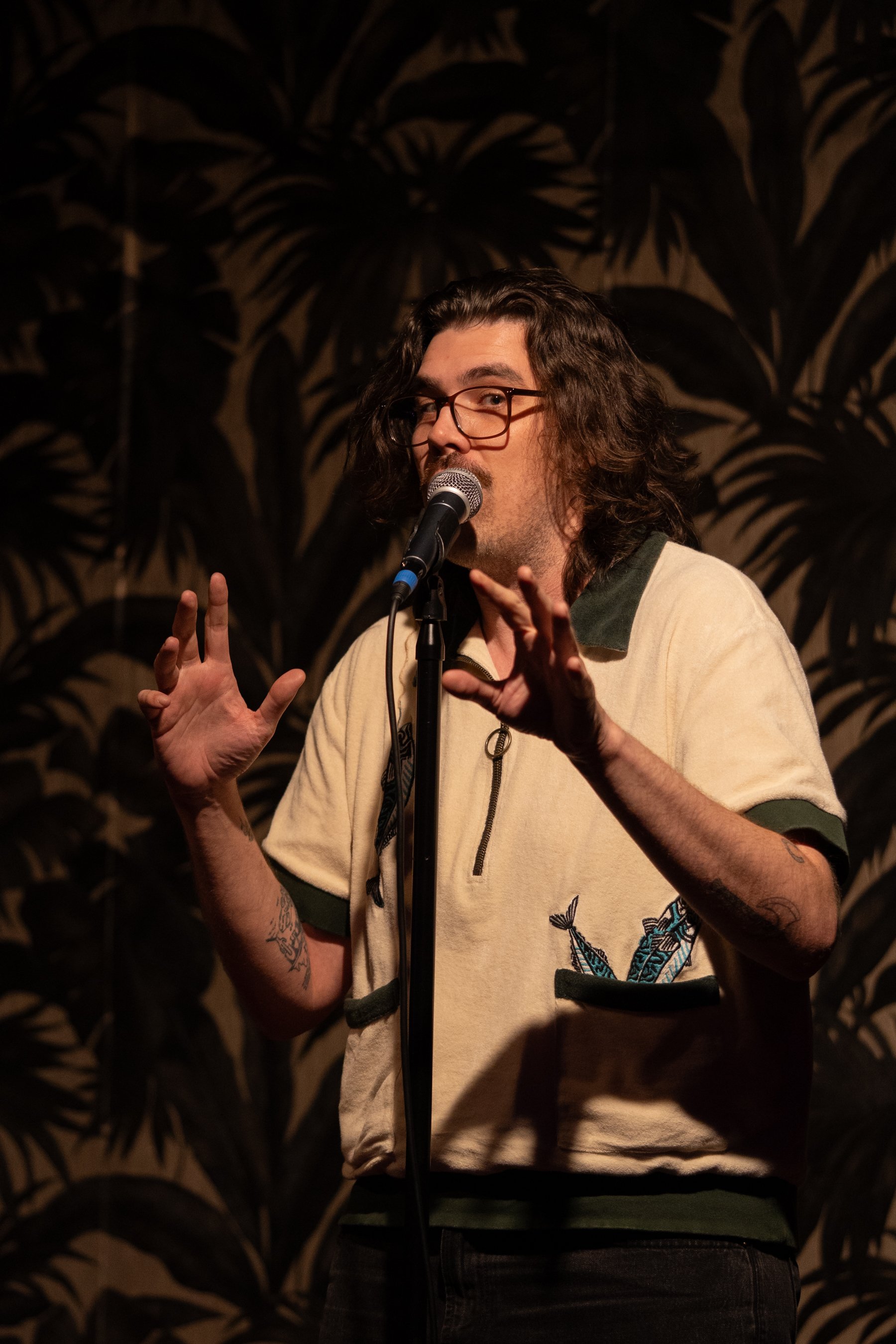
Kyle Gillis shares his story at Young Ethel’s in Brooklyn, NY in October 2025. Photo by Zhen Qin.
So I have this idea in the back of my head that I am on borrowed time. It does not matter when this thing can do my job. Someday it will. The good news is I didn't have to think about that for long because it was like two weeks. It was maybe two weeks and then they laid off our entire department.
Now, I stayed friends with the one guy they kept and I asked him how it was going. It turns out, about three months later, they hired a bunch of new people for less money to fix the computer’s work. They figured out that it just couldn’t do it.
That was when I was first introduced to this very real concept of your biggest threat isn’t an AI doing your job better than you. Your biggest threat is your manager not knowing enough about your job to know what it takes to do it successfully. The idea that graphic designers are missing out on work isn’t because graphic design is easy. It's because taste is rare. It's a different concept. Half the job of a graphic designer is to know Photoshop and the other half is to listen to a small business owner’s batshit ideas ago, “Okay, but what if we do this instead?” And we're just getting rid of these people at a breakneck speed.
So I made it my goal over the next several years after that to become independently employed because I knew it was just going to keep taking all the good email jobs. It's just going to keep taking all the jobs where you just check an email or make a logo or a website. The only thing we're going to have left is like shoveling horse shit in the park or something.
So I saw this coming and now I have gotten to this point where I almost take it for granted that my job is to just be obnoxious online and hope people pay attention to me. It is kind of a blessing. I didn't think that AI would ever come for my job, because like how? How would you train an AI to do what I do?
Then I found out that a local comedy club had fired their in‑person comedy teachers and launched a chat bot on their website that was marketed as like a comedy expert. I was unemployed enough to try to reverse engineer the thing.
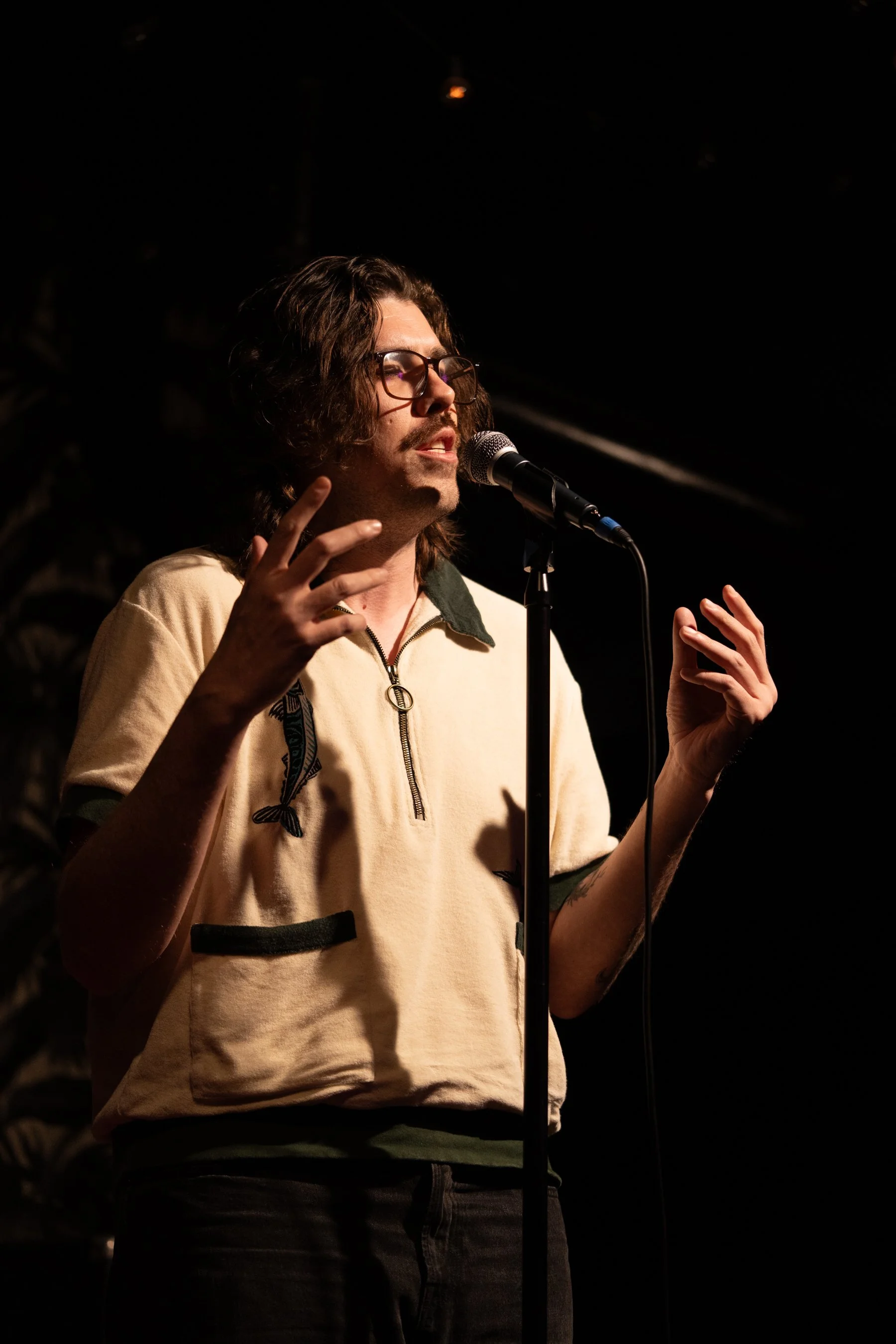
Kyle Gillis shares his story at Young Ethel’s in Brooklyn, NY in October 2025. Photo by Zhen Qin.
So I got onto it, and I wasn't going to spend any credits but I know something about LLMs which is if you ask the right questions, you can get them to parrot their source material verbatim. So from like 30 seconds of talking to the thing, I figure out that it has plagiarized a bunch of stuff from Gary Gulman, who I don't know personally but I know people.
So in like two hours’ worth of DMs, I've got the guy and his wife talking to me. I'm like, “What are we going to do about this?”
I don't know what Gulman said to these pieces of shit, but I know that they deleted all evidence of the matter immediately afterwards, including the post criticizing me for taking things too seriously. There is no such thing as taking things too seriously. Life is inherently meaningless until we assign meaning to it. I'm sorry I put my eggs in a different basket, jackass. That was my choice. That's kind of what I'm doing with my free time these days.
I guess if I could just give one piece of advice to anyone who finds themselves in my position is that you don't need to make yourself more valuable to the whole world. You don't need to be famous. You don't need to become irreplaceable. What you need to do is get really good at convincing small business owners to fear the things that you fear. I realized that my greatest technique for staying employed until I can just live off of my art is going to other small business owners and going, “Hey, this AI shit seems pretty crazy, right? Seems a little weird. I can explain if you want.”
I have become an automation doomsday prophet for law offices in the last 13 months. And this is my first time admitting this publicly, that my backup, if this whole comedy thing doesn't work, is just identifying small business owners and going, “The terror is coming. Are you with us or against us?” It's going pretty good so far.
In conclusion, if robots ever get rights, I will be considered problematic. Terminator 2 Judgment Day was my Birth of a Nation. It was a radicalizing moment for me. There was a delayed reaction to that one.
Okay, you guys have been fantastic. Thank you so much.
PART 2
I traveled 8,100 miles, over 24 hours, two checked‑in bags, one backpack to pursue my dreams, which is getting my PhD degree traveling from Bangladesh to the United States. I left behind my family, friends, and the umami‑filled, good, Bangladeshi food. Man, I miss it. I'm a foodie, okay?
But upon setting my foot here in the United States, I was mesmerized by the vast blue sky you have here. Instantly, I became friends with it. So whenever I missed home, whenever I missed my family, I used to bike around the park, sit under a tree, and stare at the sky for God knows how long.
Back in 2018, I started my doctoral degree in the University of Missouri, Columbia. So Missouri also has a Columbia, just as it has Mexico and Paris as well. You guys can Google it. And my dissertation topic was designing and developing a lightweight, wearable, intelligent biomedical device.
Whenever we hear the word “intelligence” or “intelligent”, artificial intelligence is involved, aka AI. For those who don't know what AI is, it's basically a mathematical model where we feed in tons of data and train over time so that later, after training, when we give it data, it can classify and predict.
For example, if you train it with hundreds and thousands of dogs and cats and rabbits, if your model is trained correctly, if you give it a very cute corgi dog, it should predict a dog instead of predicting it as an elephant.
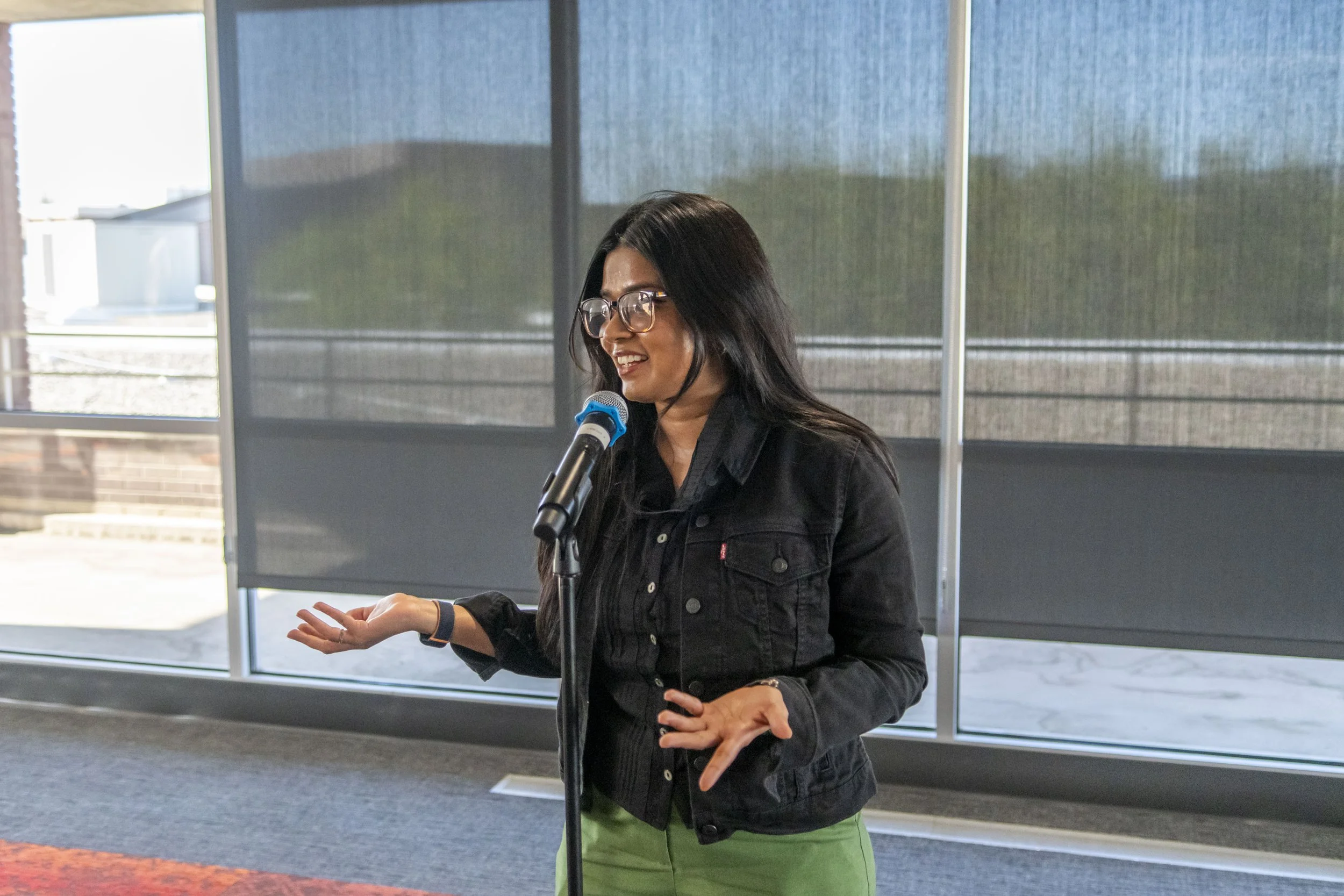
Omiya Hassan shares her story at Boise State University in April 2025. Photo by Sean Evans.
So I was super excited because, back in the day, AI was a booming topic and I was doing my research there. I'm going to be like this AI scientist, but has a hardware twist in it, right? I delved into journals, articles, day and night, and then tuned in to podcasts and listening to the greatness of AI.
Now, as a training in training, I'm a hardware engineer, so my perspective was a bit different. I kind of looked into, okay, I'm running this AI model, how much memory is it consuming, or how much computational power is it consuming? That gave me a very unique perspective, which later changed my career trajectory.
One night, during grad school, late at night, I think I was the only person there in the building, except for two grad students trying to meet their deadline. And I don't know about you, but all the engineering buildings in the university campuses are way further away from the campus. They're like in a creepy place near downtown and we always end up having the most unattractive buildings, like always. I don't get it, okay.
Then my one was a special one. My building has asbestos pipe. So, yeah, I got a good deal out of it.
So it was scary. It was late at night. I was running my simulations. I was working really hard. And since I was alone there, I kind of put some ambient music on and I had my coffee pot running. Don't drink coffee at 10:00 PM, guys, but unless you're a grad student. Research lab quality coffee is the best.
So as I was running my simulations, I was basically testing a very small AI model and trying to measure the power consumption rate and the memory rate. Then after hours of simulation, I saw the result and I kind of had a freaked out moment. The numbers that was showing on the screen was skyrocketing. It was too much. The power it was consuming was significant.
I started doubting myself. Maybe my code had a bug. Maybe I'm thinking it in a wrong way. I did the simulation again and again and again, and finally I stopped. I realized the big problem.
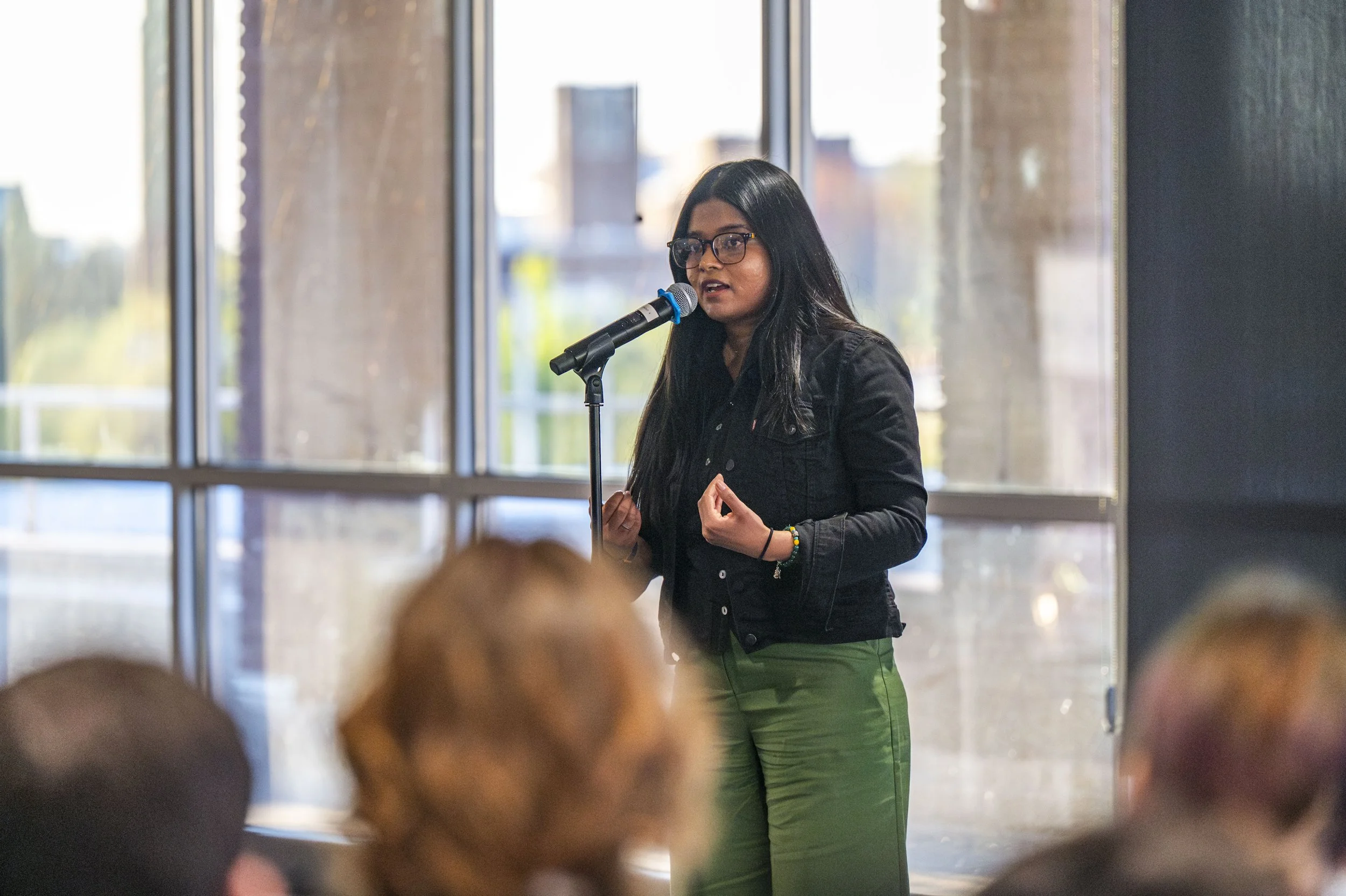
Omiya Hassan shares her story at Boise State University in April 2025. Photo by Sean Evans.
So I went home and then I quickly scheduled a one‑on‑one meeting with my supervisor. But before that, something interesting happened as well. I was trying to look at solutions and trying to solve the energy problem. Like, can I try to lower the power consumption rate? Can I have these AI models and run it through so that it's much more efficient?
As I was scratching my head, beyond and behold, 2020, Open AI unleashed its GPT3 model called, do you know what? Yes, ChatGPT 3. Exactly. Everybody was ecstatic and excited. It was a technological revolution. We're using it every day in our phones, in our computers and whatnot.
But me, I was scared. Because while I was looking and reading my journals, I actually saw that the ChatGPT 3 model, the carbon emission that it produced was around 552 metric tons annually per data center, which is equivalent to driving 123‑gasoline‑powered car every day over 120‑plus miles. So take it in.
After that, I delved into the journals and articles trying to solve the AI energy demand problem, tuning into podcasts, now listening to the not‑so‑greatness of AI. And then I was kind of worried, and also nervous as well when ChatGPT 3 was released. So I got out, I sat under a tree, looked at the sky, and calmed myself. “Okay, I can do this. Don't freak out, Omiya.”
So I scheduled a meeting, a one‑on‑one meeting with my supervisor, and in that meeting I said I want to switch my topic. From developing lightweight biomedical devices, I want to develop energy‑efficient computers to complement this monstrous model.
Now, I was in my final two years of PhD. The stakes were high and it was super risky for me. But the motivation? I still want my best friend. I still want that vast blue sky. I don't want gray skies. I don't want a dystopian world.
So, I took the challenge and I worked almost my ass off to my PhD, blood, sweat, and tears. Then, finally, I was able to give some solution to this problem. For example, I believe that bigger is not always better. I actually developed optimization techniques and compression techniques and proved that you can make really small models, have low power, make it energy efficient, and still have the same accuracy of a huge model that is consuming a lot of power and is not energy efficient.
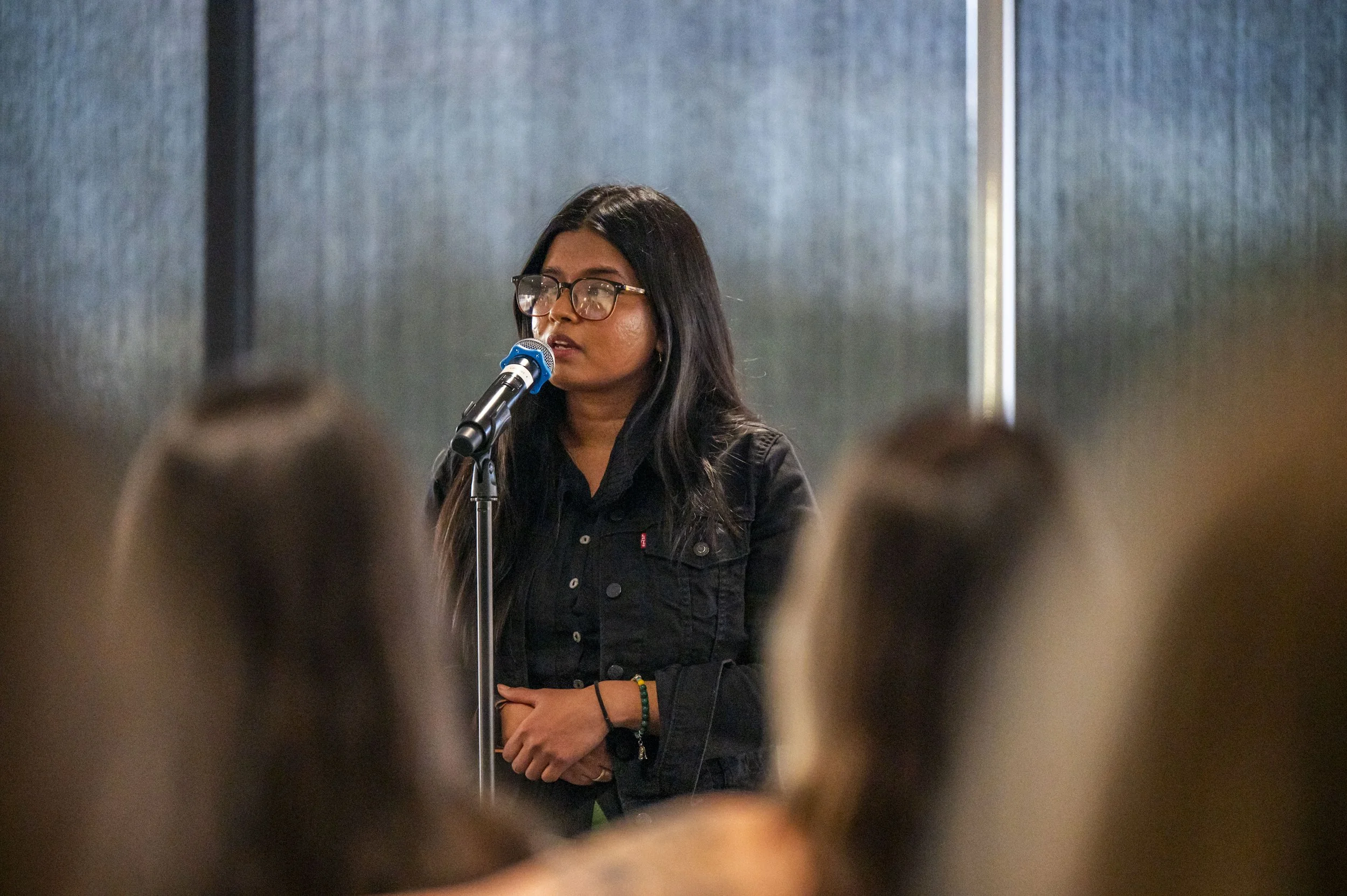
Omiya Hassan shares her story at Boise State University in April 2025. Photo by Sean Evans.
And on the hardware side, what I did was I introduced very low power logic blocks. For those who didn't take my course in digital logic system, logic blocks are basically circuits orchestrated in a very unique way, which manipulates into doing your computation, for example, multiplication, add or subtraction, division and whatnot. My concept was, you can actually design it in a very compact and low power way and then complement these models.
And I was able to prove that this architecture, this design, and this technique can reduce the power consumption rate by 13 times. And because of this breakthrough, I got my doctoral degree, I passed my dissertation, and I was offered a job here at Boise State so that I can do my research independently.
I am truly grateful that I can be part of this community. My journey as an engineer, my journey as a researcher and my journey as a professor just started. And just like the endless vast sky, the thing that we can do to lower the power and to make more energy efficiency is endless.
Now, I just don't take walks. I actually also hike with my friends on the top of the mountain and enjoy the beautiful scenery and the beautiful sky we have.
Thank you.