In this week’s episode, both of our storytellers struggle to live up to the expectations their parents set for them.
Part 1: Growing up, Kat Arney was always told by her mom that she wasn't creative—that she was destined to be a scientist instead.
Kat Arney is a multi award-winning science writer, public speaker and broadcaster. Initially starting off as a scientist, she left the lab to work in science comms at Cancer Research UK, where she helped shape the charity’s public voice around cancer research. During that time she co-founded CRUK’s ground-breaking Science Blog and became a principal media spokesperson, translating cutting-edge research for journalists and the public. She is the author of three acclaimed popular science books — Herding Hemingway’s Cats, How to Code a Human and Rebel Cell — and has presented numerous radio programmes and podcasts including Ingenious and Bug in the System on BBC Radio 4, and Genetics Unzipped. Today she is the founder and Chief Creative Officer of First Create The Media - a life science communications and marketing agency that helps pioneering innovators in the life sciences find and tell their stories to the world.
Part 2: After his father's unexpected death, Kevin McNulty becomes an investment banker, convinced it's the life his dad would have wanted for him.
Kevin is a New York-based comedian who writes and performs at the Upright Citizens Brigade. The hour long version of his solo-show, Half-Orphan, will be at the Edinburgh Fringe this summer. He previously spent nearly a decade as an investment banker and economic researcher, where he formed an unhealthy attachment to telling stories through charts.
Episode Transcript
Part 1
Are you sitting comfortably? Then I'll begin.
So, I'm seven years old. I'm standing in front of a huge wooden chest. It's the kind of chest that you see in an Agatha Christie film where there's like a body inside. But there's no body in here. There are creative possibilities. And by that, I mean costumes. There's a jester's outfit. There's a gown for a fancy lady. There's a crown. There's a top hat. There is everything in there that three small, highly creative and excitable children could want to create and put on, perform wonderful plays for the very bemused adults in the room next door.
This chest, it's in the house where my mother grew up in the Shropshire borders. And she grew up in a house full of stories. She got a lot of them from her mother who was an English teacher. Her father was a wonderful raconteur. Her aunt was a glamorous actress who actually did play a corpse in the original black and white Agatha Christie 4:50 from Paddington. So she grew up surrounded by wonderful stories. And of course, in turn, me and my two sisters grew up in our own house, surrounded by wonderful stories.
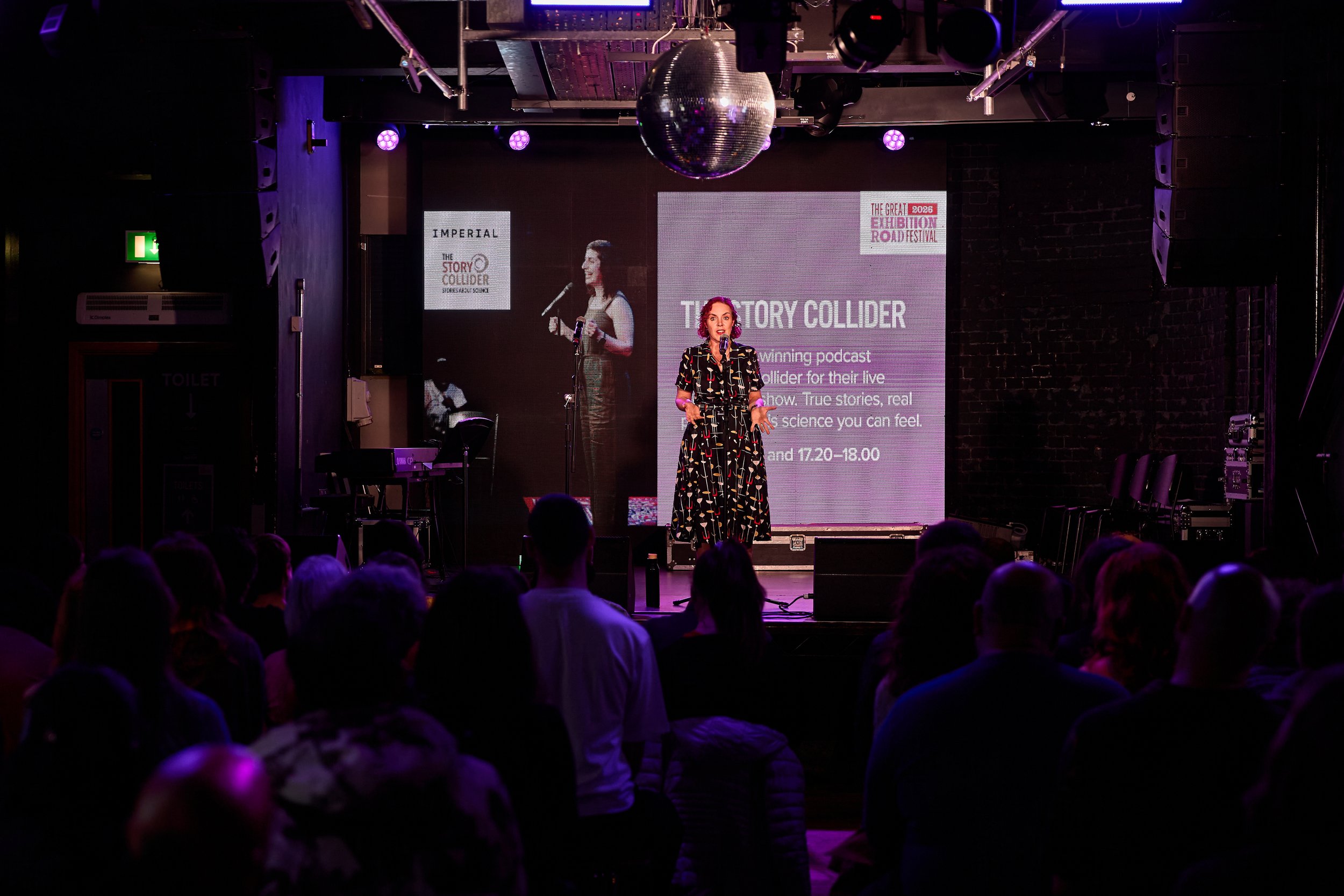
Kat Arney shares her story at Metric in London, UK on June 6, 2026 as part of The Great Exhibition Road Festival. Photo by Kate Kantur.
I had such an incredibly creative childhood. I would write stories, I would write plays, I would write songs, I would make zines when I was a teenager.
My youngest sister, she turned her creativity to comedy, songwriting. She now sort of makes a living writing musical theatre and singing songs about Heisenberg on a ukulele.
My middle sister, she's an accountant, but nobody's perfect. But of course, then there was mum and the stories that mum told, stories about how the world worked, what people were like, why we were like that.
And the best stories that she told were the ones about our family. She used to love telling us stories about, “Oh, there was this person and there was that person.” Mum got really into family history. I think it kind of sets in with the menopause, you know. That's when it gets you. But she was really into family history.
And she would tell us these stories about who our ancestors were and what they were like. Sometimes it was interesting. Often, her stories were true, sometimes maybe not so true. Often they were very funny. But they were all stories about how the world was meant to be, who these people were.
Sometimes I would get a little bit cross because it felt to me like every trait that we had, every talent that we had, everything that we did, it hadn't come from us. It had somehow been channeled to us from our ancestors in some sort of cosmic genetic stream. You know, if I am good at speaking on stage, it's because one of my forebears was a Baptist preacher. The fact that my sister is a great performer, oh, that's because of great‑aunt Joy, the actress. Even the red hair, I mean, mine comes out of a bottle now, but that's the Marchant genes. Everything that we did, everything that we were, was sort of cosmically ordered to us from the family.
It was a little bit offensive sometimes. You know, you can't be you. You're only you because of what's come before you. But like any, I suppose, religion, you start to believe that this is the truth, this is the way.
And the story that mum always told about me was, “Oh, well, you're not creative, dear. That's your younger sister. You're a scientist, like great‑grandpa Edgar.” And that would be Edgar Walford Marchant, Professor of Electrical Engineering at University of Liverpool. Yes, I was good at science. I was interested in nature. I loved playing with my chemistry set, all this kind of stuff. So, yeah, I was a scientist. And one day, I was going to be a professor, like great‑grandpa Edgar.
That was my story. That was ordained for me by the family gods.
So, I went to school, did my A‑levels in science, all the sciences. I went to university. I did my degree in natural sciences. That's a lot of science. I did a PhD, more science. It was like, well, that's your path. What's next? You have to go and do a postdoc.
So I ended up actually at part of Imperial College, the Hammersmith Hospital, overlooking Wormwood Scrubs. It's not very nice, I would say. But, I'm there, I'm doing my postdoc, because that's what you do. That's the path to being a professor, like great‑grandpa Edgar. All you have to do, do some experiments, publish some papers, set up your own lab. That's the way it's going to go.
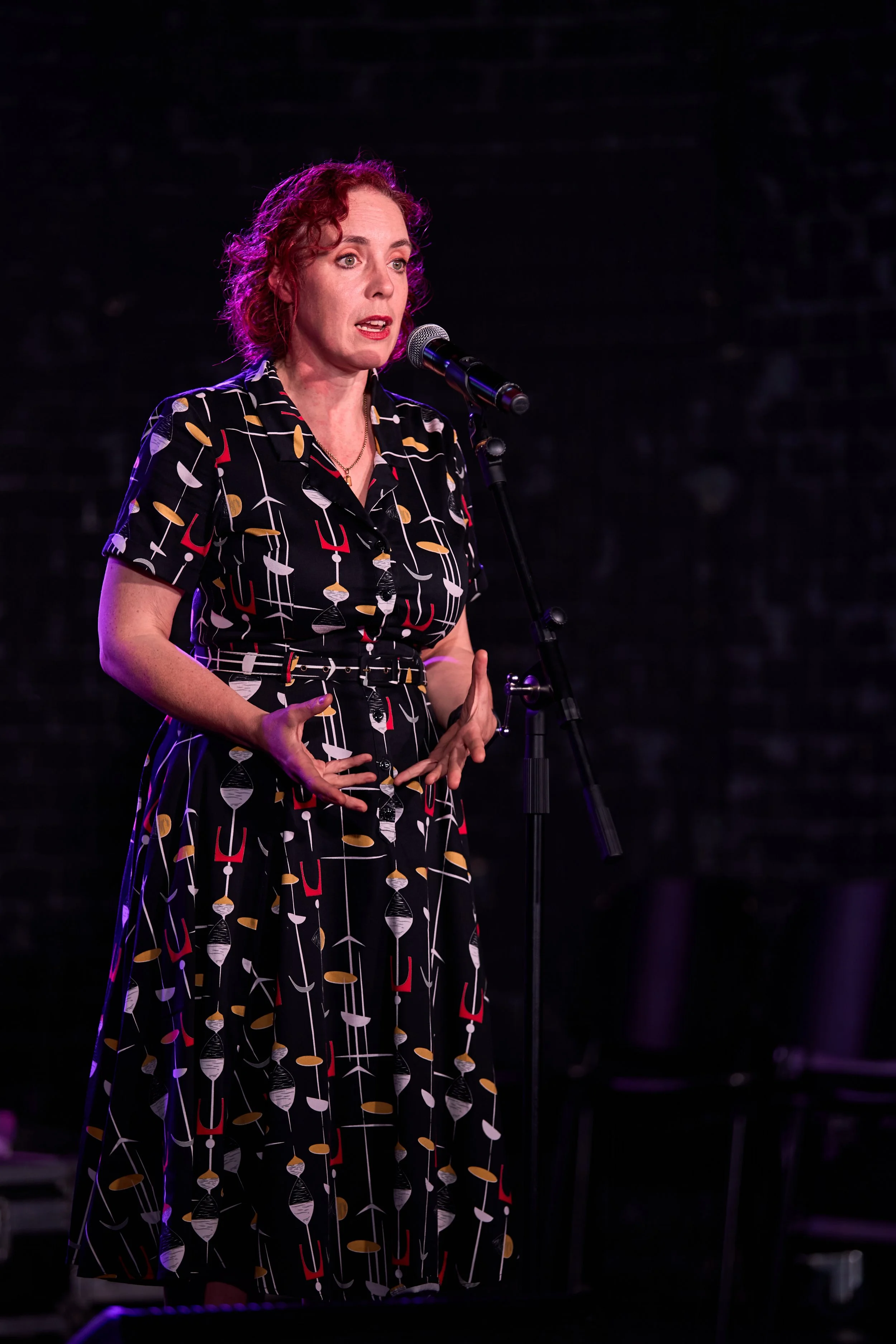
Kat Arney shares her story at Metric in London, UK on June 6, 2026 as part of The Great Exhibition Road Festival. Photo by Kate Kantur.
But the problem was that while I loved science, the area of science I was working in was absolutely fascinating. I was trying to understand the magic that happens when an egg meets a sperm, when mummy and daddy love each other very much. And it starts to unfold one cell into two cells, into four cells, into a tiny football of cells and how they sort themselves. And they switch genes on and off, and you make a baby. Like, how the heck does that work? It's fascinating.
And I would read papers, I would sit in conferences and think, “These stories are amazing. This is brilliant.”
But while I loved science, I didn't love being a scientist. I've got a really short attention span. I'm really clumsy. I just couldn't think of the right experiments in the way that everyone else seemed to be able to. I just couldn't see my way through it. Even when I did think of the experiments, nothing ever worked. And it got to the point where I'd feel like I could have just thrown everything in the bin on a Monday morning, because I'd just be in the same place by Friday afternoon.
I would go down into the basement. It was where we kept the big laser microscope. I remember it so clearly. It was very dark. It had to be dark for the laser. And it smelled this weird smell of like mineral oil and xylene and sort of this damp air conditioner. I'd sit there just listening to the laser like, “Mmeee-mmeee-mmeee,” for hours, and that's where I'd cry.
I would stay there at the lab late into the evening just trying to grind out some kind of results, anything, anything that would get me the paper that I'd need to keep going and become a professor.
I'd cycle home up the hill late at night, not really wanting to go home, not wanting to, certainly, not go back to the lab. Just not really wanting to be anywhere.
So that was pretty tough. All my life I'd been told this story that I was a scientist. I was good at science. “You're going to be a scientist. One day you are going to be a professor.” It was really abundantly clear that I just couldn't, just couldn't.
One afternoon, I was sitting up in the tea room overlooking Wormwood Scrubs Prison and there's a paper copy of the New Scientist magazine. Now, I have to tell you, for anyone under the age of about 30, this is how magazines used to come. They were paper. This was the early 2000s.
So I was flicking through this. I got to the back where the job adverts are. There's a small box. Remember, it's on the left-hand side, bottom left. And it said, “Science Information Officer (Liaison)” I started reading this advert and my spine started tingling. Because the one thing I haven't told you is about the thing that kept me sane while I was working in the lab, which was the thing that I wasn't meant to be doing. I'd been being creative.
I wasn't meant to. I'd been writing. I'd been writing stories about the science I found fascinating. I'd been helping out at science festivals and schools events. I'd got involved in a radio show. I was sitting down every week and interviewing scientists about the stories coming from their research. But I wasn't meant to be doing that, because I wasn't meant to be creative. I was meant to be a scientist, so I never thought it counted.
But I saw this job advert. The first thing they wanted, PhD. Nailed it. Second thing, evidence of science communication, creativity, writing, speaking. I was doing those too. And that counted.
I turned up for the interview. Oh, my God, I was like, “I have to get this job. I have to get this job.” I was very extra, I think. I turn up, I've got a folder of everything I've ever written printed out. Again, this was the 2000s. You print it out off the early internet. I'd even taken a scarf that I was knitting with a structure of DNA in it. I was like, “Look, this is how much I love science and I love talking about it. I'm knitting it. Please give me the job.”
My sister at the time was working as a recruiter. I phoned her up and I told her about it. She was like, “Well, I'm sure someone in the end will give you another job.” But it turned out it worked. They loved the enthusiasm and I got the job.
And I absolutely loved it. I remember I think it was either in my first or second week. I was sitting in the office. I was working late because I was enjoying it so much. I was there. It was maybe like 7:00. My manager walked through and she said, “What are you doing here? You shouldn't be working this late. You need to go home.”
And I just looked at her and was like, “I don't feel tired yet.”
She's like, “Just go home. Go home.”
It was just an incredible time. I got to write about science. I got to learn about science. I got to talk to scientists. I got to talk about science. I set up the charity’s science blog that still runs today. Again, this is the early 2000s. It was new and cool. I set up the Cancer Research UK podcast in 2006, before you could even really listen to podcasts. We're very ahead of our time. But it was just amazingly brilliant.
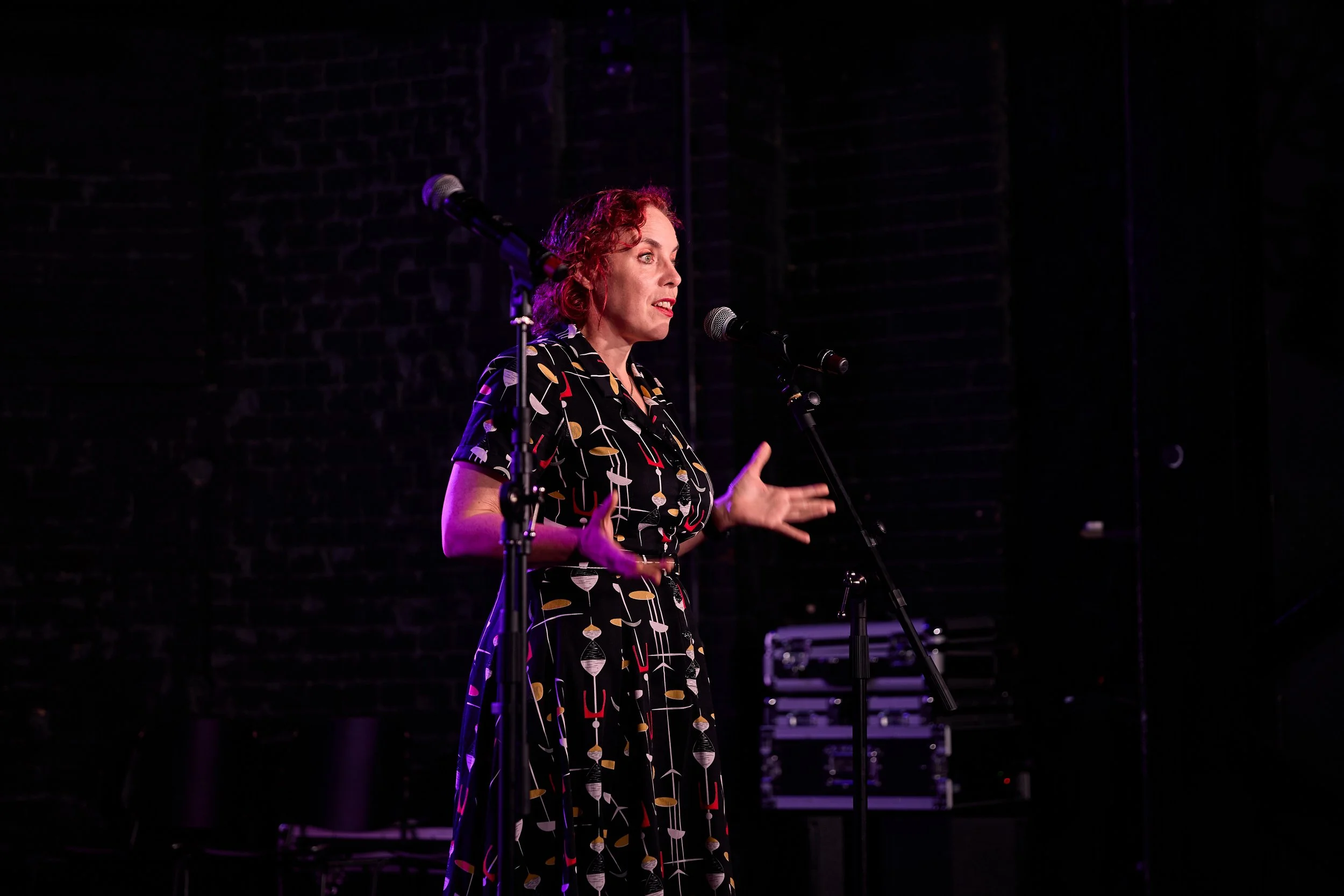
Kat Arney shares her story at Metric in London, UK on June 6, 2026 as part of The Great Exhibition Road Festival. Photo by Kate Kantur.
That has springboarded what's now become a 20‑year career in, again, something that didn't even really exist at the time, science communication. I've written books. I've made radio programs. I've spoken to hundreds and hundreds of people about the science that I find fascinating. For someone who was told that they were not a creative, I'm now the Chief Creative Officer of my own science communication agency. That's quite the plot twist, really. I mean, I chose the name and I put creative in it.
So I look back and I think about the story that I told myself, or had been told and I had come to completely believe was true, that I was a scientist. I was not a creative. But the story that I came to tell myself was that I am both. I am a scientist. I am creative. I'm a chief creative officer.
I've really come to see what I got from my mother. The gift of storytelling is also a curse, like any superpower. It means that I'm amazing at the job that I do. I get to wake up every morning and find and tell incredible stories about cutting‑edge innovation. Absolutely love it.
But it also means that I find and tell stories about myself. And because I'm a bit pessimistic, my mother was quite pessimistic, quite often, they're quite negative. “I am like this. I must be like this. This is what it must be. I am this and I can't change.” It's taken a long time to unpick that, to understand the power that stories have to shape reality, to shape belief.
Among others, the stories that we tell to persuade people to do things, to donate to a charity, to buy products, to do something different for their health. And the stories that we tell ourselves about why we're here and what we're doing and who we are.
This story, the final chapter, it comes to an end at the age of 47. I'm standing in front of a large wooden chest. But this one, it does have a body inside. I'm behind a massive Victorian lectern in the church in the village where I grew up. I sort of can peep over the top and I can see all the people that my mum touched with her love, with her friendship, and with her stories. Sometimes true, sometimes not so true, often very funny.
She had spent so much of her life telling stories about other people and telling stories about us and who we were and what we were like and how we wanted to be seen by the world. Then finally, I would get to tell my story about her. I'm still sad that she never got to hear it, because it was true. Maybe bits of it weren't. And it was also very funny.
And like all good stories, I reach into my handbag, I pull out these slightly crumpled pieces of paper. “Are you sitting comfortably? Then I'll begin.”
Part 2
My name is Kevin McNulty, and I was the youngest in a family that was good at school. My mom was valedictorian of her university. My dad was president of his. When I was 10, my brother got into an Ivy League school. Soon after, my sister was recruited by several of them. I was sent home in multiple grades for not having pants on when pants were very much required.
I was a problem child. I had developmental issues with fine motor skills and speech, and so I had to see therapists for handwriting, for speaking. I once tested in the bottom 1% of the nation in terms of reading, but I was a prodigy when it came to other children bitten. This is harder to standardize nationally, but we were pretty confident that with three victims, I was in the top percentile.
I acted out in school. I was a class clown. I was often in fights. I didn't like being a bad kid or being dumb, but I was aware that's how others saw me. But not my dad.
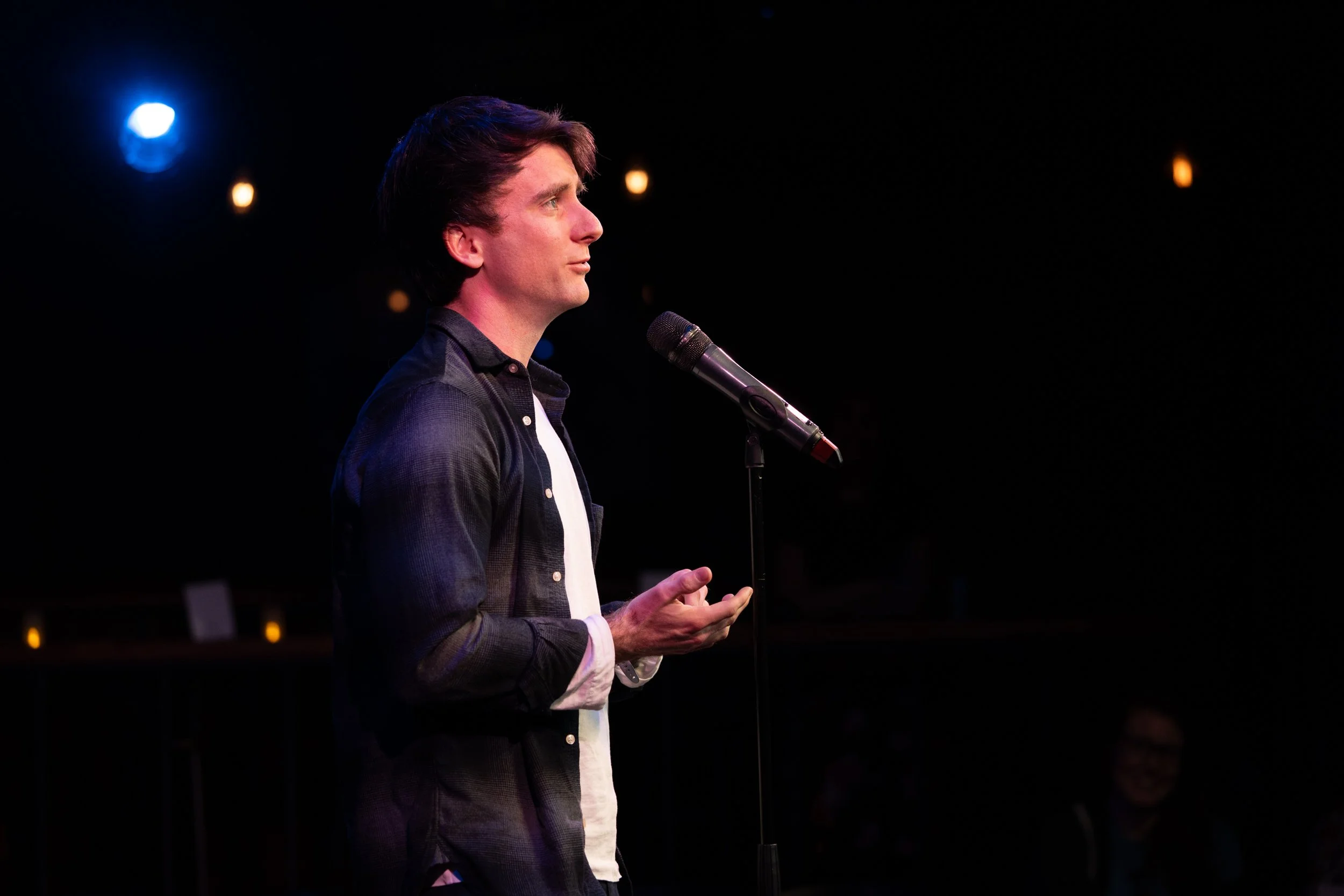
Kevin McNulty shares his story at Caveat in New York, NY on April 13, 2026. Photo by Zhen Qin.
My dad was actually the scarier of my two parents. He would wear a full suit every day. He would use serious words like “integrity” and “hard work”. He was the son of Irish immigrants. His face, like mine, would go from ghostly pale to red when he was angry or about to laugh. He was red a lot around me.
He was the quickest to get mad when I broke a rule, but also the quickest to forgive if I apologize sincerely, and the most intense in listening to me when I struggle to explain myself.
He would tell my mom he wasn't that worried about me. And I once overheard him say something like, “He gets it. He just needs more time.”
I had no idea what I got, but it felt very good hearing that I had it. Luckily, by middle school, I did start to get other things. Better handwriting, clearer speech patterns, amphetamines. Because in the state of New Jersey, if a dog bites three children, you are required to put them down. But if a suburban kid does this, you give them 50 mg of Adderall.
Through some combination of medication and mean reversion, I caught up with my peers in reading and writing and began tracking years ahead in math. I was no Weiji Ma, but I did get written up in our state paper once.
I remember my dad suggesting that I could be one of the math whizzes he worked with on Wall Street. He even joked that maybe I would be the one to support our whole family one day. I think this was the first time anyone in my family had ever joked about my future in a way that didn't involve a correctional facility. But mostly, I was just happy because academic success brought me more freedom at home.
And even though my grades improved, I loved being a class clown, making friends laugh. I made tons of videos on a webcam at home and even got to host a special assembly in eighth grade to show off my first short film. It featured my dad singing and dancing awkwardly when he thought no one was looking. He laughed when I showed this to him. He had an embarrassingly loud laugh.
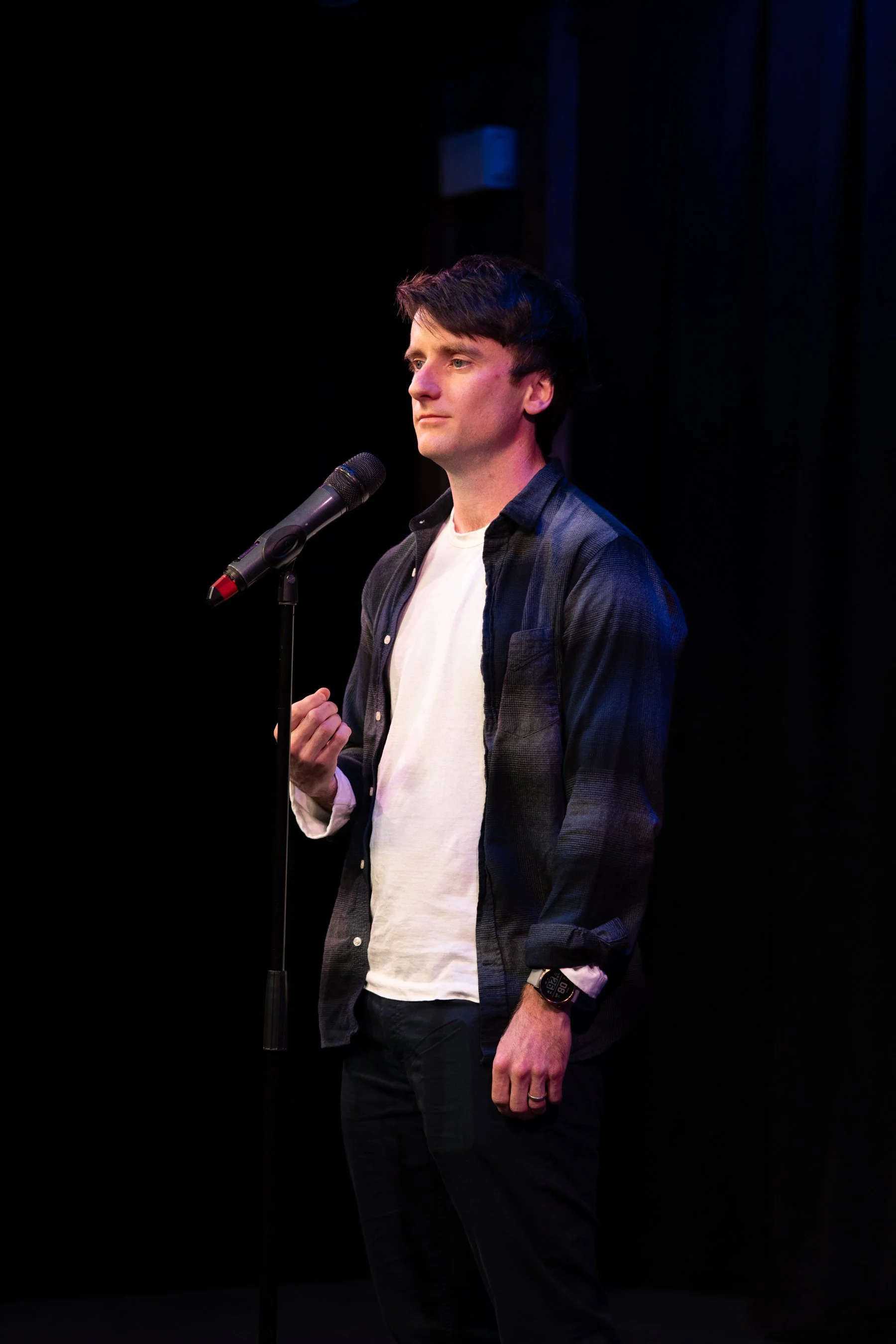
Kevin McNulty shares his story at Caveat in New York, NY on April 13, 2026. Photo by Zhen Qin.
Later that fall, I get a phone call. My dad had died. He had a heart attack on the treadmill. The week between his death and the funeral was a blur. I remember my mom asked the three of us kids to speak at the service. My brother and sister edited each other's speeches, but I didn't want anyone's help in mine. I was the youngest, but I wanted to prove that I could do this, to make a speech he would be proud of.
Looking back, I could have used some editing. The only words I said about me and my dad, how much I loved him, how he made me feel, was, and I quote, “At the dinner table, he rejoiced in my distinguishment in math.”
After that heart‑wrenching speech, I moved back with my mom to New Jersey, in a house that I had grown up in as the youngest in a loud family of five. But now, with my dad gone and my older siblings off at school, it was just me and my mom.
My mom took my dad's seat at the dinner table so she wouldn't have to look at his empty chair. This was odd because, from my perspective, he was still dead and now multiple things were different.
But overall, I felt lucky. I liked school. I made friends there. I almost made sports teams. And more than anything, I made comedy.
I'd recently gotten a Handycam. This was before smartphones. I made tons of videos, putting some online, doing some on stage. I even started taking the train in from New Jersey here to New York, where I would take improv on the weekends with adults. These were both some of the saddest and some of the most full years of my life.
But as I approached graduation, I knew it was time to get real, to pay forward all the opportunities my dad had left me, and to follow his footsteps and become something that the world needed, an investment banker.
If you think that the world is sickeningly unfair for guys with dads in finance, you should see what it's like for guys with dead dads in finance. The ability to write a cover letter, just cold, and you can imagine sad music, “Dear important sir: You may remember your colleague, Mr. McNulty, from when he was alive. Before he tragically passed, leaving at home a young boy whose only dream was to one day perform mergers and acquisitions.”
So I performed mergers and acquisitions. This was not great for my comedy. The hours were long. I took two years to write one film script, very badly. A hedge fund took me to a small town in Connecticut, and I would make a long drive every month to the nearest open mic, angry at myself for not having written better jokes.
About almost a decade into this, my girlfriend asked me what I was proudest of in my life. When I thought about my adult years, I was proud of my mediocre mics, of a charity comedy show I produced in New York. But there was nothing at the job that I spent 90% of my waking hours in that I could imagine being proud of.
I started thinking about leaving, but it felt like failure to do that and find a way to balance more writing and performing. It felt like admitting that I couldn't hack it in a real career and living up to my dad. I realized that I might be the first person to claim they felt morally obligated to work at a hedge fund.
But the more I thought about leaving, the more agonized I felt. I stopped being able to sleep for days at a time. My work suffered. I went to a doctor thinking something was physically wrong with me. The doctor pointed out that stress is a physical thing.
And that fall, my mom, on the anniversary of my dad's death, held a dinner. I saw an old friend of his. He was asking about the fund I was at, and I was floating the idea of leaving and finding a way I could involve more comedy in my life.
I was getting ready to have to overexplain this and defend myself, and he just went, “Oh, your dad would have loved that.” And I was confused. He was like, “Yeah, he always thought you're going to do something way out there. You know, like be a vet.”
This was true. I did love dogs, especially as a kid, but it wasn't really relevant to the story until now.
But he went on, “Or be a creative. You know, do something you really cared about.”
I asked my mom about this and she agreed. She said, “Yeah, he always loved the idea that you could do something totally different from him.”
I don't know how we hadn't talked more explicitly about this in the intervening 20 years, but it made sense when I tied it to other things I learned about my dad after he died, things I heard in stories from his friends, his family.
My dad, for instance, was the first person in his family to get to go to high school. His father was orphaned in Ireland and never finished grade school. And the two of them had tension when my dad became the first one to get certain opportunities, to go off to college, to go to grad school, to work a white‑collar job. I knew they didn't speak much, but I didn't know about the resentment my dad felt from his father. I just knew how intensely he celebrated us, our achievements. You could even say “rejoiced in our distinguishments.”
And how much he loved seeing us pour ourselves into what we cared about. Like when he saw all these hours I'd put into these very dumb home videos, and how the last gift I ever got from my dad was that Sony Handycam I made all those videos with in high school.
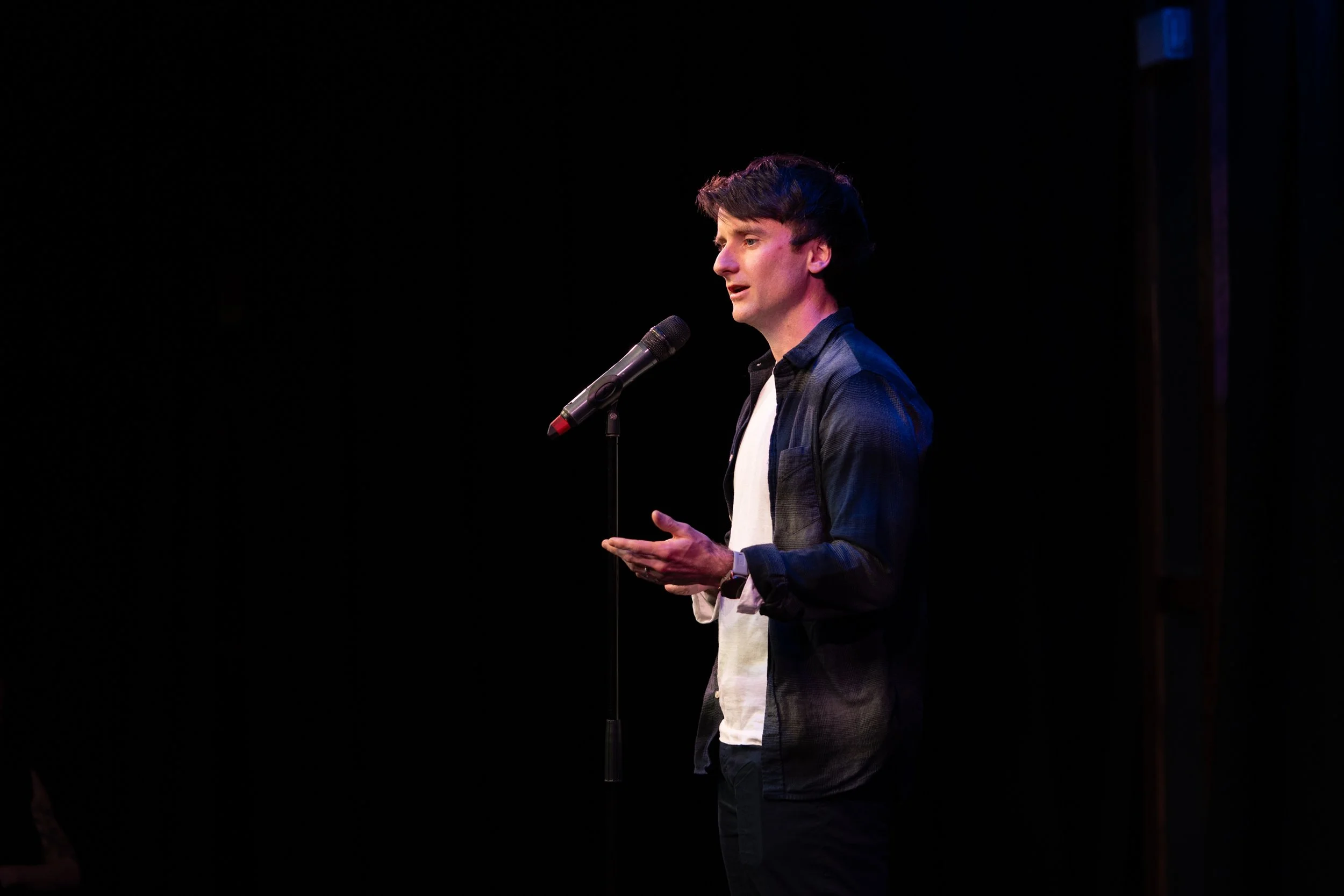
Kevin McNulty shares his story at Caveat in New York, NY on April 13, 2026. Photo by Zhen Qin.
Now, the last two years, I've gotten to spend a lot more time writing and performing and producing other people's comedy, even working part‑time at comedy theaters. It's not always fun. I don't particularly enjoy cleaning toilets or editing other people's podcasts at night, but I recognize how lucky I am to be able to make this pivot. It's the happiest I've been since childhood. And in a weird way, also the closest I've felt to my dad, or at least a lot closer than when I was trying to be a worse version of him.
I'm having my first kid soon, and so a lot of this is on my mind. My wife is actually someone I met at work. She was that girlfriend who nudged me into an existential crisis. She is a star at that company, like she was in school. She's British. She went to Cambridge. She was a European championship debater. I hope that my son finds school as easy as she did. But if he doesn't, I won't be too worried about him.
I think there's a lot of things my dad left me that I want to figure out how to pay forward in the world. But the thing I'm most appreciative of is that he was a dad who made his kid feel loved. I think that's the easiest thing to pay forward.
But in case I do die suddenly, I'm going to be extra explicit that he doesn't have to prove himself in finance. Or I guess in our case, comedy.
Thank you.