In the final episode of our At Odds mini-series, we explore perhaps the trickiest disagreement of all: what happens when the person you love believes something you just can’t understand.
Part 1: Climate scientist Katharine Hayhoe is shocked to discover she married someone who doesn’t think climate change is real.
Katharine Hayhoe is a Paul Whitfield Horn Distinguished Professor and Endowed Chair in Public Policy and Public Law in the Public Administration program of the Department of Political Science at Texas Tech University. She is also the Chief Scientist for the global conservation organization, The Nature Conservancy. Recognized among the TIME100 most influential people and a United Nations Champion of the Earth, Katharine is known worldwide for her ability to make complex science accessible and meaningful, and for connecting climate and nature to people’s values in ways that inspire action.
Part 2: Rajesh Mirchandani discovers his date hates onions — a fact that, as an onion lover, he struggles to accept.
Rajesh Mirchandani has been a storyteller all his life - by profession and passion. As a BBC global journalist, a nonprofit communications executive, and now as founder of Storyteller Consulting helping organizations and leaders find, shape and share stories that make human connections and drive impact. He fuels his work by performing on storytelling stages around the country; he’s a three-time Moth winner, runner-up at the 2025 National Storytelling Festival and host of the podcast Finding Our Flavor. Sometimes he sleeps.
Episode Transcript
Part 1
I'm a Canadian, and my dad was a science teacher. So I grew up pretty much with the idea that the grass is green, the sky is blue, and climate is changing due to human activities.
And then I moved to the States for grad school. I was unaware that there were people in the world who thought that basic radiative transfer and nonlinear fluid dynamics was a myth. I was also unaware that there were people in the world who did not drink. I was so unaware of these two facts that I married someone before I knew that he was both.
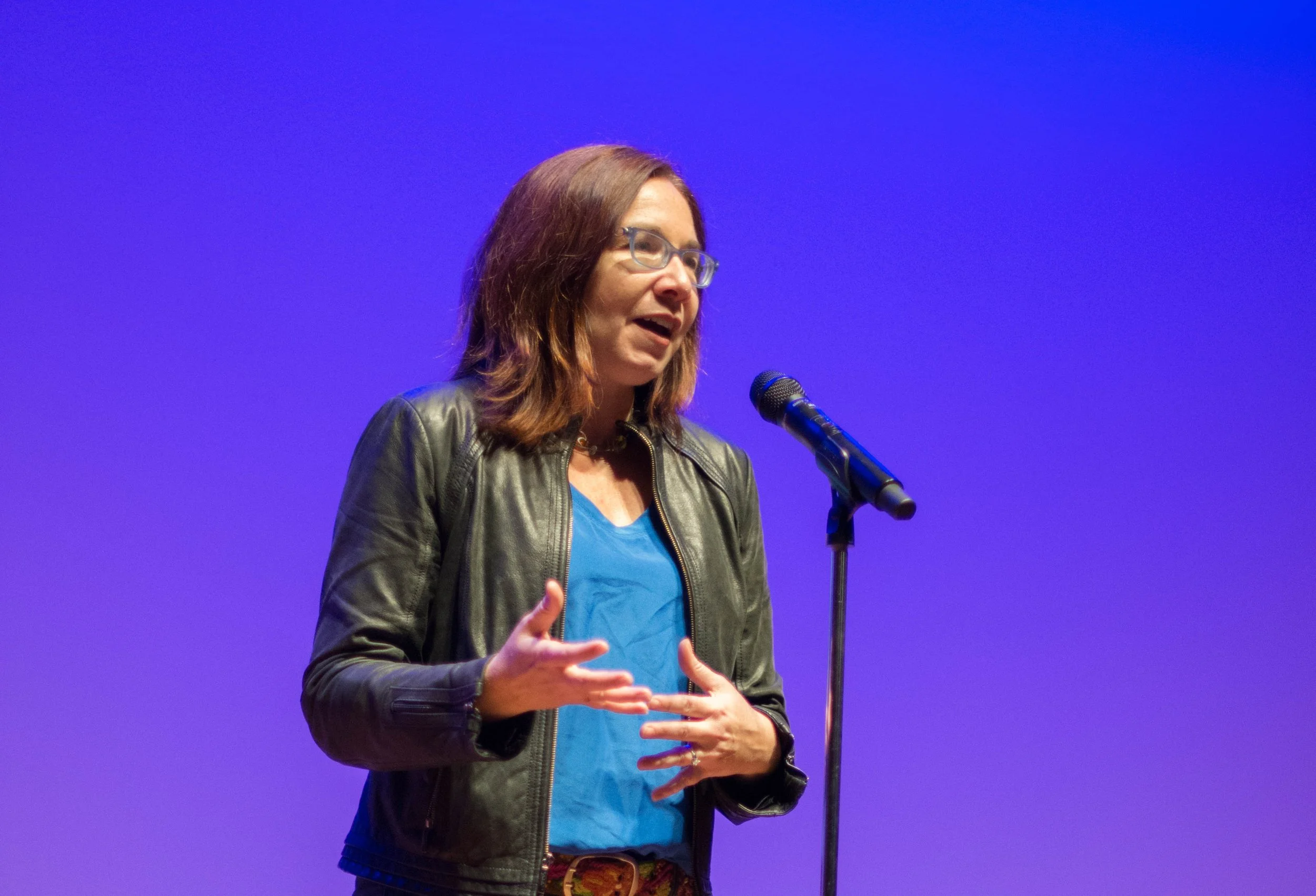
Katharine Hayhoe shares her story at an AGU conference in 2018 in Washington, D.C. Photo by Lauren Lipuma.
You may ask, “What do you talk about in graduate school?” And the answer is, you talk about a lot of things. But when you don't ever imagine that the other person you're talking to doesn't think climate change is real, why would it come up?
And on his part, he had never met somebody who shared his faith who did think climate change is real. He grew up in northern Virginia in the horse farm country. My husband is a really smart person. He was doing his PhD in applied linguistics when I met him. He was an endowed professor at the University of Notre Dame at age 27. He'd be in the gym playing basketball with the students and they'd be like, “Well, what do you study?” And he'd be like, “I teach you.”
But we had been married a couple of months before it dawned on us that we were on opposite sides of the fence when it came to a changing climate. So here we were married to each other. We loved each other. We would prefer to stay married to each other. And, and this is the most important, we respected each other.
I knew he was a very smart person. He did quantitative research. He understood data and statistics. And he knew that I wasn't one of those people that he'd always imagined fudging data for monetary gain. That I sincerely was doing what I was doing not for the monetary gain, but because I was genuinely concerned and I wanted to make a difference in the world.
So we started talking. We started doing the most uncomfortable thing in the world, which is talking to someone you love about something that you profoundly disagree with them on. And it wasn't a conversation that happened every day but, you know, once a week, twice a week, take a break for a couple of weeks. We waded through the questions he had, the objections he had.
And I'm going to tell you something. I feel like I learned more from him than he learned from me. Because I had never spent any time talking to people who didn't think that climate change is real. I just imagined they were sort of over there, way distant, some other type of species.
But here was someone who I knew, who was smart, who was curious, and he didn't think it was real, so we could talk about it. And I could kind of start to understand, well, what have you heard? What have you been told? What are your objections?
He never had a chance to look at the data either. So it wasn't a light bulb turning on one day. It was a slow, gradual process with inflection points.
One of the inflection points was when we went to NASA's website and we downloaded the global temperature data. He himself opened it up in Excel and fit a trend line to it, and he said at that point he had a choice. Is all of NASA who put men on the moon involved in a global hoax extending back decades, even centuries, or is the planet actually warming?
And then you have to get into, well, how do we know that it's humans? Could it be the sun? We dug up the radiation data for the sun and we looked at what the sun has been doing. Turns out it's energy has been going down the last 40 years, not up.
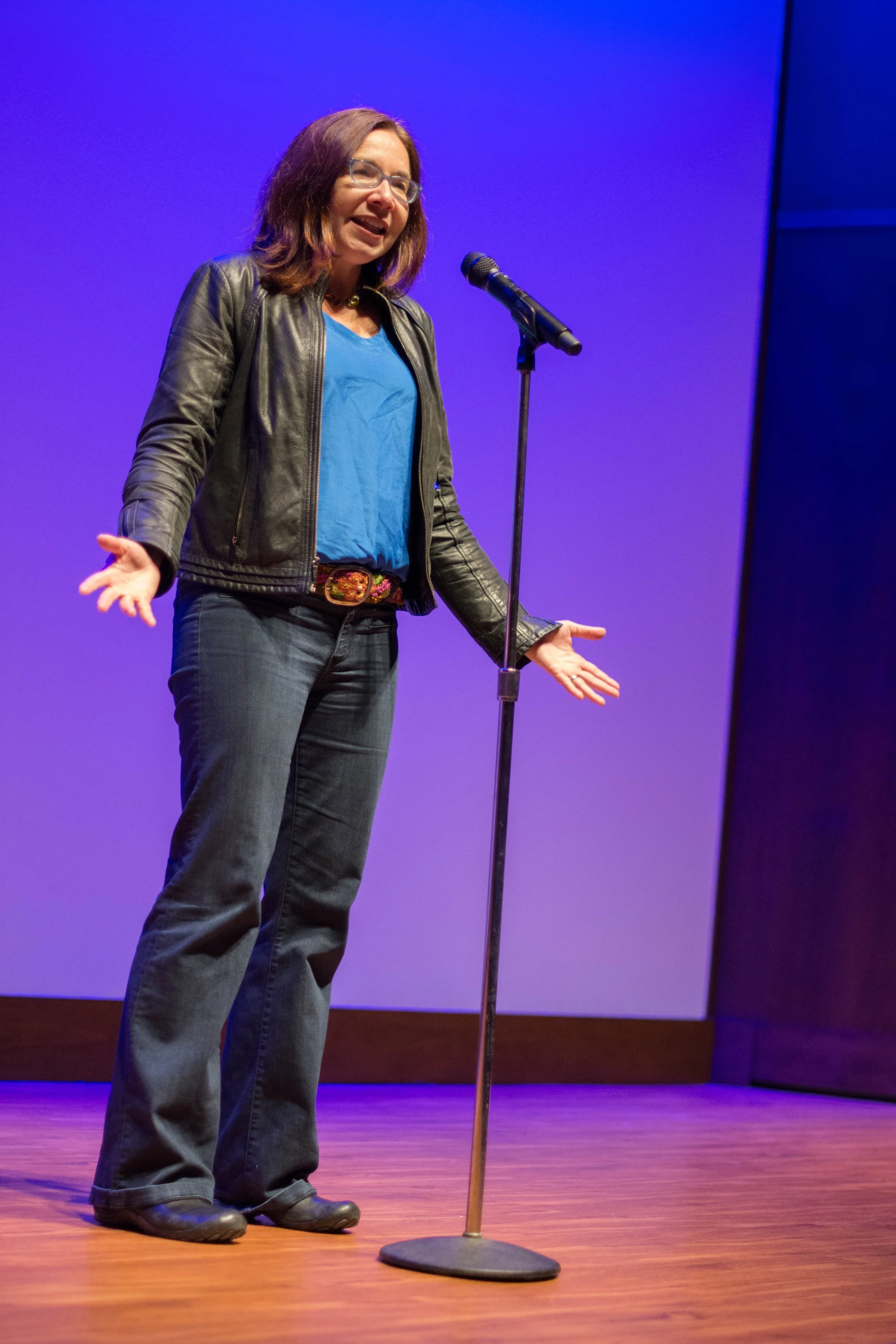
Katharine Hayhoe shares her story at an AGU conference in 2018 in Washington, D.C. Photo by Lauren Lipuma.
What about orbital cycles? We got into that too. According to orbital cycles, we should be heading into the next ice age, not getting warmer.
We dug into El Nino and looked at how El Nino can't just spontaneously create heat. It can lose a little bit of heat out the top of the atmosphere, but all it does is rearrange the energy balance of the Earth's climate system.
And then the rubber really hit the road. The root of his objections were not scientific. The root was ideological. How can we fix this thing without destroying the economy? Doesn't it mean that we need more government regulations, so the government's going to start telling us how much water we can use when we shower and what type of car we can or cannot drive? That was where we've had the most fruitful conversations, and we still have those conversations today.
But today, the other day, I heard him texting his friend. He was lecturing his friend about climate change.
He said, “Don't you know that the poorest and most vulnerable people in the world are the very ones most affected by a changing climate?”
And in addition to being a linguist, my husband is a pastor and his friend was a pastor. So he's saying, “As Christians, we have to care about the poorest and those who are suffering in the world today, and that's why we should care about climate change. What type of political ideology have you swallowed that makes you blind your eyes to these facts?”
I have to say my favorite thing in the world is when somebody goes for me. And if you know me, you know people go for me every day on social media, on Facebook, sometimes in email. I even get some written letters. Occasionally, I walk down the hall to my office and I see somebody kind of walking around with this look in their eye, and I'm like, “Ooh, I think I have to go the other way.”
But my favorite thing is when somebody goes for me in front of my husband, because I just sit back and he just digs right in.
But I honestly believe that I learned so much more from him than he learned from me. Because he showed me how to put yourself in someone else's shoes, how to understand that people already have values and that, in fact, just about every single person on this planet already has the values they need to care about a changing climate. They just haven't connected the dots.
And the most important thing that each one of us can do about climate change is talk about it. If you ask people across the US, “Do you ever have a conversation about climate change,” two‑thirds of people say, “Never.”
So if we never talk about it, why would we care about it? If we don't care about it, why would we vote about it? If we don't vote about it, why would we ever fix it? It all begins with a conversation today. But that conversation has to begin with what we have, what we share most in common. Too often, we tend to begin conversations on what divides us the most. “Uncle Joe, how can you say that? You know that's not true.”
But if we begin a conversation, instead, from a place of respect, focusing, first of all, on what unites us, what we truly agree on, what we share, from there we can walk together connecting the dots to why the exact person I already am is the perfect person to care about a changing climate.
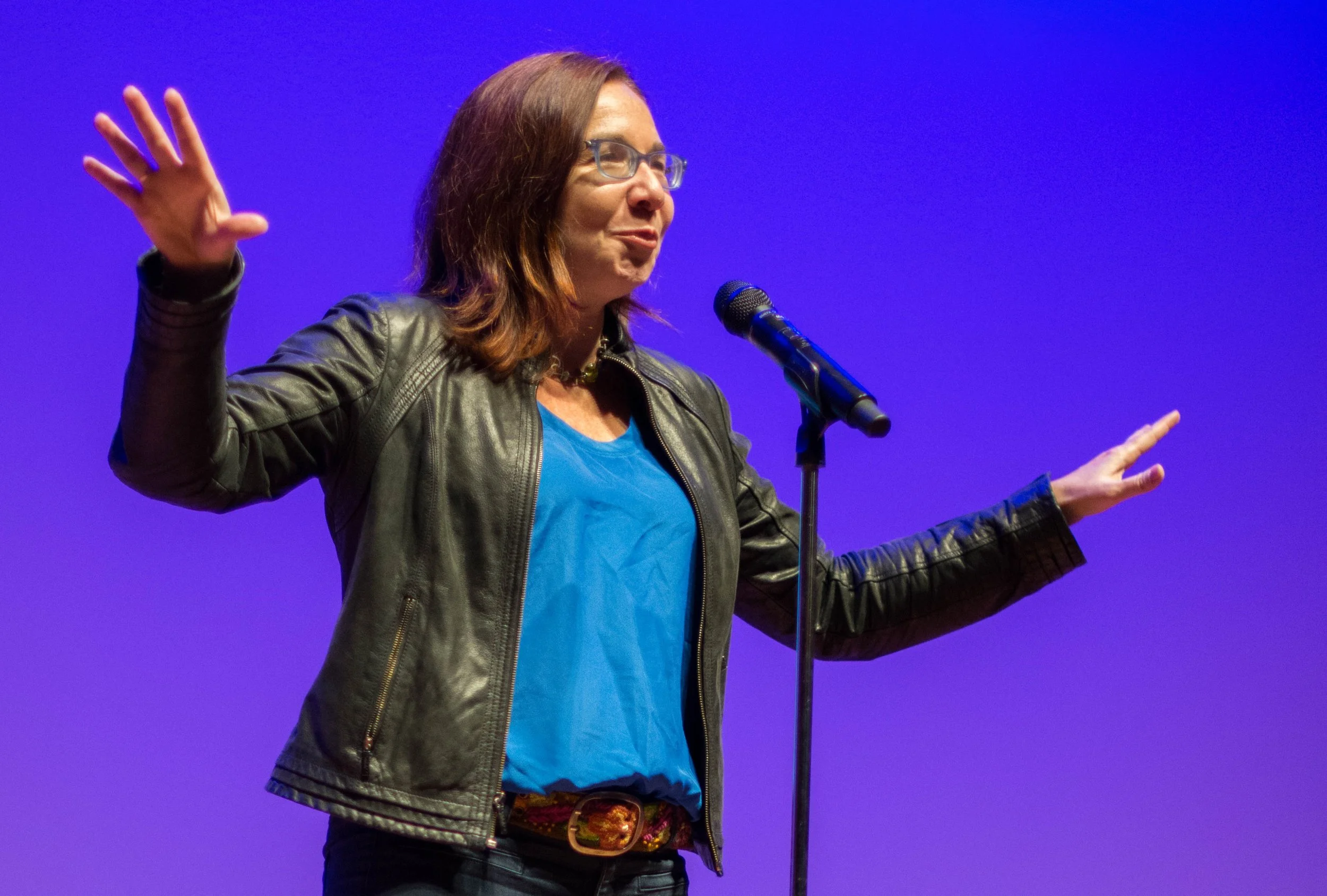
Katharine Hayhoe shares her story at an AGU conference in 2018 in Washington, D.C. Photo by Lauren Lipuma.
If you don't know where that place is, then don't have a conversation about climate change yet. Have a conversation and get to know them. What makes them tick? What do they love? What are their passions? What are their fears and their concerns? And then when you find something, that's when the conversation can begin.
So I feel that the greatest lesson that I have learned in my entire career of having thousands of conversations with people all across the US and beyond is the very first lesson that I learned from my husband. That is that we already have the values we need to care. By recognizing that in each other and by respecting who each other is, we can have the types of constructive conversations that we need to help us all move forward together. Because, in reality, don't we really want the same things when it comes down to it? Don't we really want a better world, not a worse one? Don't we really want energy that's abundant for everyone, an economy that's healthy, resources that are available to the rich and the poor? Clean air to breathe, clean water to drink, enough food to eat, a safe and happy and healthy planet to live on? That's what we all want.
I was speaking to the Royal Astronomer of England last year and Stephen Hawking had just said before he died that maybe we'll have to terraform Mars so we can move there to escape from climate change.
So I talked to Martin Rees, and Martin Rees said, “Oh, I've known Stephen for a long time.”
I said, “Well, what do you think of the idea that we should terraform Mars to escape climate change?”
And he said something I've never forgotten. He said, “Fixing climate change is a dawdle in the park compared to terraforming Mars.”
This is the only home we have and we share it with every single brother and sister on this planet. What's the best thing we can do for ourselves, for our families, for every single one of us? The best thing we can do is have that conversation today.
Thank you.
Part 2
“I hate onions”.
OK I see that’s a vote winner here tonight - but this wasn’t me saying it. This is what my date said to me as we sat down at a restaurant.
And he went on. “I hate the way they look, the way they feel, the taste, the smell, everything.”
“All right,” I said, as my inside voice said, “I better cancel that French onion soup, or tonight is not going to end how I'm hoping.”
And up to that point, the date had gone really well. He's a super cute guy, really smart. We had similar values. We both liked the outdoors. We liked wine. And we liked food, which is why this was such a strange moment.
The scientist in me set about doing some research. “Are you allergic?” I asked.
“Oh, no,” he said. “I just really hate them. In fact, seriously, I can't be around them.”
Right. You might have called this a quirky character trait. I called it a red flag.
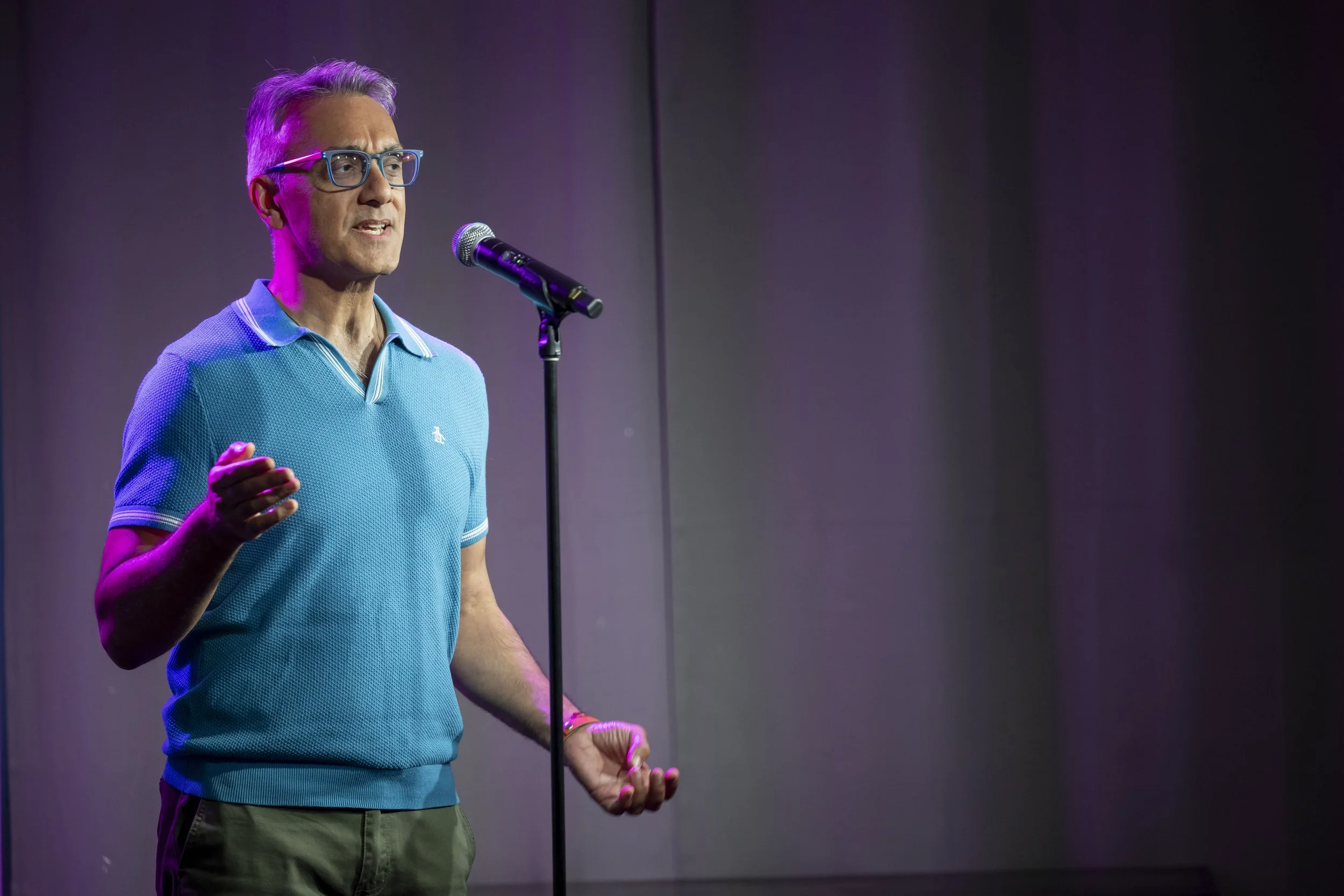
Rajesh Mirchandani shares his story at Penn Social in Washington, D.C. in July 2026. Photo by Lisa Helfert.
You see, I love onions. My culture is Indian. You can't move onions in our food. Curry, chutney, paratha, little slices of onion between chunks of chicken on a tandoori skewer. Sometimes we even eat them raw. And also, it's not as if I wrote on my dating profile, “Must love every member of the Allium family.” But it did make me wonder, if he has such a visceral reaction to something so innocuous, what else might he freak out about? How else might we be incompatible?
Maybe I shouldn't have worried about it. This was only date two. I could have walked away. But it had been quite a lean dating patch. And, truthfully, the heart rules the head, and I'd already decided that I wanted date three and beyond.
So I resolved. I'm going to take it on trust that this is not a sign that he is a crazed psychopath. I'm going to go with this, but I'm going to get to the bottom of it.
So those first few months was about gathering data. “Is it the flavor,” I'd ask. “The onion crunch?” Even the words “onion crunch” made him squirm.
The next few months was about analyzing and testing hypotheses. Is it just onions? What about shallots and leeks? No, it was all of them.
Now, if you know your vegetable taxonomies, I'm presuming everybody here does, right? You are scientists, after all. Then you know that the family that contains onions also contains garlic. Now, this would have been a deal‑breaker if he didn't like garlic. How else would I have known if he was a vampire or not?
But no, he was fine with garlic. In fact, one of the foodie ways we bonded is by agreeing that you can never have enough garlic. But now this didn't fit my hypothesis. So I had to probe deeper.
“Did your mother ever punish you by force‑feeding you onions,” I asked.
“Um,” he looked at me. “I don't think so.”
“Okay. How about chasing you around the house brandishing an onion so it's now a trigger of a deep‑seated trauma?”
“No,” he said emphatically. “That never happened.”
“Would you consent to undergo hypnotherapy?”
He looked at me patiently, but pityingly. So no tracing the cause that way then.
By this point, we were about a year into this relationship, and we both kind of decided that we were in it for the long haul. But this onion phobia, it was so irritating because I couldn't figure it out. And if I couldn't figure it out, I couldn't fix it.
When we moved in together, I thought, “Okay, now I have an opportunity to really get to the bottom of it and I can put an end to this onion nonsense once and for all.”

Rajesh Mirchandani shares his story at Penn Social in Washington, D.C. in July 2026. Photo by Lisa Helfert.
I devised a process that I call the reverse placebo effect. You might call it lying. One time I was making a dish and it really needed onions. So I took an onion, I cut it in half, and from that half I peeled off eight slices. I put them in the dish, stirred them carefully, and then when the dish was done, I took the onions out. One by one, I counted them and I inspected them. All were intact. No onion goo dripping into the dish.
I was so proud when I sat down and presented the dish at dinner. He was never going to know.
And then I thought, “I can't lie to him.”
Right, maybe it was still the early flush of romance, or maybe I'd just been reading too much about honest communication and all that. But as we were dishing up, I told him what I'd done. “But,” I said confidently, “there's not a trace of onion left in this dish. Mm-mm.”
Big mistake. He looked at me as if I had poisoned him. And he got genuinely upset.
“Why can't you just accept this?” He shouted and stormed off.
I slept on the couch that night.
“This is becoming a flashpoint,” I thought to myself. And there's so many other little things, like the way he gets mad that I leave things around the house and I don't even see it as mess. Like I get mad that he wastes water brushing his teeth. Like he gets mad that I take too long to get ready. It seems like we're always fighting. Maybe we're not compatible after all.
And then my mother came to visit.
Now, let me back up. I am the only son of an Indian family. I'm the golden boy. Everything is forgivable. Got my ear pierced, forgivable. Gave up finance for journalism, forgivable. Shacked up with another man, well, that might be pushing the boundary a little bit. But, ultimately, forgivable because, of course, he corrupted me. So, that's what the story was.
So mum comes from the UK to the US for Thanksgiving this one year. And the whole meal, she sits there and she stares at my partner, barely saying a word. Meanwhile, he's just pouring more and more wine down his neck quite reasonably, and the next morning leaves for a work trip.
When it's just my mother and me, we talk about Indian food, safe ground. And I basically put her to work in the kitchen, making all my favorites so I can freeze them when she leaves. In this spirit of mother‑son bonding, you might call it servitude, I tell her about my partner and onions.
She stops cooking and she just looks up at me. This tiny woman with the perfect helmet of jet black hair has a look of sheer incomprehension on her face.
“He doesn't like onions?” And then she just shakes her head as if it's confirming everything she'd always feared.
“I've tried. I've tried to get to the bottom of it. I've tried this. I've tried everything and I can't figure it out and I can't fix it, and I just want him to be able to eat our food in the way it's supposed to be eaten. It's so frustrating!”
She said nothing, just carried on cooking.
And then a very strange thing happened. Soon after she'd gone back to the UK, I opened the freezer and I saw two plastic containers with identical labels in her handwriting. She'd made her signature curried cauliflower dish, which is cauliflower, tomatoes, spices, and onions.
But she'd made a second batch, without onions, and it tasted great.
When I FaceTimed her about it, she said simply, “If there's something you don't like, and it's not up to you, what choice do you have?” With a little head bobble.
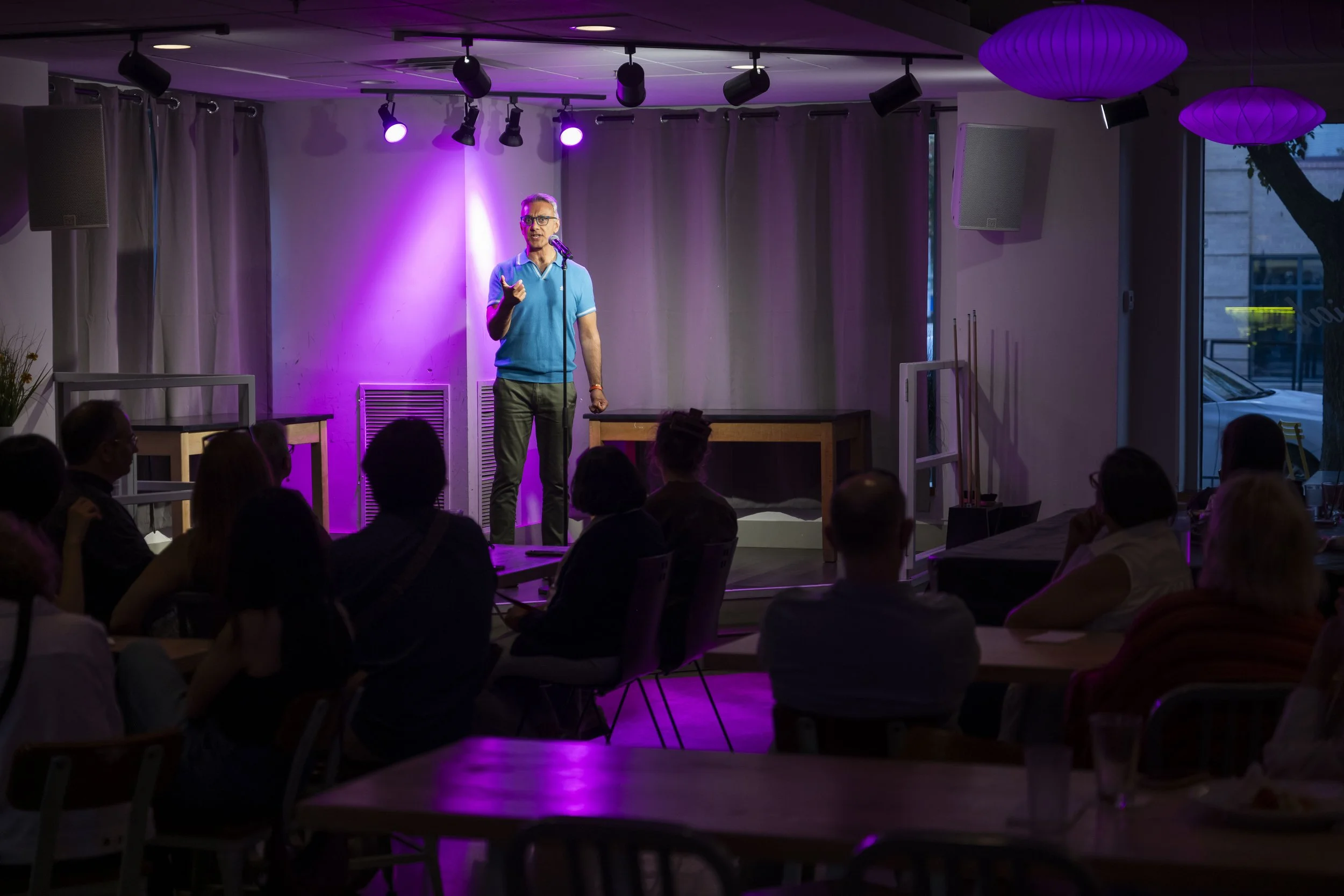
Rajesh Mirchandani shares his story at Penn Social in Washington, D.C. in July 2026. Photo by Lisa Helfert.
After that, every time we'd speak, she'd suggest ways to make our Indian food onion‑free, and I'd try them. Eventually, so did my partner.
There'd be other workarounds. If a sauce or a masala gravy really needed onions, I'd make it according to the recipe when he was out of the house, and then I'd liquidize the whole thing. At first, he was repelled, but he soon realized he couldn't smell, taste, or see the onions. He tried the dish, and it was good.
The more I adapted, the more he adapted. And we learned onions are the enemy, not each other. And we learned, don't try and change what you can't control.
Which brings us to today, 18 years since the restaurant date, and we have an exact and surgical process down pat. If we go to a restaurant and a dish arrives with onions on it, he just slides it over to me. I extract the offending items onto my plate and then pass it back, and he tucks in.
If he still finds one lurking, he doesn't freak out. He doesn't pass out. He just picks it out and still enjoys the dish. Ladies and gentlemen, progress.
Now, if I could only get him to like mushrooms.
Thank you.