In this week’s episode, both storytellers explore the surprising connections between dance and science.
Part 1: Learning a modern version of her childhood Indian dances puts Sumitra Mattai’s brain and body to the test.
Sumitra Mattai is a writer, storyteller and textile designer. She holds a BFA in Textile Design from the Rhode Island School of Design and an MFA in Creative Writing from The New School. Her essays have been published in Huffington Post, Scary Mommy, and Lit Magazine, among others. She lives in Harlem with her family.
Part 2: When people doubt that dance can empower girls to pursue STEM careers, Yamilée Toussaint sets out to prove them wrong.
Yamilée Toussaint is the Founder & CEO of STEM From Dance, which empowers girls with the skills, experiences, and confidence to pursue careers in STEM through the transformative power of dance. Combining her background in engineering, education, and a lifelong passion for dance, she started the program in 2012 to inspire girls of color to pursue STEM careers. Yamilée holds a B.S. in Mechanical Engineering from MIT and a M.S. in Teaching from Pace University. She has earned numerous accolades, including the MIT MLK Leadership Award, Teach For America's Social Innovation Award, AnitaB.org's Educational Innovation Award, Falling Walls Foundation Science Engagement Breakthrough of the Year, and a 2024 Top 5 CNN Hero.
Episode Transcript
Part 1
My daughter was four years old when she took her first lesson in Bharatanatyam, a form of Indian classical dance. I tried not to cry as I watched her learn the same steps I had learned as a child. We were in a studio in the Upper West Side, but when the teacher sang the notes, I was transported straight back in time.
Kita taka tari ginata, kita taka tari ginata, kita taka tari ginata. The rhythm beckoned me like I was a weary traveler coming home. For weeks, I wanted to ask the teacher if she had a class for grown‑ups. But every time I tried to send the email, I talked myself out of it. I'm too old. I don't have time. What's the point?

Sumitra Mattai shares her story at Pier 57’s Discovery Tank in New York, NY in September 2025. Photo by Jason Serrano.
Bharatanatyam originated in Tamil Nadu in South India and found its way to me and my family in the suburbs of New Jersey. I began learning as a third grader, and by the time I was a teenager, I was dancing every weekend. While my friends were throwing Sweet Sixteen parties, I had an Arangetram, or a dance graduation, a three‑hour performance with live musicians and my teacher's guru, who we'd flown all the way from India.
Up until I went to college, Indian dance was the single greatest commitment of my young life. But I wasn't 16 anymore with endless stamina and an impeccable memory. I was 43 with creaky knees and an aging brain. I'd read that the prefrontal cortex, the part responsible for working memory, starts shrinking in your 30s and 40s. This only worsens with stress and lack of sleep, both hallmarks of my life as a working parent of two young children. There was no way I was just going to pick up where I left off.
The perfectionist in me took a hard stance. If I couldn't do it well, I shouldn't dance at all. But on the weekends, I continued to practice with my daughter. Together, we did the Namaskar, the opening and closing prayer, where we pay respects to the earth and ask for blessings from the gods, the guru, and the audience. I loved when we moved in sync and the serious expression in her dark eyes.
Finally, nostalgia got the better of me. I sent that email to my teacher, Uma, and she wrote back that, yes, actually, she did have a class on Tuesday nights and would I like to join.
At first, I was nervous and afraid to embarrass myself. I was certain I'd lost my form, and there was no question of my endurance. But all those years of practice were stored in my limbs. I was surprised by the muscle memory that awakened.
In my mind, the Adavus or steps, and the Mudras or hand gestures, they were still there, buried like treasures in my gray matter. I still had the fundamentals, but in that classic paradox of aging, I could remember choreography from my childhood better than the steps I learned just last week. I suspected this was due in part to what psychologists call the reminiscence bump. This is a phenomenon where people tend to have incredible recall from about ages 10 to 30 when their life experiences are new and formative. My learning of Indian dance certainly fell into this category, but now I was straddling two realms, the dance of my childhood and the dance of now.

Sumitra Mattai shares her story at Pier 57’s Discovery Tank in New York, NY in September 2025. Photo by Jason Serrano.
My teacher, Uma, was just a few years younger than me, and she brought a modern perspective to this traditional art form. I found this both refreshing and disorienting. In class, we talked a lot about neuroplasticity and the brain’s ability to adapt and grow with new experiences. Uma loved taking these traditional, classic sequences and steps and remixing them and remolding them into something new. This completely boggled my mind and sent me into this heightened state of awareness. Her teaching style wasn’t easy or comfortable but it definitely got my gears turning.
I was hoping we would start with a short easy piece, but of course Uma took us straight to the deep end with a Shiva Tandava, a dance celebrating the Hindu god. Lord Shiva was known as the destroyer, but he also had the power to create, protect and transform. Perhaps this was the energy I needed.
Around Thanksgiving, Uma announced there would be a winter showcase for all her students. Seeing that deer‑in‑headlights look in all our faces, she tried to reassure us that it was lowkey and it would be fine. But I felt this sick feeling in my gut. I wasn't ready to perform. I was just happy to be moving again. I was scared and I was uncertain.
“Something is holding you back,” Uma said to me one day after class. “What are you afraid of?”
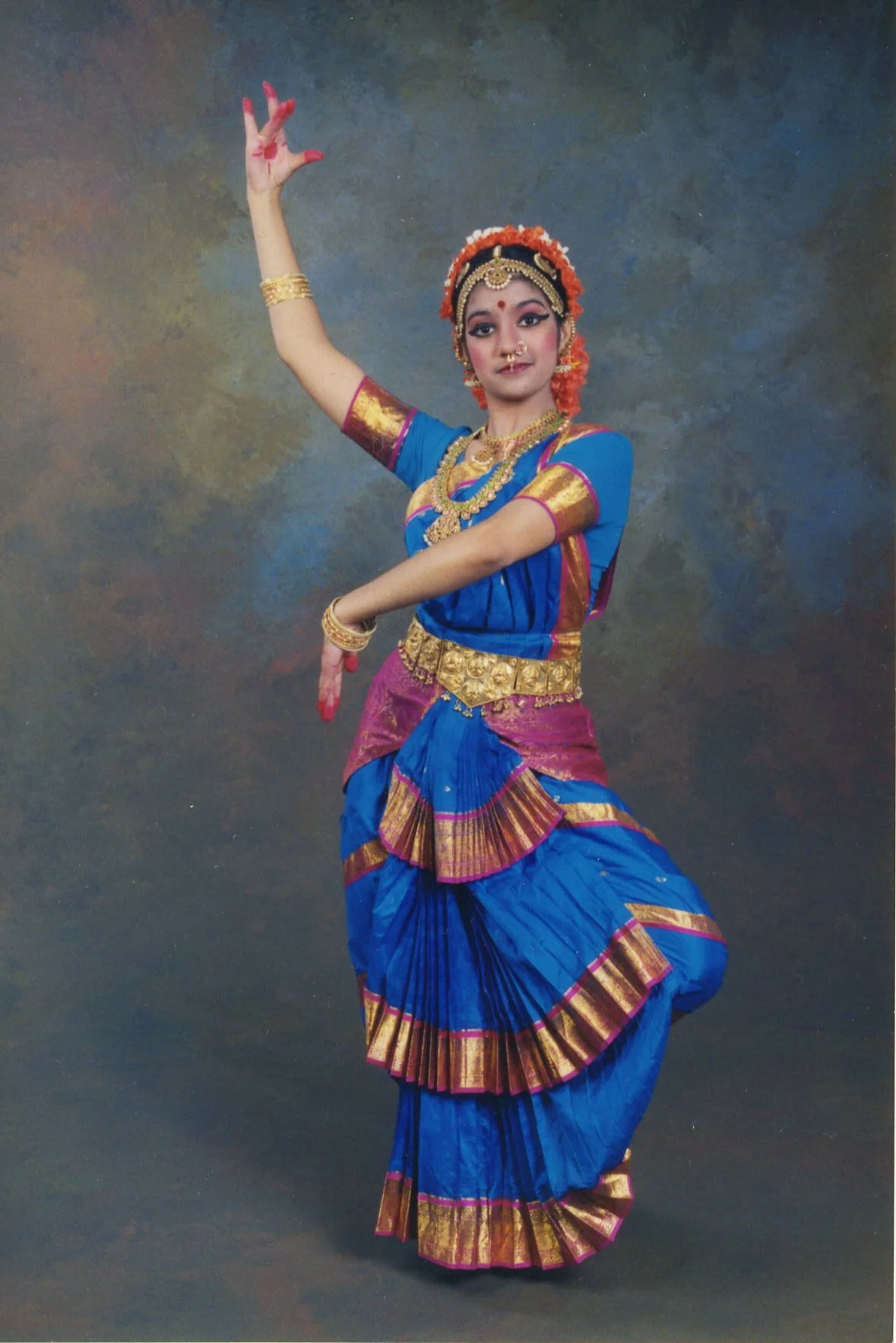
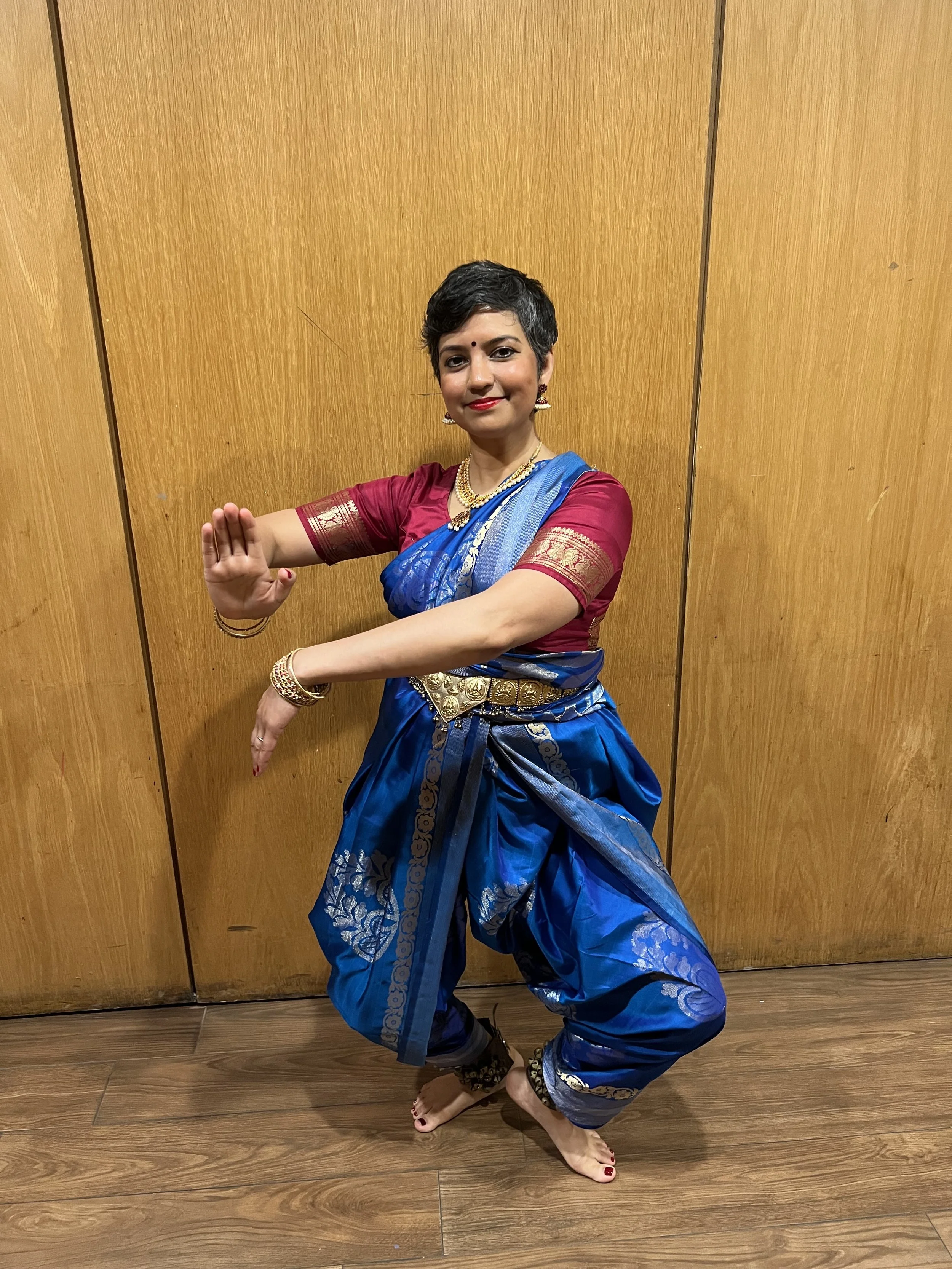
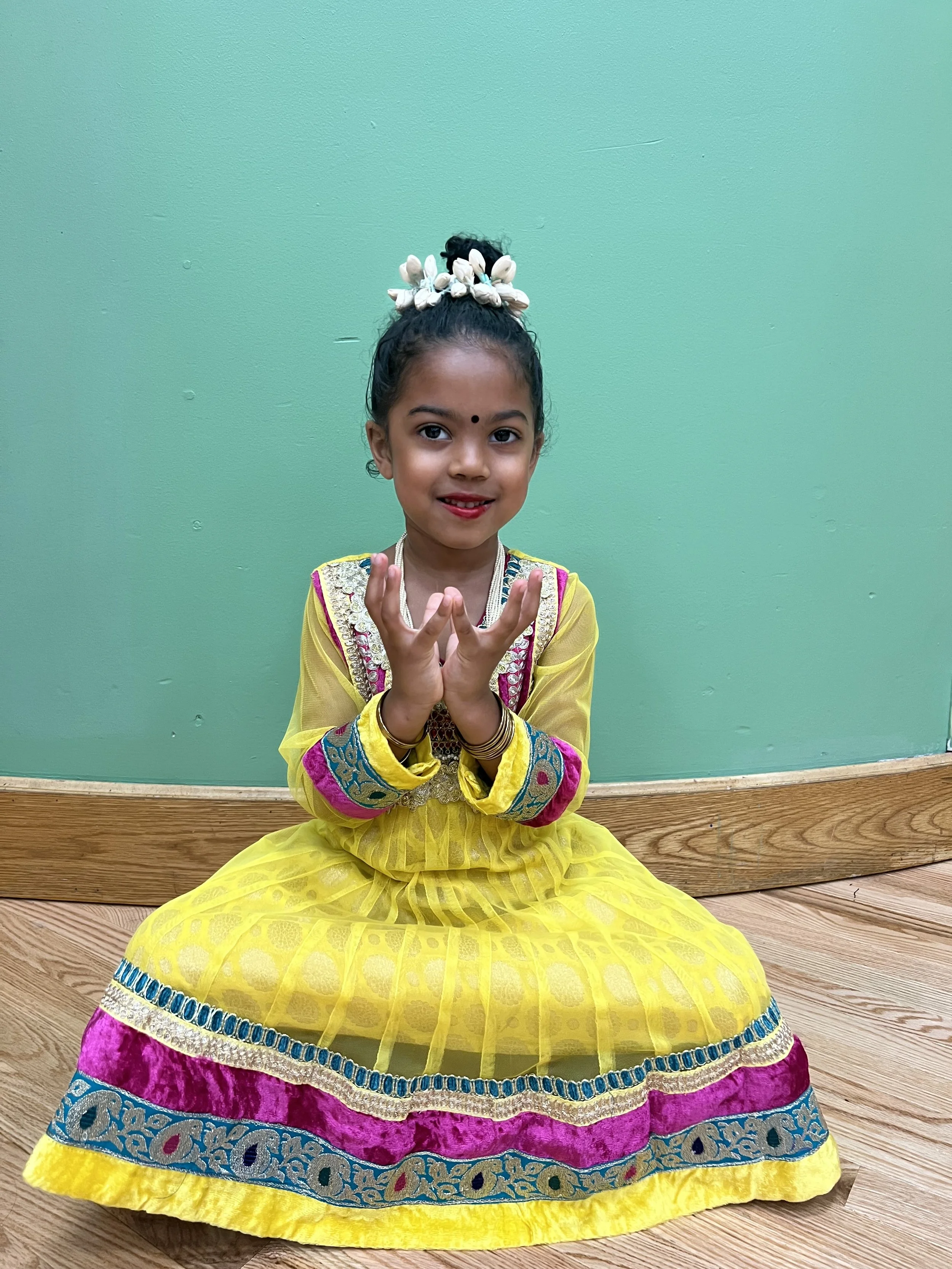
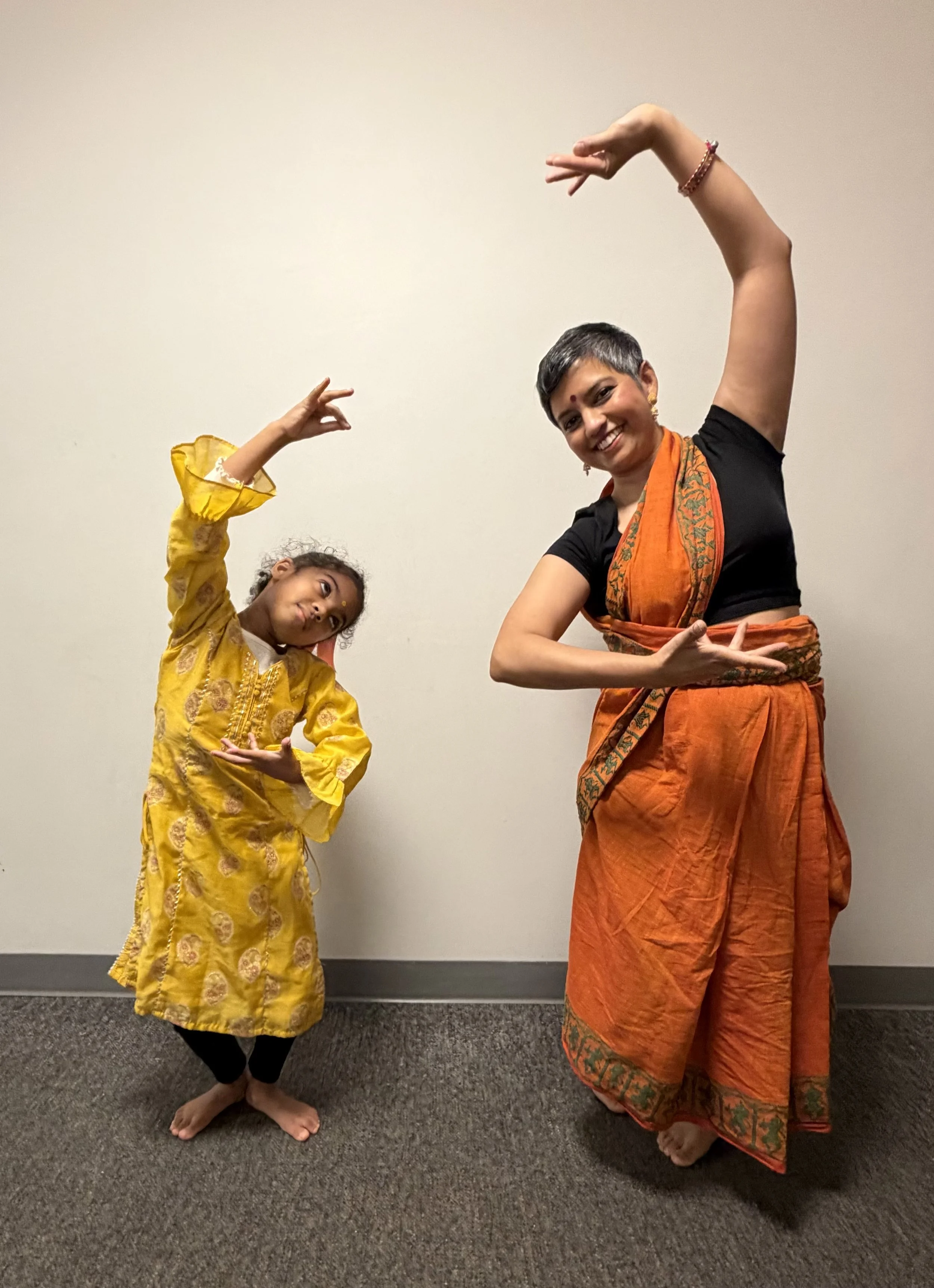
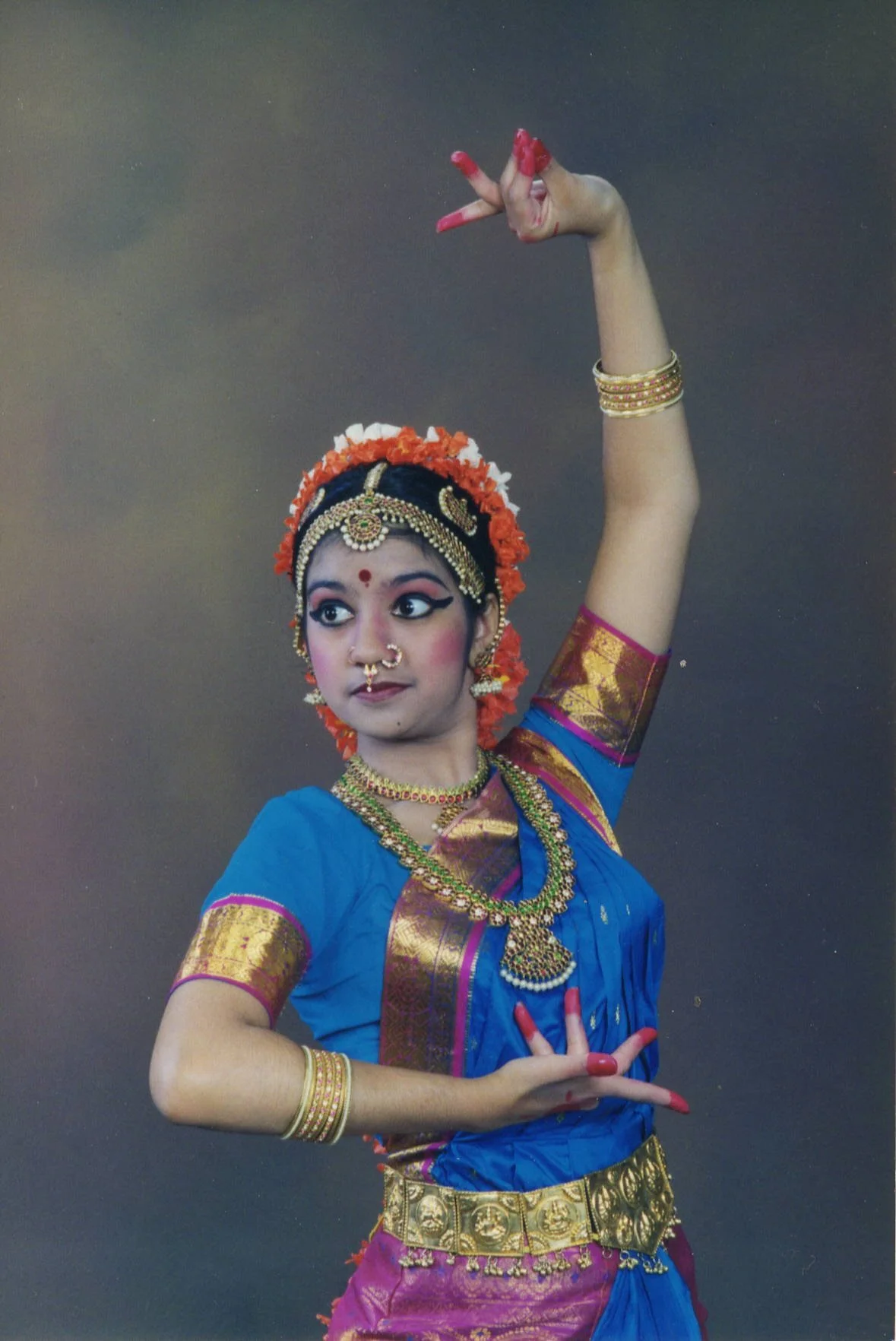
I thought about this question for a long time. I was deeply uncomfortable in my middle‑aged body, with my double chin and achy hips. It was hard for me to imagine that this version of myself could still convey beauty. Part of me felt like I should be in the audience with the other mothers, supporting my daughter and not putting myself in the limelight. I knew that I had to move forward, and it was scary.
I struggled to retain the choreography, but I had to figure it out. So I finally started practicing in earnest. About 10 days before the show, I moved the coffee table out of the living room, and every day after I came home from work and put my kids to bed and did all my chores, I danced. Finally, after about a week of consistent practice, my mind finally stopped going blank.
I started to feel the connection between the movement, the music and the meaning of the song. I wasn't just moving around, expending energy. For the first time in a long time, I felt like I was making art.
I still didn't know how it would all turn out, but by the time the day came, I felt the tiniest glow of confidence. That day at the winter showcase, my daughter and I performed. We shared the same stage. She was the youngest and the smallest of her cohort. She was totally unfazed. Unlike her mother, she didn't have all these expectations and hang‑ups and fears around her. She just got up on stage, and when the music was too fast for her to follow, she just stopped until she was ready to start again. I was so proud of her.
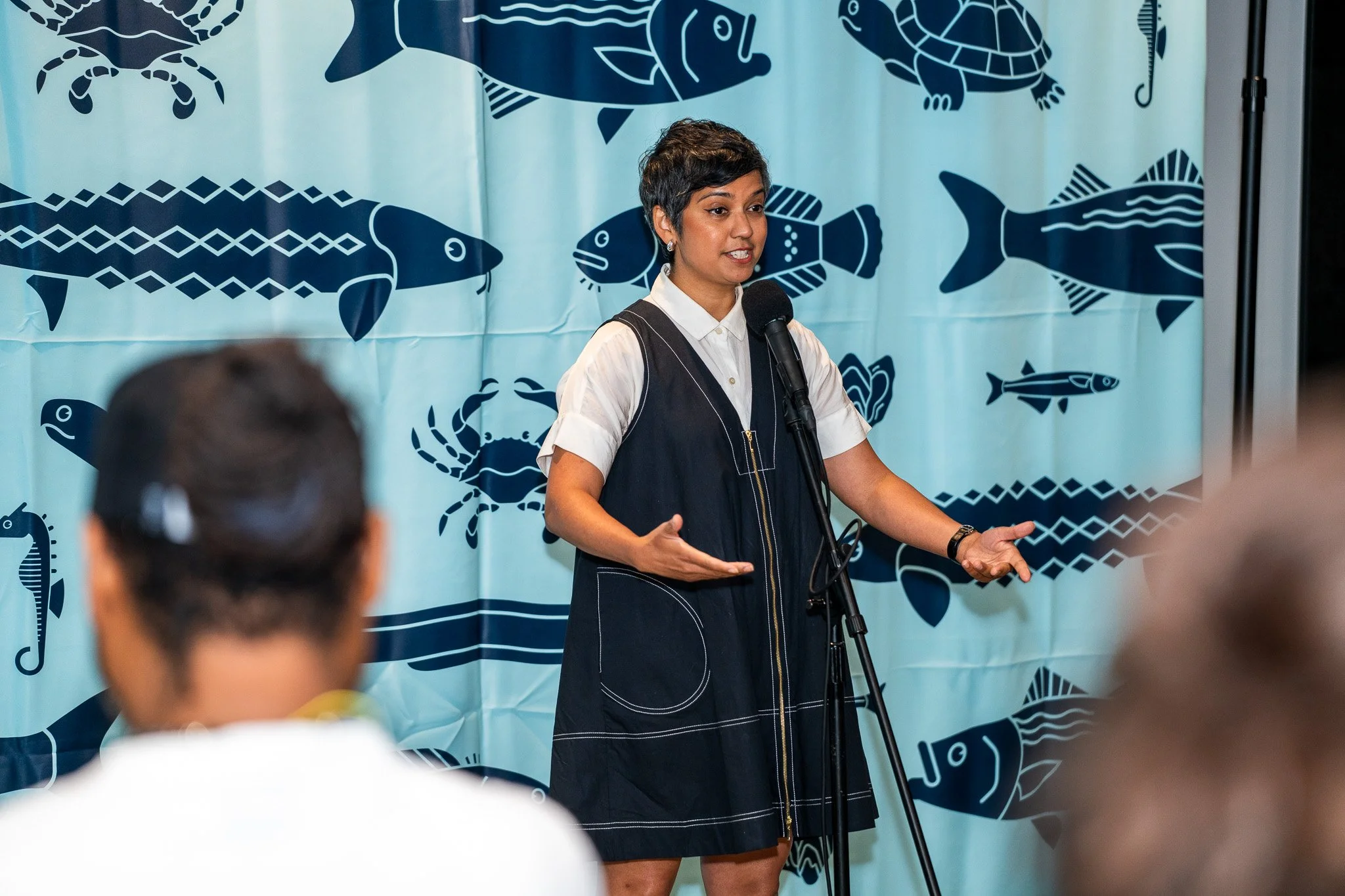
Sumitra Mattai shares her story at Pier 57’s Discovery Tank in New York, NY in September 2025. Photo by Jason Serrano.
When my turn came, I was surprised to remember how much I had missed the thrill of performing. In front of the audience, I felt glimmers of my old self, the dancer I had once been.
The time went too fast and I left the stage warm, giddy, and craving more. Afterward, my son gave me a high five and said, “You still got it, Mama.”
Part of me wished I could put us all in a time machine and take us back to the ‘90s so they could see me in my glory days, but then I thought it was better for them to see me now, working ten times as hard for the same result. I had just demonstrated to them the resilience that I hope they would cultivate in their lives.
This year, with Uma's guidance and encouragement, my daughter and I performed again at the summer showcase. Slowly, I'm learning to trust myself. My daughter is still at the beginning of her journey with Bharatanatyam. Mine has had a few detours, but I'm grateful it's not over yet. My prefrontal cortex might be shrinking, but there's no reason to stop trying. Perhaps there's more to this body of mine.
Thank you.
Part 2
Growing up, I never missed a day at school. However, there's one day I was eager to miss, and that was Bring Your Daughter to Work Day. I got to go to work with my father, and not only that, I got to dress up. I would wear a long dress with my white opaque tights, my patent leather shoes, my pearls. And instead of going out the driveway to the right to go to school, I got to drive to the left and go with my father to work.

Yamilée Toussaint shares her story at Caveat in New York, NY in April 2023. Photo by Zhen Qin.
I got to see where he would park his car and I would get to walk behind him in the hall, see him greet his coworkers, see where he went to lunch. And then I would get to go in his office and sit in his chair, and he would have these 3D drawings all over the desk, because my father was a mechanical engineer at a manufacturing company that made electrical parts. He would organize these activities where we would get to tinker with these electrical parts.
I would just look forward to this day every year, and it made me start to feel like I could be an engineer, too.
So that's what I decided to do. I went to MIT to study mechanical engineering. And I distinctly remember my first mechanical engineering class. It took place in one of MIT's funky‑looking buildings. It's in this 200‑seat lecture hall.
I find my seat, not too close to the front, not too close to the back, somewhere in the middle. I find my seat, I take out my notebook, and I do what I normally do when I'm in a room, which is scan the room just to see who's in the room. Often, I'm looking for how many other people there are who look like me. And so I start to count. One, two, and myself makes three black women in a room of 200.
Later on, I found out that in the STEM workforce, only 5% of STEM employees are women of color. I felt that in that room. And with all that I accomplished to get to that point, all the confidence that I had, it started to make me question whether I belonged.
I didn't like that feeling. It felt wrong that I didn't feel like I belonged in a place that I knew I deserved to be in. That just got me thinking, maybe there's something I can do to change that. Oddly enough, I started to think about dance.
So when I was at MIT, I would take these engineering classes in the day, and in the evening, I would dance with my dance group. Dance was my way of releasing. And what I didn't realize then that I know now is that through dance, I built confidence. I was empowered to be creative. I was engaged in this activity that was meaningful to me and my culture, and I gained a community. I realized these are the things I want young people, especially girls of color, to feel when they learn about math and engineering.
That's what led me to launch STEM From Dance over 11 years ago. It was this idea that girls can feel empowered, feel encouraged and be free to express themselves, and that we can have a world where the STEM workforce is diverse, it's equitable, it's inclusive, and that girls can be empowered to bring their whole selves, their whole creative, confident, equipped selves to be our leaders and innovators.
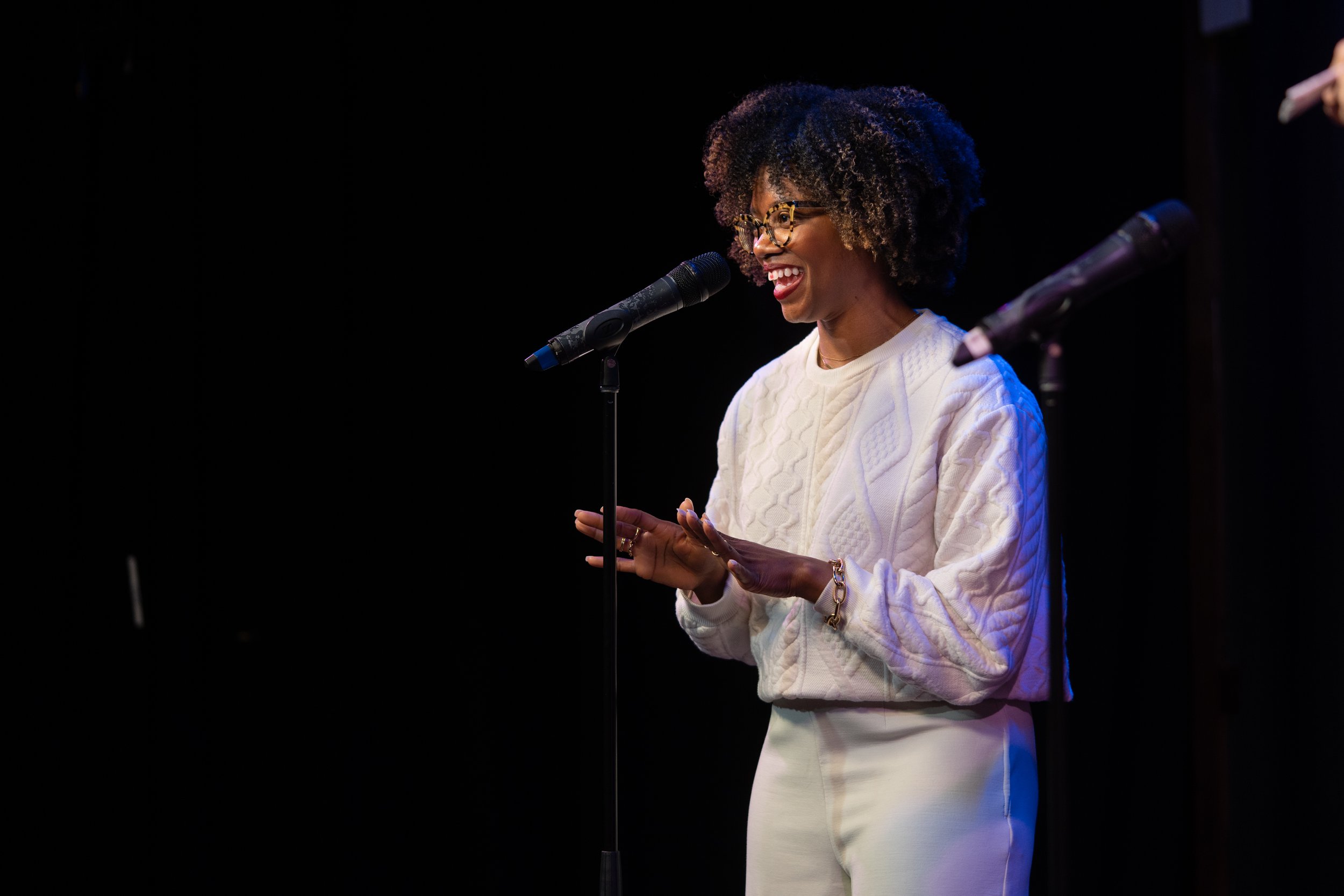
Yamilée Toussaint shares her story at Caveat in New York, NY in April 2023. Photo by Zhen Qin.
Now, I then was faced with a small feat, which was how to combine dance and STEM together, and this idea faced a lot of skepticism. I remember a phone call I had with someone whose support would mean a lot at the time. He worked for an organization that supports early stage entrepreneurs with funding, which I needed. And he just did not get it. He felt like dance was just a hobby. Like, sure, they would have fun doing it, but that it wouldn't bring about some kind of change.
I remember hanging up that call and being in my studio apartment in Flatbush Avenue just feeling defeated. But there was something in me that just felt that this idea still had some potential.
So I said, “You know what? I'm going to do a pilot. I'm going to actually test this and show these people that it does work.”
So I went to a school. I got the permission to work with about eight students and we danced, and we did math tutoring. I had another idea. Let's do a performance, and I can invite people and document it and show again that there is potential behind this idea of combining these two things.
So it's the day of the performance. I leave my full‑time job early to go to the school. I go to the room where I always meet the students. They're not there yet. So you know what? I'm going to pull up a chair in the hallway and just wait for them there.
After some time passes, I still don’t see the students. And after some more time passes, I start to panic, because I invited a photographer, a videographer, my parents who are guaranteed audience members, my co‑workers. I just realized, you know, I need to call everybody and tell them not to come.
And so I called the videographer, called the photographer, my parents, the co‑workers to say, “Hey, don't come. They didn't show up.”
And I remember after I made my phone calls, sitting in that hallway, this empty school, again just feeling so deflated, because this was my moment to show that this worked, it could work. And those that I was meant to serve didn’t even show up for their own show. And yet, I still felt like there was something worth exploring here.
So I did yet another pilot, and then another pilot, and just kept doing these programs. Over the years, I started to uncover this way that we can combine dance and STEM. We started to allow the girls to create dance performances that incorporated the two.
So imagine costumes that light up. Every time they jump, they could make it turn blue. Or animations that they can program that get projected on the stage behind them, or coding drones to dance alongside them. We found all these interesting ways for them to combine these things together.
Fast forward another couple of years, we had another performance. It was at this high school in Brooklyn, and the performance was going to take place in front of the whole high school student body. So remember back in high school and being on a stage in front of all your peers. This is what our students had to do.
I remember this one group of three girls. It was led by Summer. They get up on stage. I'm in the front row like a proud, nervous mom. They get up on stage, they start performing their routine. I know the routine well. And I see that Summer, she kind of freezes for a moment and then she runs off stage. I'm just like, “No, no, no.”
And I could hear it in the audience, them reacting in like not an encouraging manner, and I just feel so embarrassed for her.
Yet Summer came back the next semester and we worked on things. They had made these shirts that had LEDs hand‑sewn into them that they programmed. And we worked on the tech of the shirt. We worked on her stage presence. We worked on the choreography. Because at the end of that semester, they had another chance to perform.

Yamilée Toussaint shares her story at Caveat in New York, NY in April 2023. Photo by Zhen Qin.
Once again, I'm in that front row, more nervous than the other time. I see Summer and the other two girls get on stage. And y’all, they crushed it. They nailed it. The confidence that they had, all their lights were working, and the audience was, it was just uproarious. They had a standing ovation.
We recorded this performance and it has thousands of views on YouTube. It was just a really stunning, awesome, powerful performance.
You know, I've been doing this work for 11 years. The reason why that's one of my favorite moments is because it demonstrated the power of having an atmosphere where girls can feel like they can do hard things, where they can feel safe to explore things that are scary and be able to face these things that feel like barriers and overcome them.
Imagine what can happen in that atmosphere when they're also learning about programming and circuits and engineering. That is what encourages me in the power of using dance and STEM. I see a world where we can have a creative STEM experience. It doesn't have to just be learning equations on a board.
At this point, STEM From Dance has served over 3,000 girls. And over the next decade, we plan to serve one million girls. And what excites me is that we can have a world where the STEM workforce is diverse. That girls can go to a room in MIT and see people who look like them. That they don't have to have a father who is an engineer who takes them to Bring Your Daughter To Work Day, but that they can be empowered and believe that they do belong in these STEM spaces.
Thank you.