Oxygen sustains almost every living thing on the planet and the air we breathe is meant to be invisible. But industrialization has changed that. In many cities around the world, the air is no longer clean. Polluted air affects our health, contributes to rising global temperatures, and harms ecosystems in ways we are only beginning to fully understand.
In this week’s episode, both of our storytellers share how polluted air shaped their lives and changed the way they see the world around them.
Part 1: After witnessing toxic fumes pouring from a nearby factory, Virginia Kilgore decides to take action.
Virginia Kilgore was born in Oak Cliff and raised in Duncanville, Texas. Much of her youth was spent outdoors building forts and playing in the woods. As a teenager she frequently commuted through a town near Dallas with large factories where she experienced air pollution and became aware of the wide spread associated human health and environmental impacts. This inspired Virginia’s self-funded lobby for stronger environmental regulations in Texas. Virginia traveled as college exchange student to Germany and stayed in Europe for 2.5 years before returning to study further in Texas. Virginia is certified in Alphabiotics, a wholistic brain balancing technique. She also attended Texas A&M firefighting academy at Commerce and continued there as an EMT instructor after receiving a Texas firefighting and EMT certificate. She has worked and lectured nationally and internationally on environmental justice and health related issues. Currently, Virginia is the Executive Director of Water Is Alive Inc, a non-profit organization developing solutions for organic wastes through fermentation and teaching students of all ages how to make biostimulants from agricultural wastes to improve soil and water quality. Virginia is fluent in Dutch, Spanish & English.
Part 2: While working in Delhi, Sai Krishna Dammalapati is baffled by how unfazed people seem by the city’s severe air pollution.
Sai Krishna Dammalapati is a civic-technologist and storyteller who explores the world through science and stories. He builds open data tools in areas such as air pollution, disaster management, and legal research. He writes and enacts stories and screenplays that aim to make readers kind, confident, and knowledgeable. Outside of work, he enjoys reading. His current read is Book Lovers by Emily Henry.
Episode Transcript
Part 1
I was actually born not far from here in the hills of southwest Dallas. When I was five, we moved a little bit further, a couple miles further, and I spent my youth playing in the creek. We kept bees, and we all worked outside in the garden.
Then when I was in high school, I went with my father to the country. We worked a lot in the country, in the hill country. So we were coming back from the hill country one day, and it was Sunday night. I could see, like, a big glow on the horizon. It was like there was a fire or something.
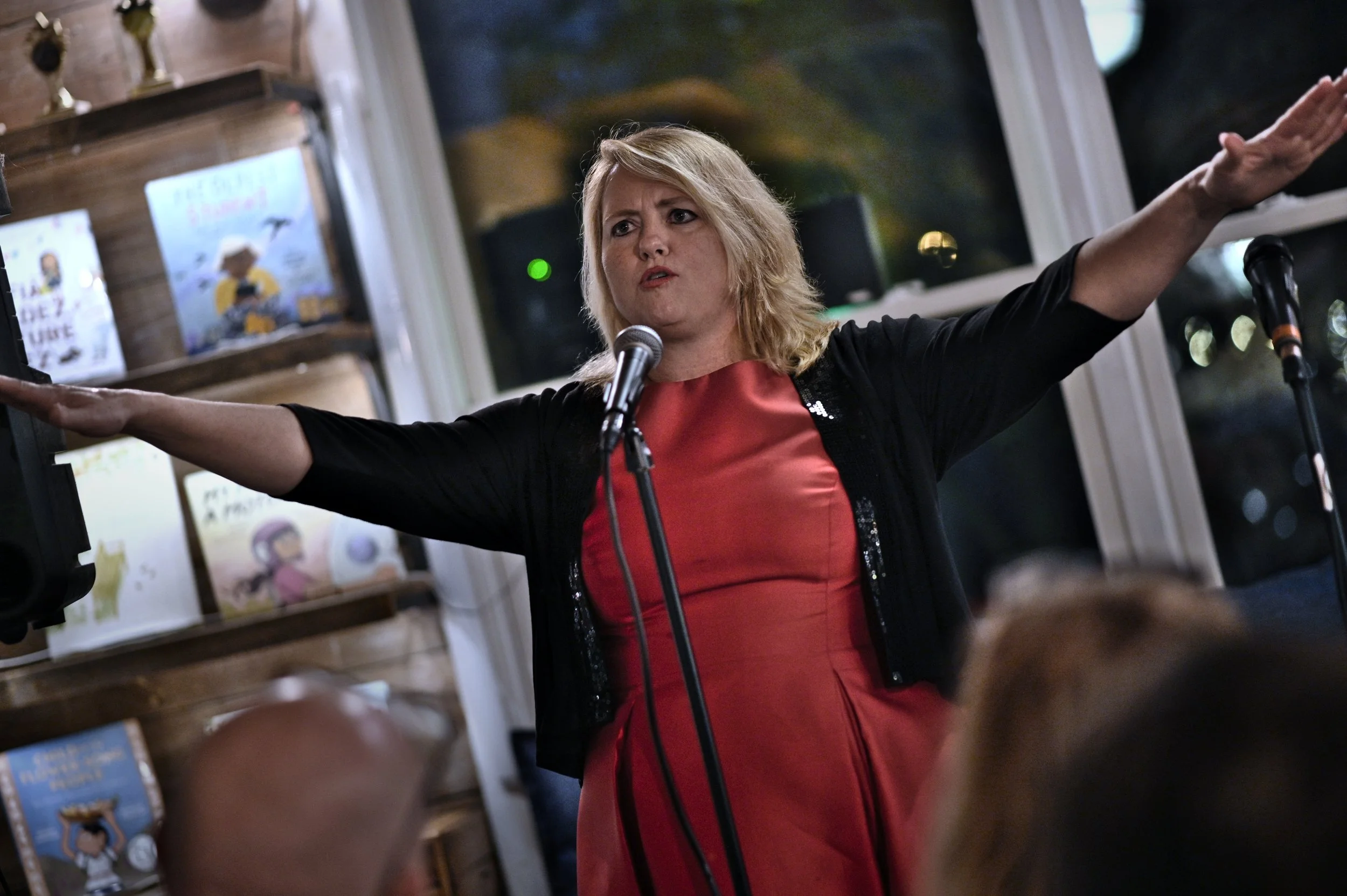
Virginia Kilgore shares her story at Wild Detectives in Dallas, TX in December 2022. Photo by Jason Hensel.
So we were in the country coming back to Dallas, and we were, like, an hour away, 45 minutes away. The closer that I got to this kind of glow, the more I thought, “What the heck is that?” Then when we got closer, I saw, oh my goodness, that's a big factory. That's a lot of lights.
So when we were right at the foot of this factory, we could see this, like, just spotlights all over the shininess of this factory. It was all over the highway and it was like as bright as the morning sun. Ridiculous amount of lights, but it was also illuminating this kind of heavy smoke that was actually falling out of the smokestack. Smokestacks are generally really tall so that the wind will kind of carry them away. But in this case, they just came out and then fell down and hit the ground.
And it was blowing across the highway, so we were going into this cloud of smoke behind all the cars that were in front of us. After we got in there, it didn't take very long before we started choking. So whatever was this smoke that was crossing the highway, had gotten into the cab of the truck.
So I turned the air conditioner off and I rolled up the windows and I was just glued to the window looking out at this horrific amount of whatever it was that was surrounding the truck and in the cab of the truck with us. I tried to look at people to see the people that we were passing on the road, to look at their faces. I couldn't see any faces.
But I followed the smoke and it crossed the highway, and I saw a field of cows there. They were standing behind the fence, and I was thinking, “Oh, my goodness, I'm choking. I can't breathe. What's going on with these guys?” I was horrified. It was a very painful situation.
When I got home, I called 911. I was like, “There is a factory melting south of town. It's made me very sick. There's cows out there. This can't be a good thing.”
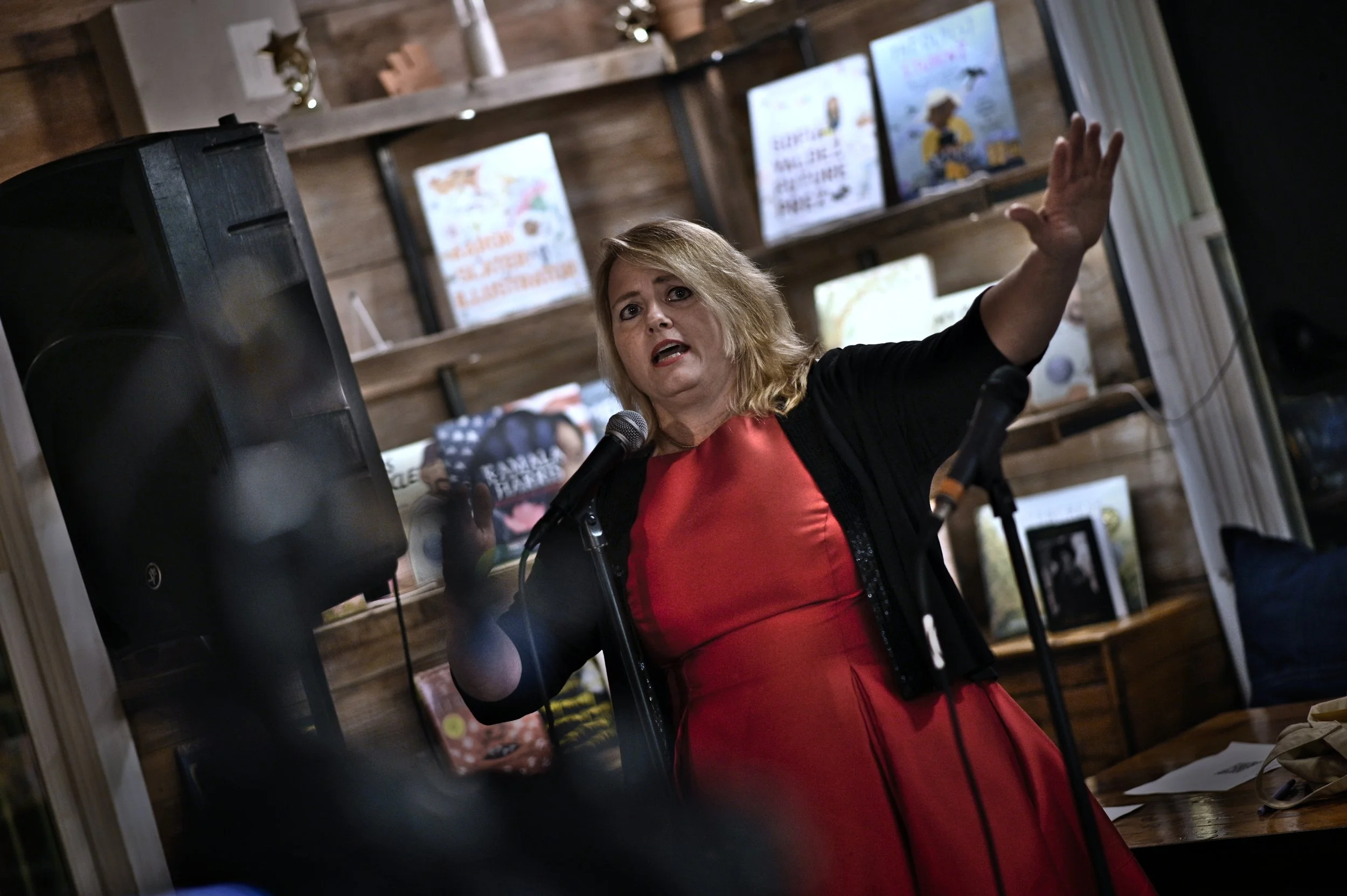
Virginia Kilgore shares her story at Wild Detectives in Dallas, TX in December 2022. Photo by Jason Hensel.
And they were like, “Lady, calm down. Calm down. It's okay. They're permitted to do this. We've gotten a lot of calls about this but, unfortunately, it's Sunday night and we can't help you.”
Wow, that's heavy. I mean, what about the people that live there, right?
Then the next day I decided to call the newspaper and find out exactly what was going on and how I could get involved to stop this, because it went on and on. And every time we came by there, not every time but many times that we drove by there, we'd get the same kind of effect. This gas would make us sick. We'd get home. We'd be sick. You know, what's going on here?
So, I called the newspaper and I asked them what was going on and how can we get involved to stop it, for goodness sakes. So they gave me the number of several groups that had been meeting about this. Just specifically, one group was just specifically working on this particular issue because it was making people sick and causing record amounts of asthma in this part of town, a little bit further southwest than here.
About that time, my mom started to develop asthma. I was just, like, fresh out of high school. She started to develop asthma. I just called her a little while ago, and she did an inhaler. She just strapped this thing to her face and do these vaso/bronchiodilators every day to breathe, and this was the origin of her asthma. This was 30 years ago. So it's still kind of going on.
So with this group, we had meetings every month. We focused on the permitting of this company and, of course, that's a really boring subject. So we'd dress up in costumes that looked like smokestacks, and we'd go out and do street theater. And we did all kinds of programs for cable television. That's when you still had the kind of things that weren't digital. They called them analog, and you had to actually cut and paste your film when you were making it. So we'd send that out on cable television just to try to bring it creatively and not be such a wet cloth about, oh, my God, what a boring story, polluted air.
So we did all kinds of stuff. During that time, I was invited to go to Mexico and speak to a large symposium of professors from Mexico, Central America, and South America to talk about the adverse effects of dioxins, incinerating dioxins. So we really got into the permitting process of how can this happen? How can they be doing this? This is obviously making so many people sick.
The permitting process was a failure. We spent like 10 years fighting this permit. We finally went to court with all the other environmental groups in Texas, because everybody thought this was a terrible scene. So we took them to court to fight their permit. It ended up being the longest and most expensive court case. It was called a contested permit hearing. It was the longest and most expensive one in Texas history ever.
After that, I was personally, because of my mom, because of our reaction, because of the kids, because of the cows, because of everybody that lives here, very much emotionally and physically involved. And then I had 10 years invested in this permit and this permitting process, so I decided I'm going to do something about it. I'm going to do something.
I thought, “Well, what am I going to do?” And then I thought, “Oh, I was so inspired by Gandhi when I was in high school about this, you know, his whole fasting to make change in the world,” so I decided I'm going to do a hunger strike. Yeah, that's it.
I mean, I was very involved in this, and I thought, “Well, what's the biggest thing that I could offer?” It's my life. So I thought, “Well, yeah, I have my life to offer. This is making a lot of people sick. Maybe I can change the scene.”
It took me about a year to get a permit to hunger strike, because there are no permits for hunger strikes in Austin. I wanted to go right to the Capitol steps and, front stage, do a hunger strike, right? Gandhi did it.
So I was out there. Every day I'd go and I'd talk to the representatives and the state senators. I'd tell them about my problem and our issue, and I'd talk about the cows and the people and the kids, and people living in their house getting gassed and me driving by getting gassed. That didn't really get the attention of the particular person that I was aiming to get the attention of. That was a very prominent politician at the time. I felt, I just felt that that guy can help me change the situation. I can talk to him. He's going to understand this. We're going to change the situation.
Anyway, I was not getting his attention at all. I was out there for a week. The week went by. I was getting really dizzy in the week. Everybody was like, “Lady, you need to go to the nurse and find out what's going on with you.” Well, of course, everybody knew what was going on with me. I'm not eating.
So what I did is I thought, “Where's the common ground here between me and these legislators, common denominator?” So I was looking for a common denominator. What's going to endear me to them?
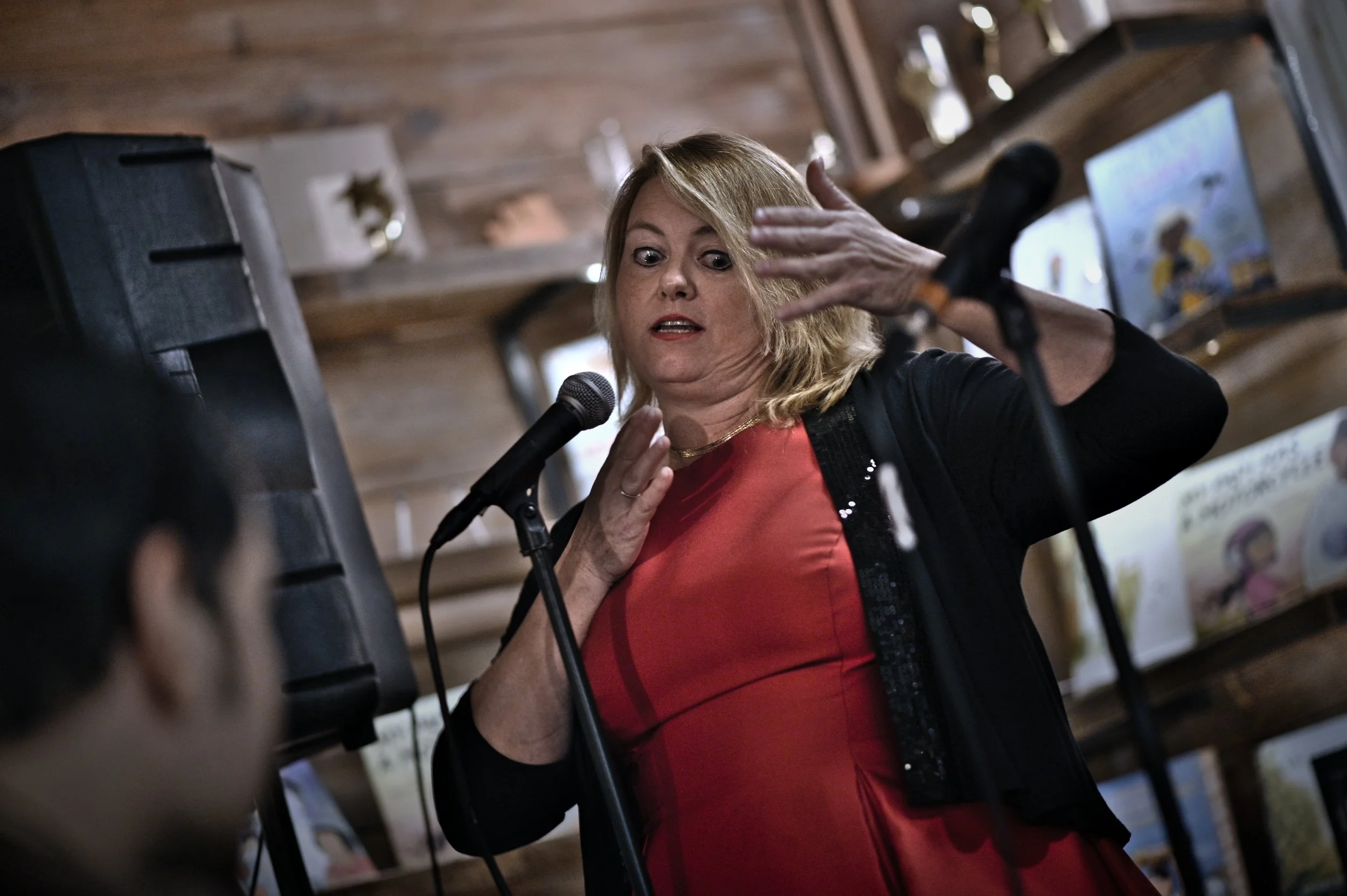
Virginia Kilgore shares her story at Wild Detectives in Dallas, TX in December 2022. Photo by Jason Hensel.
And I thought, “My letter jacket.”
In high school, I lettered. I had a letter jacket, of course. It was a letter jacket and all kinds of patches. It was ridiculous. I never wore it. It was new. It just wasn't my style. I was a punk rocker. I was a jock and a debater, but I was definitely not wearing my letter jacket.
This was the first time I'd ever worn it. I was out there on the south steps of the state capitol during legislative session and talking to everybody that would walk by and look at my poster, and listen to me and ramble on about my issue. And, you know, kind of a little tired because I hadn't eaten in a long time.
So they sent me in. They were observing the shutdown of my kidneys. They were definitely focused on my kidneys because that's a cheap test. And they would tell me, “You know, lady, your kidneys are shutting down. You know, you could die from this if you don't stop.”
“Well, anyway, even if you do stop, the minute that you pass out, we're going to be down here. We're going to restrain you. We're going to detain you. And we're going to force feed IV you back to health. So you're not taking anything with you except for these days.”
But the letter jacket paid off. Because the particular politician that I had been kind of provoking just by being there on his front steps, he noticed me. He said, “Oh, my goodness, wow, that's a high school. I know that high school.”
He came up and he was like, “Oh, you're from that high school. Wow, that's a lot of patches. Wow. Cool.”
And then he started listening to my story, whereas he wasn't listening before, but he was listening now. So I told him about the issue, pointing to my poster to illustrate the problem.
And he was like, “Lady, you're all alone. There's nobody here with you. If you were 10,000 people, I might be able to help you, but you are all alone. So thank you, but no.”
What happened after that is that he kept talking to me. He'd come up to me. We'd talk. I didn't even have to run after him. I mean, he'd come and evaluate I guess my mental state or something.
So what he did is he encouraged me. He told me that he was proud of me. Darn that I was alone, but he was proud of me. And he gave me some really good advice that actually took years to understand.
We talked eight times, nine times in total, including that first time. I did a 17‑day hunger strike. And in one of our last conversations, and this is when it was getting down to the wire, they were really worried. I had a lot of press coverage because they thought I was going to fall dead any moment. He said, “You know, if you really want to affect environmental quality and do any kind of changing at all, you need to work with those big polluting businesses. You could do all the protesting you want, lady, but you need to get it together and work with these businesses and present solutions to these huge problems, because they don't know. We're all just trying to get a piece of the pie. They're incinerating this terrible stuff because they're saving money and getting paid to incinerate the waste and selling their product and making a living for a lot of people working in this area. That's what you need to do. You need to get together with these businesses where they're just in the planning stages of whatever permit process they're going to go through, or even the construction of the factory.”
It took years for me to understand this. I actually was already involved in daily meditations for years before I could evolve to fit my head around this because it seemed like it was the opposite of what I was. I felt like I'm an “us”. We're an “us”. We're getting poisoned by “them”. And to come to the realization that I want to be a “them" and how am I going to rearrange that in my own life to be a “them” and work with “them” to save “us”, well, that didn't fit through my door.
So I did. I did, after all this meditation, realize that that is the answer, that that's got to be the answer. Is to work together to find a solution to help us all through this environmental crisis and to come to the table and to be active and proactive in presenting solutions where there are otherwise no solutions.
So, today, and this is spanning over a 30‑year period of time, today I present to you and to everybody, to myself and to big businesses, ideas on how to recycle organic waste and inoculate them with microorganisms so that they eat trash, because they're born onto organic waste. There's a lot of energy in that, the good stuff. And then when we wean them onto the contamination, it breaks the contamination down. So we're actually eliminating two huge problems at the same time.
In this way and in other ways and whatever ways we can think of to present solutions, I believe that even though we all feel differently, and it is kind of an “us” and “them” if you think about it, but if you don't think about it from about 100 feet that way, we are all the same. We live on the same ship. We want the same things, or very similar things to each other. And we definitely can learn how to work better together and be better stewards of our environment.
Part 2
It all started when I graduated. I think I was only good at math and statistics. Those were the subjects I was doing well. I was looking out for companies where I can actually employ these skills, but I was also finding those companies where I can get to solve public problems. I don't even know why. This entire sector of data for good, etc. was new to me. But it was a process of negation where I was not happy with companies where I was using these skills to sell a credit card or something. I was looking forward to work on public problems.
I read a newspaper article about how my city government selected 10 startups to tackle various public challenges. These civic tech startups were working on areas like waste management and data‑driven governance. I emailed each of them expressing my interest. One of those startups, called Lakeer Foundation, saw me fitting in their culture. My career started then.
Over the next three years, I learned data applications to public issues. I mapped flood‑prone areas of a city, worked on making public transport more inclusive, researched on economic and urban policy, wrote data stories on regional media on the spread of COVID‑19, etc. I started to call myself a civic technologist.
There were few places in India where civic technology industry did well. Bengaluru, Pune and Delhi, the national capital of India, had most of the opportunities. To my surprise, I got a job working with the Delhi government, working on its most important problem, air pollution. I was very excited. War on air pollution was a project I got stabbed on by a consulting firm called GDi Partners.
Delhi is one of the most polluted cities in the world. Solutions like air purifiers treat the symptoms but only governments can address the root causes at scale. I worked for the Green War Room, a command center coordinating efforts across civic authorities responsible for keeping Delhi's air clean. These agencies reported daily on their efforts. My job was to automate the generation of insights from their reports, helping the war room identify and address inefficiencies.
I felt this is it. I was elated that I got to use my statistical wand on one of the most important public problems in the country. I was proud that I found this use case of my skills. I did not limit myself to being a data guy who codes. I bristle when someone calls me a techie. I cherish more about the domains I work.
I immersed myself in the study of air pollution as I worked at the Green War Room. When a civic agency reported open waste burning, I studied how waste management impacts air quality. When another agency reported on construction debris, I dug into that as well. Variable by variable, I built up my domain knowledge about air quality, the science, the policy and the politics of it.
I became the person who checked the AQI, the air quality index, before stepping out and started to carry a mask. I wondered why very few residents of Delhi are not doing the same. Maybe I just ingrained these habits as I worked on the problem.
But then disappointments started creeping in. Firstly, health. No matter the amount of precautions I took from air pollution, I started feeling its impacts. An AQI below 50 is considered safe. It had crossed 300. My eyes used to turn red as I cycled to the office, not from exhaustion but from pollution. I felt irritated. Some people even laughed at my mask‑wearing and the concern. They said they got habituated to pollution. I hope evolution works so fast.
The air which we once learned in school was invisible had started becoming visible to me in its most polluted form. I learned that living in Delhi could cut 7.7 years of my life and leave me with a bunch of respiratory diseases. Every breath came with anxiety. I felt guilty for prioritizing my health over my work. That's a toxic work ethic to have.
I also had romanticized the sector a lot. That with my mind of statistics and technology, I thought I would bring a great change in the society. That illusion started to fade away. There was superficiality and mediocrity in the bureaucracy and the development sector. Best solutions were not getting implemented for absurd reasons. There was grand talk about Sustainable Development Goals and other such buzzwords that were freely thrown around, but there was very less real work done on ground.
For instance, the government planned to construct smog towers in its war against air pollution, the tower whose impact is limited to 50 meter radius. There was next to zero knowledge and reason that supports such a decision. Yet, a smog tower could catch a lot of media attention and everything. Including my work, everything got reduced to that, optics.
My mentor suggested that I actually focus on doing what I can do best to create greater impact instead of chasing this optics of impact.
I left Delhi. The stint lasted for less than a year. I doubted myself if I was taking decisions too quick, but I had to decide. I couldn't withstand the stagnancy and mediocrity crowding around me.
I left Delhi but not the dream of solving public problems. I found a remote job at CivicDataLab that let me continue similar work. I continued working on air quality at UrbanEmissions.Info. This time there were no illusions. There was no romanticization. My work wasn't building data sets and knowledge on various public problems: disaster management, child labor, air pollution, etc. I hope that, one day, politics will enable action on these issues. And on that day, this data and knowledge will help cities be prepared to act. I continue to work with that hope.
I returned to Delhi for a short trip to attend the conference. From the moment my flight landed, I was masked up. The AQI had crossed 300 again. My eyes were turning red again. I saw the Indian national flag fluttering at the airport against the backdrop of a fuming air.
The conference was about how open data can solve public issues. It covered many of India's public issues: urbanization, disaster management, judiciary and air pollution. It had participants from all over the world. There were bureaucrats, representatives of international organizations like the UN, professors, activists, philanthropists, journalists and data scientists like me in the conference. They discussed many solutions from their countries, but the most common fitting the theme of the conference was open data. The idea was that if we had more data about these problems, we could solve them. The idea which gave my work some meaning and purpose for the previous two years.
We have all the data on how bad the air quality is in Delhi. There is general awareness of the health consequences of air pollution. So why is there no action? That was a question from the audience.
I turned to see who asked it. She is an elderly woman who I later learned runs a couple of think tanks in India. No one has a proper answer to that question.
Platitudes about open data are thrown around as responses. They don't satisfy me. I am sure they don't satisfy her either.
I kept thinking, why is there no action? I want an answer to that question. How can I justify my work if I cannot? Will I just keep opening data sets while no action is taken on them? Forget government action for a moment, which often gets bogged down by bureaucracy. I wonder about something simpler. Why are not people wearing masks, even when they know they are breathing poison? I have no answer.
Now, after the session, I looked for the woman who triggered this existential crisis in me. I needed to hear her thoughts. “When will there be action?” I asked her.
She told me about a photograph of a three‑year‑old Syrian boy lying face down on a beach. The moment she mentioned it, I recalled it. No, it was not just the image. I remember the entire context of the Syrian crisis.
That conversation sent me down a rabbit hole. I discovered a book called Descartes' Error: Emotion, Reason and the Human Brain. It argues that decision‑making is governed by emotion. A robot, even an LLM model, can process all the data and logic, but it has to feel something to make a decision.
And that, I realized, is an answer to the question, why is there no action? There is no action because there is no feeling. You have to feel to act. The photograph of the Syrian boy made the world feel compassion. I felt fear about pollution and that made me mask up and leave Delhi. For me, they weren’t just numbers and reports. It was personal. Fear.
The decisionmakers responsible for our air? They are not feeling it yet. I just have to evoke that emotion in them to make them feel it and take action upon it. I felt art does that job beautifully.
So on the flight back from Delhi, for the first time in my adult life, I wondered, could I be an artist? I couldn't even draw a straight line. I rarely read fiction. I don't know if it was the turbulence in the flight, but that very thought felt tremulous. Regardless, I could not un‑dream a dream, so I decided to live it.