In this week’s episode, both of our storytellers build shields to protect themselves and discover what happens when those defences fail.
Part 1: As a lonely teenager searching for connection, Christopher Moncayo-Torres turns to an unlikely disguise—a giant Clifford costume—in hopes of bridging the gap between himself and the world around him.
Christopher Moncayo-Torres is an Ecuadorian-American writer, actor, teaching artist and live storyteller, born and bred in Queens, NY, and new-ish to living in LA. Most recently, he performed alongside his Ecuadorian father (yes, really) in "No Sabo", an award-winning, solo-ish show about rekindling their once estranged relationship, despite their language barrier. He's now working on a live-ish cooking show with his mother. He also hosts the monthly storytelling-workshop show, Fail Better Story Time at Studious Coworking Space in LA's Chinatown. More info can be found at www.failbetterarts.com. He's an instructor and host for The Moth. He's also a 3x Moth StorySLAM winner who has been featured on The Moth Radio Hour podcast.
Part 2: JP Flores has always been the family’s “smart kid,” a role that becomes his armor in college—until the pressure of living up to that identity begins to crack.
JP Flores recently completed his PhD in Bioinformatics and Computational Biology from UNC Chapel Hill, where he studied how DNA folds in 3D space to control when, where, and why genes turn on. He calls this the origami of gene regulation. Originally from Los Angeles, he's also pursuing a Graduate Certificate in Innovation for the Public Good, blending his love for bridging science and society. He’s a HHMI Gilliam Fellow, a podcast host (From Where Does It STEM?, a Spotify Next Wave Award winner), and is passionate about turning science communication into community connection. He is also a co-founder of the nonprofit organization, Science For Good. Outside the lab, JP plays guitar and gigs around North Carolina, and lives with his very opinionated and stubborn wiener dog, Vienna. As a first-gen college student, he’s driven to make science more community-centered and for the public good.
Episode Transcript
Part 1
Because I'm the youngest of too many siblings and a latchkey kid, I always had a deep curiosity about my siblings. We have a large age gap between us. And because of the latchkey thing, we didn't spend a lot of time together. They'd be working. My single mom would also be out of the house. And so I thought the way to get to know them in our home in Queens, New York, was to snoop through their stuff.
I was unsupervised. I'm alone in this house. So I would try on my brother's clothes and their Mets jerseys. And my sisters, I would read too many of their journals. And my mother, I looked through her home videos and I would see movies of them together before I came into the picture. They have so much family togetherness and I'm jealous and I want to connect with them, and I'm thinking how can I do that?
Fast forward, I'm 16. I think the way to do it is to do community service. I am volunteering at the New York City Parks Department. I'm at Forest Park and they're asking, “Who wants to be Clifford the Big Red Dog?” Parks Department employee has got a box, and he's pulling out a lot of large red fabric.
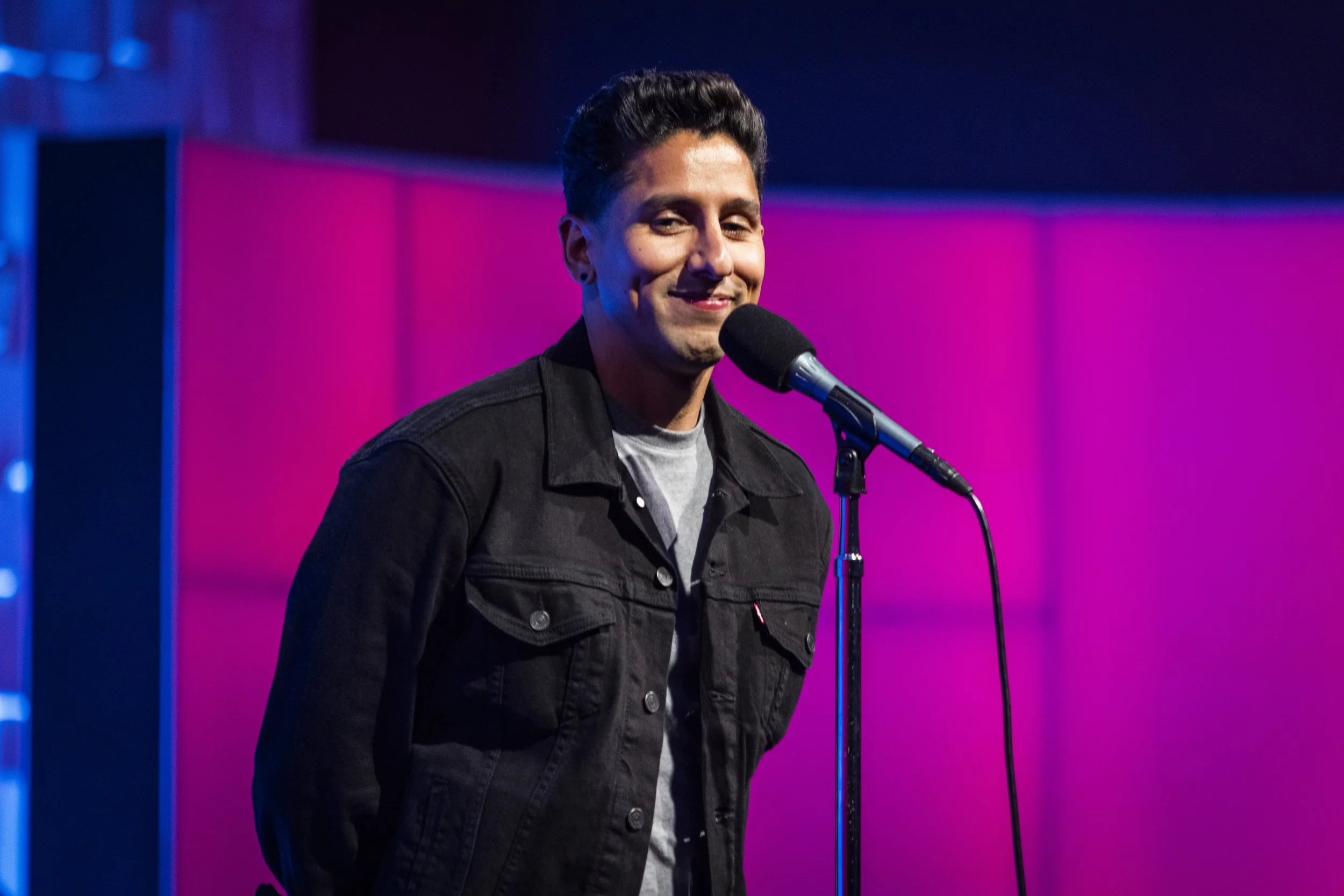
Christopher Moncayo-Torres shares his story at Crawford Family Forum in Los Angeles, CA at a show sponsored by LAist in July 2025. Photo by Unique Nicole.
And the most that I know about Clifford the Big Red Dog at this point, animated series, books. Apparently, his owner is the reason he's so large, because of the love and care that this owner has for Clifford. Good for him.
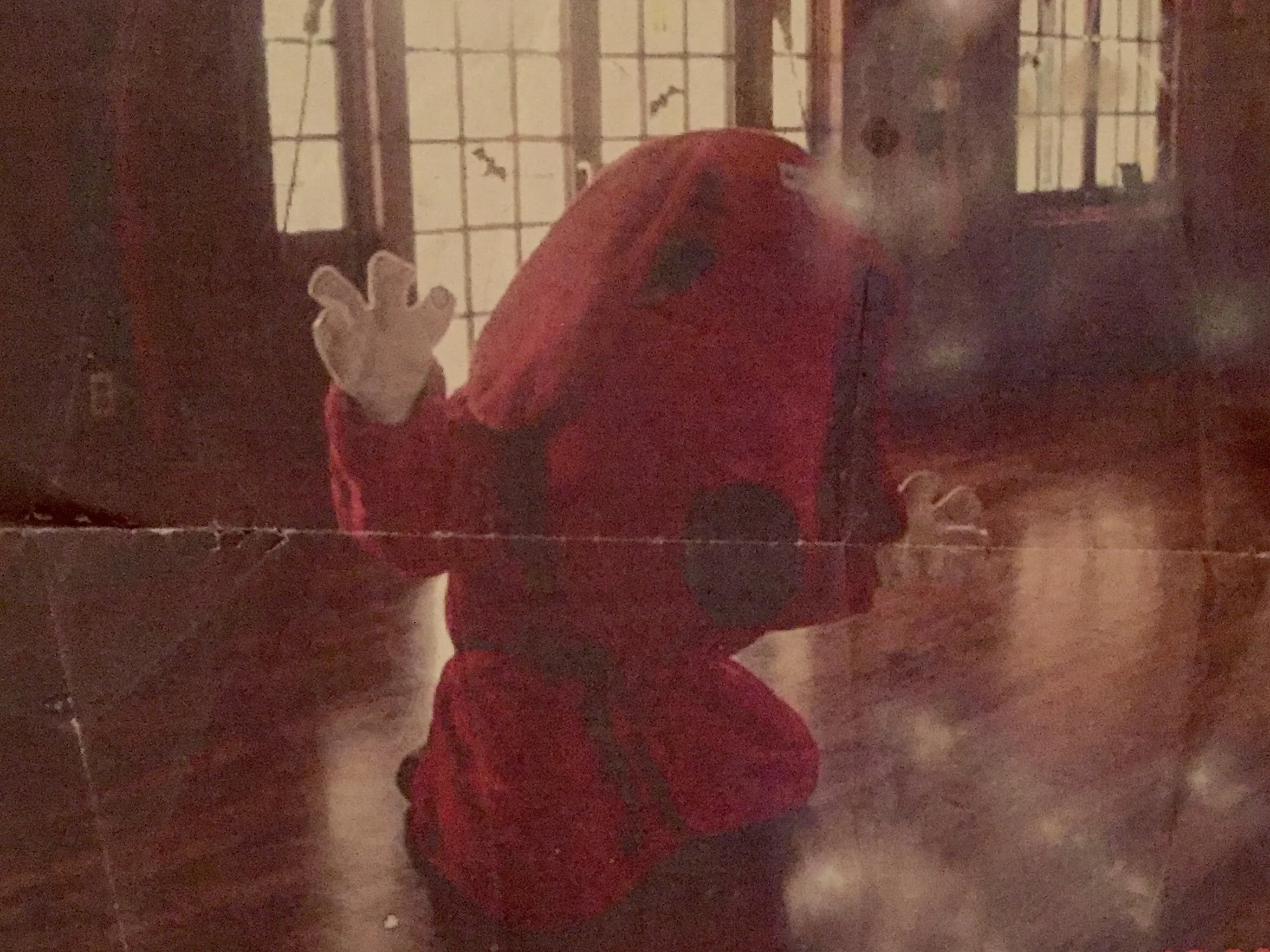
I'm thinking, “Do I want to be Clifford?” Because as they take it out, it's like mangy fur. This is like New York City Clifford. Like he's been through it. He's got no paws. There's white gloves instead of hands. There's nothing for the feet. There's like weave eyes that are torn apart. He's definitely been through the subways, you know what I mean?
I'm thinking, “I want to connect with people. Maybe in this costume I'm going to feel safe.” So I raise my hand. I'm like, “I'll do it.” Great.
So it's a fall festival and I get in the costume. I need a handler because the head is huge. It hangs down to my waist. I need someone to guide me. You're thinking immediately, “Kids are not going to like this. They're going to be scared, terrified.” They loved it. They would just see this big red mascot thing.
They danced with me. They played with me. The moms are like, “Take a photo.” The dads are asking the same thing. It's a great time.
We wrap up the festival, and the handler is a little busy, so I'm just standing there by myself. For the first time, I'm just thinking in my head. I was so in the moment with the kids and the parents. And something happened where I just start seeing all this family togetherness, and I start shaking in this costume. I start sweating under the white gloves that are in my hands and I think I'm seeing an absence that I don't have. I'm like, “Oh, I don't have that family thing.” I'm seeing so much of how I don't have it in my life at that time.
Heart palpitations are happening and I'm getting a shortness of breath and I'm feeling tingling in my forearms. I want to pull my head off but I don't want to traumatize these children. So I want to cry. And I don't know about you all, but when I cry, I go for my eyes to wipe away the tears. But if you were outside of this costume, what you saw were white gloves on this big red head, just shaking away. Clifford's having an existential crisis.
And so I run away. I get to the bus stop and it's safe enough that I could pull my head off, but I'm still in the red bodysuit. The Q88 bus driver just looks at me and he just says, “Just get on.”
I go back home, and I'm out of the costume. I just look at my house and, for the first time, I could just see so much of this loneliness in my life. I can’t unsee it, and I feel like Neo in The Matrix.
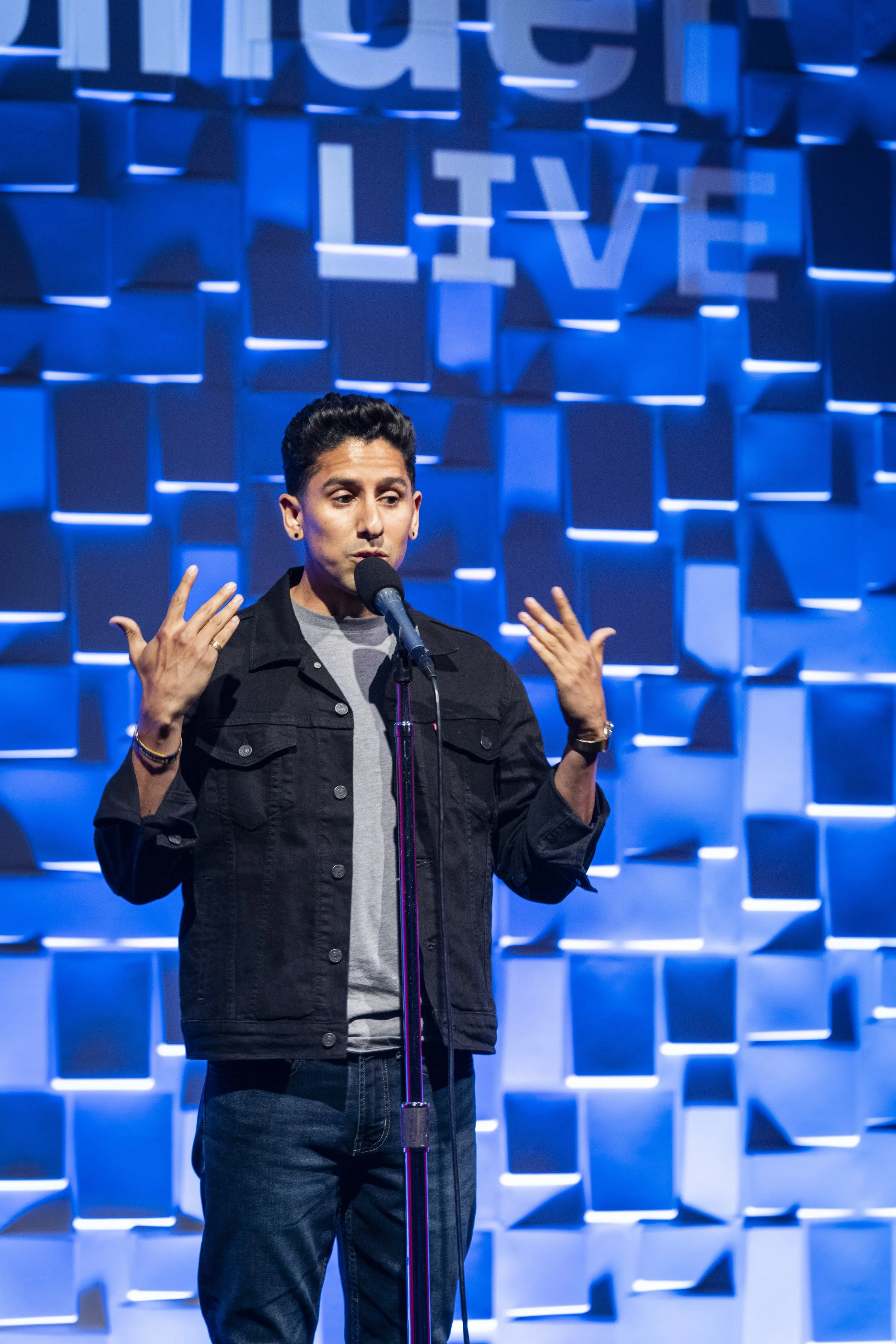
Christopher Moncayo-Torres shares his story at Crawford Family Forum in Los Angeles, CA at a show sponsored by LAist in July 2025. Photo by Unique Nicole.
In The Matrix, he can see the simulation now. It's all zeros and ones. So that's all I see, just the emptiness of this house and the absences in my family. I start doing the movie montage thing of all the times that we just didn't do things together.
The next day, I'm in school. I tell a counselor that I confide in. And she's like, “You know, we have a therapist on board. Maybe let's get you an appointment.” I kept rearranging that appointment. I kept avoiding it. I kept avoiding it. Because once I sit down with somebody, it's going to become really real, and I wasn't ready for that.
So, finally, they had monitors who got me from my classroom, who guided me all the way to the office. They were like, “Great. Here's the appointment.”
I meet Mr. Lee Han. Large guy, salt and pepper hair, very confident, straight to the point, didn't mince words. He's hearing me tell him what happened, and he immediately says, like, “You sound very self‑aware. You should be happy about that.”
Cool.
He immediately says, “Okay, so it sounds like you had a panic attack and anxiety attack. Are you familiar with flight or fight? Your sympathetic nervous system seems like it got activated. Maybe you sense some danger. What do you think the danger is?”
I tell him, “I think I'm alone. I think I'm alone all of the time.”
And he's like, “Okay. Well, are you familiar with the parasympathetic nervous system?”
I shake my head, “No.”
He's like, “Okay, you want to essentially rest and digest?” He's using language I've never heard before and essentially, he's like, “You want to ground yourself and distract yourself, so let's get you like a toolbox, a mental health toolbox.”
And he's telling me to think of a place that makes me feel safe, or someone that you feel safe. You ask this for a latchkey kid, that's kind of hard because you're spending so much time at home. Essentially, I couldn't leave this house. So I really couldn't think of anything but the most New York City thing that I could think of, the subway.
And I'm like, “Well, the 7 train. I like the 7 train. It's moving. There's a lot of people in there. I'm not alone. There's a click‑clack.”
He's like, “Great. What smells?”
I'm like, “You don't want to know about the smell.”
“Fair enough.” He's like, “But let's use that for now. That's a place you can think of when you're getting activated.” And you know what? We did a lot of more talk therapy. He starts telling me other things, like, think about what's in the room, tips of your fingers, other tools in this toolbox.
As the years go by, I wish I could tell you that I was always going to this toolbox. It collected dust. I barely used it. I was intellectualizing a lot of things. I could talk about it, but I wasn't really doing the grounding stuff.
So I'm past high school, past college, and I'm in the gig economy. I'm a tasker for TaskRabbit. TaskRabbit, for those who don't know, it's when really nice ladies in the Upper East Side ask you to build their shelves, help you to move, other tasks. Sometimes it's other gigs where someone's like, “Hey, just do this random thing.”
A random thing I got was, “We need someone for a video. And we're a corporate entity. We're in Midtown.” You don't get a lot of details. You just sort of have to press it like Lyft or Uber. You just have to get it before it goes away for TaskRabbit.
So I don't read all the details, but I just see a video. It's a lot of money for an hour. And I'm like, “I need the money. Great.” I say yes. Then all the details come out.
It's in Midtown. I'm like, okay. Doesn't sound anything suspicious.
So I go Midtown, 6th Avenue, across from 30 Rock. I'm looking at this big, tall glass building in front of me and they tell me to go to the 22nd floor. I check in with security.
And security right away is just like, “Hi, do you have ID? What are you here for?”
And I see on the app that it's Scholastic. I'm like, “Scholastic asked me to be here.”
He starts laughing. He's like, “Oh, I know what you're here for.”
Gives me the badge. I put it on my chest. I go up 22 floors. Elevator doors open and I see “Scholastic” on the wall.
Scholastic, book fairs. Okay, I remember that from school. And I'm looking at the app to make sure I get all the details, so I don't really pay attention around everywhere, but I see the person who hired me, a very nice lady. She's like, “Great, just wait right here, I'll be right back.”
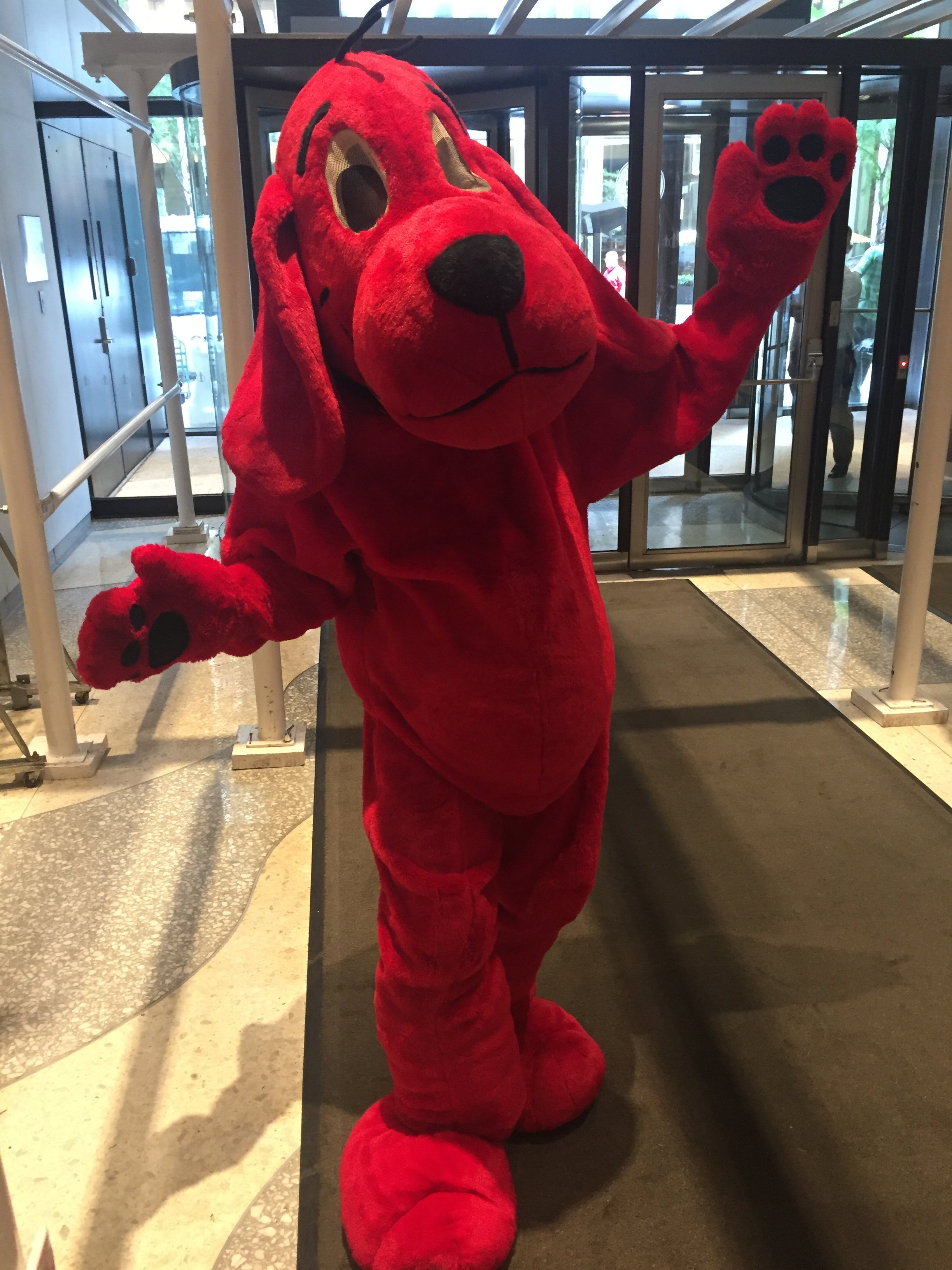
She comes back with a box and she starts pulling a lot of red fabric, and it's a lot of red fabric. Suddenly, I'm feeling my chest tighten up and my arms are tingling. Sure enough, I start looking around the floor that I'm in and Clifford is everywhere. Because Clifford is the mascot for Scholastic. He's on the walls and there's cut out cardboards of him. And she's giving me instructions, but I can't hear her because all I hear is just my heartbeat in my ears.
And she asks me, “Do you have any questions?” And I say, “Where is your bathroom?”
So I go to the bathroom, I'm throwing water in my face and I'm thinking of the 7 train but the train is stalled. It's not working. I just feel like I got to get out of here.
I'm heavily breathing because the last time I was in Clifford, my entire life changed. I couldn't unsee something, and I didn't see it as something that was great. Self‑awareness was a scary thing for me.
I hear a knock on the door. “Hey, are you okay?”
I want to say no, but I need this job. If you say no to a task on TaskRabbit, analytics‑wise it doesn't work out for you. You get less jobs. It's a gig economy. I really need the money.
And I say, “Yeah, I'm fine. I'll be right there.”
She gives me the costume.
I'll say this much. When I did put on this costume, this is corporate Clifford. He's looking great. He's got paws, head is appropriate size. I have feet. I don't have any kind of rope holding my pants. Clifford's doing very well.
“We need you to be in a cubicle. We need you to be in a conference room.” They're telling me what the video is. So at the end of their fiscal year, they essentially do a fun video where Clifford is just hanging out with the teams. And then they show it to the rest of their teams in sort of a wrap‑up of the year.
So I'm with spreadsheets. I've got a little headset. I'm holding meetings. I'm not saying anything. I'm just pantomiming a lot. And I'm thinking, “Okay. Great. Tips of your fingers.” I'm constantly thinking of like just be in the moment. Be here.
And then they're like, “Would you like to do a shot outside? I think that'd be cool if we have Clifford like walking down the street of New York.”
I'm like, “Let's do it.”
So we go down. I take the head off. I'm in the elevator and I come out of the elevator and I hear the security guard right away. He's like, “Clifford.”
I'm like, “Shut up.”
So right away the team is nudging me, like, “Put your head back on, put your head back on.” It's because there's a kid coming through the revolving doors.
I put my head on back as quickly as I can, and this kid sees me. And with all the joy in his eyes, he just screams, “Clifford!”
I'm not yelling Clifford. I'm like, “No.” Not right now, because as I see this kid, I'm back at Forest Park and I'm seeing families together and I just feel so alone.
He's running, and before I can think anything else, I just feel tiny hands around my waist. I look down and I just instinctively hug him back. I'm holding him and he's holding me, and we're holding each other, and I'm feeling really connected to this kid even though I don't know him.
Mom comes in right away. “I'm so sorry. I'm so sorry.”
Right away, I get up so she can hear me. I'm like, “We can take a photo if you want to take a photo.”
She's like, “Oh, my God, please.”
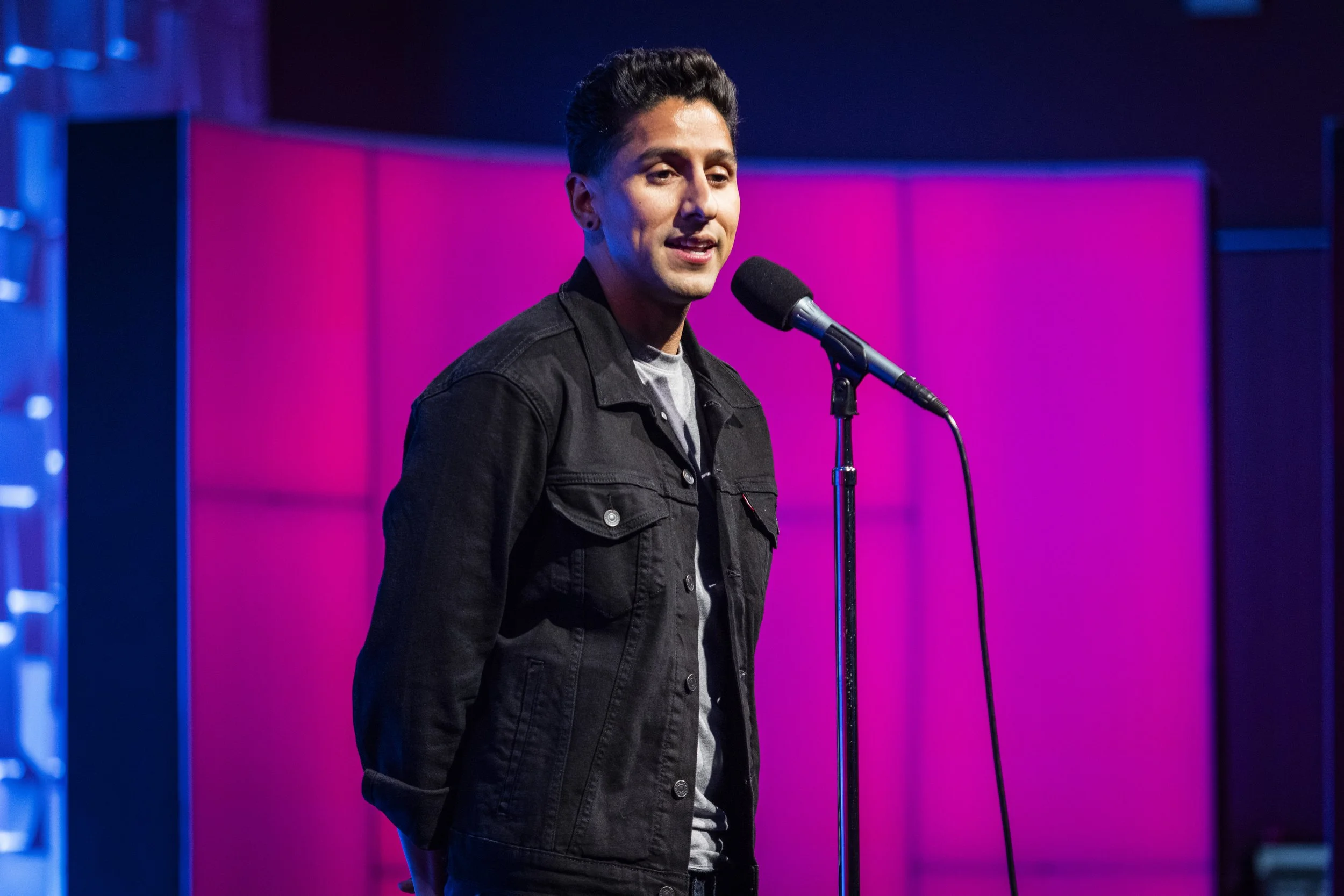
Christopher Moncayo-Torres shares his story at Crawford Family Forum in Los Angeles, CA at a show sponsored by LAist in July 2025. Photo by Unique Nicole.
We take a photo. I kneel down with the kid. I'm coming up with different poses for Clifford. I'm like I'm really into it. I'm just so in the moment with this kid. I'm just giving him as much as I can.
The mom and the kid go away and we do the shot outside. We go upstairs. I'm out of the costume. I'm done with the gig. They pay me and I thank them very much.
I'm back on the elevator and I'm just going down 22 floors. And this elevator just has mirrors all around and I'm just staring at myself. Now that I'm out of this costume, I'm realizing I should have used those tools more often. But then I was remembering, we don't use should statements. And I realized that now I have this new thing I can put in my toolbox, which is this moment with this kid. I can connect with somebody. And even though I'll probably never see that kid again, I'm always going to have this memory. So it helps me now to ground myself that I can connect with somebody and we can do that, even if just for that moment.
So I'm out of the elevator, and I'm still processing things. And I hear, “Hey, Clifford.” I turn over and it's the security guard. I'm rolling my eyes at this guy and he's like, “Hope you have a good day.”
And I tell him, “I'm going to try. I'm going to try.”
Thank you.
Part 2
When I first started college, I thought I was ready for anything. I was a smart kid in my family, the first generation college student. The one teachers praised and cousins rolled their eyes at. And everyone told me, “You'll figure it out, JP. You always do.”
And man, did I wear that like armor. Because if I didn't know where I belonged, at least I had this identity to fall back on. The kid who was supposed to make it.
But being first gen was the first crack in my armor. Everyone else seemed to glide through campus like they'd been handed a secret map on day one. I was just lost. Not just physically, but mentally. I didn't know how office hours worked or how you're supposed to network with professors, or even what classes I should have been taking.
My friends from home would text me about parties and new crushes, what they were doing that night while I just sat in my dorm room Googling, “What is a titration? How do I titration? Who is a titration? What is titration for?” None of the strategies I used in high school were working. But still, I told myself, “No, this is fine, JP. You'll figure it out. You always do.”
Then by the end of my first semester, I had a 1.84 GPA.
Now, believe it or not, I was recruited to play baseball at Occidental College, all 5'5” of me. One day, my coach calls me into his office. The place smells like sweats and leather. I hear my teammates bickering in the background. Their metal lockers are just slamming in the background. My heart pounds as my coach is just sitting there reminding me, “JP, if you want to stay, you're going to have to keep your grades up.”
At this point, I'm desperate for help. I email one of my biology professors. I go into his office the next day and I'm just sitting there bawling my eyes out as he consoles me and teaches me, you know, “Maybe this is how you should study. Maybe this is what you can do to get your grades up.”
And then what felt like a last ditch effort, he pulls me aside and then says, “You know what? Let me show you something. Follow me.”
So I follow him into his lab. It's dim. All I'm hearing is the low hum of water pumps and filters. The air smells like seawater. It's metallic, salty. It felt like I was at the beach, but obviously there's no fun, right? No volleyball, no spike ball.
Casually, he just says, “We're going to feed a cone snail.”
I didn't know what to expect, so I follow him to this drawer. He opens it. There's a bunch of plastic bottles in it. I thought he was going to whip out some snail flake stuff, kind of what you feed fish, those fish flakes. I didn't know what snails ate, to be completely honest with you. I didn't know what to expect.
But instead, he grabs a fishnet. He walks over to the tank filled with fish. He catches one. He grabs it with a pair of tongs and lowers it into the cone snail tank.
I lean in, nose basically almost pressed to the glass, expecting something slow and polite. The snail just inches over to the fish. Its proboscis, which I only thought butterflies had, started poking around at the fish. And then out of nowhere, bang! It fires a venomous harpoon, like some tiny underwater assassin.
The fish starts flailing around as it was caught on the snail's barbed harpoon, and then the fish just went limp. The snail just swallowed it whole.
Then my PI just turns at me and goes, “And in a couple hours, it's going to regurgitate the bones like an owl.”
I stop breathing. My brain just screams, “What the hell did I just watch?” It's gnarly. It's the coolest thing I've ever seen. Like a nature documentary if Snoop Dogg had creative control.
But to this day, what sticks with me isn't the shock. It's the wonder. That buzzing in my fingertips. That instinct to lean forward and want more. And I don't have a name for it, but I know I want to chase it for the rest of my life.
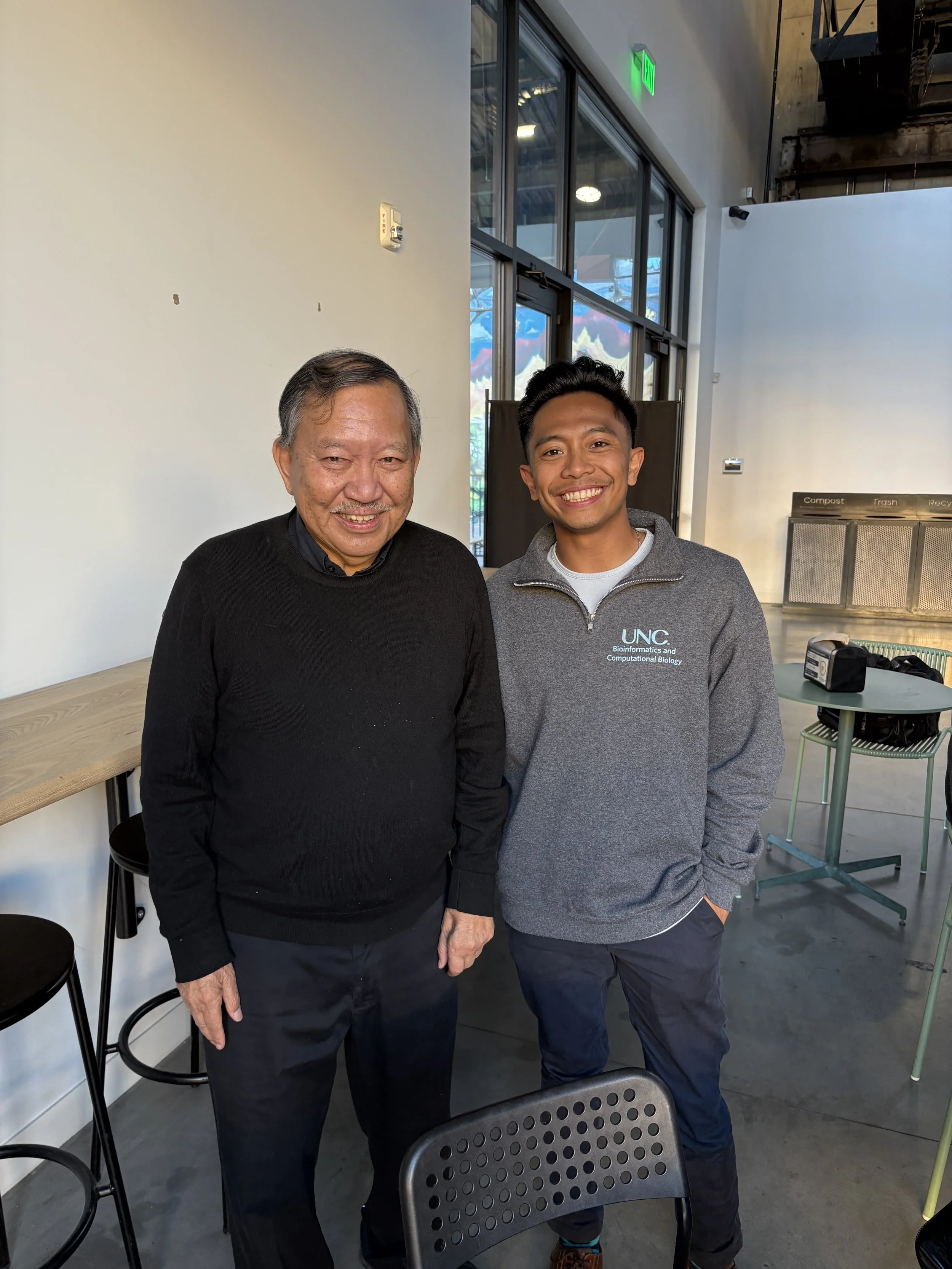
JP Flores with Dr. Baldomero "Toto" Olivera. Photo courtesy of JP Flores.
And I remember in that moment, I was thinking, “This is where I buckle in. This is where it all clicks. Maybe this is where this armor actually works. And maybe I belong in the field of biomedical research.”
Except it doesn't. Right after that, I asked to join the lab. He immediately agrees. And at my first lab meeting, I show up with my lab notebook, armor polished, trying to look the part. And within minutes, people are throwing around words like “conotoxin diversity” and “ortholog”. It reminded me of how people talk about fantasy football. I nod along pretending I understand, then I duck into a bathroom stall later to Google the words on my phone.
And that's the thing about those early years. Figuring it out doesn't feel thrilling at all. It feels like showing up to a party where everyone already knows the secret handshake and you're just standing there by the chips waiting for someone to notice you don't belong. I think about walking away from science altogether.
Freshman year flew by and blurs into a bunch of partying, not enough studying, but I will say my GPA did hover above a 2.0. And in my sophomore year, my PI decides to send me to a conference in San Diego. In my head, I pictured it as one big nerd party. A bunch of posters, lectures, handshakes. I was excited. Maybe this is my chance to finally belong.
But when I walk into the San Diego Convention Center for my first ever Society for Neuroscience meeting, I scan the crowd and my stomach just sinks. I smell the coffee. I see the glossy posters. I see clusters of people laughing, comparing notes, but not many people who looked like me.
I float from talk to talk, a notebook in hand, writing down words to Google in the bathroom stall later. And by the end of day one, I feel two things at once: the dumbest I've ever felt and the most invisible.
That's when it hits me. The armor just isn't working anymore. And weirdly enough, that's when things start to shift. That pit in my stomach, that feeling that this world I love doesn't quite see me in it, it turned into fuel.
So I start creating the spaces I wish existed. I don't know where I got this, but I decided to launch a podcast called From Where Does It Stem, where scientists tell the deeply human stories behind their research. I ask all of them, “How did you get to where you are?”
I invite others that are also trying to figure out this whole higher education thing with me to co‑host with me. Just a couple of months ago, I put together a team of social scientists to analyze all the episodes of this podcast to ask, what factors influence a scientist's journey.
I pair scientists with local breweries to turn their work into beer labels. The hope there is that someone will stumble across a pint and read the beer label and feel that same exact spark I did in that lab years ago.
I lead these projects called the Atlas Projects where I build databases of historically underrepresented scientists. The idea here is that the next generation of scientists can actually be what they see, because representation matters.
This past year, I co‑led Stand Up for Science rallies, and a couple of the other organizers and I left to start our own nonprofit that reimagines science with communities rather than for them. And now, I'm organizing initiatives where grad students walk into their local lawmakers' offices, and they're in there talking about their experience in science, how they got into it, why their science matters, and how it affects everyone that we love.
Little by little, things begin to shift. Not because the old spaces suddenly welcome me in, but because I'm building new ones and I'm trying to bring people up with me.
And then I had my whole full circle moment. This year, I'm invited to speak at a conference. It's a graduate research symposium. The keynote speaker walks on stage and I remember my jaw just dropped, because it was the leader of the cone snail field. It was the one my mentor once told me about. He was Filipino just like me.
Growing up, I never saw scientists who looked like me, let alone leading an entire field. He gave this beautiful talk about his career and how his work in studying cone snail venom led to a chronic pain reliever. I think the therapeutic is called Prialt.
At the end of his talk, he lays out a table full of cone snail shells. He invites people to take one home, so a bunch of people walk up to the front of the room. I remember running and I spot the exact species I study. I pick it up, I walk over to him and I say, “This is the snail I studied in college.”
And without missing a beat, he smiles and replies in Tagalog, which is the language of the Philippines, and he says, “Salamat,” which means thank you. For me, that was everything. Because in that moment, the spark I felt as a freshman watching a cone snail fire its harpoon into a fish, that wild, gnarly wonder meets something deeper. Belonging.
And not just belonging in science but to a whole lineage, to a story bigger than me. For the first time, I realized the armor was never what kept me here. It was the people. It was that Filipino PI. It's all of these leaders who are leading their fields and how they are making sure no one is alone with the chips at the party. It's the moments, especially the ones that we all have together, that made me feel like I didn't need armor at all.
And honestly, that's even better than watching a snail take down a fish.