In this week’s episode, both of our storytellers are forced to confront the terrifying unknown and decide how to live in the shadow of what might come.
Part 1: After three generations of women in her family develop Alzheimer’s disease, Mary Jo Pollack enrolls in a study that could reveal whether she’s next.
Mary Jo Pollack lives life out loud, not only as an award-winning storyteller but also as a general life philosophy. She has appeared at Odyssey Storytelling, Female Storytelling (FST!), Tellers of Tales Tucson, Phoenix Moth, which she won twice, and numerous virtual shows, including the 2022 Toronto Storytelling Festival. Mary Jo loves the 99-second storytelling format.
Part 2: When Sabrina Samuel is diagnosed with a brain aneurysm and told to wait a year before surgery, she must choose between living in fear or embracing the time she has.
Southern Nomad, photographer, and nature lover; Sabrina Samuel is originally from Atlanta, Georgia. She enjoyed a childhood full of outdoor adventures with her little sister and their many beloved ponies, ducks, goats, cats, dogs, and rabbits. After studying art at the University of Georgia, she traveled to India and lived there for many years. In 2002, she returned to Atlanta with my husband and 2 kids. Currently, she owns and operate a small real estate photography business, Sabrina Samuel Photography. When she’s not working, she enjoy long walks visiting her tall forest friends - Trees.
Episode Transcript
Part 1
I'm in the PET scan tube listening to classic rock, because you're in there for like 45 minutes to an hour. What do you want to listen to? Classic rock. I grew up with it. It's my thing.
And it's a two‑day operation. So today, I'm being tested for tau, and tomorrow for amyloid. Those are two protein plaques that build up on the brain and cause Alzheimer's disease.
Alzheimer's disease is my greatest fear. Three generations of women before me died with Alzheimer's disease: my great‑grandmother, my grandmother, and my mother. I didn't know my great‑grandmother. She died before I was born. I'm actually named after her and wear her ring.
But I knew my grandmother very well. She only lived about a mile from us when I was growing up, and I'd ride my bike over. They had a big backyard. She was always in the garden. There were tulips in every color, lilacs, blooming in St. Paul, MN. And this garden was vibrant nine months out of the year when it wasn't covered with snow.
Then she taught me how to bake chocolate chip cookies and brownies. And I'd go in her house, I'd follow her around like a puppy. She always looked beautiful. She had gray‑green eyes and blonde hair that she wore in a French twist. She always left the house dressed impeccably, makeup, and the shoes and purse always matched.
I remember the last time I saw her. She was in assisted living. My grandfather made my mom and my aunt promise, when he was on his deathbed, to never put her in assisted living. But that is impossible not to do sometimes.
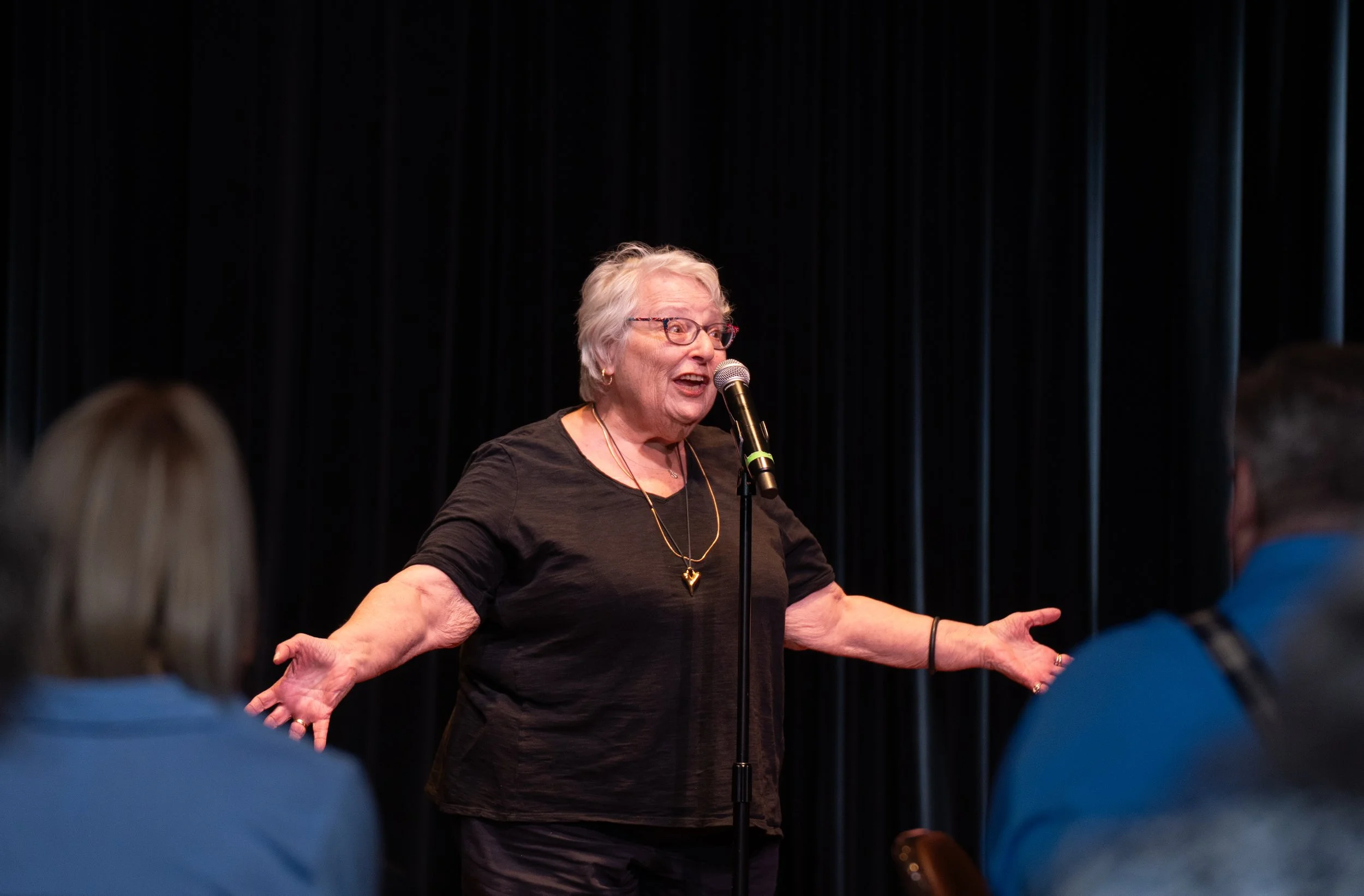
Mary Jo Pollack shares her story at ASU Kerr in Scottsdale, AZ in April 2025. Photo by Gibran Sanchez.
So I came out from LA to St. Paul. I escaped the snow. And pretty much to visit my grandmother. And I go into the assisted living facility and I see my aunt talking to some little old lady down the hall. I'm like, “Who's she talking to?”
As I get closer, I realize that’s Grammy with the bad perm and the gray hair and disheveled clothes? I couldn't believe it. And as I get a little closer, she jumps up, runs toward me, arms out, “Mary Jo is here. Mary Jo is here.”
I was flabbergasted. Based on what everybody told me, I thought for sure she wouldn't know who I was and this was going to be horrible. But she recognized me.
My mom, aunt and grandmother and I, we went to lunch and we visited and had a lovely afternoon. And she walked us to the elevator and I turned around and said, “Oh, Grammy, I love you.”
She looked at me with those eyes with no recognition and said, “Why?”
I waited until the elevator doors closed before I cried, and then cried all the way home. I also cried a lot for my mother, because about 15 years later, my brother and I started to deal with her and her memory.
I got her to go to a neurologist and take some medications, and then we were making arrangements to move her into an assisted living that had levels of care. And she signed a new lease in a new building for a year.
But her boyfriend, Bob, lived down the hall, so there was going to be some oversight. I wasn't living in LA anymore and my brother worked, and so, okay.
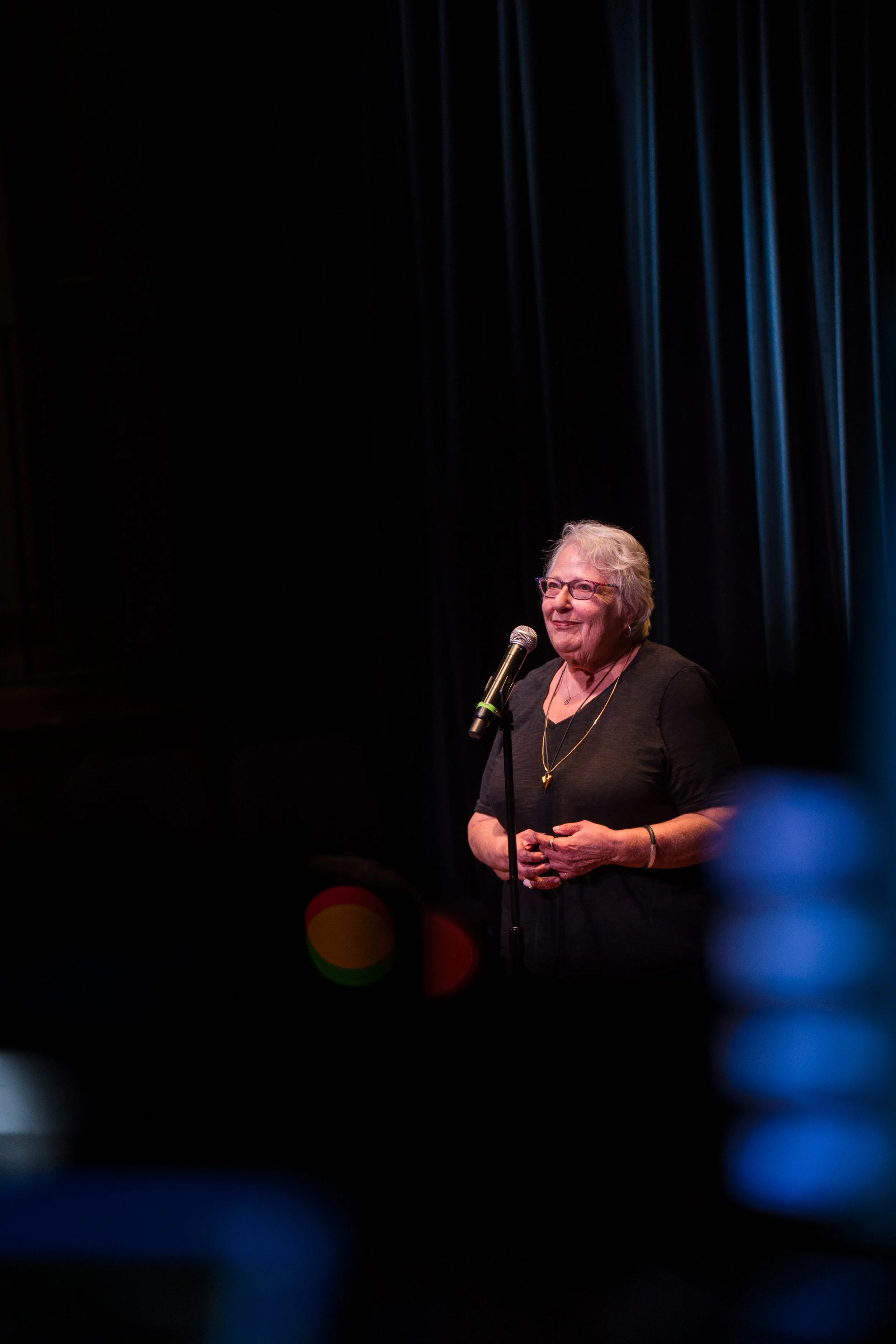
Mary Jo Pollack shares her story at ASU Kerr in Scottsdale, AZ in April 2025. Photo by Gibran Sanchez.
The moving day, I did come down to help with the move. The moving day, she's sitting there and I said, “What?”
And she said, “You know, I changed my mind. Tell everybody, tell them to take it all back.”
“Oh, no, you can't go back, Mom.”
“Why not?”
“Well, like, you moved in here, so your apartment was vacant and somebody's moved into your apartment. They're moving in like you're moving in here.”
“I thought this was just a vacation.”
“No, this is your new house.”
And when the lease was up, she did go into assisted living. Poor Bob.
And I thought, “Well, you know, maybe I need to be part of the solution.” So I looked around after I moved to Tucson 10 years ago, and I found a study at University of Arizona Banner Alzheimer's Institute. And I was accepted.
The first few years, all I did was neuro and cognitive testing, which is being in an office for a few hours, filling out tests and doing puzzles. They test your memory in a bunch of different ways.
And then the doctor who was in charge of the study said, “You know, I can get you some scans.”
And I said, “That's great.” So I had an MRI and a CT scan.
Then about a year or so later, he said, “I can get you PET scans if you can get up to Phoenix to Mayo.”
“Yeah, I can.”
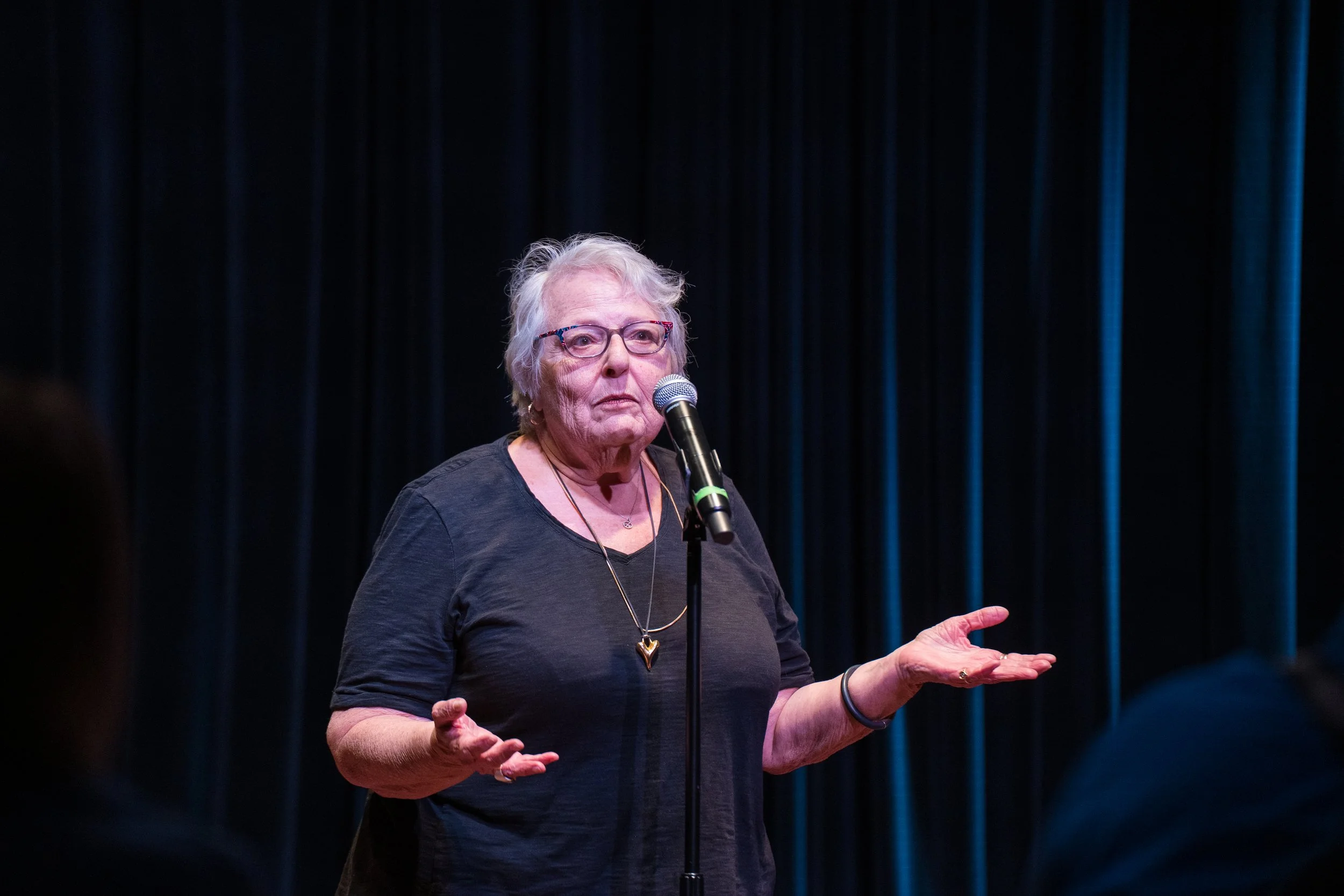
Mary Jo Pollack shares her story at ASU Kerr in Scottsdale, AZ in April 2025. Photo by Gibran Sanchez.
And part of the study is that when I die, my brain goes to Mayo. I don't know what I'm doing with the rest of my body. I told my lawyer to put it that they could just throw it in the desert.
So I get in the study and the scans, they're clear. Then about a year later, I can get the PET scans. The PET scans are definitive tests for Alzheimer's disease. One day you get a dye for tau, one day for amyloid.
A few months after I had these PET scans, for real science that's positron emission tomography, and I met with the doctor. He said, “I don't always tell people the results of their scans. It's a blind study. But I feel that you need to know because of your family history.”
And I'm starting to sweat and I'm ready to cry. I'm really getting upset. I don't know what he's going to say. And he said, “I've examined your scans thoroughly and there is no tau and no amyloid. And because of your family history, with your great‑grandmother and your grandmother and your mother, Mayo is really excited to get your brain.”
Well, you tell Mayo they're going to have a long wait.
Part 2
So there are two constants in my life. One is trees and the other is photography. I was raised here in Atlanta. My parents divorced when I was very young and we bounced around, me and my sister bounced around a lot as kids. So there wasn't a lot of stability at home. And sometimes there wasn't a lot of happiness inside either, so I would go outside to find my happiness, to find stability and joy.
And I found trees to be great friends. They're good listeners. They don't call you names. And they don't turn their back on you and stomp off in a rage. They're really great friends.
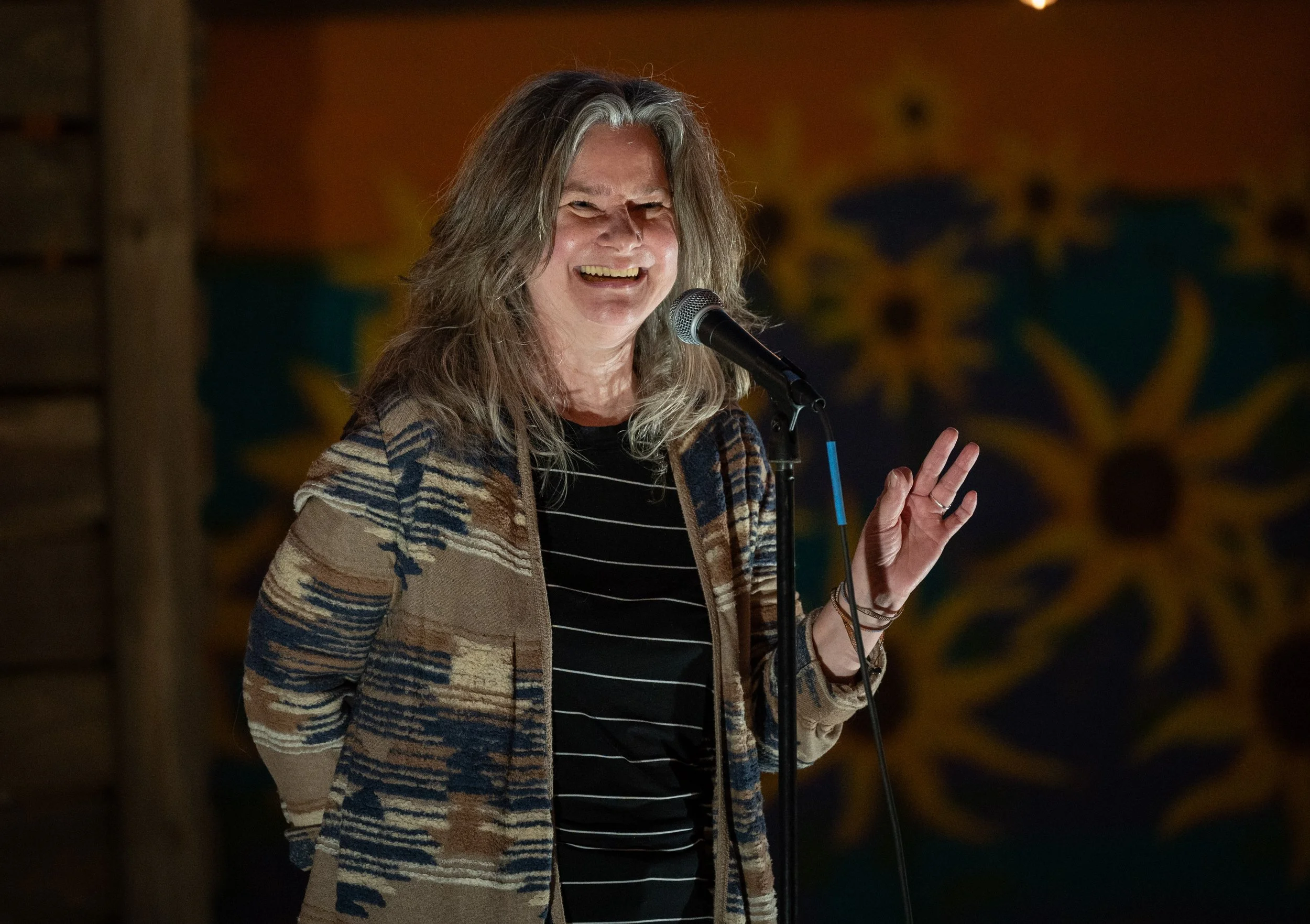
Sabrina Samuel shares her story at Waller’s Coffee Shop in Atlanta, GA in March 2025. Photo by Rob Felt.
The second constant that I've had throughout my life is photography. My Uncle Barney gave me a camera when I was 12 and I have been interpreting the world around me through the viewfinder of a camera ever since.
Well, we grow up, don't we? And then we get in all this stuff in our head and we overthink things and we get so busy with work and what we think is real life. I didn't quite lose my connection with trees as an adult, but it did definitely wane. I mean, my family will attest we're hikers and campers, but that deep‑rooted connection that I had with trees and nature waned a bit as I got older.
All of that changed in 2023 when I was diagnosed with a brain aneurysm. My dad had a brain aneurysm. So I knew through my dad's experience what that can do to the body. Daddy's brain aneurysm burst, and he went through three brain surgeries, 36 days in ICU, and was left paralyzed on his left side. He was tethered to a bed and a wheelchair the rest of his life. To say I was freaking out is mild. I was really freaking out.
When you get a diagnosis like that, the first thing they do is they shuttle you off to a specialist. And I had a wonderful specialist, Dr. Khaldi. The first visit, I dragged my husband Stanley with me because I knew I was going to be freaking out so much. I wouldn't be able to hear what he had to say.
Well, Dr. Khaldi was fantastic. He told me where it was, how big it is, and all the stuff that can go with that. Then he started laying out where are we going to go from here. He said, “Well, we could go ahead and do surgery. Or, since this is your first brain scan and this is new, we could give it a year, do another brain scan, and reevaluate at that point.” I just had to make sure my blood pressure didn't go up and I had to make sure I stayed relatively calm, which, if you know me, that's a hard thing to do.
So we left the office. I had one year in my head, one year. Was I going to live this next year paralyzed with fear and worry and anxiousness, or was I going to grasp this year like it's my last year on this planet, walking with these two legs, going about doing things that I truly love?
What did I love? I had to dig deep for that. And I was reminded of a hiking trip that we did with our kids when they were little. We hiked Blood Mountain. And on the way down, my youngest asked me, “Mom, when are you your happiest? Where's your happy place, Mom?” And without a doubt, I answered, “When I'm in the woods hiking on a trail, that's my happy place.” That's what I wanted to do for this last year.
My husband is fantastic. Within weeks, he had me in the Tongass National Forest in Alaska, one of the largest and oldest temperate rainforests on our planet. I got to soak up all that goodness that those trees had on that trip. Then he took me to Canada and I got to hike around the ancient forest in British Columbia, Canada. With our good friend Judy over there, we camped under the live oaks on Cumberland Island.
I did a few trips on my own. I got to visit 35,000 acres of trees here in Georgia, the Piedmont National Wildlife Refuge Center. Go see it. It's fabulous. No tourist.
So as I kept going through the forest. I knew I need to deal with some things. The first thing I really felt impressed that I needed to deal with was my own mortality. I mean, we all have an expiration date, so let me face it. And the place that I knew I needed to go to face this was Driftwood Beach on Jekyll Island.
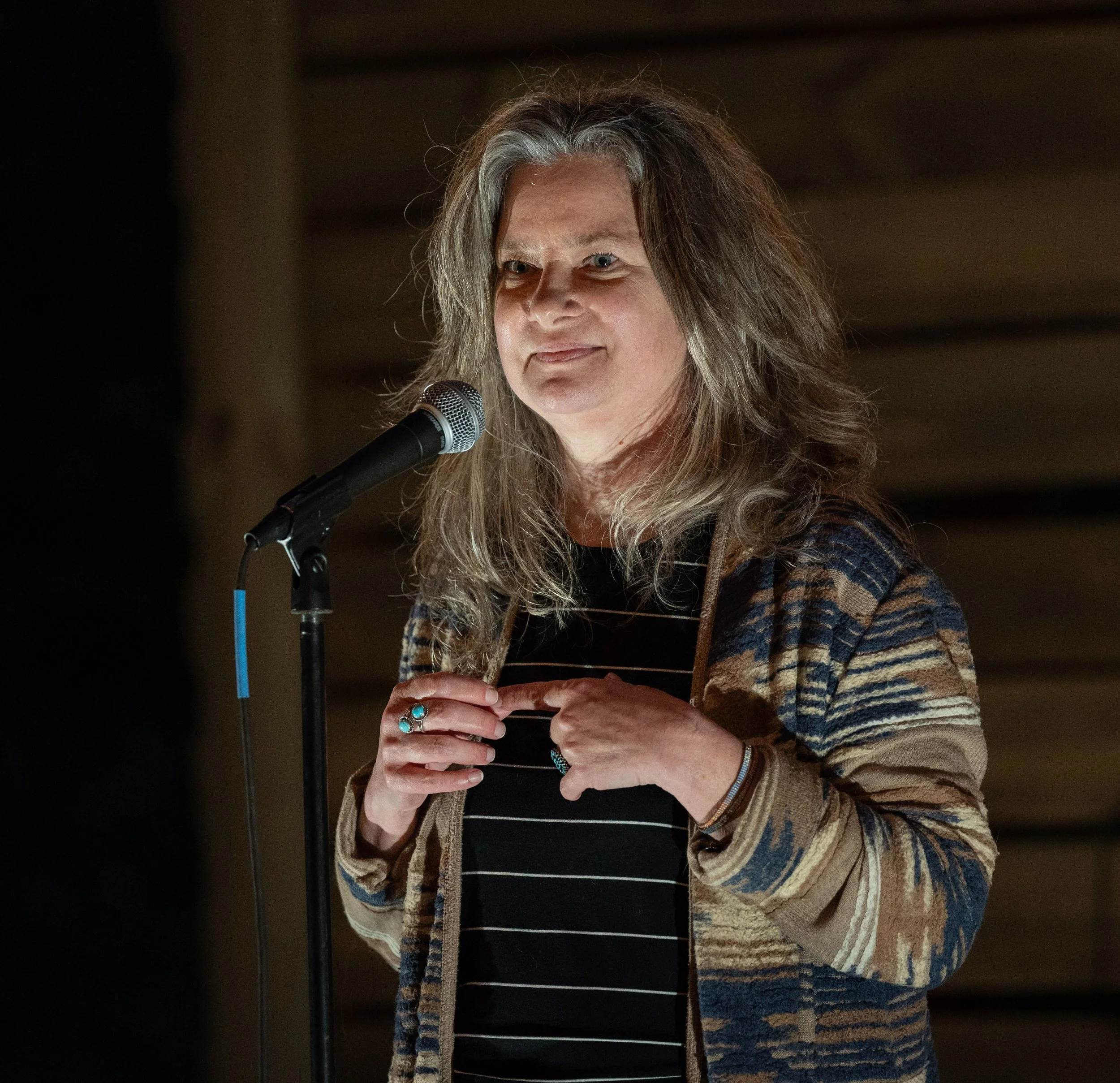
Sabrina Samuel shares her story at Waller’s Coffee Shop in Atlanta, GA in March 2025. Photo by Rob Felt.
My single mom, whenever she'd scrape together enough money to take us camping there, we would go to Jekyll. As a kid, I would see those majestic trees lying on the beach. It was like tree bones, tree skeletons.
And I remember as a kid rubbing my hand on them, thinking, “Oh, I'm talking to tree ghosts.” What better place to go and face mortality than a beautiful place like that.
Well, photography kicked in and I took my tripod, my camera and I started exploring the beach. And one of those beautiful, majestic tree skeletons was lying out on the beach on its side and branches went up towards the sky, as if to make an embrace for anyone who would pass under it.
I set my tripod up there and I began passing under that embrace, because I knew, as we have an expiration date, I really am kind of a walking ghost. I took hundreds of photos of me just ghosting underneath those arms, the branches of that tree. And they taught me to face mortality with beauty and dignity.
Keep going. I had to deal with something else. Adulthood had stolen my joy. Too cerebral. We overthink everything, don't we?
The trees that taught me joy were in New Mexico. One of our favorite places to go as a family is Abiquiu. Georgia O'Keeffe, a famous American artist, has a ranch out there called Ghost Ranch. And on her ranch, there's a creek. And on that creek are these majestic cottonwoods. If you ever get to hear the wind go through the canopy of a cottonwood, it's like they clap. They're so excited to see you. They're so joyful at your coming.
I stood underneath those cottonwoods and the wind coming through. And as the wind made their leaves clap for me, I threw my arms up and released that aneurysm, released that fear, released all the stupid adult things I'd bought into, and I gave it to the wind.
A year was up. It's time for that second brain scan. And I ain't going to lie to you. I didn't sleep very well the night before that brain scan. The brain scan showed my aneurysm went from 3.6 millimeters to 1.6 millimeters. How did that happen?
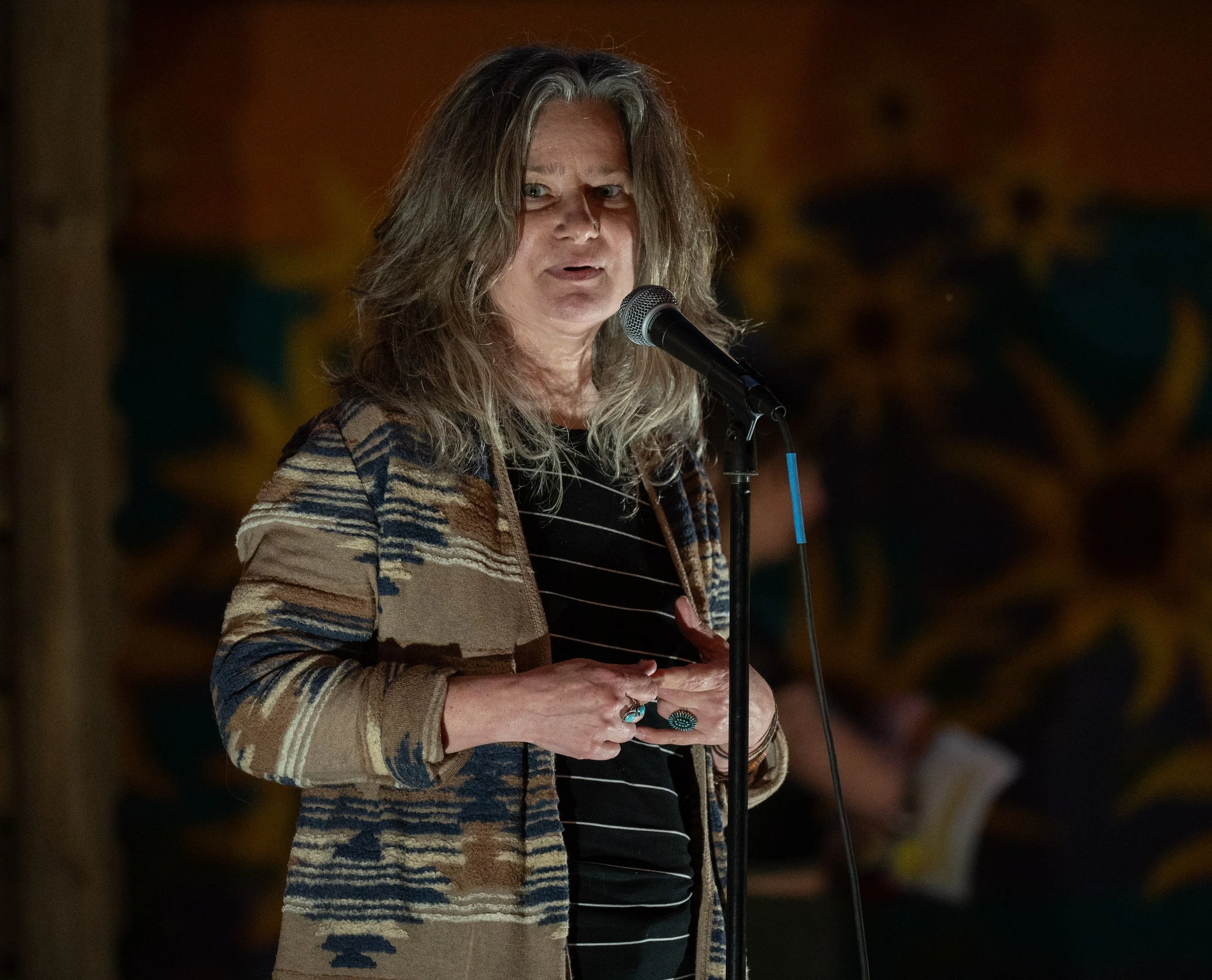
Sabrina Samuel shares her story at Waller’s Coffee Shop in Atlanta, GA in March 2025. Photo by Rob Felt.
Follow up with a specialist was really lighthearted. Stanley didn't have to go with me. I thought I could handle it on my own. Dr. Khaldi, he explained, “Well, you reduced your stress. That reduces inflammation in the body.”
Then he asked me what I did throughout the year, and I told him about all of our adventures in the woods, soaking up nature. And I told him, I said, “Oh, yeah, and by the way, I gave my aneurysm to the wind while I was out in New Mexico.” I said, “I guess I better go out there and give thanks.”
And Dr. Khaldi looked me straight in the eye. He said, “Yes, you do. You need to go back out there and give thanks.” What kind of doctor does that? Great doctors do that.
Two weeks later, I was on the plane headed to New Mexico. I was going to go give thanks. I bought my sage from a little hawker in Santa Fe, got in the rental car, headed that 50 miles north of Santa Fe to Abiquiu, went underneath those trees, lit my sage, did my little woo‑woo dance, cried a little, and gave thanks. Trees have power to heal.
Thank you.