While we often like to think we're in control of our own lives, both of our storytellers learn that some things remain beyond our grasp, no matter how hard we try to steer the outcome.
Part 1: After years of helping others safely navigate glaciers, Monte Montepare suddenly finds himself at the mercy of one.
Monte is a comedian, storyteller and adventure guide originally from Colorado. He’s been Keynote Speaker at The Ouray Ice Festival, is on the cover of The Alaska Packraft Guidebook, and is part owner of Kennicott Wilderness Guides in Wrangell-St. Elias National Park, Alaska (all real things and places). Monte is a Moth GrandSLAM Champion, has been featured on The Moth Radio Hour and has a story published in The Moth's most recent book "A Point of Beauty: True Stories of Holding on and Letting Go." He lives in a little house on a hill with his partner Jillian, their kiddo Rocky and chiweenie Sage.
Part 2: Jessica Lee Williamson's OCD fixates on a single question: how will she die?
Jessica Lee Williamson is a Los Angeles based television writer and comedian known for her work on I’m Dying Up Here, F is for Family, and The Big Leap. A first-generation American, she was raised by her Cuban mother in a small town on Maryland’s Eastern Shore. After moving out west, Jessica graduated from The Second City Conservatory. In addition to developing shows for Netflix, F/X, and Amazon, her stories have been featured on This American Life, The Moth Radio Hour, and Lena Dunham's Women of the Hour.
Episode Transcript
Part 1
At 23 years old, I was in my third season working as a glacier guide in Alaska. Being a glacier guide is like being a waiter if the people you're waiting on have never eaten food before, and are also pretty afraid of food.
I took people hiking on glaciers. I took them climbing on glaciers. And that spring, I personally had summited the 16,000‑foot glaciated volcano that looms over town. I was feeling very confident in my skills in the mountains and I could finally grow a full beard.
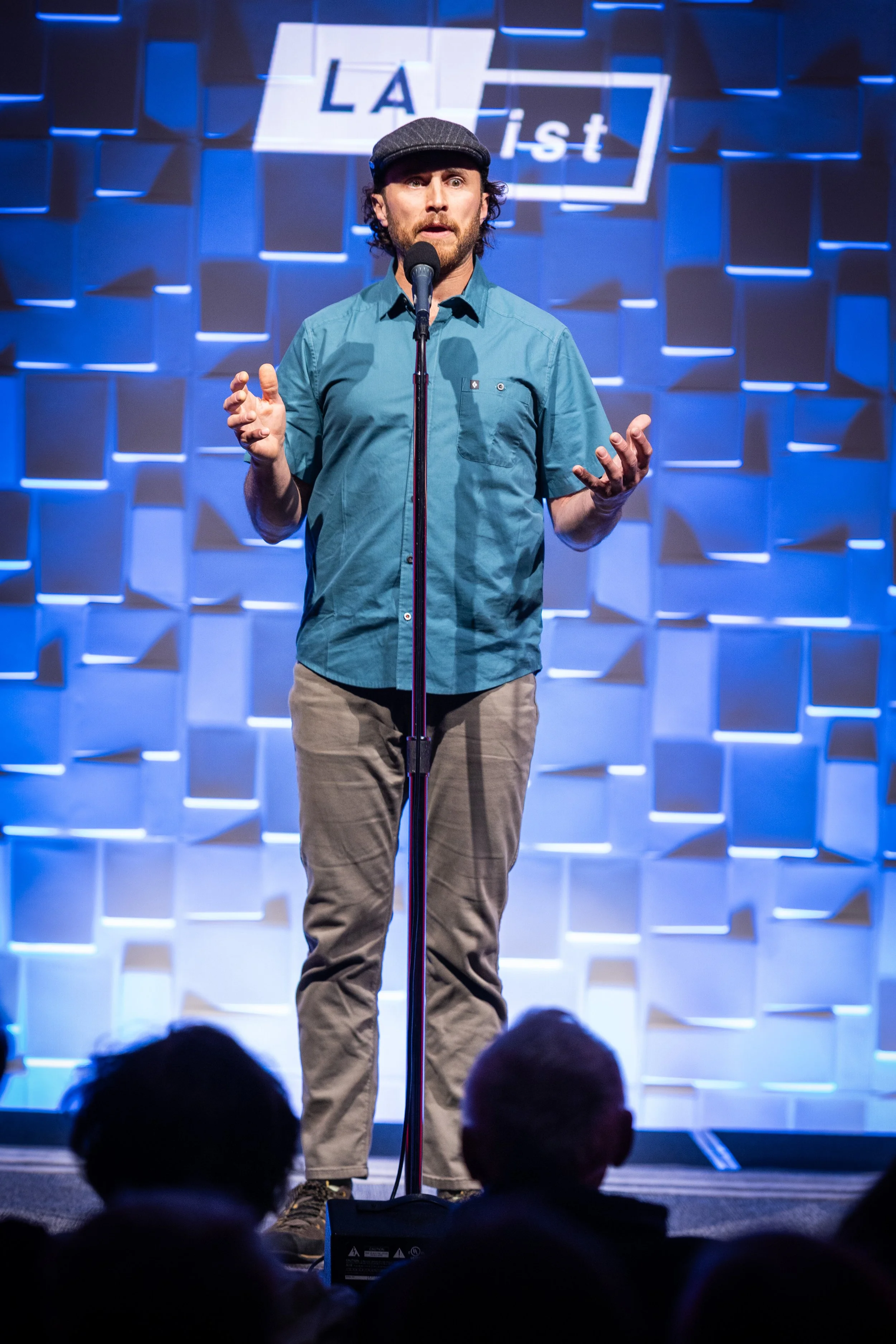
Monte Montepare shares his story at Crawford Family Forum in Los Angeles, CA in February 2026. Photo by Louis Felix for LAist.
So when my friend Elizabeth asked if I wanted to be her assistant guide on a fly‑in base camping trip, I said, “Oh, yeah, that sounds super chill.”
She told me the clients were the four women I had met at the guide service that afternoon. They were decked out head to toe in brand new Arc'teryx rain gear, which is a red flag. Not only is Arc'teryx the Prada of outdoor equipment, but generally speaking, the newer the gear, the less the experience, which was exceptionally true in this case. They were from New York City and had never been camping in their life. They never slept in a tent. I lived in a tent.
Elizabeth said, “Yeah, that's why they want you along. They like the idea of a full‑bearded Alaskan there to protect them from the wilderness.” How could I say no?
Fly‑in base camping is like car camping with an airplane. So all four of us pile into a plane the size of a minivan and fly over rivers and forests and mountains and glaciers, some of the wildest terrain on the planet. We land in a big valley next to an even bigger glacier, and I'm pumped. I just got a free plane ride to a place I've never been before.
Our clients are in shock. And when the plane leaves, I watch all four of them have the gut-wrenching realization they just paid someone to strand them out here.
They each wanted their own tent for privacy, but also wanted to sleep next to each other because they were afraid of camping. So I set up four identical tents wall‑to‑wall, like a nylon apartment building in the wild.
Elizabeth cooked dinner, I entertained, and their first night out was like an REI ad come to life.
The goal of this trip was just to spend a few relaxing days in the wilderness, maybe go on a couple day hikes. So the next morning we wake up and head out towards an area of alpine on the other side of the valley. And it is a beautiful, sunny summer Alaska day, but after a couple hours of rocky walking, morale is low.
I'm pulling out all the stops too. I'm doing interp on geomorphology, telling them that where we're standing is the convergence of four separate mountain ranges that were each formed in a different part of the planet and then migrated to this location via plate tectonics. They are not that interested.
I am telling them that this area is so rocky because what we're walking on is actually an ancient stream bed that was carved by a sub‑glacial river flowing under thousands of feet of ice 10,000 years ago at the glacial maximum. They are like, “Is that why the walking sucks?”
I'm telling lichen jokes. Because to explain this growth that's moss‑like on the rocks, which is actually two separate organisms living with each other in a scientifically‑difficult‑to‑describe relationship. That's right. Alice Algae and Fred Fungus took a lichen to each other, but their relationship was on the rocks. Fun stuff, right? None of it is landing.
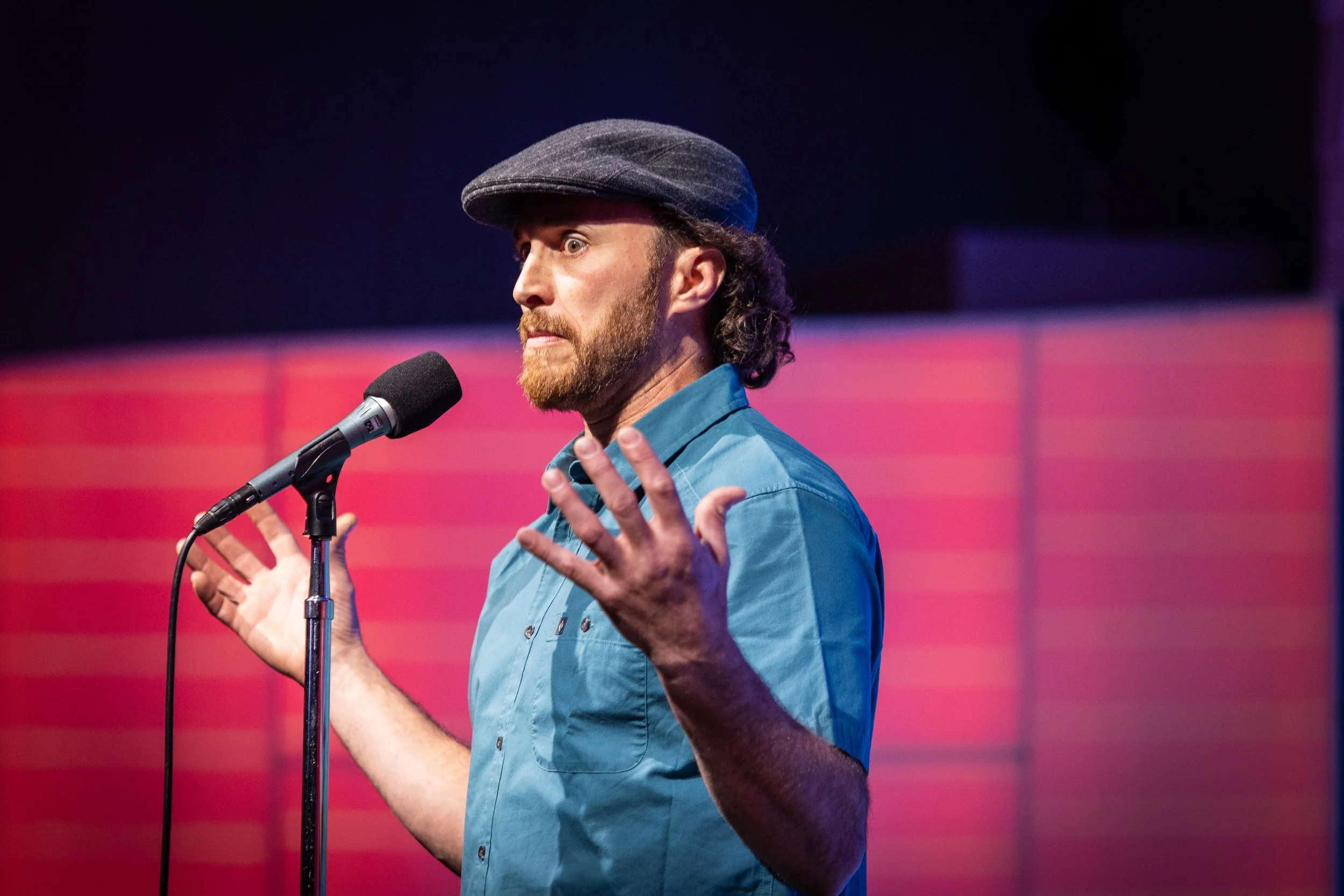
Monte Montepare shares his story at Crawford Family Forum in Los Angeles, CA in February 2026. Photo by Louis Felix for LAist.
And we get to the head of the valley and we realize the best way into the alpine is over the glacier. Elizabeth and I take people hiking on summer glaciers all the time. We don't have our full kit, but it's a nice day. We got good hikers. We're good to go.
To get a glacier, you have to fulfill a simple mathematical equation. More snow has to accumulate in a certain location than melts in that location year after year. That accumulated snow then piles on top and on top and eventually becomes heavy enough that it compresses into glacier ice. When that happens for thousands and thousands of years, there's enough glacier ice that it's so heavy that it pushes the ice down out of the mountains, carving valleys in its way.
That place where the mathematic equation is being achieved is called the accumulation zone. This is where it's snowing all the time. It's winter year round. Think Frozen Act One, if you have a three‑year‑old.
Where we were hiking is called the ablation zone. This is the area at the end of the glacier where it's actively melting. It is not fulfilling the accumulation zone requirement. This is why glaciers don't go on forever and ever. Think Frozen Act Two.
So where we're hiking is a magical land. In the summer on ablation glaciers, it's alive. It's sparkling ice crystals. There's these incredible creeks carved into the ice by the meltwater, brilliant blue pools. And our clients start enjoying themselves. They're engaging with the environment. They're doing yoga poses, taking selfies. This is what they're here for.
And then we encounter a little bit of snow, and then a little bit more snow. And when you're traveling on a completely snow‑covered glacier, it's customary to rope yourself to each other in case somebody unexpectedly breaks through the snow and falls into a crevasse.
A crevasse is how the glacier releases tension. If you think of a glacier as a Snickers bar, because why wouldn't you? The middle of the glacier is nougat‑y and can bend. It's got a lot of force and friction. It's heating it up enough that it can bend around mountains or over the edge of mountains. But the top is brittle. So if you bend a Snickers bar over a table, you're going to get crevasses across the top. Or around a corner, you're going to get crevasses around the corner.
So in the winter, these crevasses are covered in snow. But in the ablation zone in the summer, there's no snow. You can see all the crevasses and it's safer just to walk around them. It's actually dangerous to be roped up in those areas.
So a little bit of snow on a summer glacier doesn't change the game completely, but it's added a layer of complication. So Elizabeth goes ahead to scout our way off the ice and I stay with my clients guiding us. I'm keeping us on exposed ice. And if I have to step on the snow at all, I use my probe pole to make sure that it's snow over ice, not snow over air.
I have already predicted the location of and uncovered a baby crevasse, which not only impressed my clients but further reassured me of my glacial prowess. Now, I'm having fun. I'm moving clients through terrain. I'm keeping us on the glacier ice. If I've got to walk in the snow, I probe, I step, I probe, I step. I'm thinking, “I am a good guide.”
Overwhelmed with that confidence, the next step I take is just in front of my probe pole, and the snow under my feet disintegrates. I free fall into the glacier instantly, and for long enough to think a few things.
First, “I'm going to die.” And then, “What an embarrassing way for a glacier guide to die.” And then, “Hey, let's try and not die,” and I put my arms and legs and ski pole out to try and slow me down on the sides of the crevasse. I come to a stop on a rotten pile of snow. I'm 20 feet below the surface of the ice. It's dark and cold and blue. It's like a long, narrow hallway with tall ceilings and a single skylight.
I’ve been inside glaciers before but never involuntarily, not to mention it's immediately humbling to be swallowed whole by the earth, and I just left the four New York never‑campers who had just spent their first night in a tent after being flown into the middle of nowhere and then watched the guy they brought to protect them from the wilderness vanish into thin air.
I assess my situation. I am not injured besides my ego. I don't know where my clients are. I don't know how far away Elizabeth is. I decide the best thing to do is wait.
My mind is racing. How am I going to get out of here? How am I going to live with this shame if I do? How big of a mistake did I just make? I already have a chill in my bones, and I know that it's at least a two‑hour hike back to our emergency equipment at camp. I know that even if we initiate a rescue, it could be up to eight hours for a helicopter to get here.
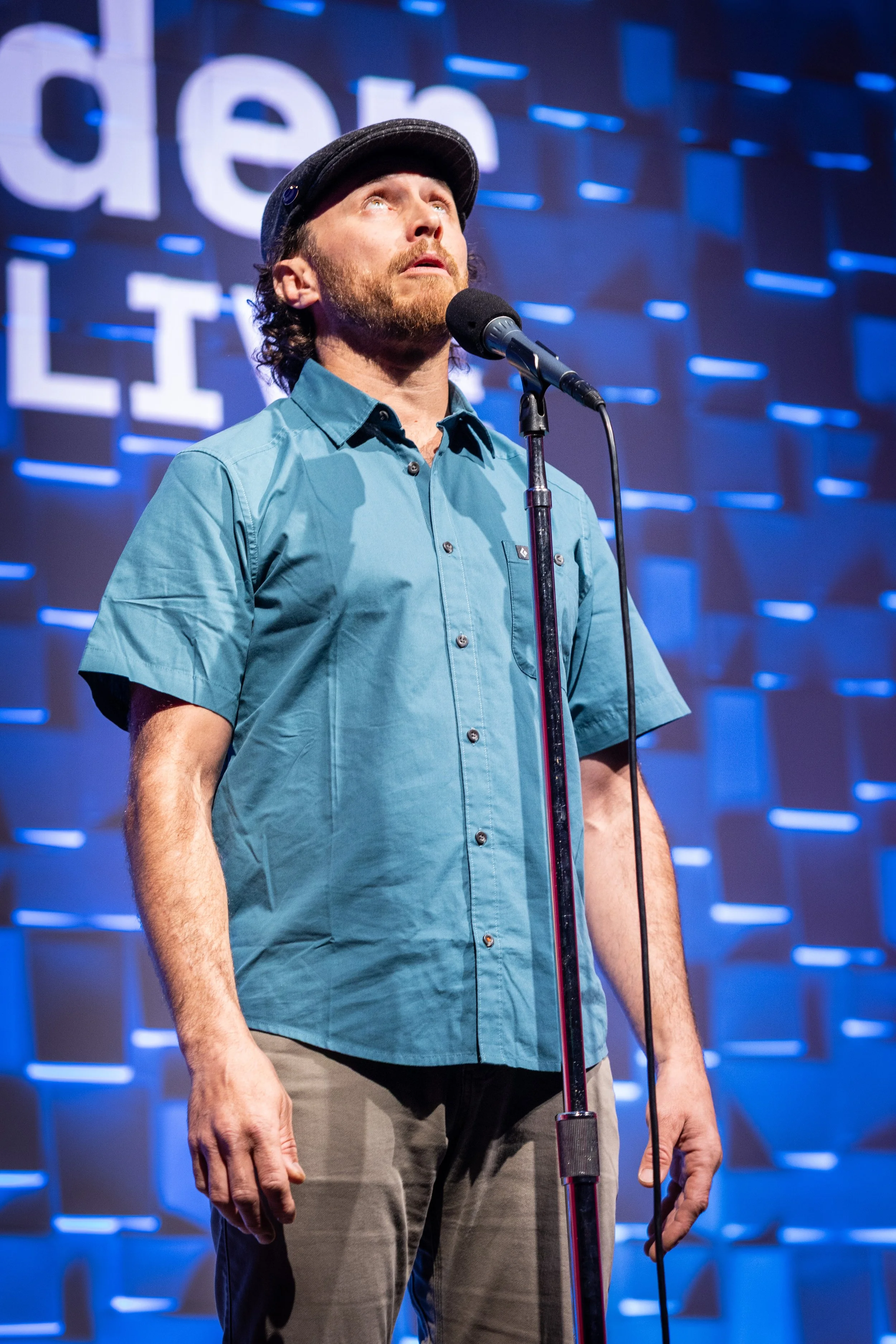
Monte Montepare shares his story at Crawford Family Forum in Los Angeles, CA in February 2026. Photo by Louis Felix for LAist.
I know this is not the bottom of the crevasse. What I've landed on is some seasonal snow that's fallen in here and just got stuck. I'm guessing the ice we were walking around somewhere between 800 and 900 feet deep. So I do a little poking with my probe pole, but I don't want to trigger a second trap door. I'm not real interested in knowing how thick the chocolate is.
Glacier ice is so dense, it eats sound. So I just stood there in the silence, constricting and releasing my muscles to try and stay warm without moving.
Finally, Elizabeth looked down at the hole I'd punched through the snow. We make eye contact. Neither of us needs to say we should have brought a rope. I tell her I've been problem solving and I think I can climb up a ways, but I don't know how to get past the overhanging snow at the top. Even if you are roped up, the hardest part about getting out of a crevasse is dealing with the snowy ceiling you fell through.
Elizabeth's eyes get wide. She says, “If you can get up here, I can get you out.” And then she disappears.
By the time I start climbing, I've been in the ice for at least 20 minutes. I'm stiff. I'm cold. I start pushing on the walls with my hands and feet. I'm using my ski pole to improve tiny ledges, jamming my hand in icy cracks. I climb up five feet, ten feet, and then I look down, and I do not like what I see. The snow I was standing on looks like cotton candy. And when I knock ice crystals through the darkness, I can't hear them hit the bottom.
I climb up five more feet and then a couple feet more and establish this icy stance below the lip. I can't climb up anymore. I don't think the snow would take another fall. And the reality of the situation hits me hard. I have turned a relaxing weekend in the wilderness into a life‑or‑death ordeal. I'm terrified.
Just then I hear the flap of fabric and a flash of color and then the first of four brightly colored, brand new Arc'teryx rain jackets is lowered down in front of me, tied sleeve to sleeve. I had never been so glad my clients had brand new rain gear. Because I grabbed a hold of what was at least a $3,000 rope, and Elizabeth and those New Yorkers pulled me up into the sunshine.
When I got there, I was embarrassed. And they said things to soothe me. They were just impressed I climbed out. They said stuff like, “Don't worry. We all make mistakes.” It turns out, lack of experience doesn't equal a lack of empathy. They even swore themselves to secrecy to hide my shame. I hope they told somebody, because that is a doozy of a first‑time‑I‑went-camping story.
I myself didn't tell anybody the story for years. I was so ashamed of it. But these days, I own that guide service and I tell all the guides that story under the heading, “The glacier does not care how full your beard is.” Because the reality is we all make mistakes. The real shame is not being able to own them, so that we can learn from them.
Thank you.
Part 2
My problem with OCD, besides the fact that I have it, is that you don't get to choose the things that consume you. For a lot of people, OCD manifests with this deep need for cleanliness and organization, two things that I have never been particularly concerned with but could benefit from immensely.
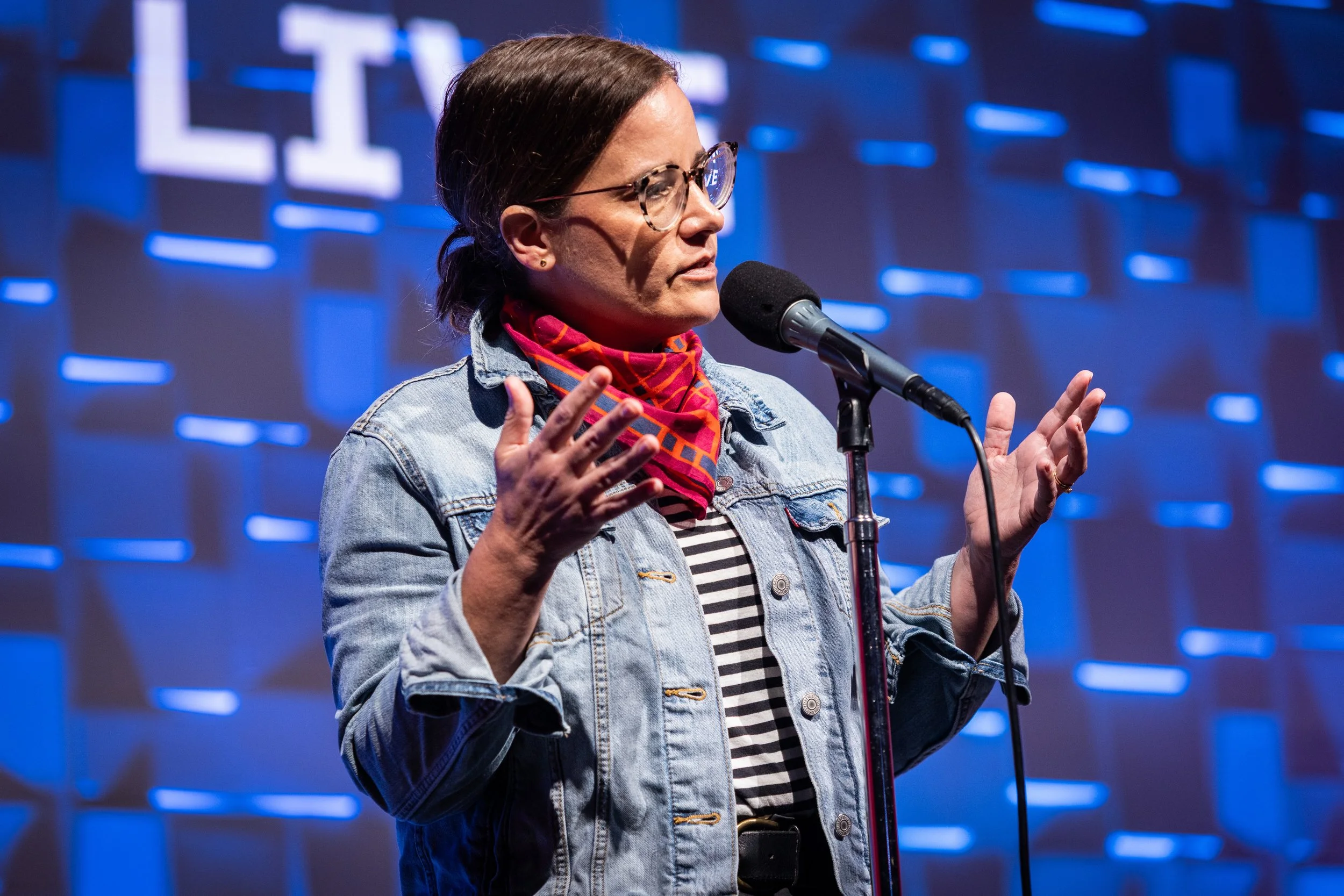
Jessica Lee Williamson shares her story at Crawford Family Forum in Los Angeles, CA in February 2026. Photo by Louis Felix for LAist.
For me, I have what's called intrusive thought OCD, which basically means that there's a 24‑hour marathon of the movie Faces of Death projecting onto my brain. There's a lot of ways that people cope with this, with the anxiety of fearing death. Like, you know, you guys came in tonight and you were probably annoyed by the metal detectors. I was so relieved by them. But there's a lot of different ways.
To put it another way, the anxiety that comes from the obsession compels you to behave in a way that most people would find absolutely ridiculous. That is, in a nutshell, what it is. So one of those ways it's ritual, which is the fancy way of saying that when I first came down with OCD, I would go in the bathroom and kind of make this deal that if I brushed my teeth for long enough past an arbitrary number on a clock that I wasn't allowed to look at, it would mean that I wasn't going to die in that moment. Then I would go back to my bedroom and, five minutes later, I'd be compelled back to the bathroom sink to start all over again, brushing my teeth.
Another thing that you use to deal with it is bargaining. I remember when I was 14, I made this deal with God that I would stop worrying all the time that I would die if he would agree to play a certain song right before, so that I would know that it wasn't a false alarm. I would get to choose the song.
When I came up with this idea, my mom was watching this PBS show. There was like old footage of a woman singing on it and I felt like, “Oh, this feels dated. This feels like something people have forgotten about if they hadn't already, that'll just be like locked away. I'll never hear this song.” It turned out to be I Will Survive by Gloria Gaynor, which, unfortunately, was one of the biggest hits of the last century.
And then there's like a whole nother layer of irony to it, where just by telling myself I will survive a situation, I'm kind of singing the lyrics too, a song that says that I won't.
The last of the compulsions that I'll mention are, it's called research and rehearsal. I spent most of my 20s on this website called MyDeathSpace, which basically links people's social media page to a news article about the way they died. The bad thing about MyDeathSpace is that you learn about all these ways to die that you didn't know before: a hockey puck, a camel, a pool drain, bending over to pull out a plug and getting stuck behind a bookcase upside down.
The great thing about MyDeathSpace is that you learn about all these ways to die that you wouldn't have known otherwise, like, you know, a hockey puck, a camel, a pool drain. So you know all the stuff to look out for, which is basically everything, you guys. You have to look out for everything.
And I would say that these days, my research and my rehearsal is basically just standard for most women my age. It's the tragedy section of People.com. Also, I got to give a shout out to Dateline, 20/20, 48 Hours Mystery, which, if I'm being honest, I feel like that title is very misleading. I feel like they should just call it 48 Hours: The Husband Did It.
But I've best heard rehearsal articulated, the benefit of it, from this astronaut named Chris Hadfield who was saying that thinking of disaster is kind of counterintuitive to success. But you have to think of disaster and plan in order to stay alive. So he plays this game called, What's the Next Thing That's Going To Kill Me? In his case, the next thing that's going to kill him is either a faulty rocket booster, a meteorite. For me, the next thing that's going to kill me is like a tumble down the stairs or the corner of my coffee table.
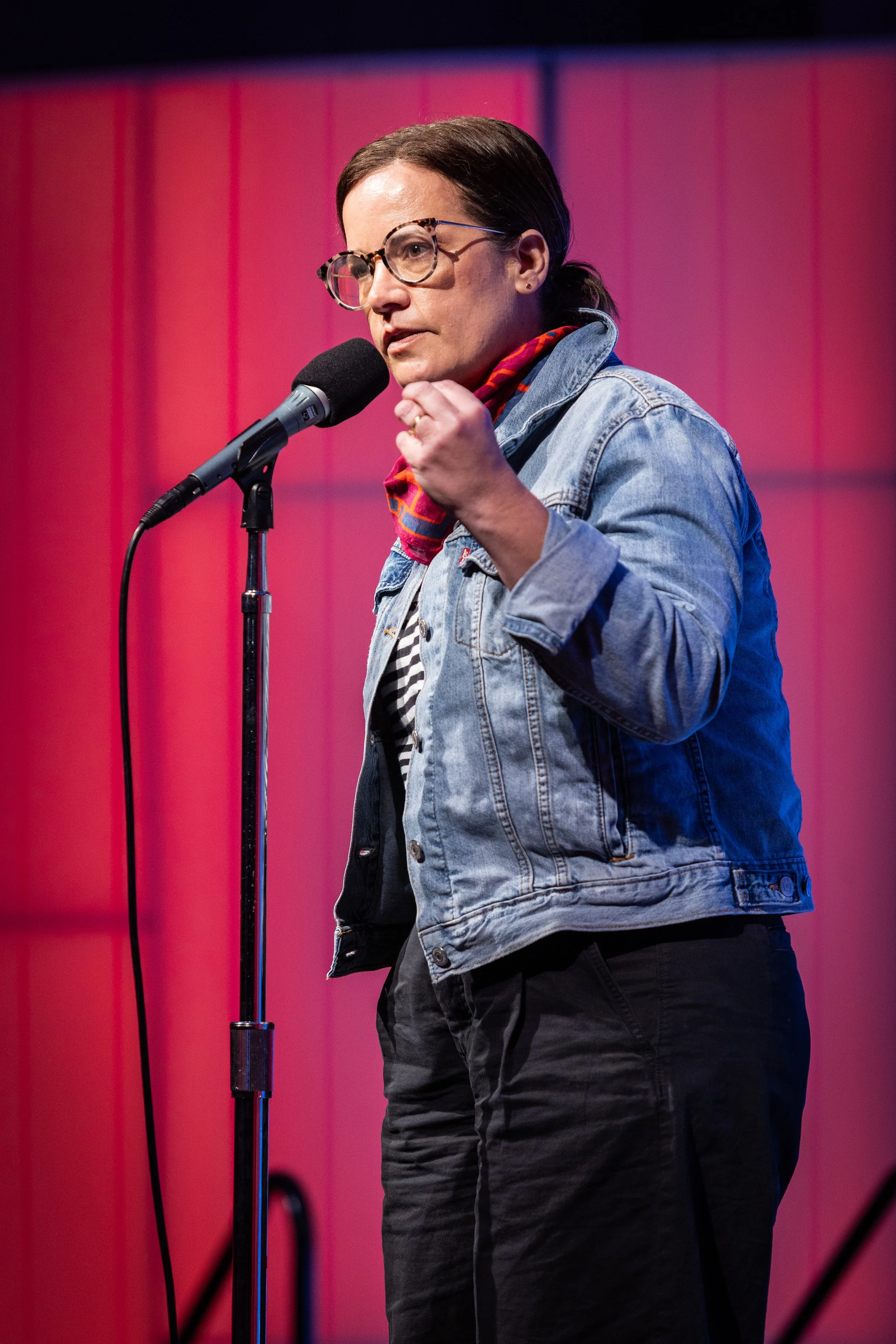
Jessica Lee Williamson shares her story at Crawford Family Forum in Los Angeles, CA in February 2026. Photo by Louis Felix for LAist.
I play this game every hour of my life. It's like, “Oh, a faulty hairdryer cord. I need to be extra careful and check it 20 times.” Or, “What if I'm the victim of a gang initiation shooting?” So I have to, every time a car drives by too slow, I duck down in my seat. It's a slip and fall in the bathtub, a falling tree limb, an earthquake during a visit to the lumber aisle of Home Depot.
After about 10 or 20 of these things, I find myself wishing it were socially acceptable to wear a helmet 24 hours a day. But I don't wear a helmet, mostly because I feel it would really limit me professionally and socially, but also because I do not want to be a person who lets fear run their life.
And I've done a lot of work, a lot of really embarrassing therapies where they've had me take my shoe off and tap on my toe or silly things to get to the point where I can go out and face the world even if I'm terrified.
But the thing is, is that you never know when anxiety is going to take the mic again. In this particular case that I'm about to tell you about, I feel like I probably should have seen it coming.
About 10 years ago, I attended the world's largest machine gun rally in Arizona, the Arizona desert. I had been making a podcast about different types of enthusiasts. And in one of those I'm‑not‑going‑to‑let‑fear‑run‑my‑life moments, I told myself that I was the type of person who could handle being around thousands of killing machines and the people who loved them so much.
They put dynamite in porta‑potties. That is not a metaphor for going number two. They put actual dynamite in porta‑potties and then shot at them until they exploded. Even the 10‑year-old Webelo scouts that were there were all packing heat.
Was I terrified that I would die once I was there? Yes, absolutely. But I've also been just as terrified I would die folding laundry in my living room. I'm just saying, for a person like me, it's really hard to trust your instincts.
A couple hours after I got there, one of the organizers, this man named Mike, pulled up on an ATV and asked me if I wanted to go see a waterfall with him. And despite the fact that he had two handguns strapped to his waist, I accepted his invitation and climbed on the back of it because I didn't want to offend him by making him think I was afraid he would rape me and strangle me with a snake‑skinned belt.
We rode down the hill and his girlfriend, Tammy, was down there waiting for us. She had a long mullet and she was on her own ATV. Instead of scrapping the rape scenario, I just replaced it with the idea that Mike had told Tammy he thought I was prettier than her, and now she was going to force him to kill me as an apologetic gesture.
So I kind of like leaned into the rehearsal part of my coping mechanisms and came up with this three‑tiered game plan as we rode these ATVs out into the desert. One, I would take as many pictures as possible and then drop my flashcard somewhere near the future crime scene. Two, I would talk about my husband a lot so that they would realize I wasn't a threat. And three, I would make them like me by paying them lots of compliments.
So over the course of this 30‑minute ATV ride, I kept shouting things like, “Your hair looks so awesome blowing in the wind. Let me take a picture.” Or, “What kind of gun is that? My husband would love that. Do you mind if I take a picture?”
We eventually pulled up to this wall of rock, and that's when Mike told me that we would have to hike the rest of the way in. I offered to stay back and guard the ATVs so that no one would steal them, as if we were at some motorcycle bar. Mike and Tammy just laughed at me and told me, “No one would steal them. We're in the middle of nowhere.”
And he actually shouted that part so that it would create an echo, so that it was like hearing it three times instead of once, which made it feel so much worse.
So then I started rubbing my ankle and told them I didn't think I could make the hike in because I sprained it a couple weeks ago hiking with my husband, but Tammy wouldn't hear of it. She felt like I really needed to see the waterfall because she felt like it was going to be really pretty. I told Tammy I thought that she was really pretty, which was followed by an awkward moment of silence.
And then, to make it even worse, Mike had pulled out his gun and cocked it in case we ran into any rattlesnakes, which, honestly, I would have been terrified if I hadn't already bought a ticket for the These‑people‑are‑going‑to‑murder‑me train.
At some point, Tammy turned to me on the hike and asked if I was crying. I told her it was just my allergies, and then hobbled along like an old dog on its way to be put down. We finally got to the waterfall, which, if I'm being honest, was not worth losing my life over.
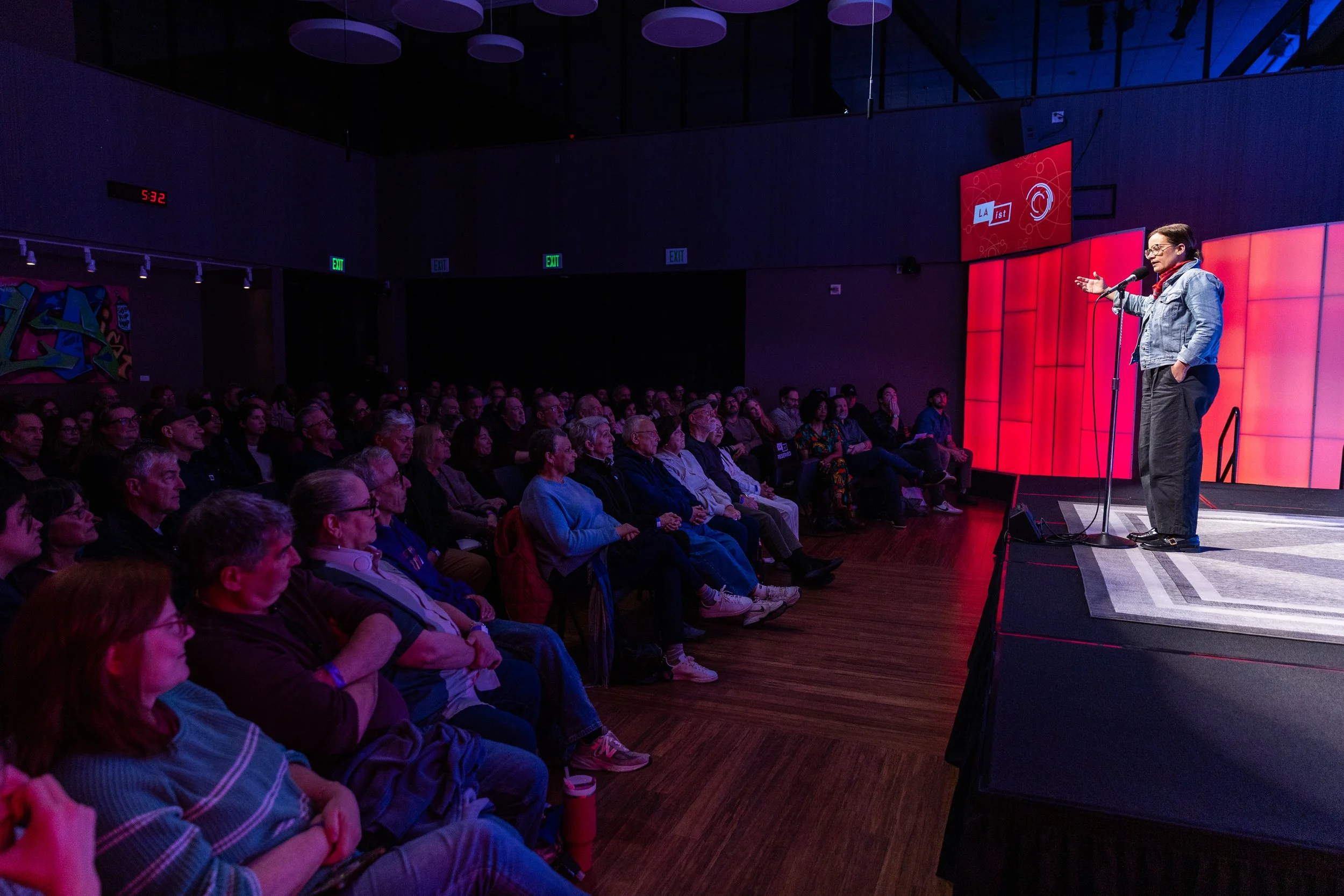
Jessica Lee Williamson shares her story at Crawford Family Forum in Los Angeles, CA in February 2026. Photo by Louis Felix for LAist.
That's when Tammy reached into her bag and I braced myself, because I felt, at this point, acceptance is the only way to go with dignity. And she didn't pull out a gun or a bowie knife. She pulled out a camera.
It quickly became clear to me that the only reason they had invited me was because they don't have any nice pictures of them together as a couple, and that they wanted me to take a photo of them that they could put on their mantle. I was like, “Oh, I've been taking pictures the whole time, guys. I can send them to you,” God willing I make it home alive. So I took some photos of them with and without their guns.
Our walk back to the ATVs was mostly uneventful. Tammy did point out that my ankle had suddenly healed. But as we rode back, the sun was setting, and I really wish that I could tell you that I had some kind of epiphany about how beautiful life is and how I'm missing it by worrying about how and when it will end, or that at least I felt some kind of shame for judging these two people based on their haircuts and their hobbies and their matching camo fatigues. But, honestly, the only thing I was thinking about was, what kind of head injuries are associated with traveling on rocky terrain at a high rate of speed, and why, in God's name on the one day when no one would have thought anything of it, didn't I ask to wear a helmet? Thank you.