This week’s episode — produced in partnership with Boise State University’s “AWESOME” Center — features two stories from The AWESOME Center’s research team.
Part 1: Physicist Leslie Atkins has spent her life trusting evidence over intuition.
Leslie Atkins is a professor at Boise State University whose work moves across physics, science studies, and education. Trained as a physicist, she studies how scientific concepts—light, time, energy, information—take shape, how those concepts are made legible to nonscientists, and how they transform how people notice, interpret, and inhabit their everyday lives. Her work has included collaboration with the Dalai Lama's Emory-Tibet Science Initiative, the North Carolina Governor's School, and the Matthew Strother Center for the Examined Life. She lives in Boise with her daughter and her dogs, Newton and Emmy Noether.
Part 2: Eric Jankowski is determined to beat his math-genius dad at the game Go.
Eric's first Story Collider show was in the basement of the Ann Arbor District Library in 2011. Since then, he's published over 40 papers on molecular simulations and engineering education and he now leads the Micron School of Materials Science and Engineering at Boise State University. His collaborations with The Story Collider have led to three NSF-funded projects and been recognized by the American Society for Engineering Education and the Anthem Awards. He still likes bicycles and playing a board game called go, and still thinks sharing stories is the best way to improve big, complex systems.
Episode Transcript
Part 1
The summer I was 16, a man named Blaze Hayes offered me a peach and a cupcake. He was called Blaze because, as a child, he set things on fire. He was now a philosophy teacher. And on that day he brought us snacks, peaches and cupcakes.
He hadn't brought enough for everyone in the class to have one of each, so he asked us to choose. I chose a peach. And then he said, “Did you really get to choose that or was it somehow preordained?”
And then he named the question - he's a philosophy teacher - free will versus determinism. No one had asked me that question before. No one had asked me that kind of a question before.
I grew up in Apex, the peak of good living, North Carolina. It was a town of 3,000 when we moved there, but it's much bigger now. I lived at the end of what we called the “Bumpety‑bump” Road because it had no name and had no pavement.
My father owned a small business selling and repairing copiers. There were five of us in the house, four TV stations, one TV. We could choose one show a week. I picked Full House. There was no internet, no cable, which is to say, if information was going to come to you in the early ‘90s in Apex, someone was going to put a book in your hand, someone was going to mimeograph a zine, someone was going to make you a mixtape.
And maybe there were kids, I like to think, my age in big cities who were finding their way into record store stuff by college kids, or independent movie theaters that showed foreign films, or used bookstores with dog‑eared philosophy books, but that had not been my childhood.
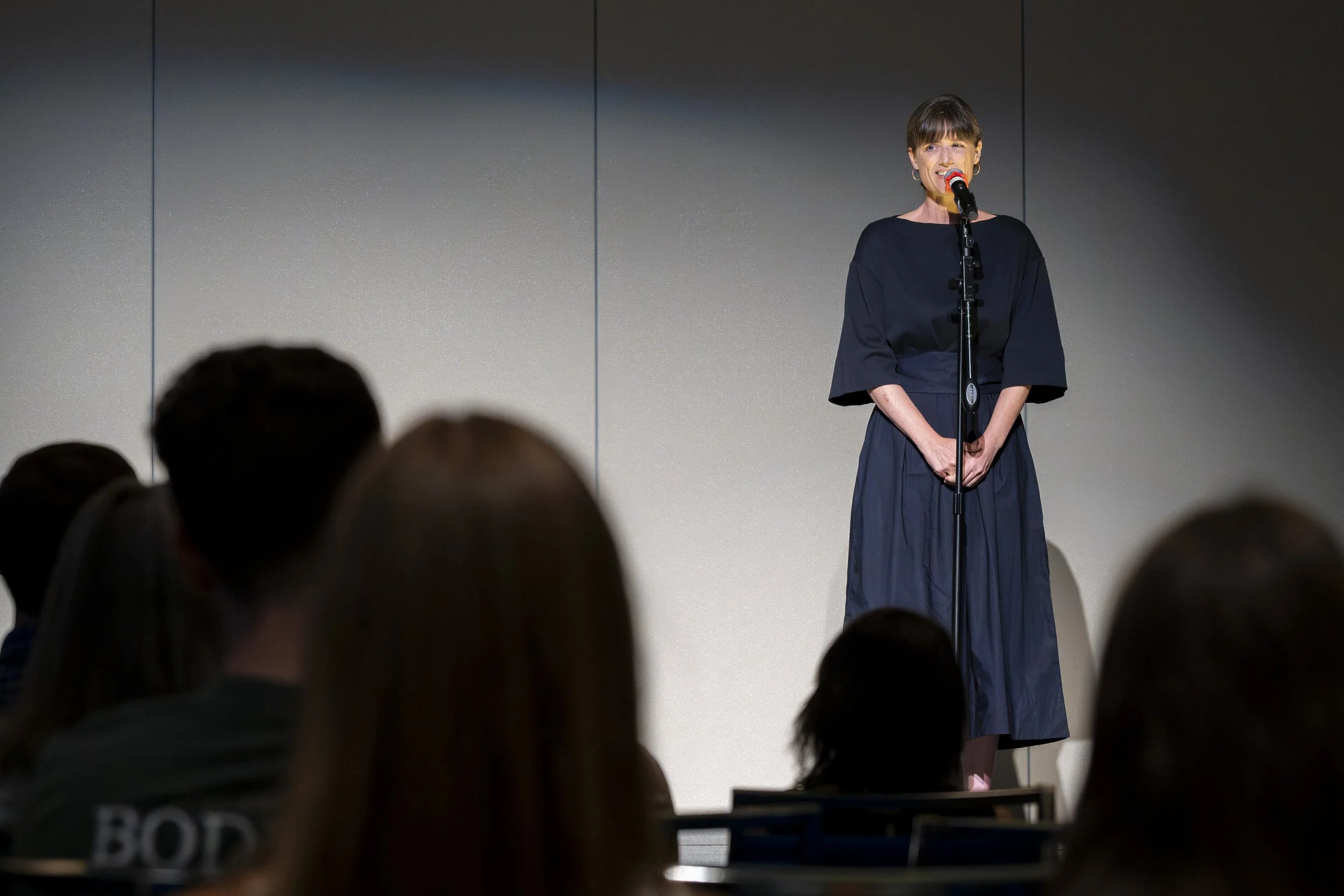
Leslie Atkins shares her story at Simplot Ballroom D at Boise State University in August 2026. Photo by Sean Evans.
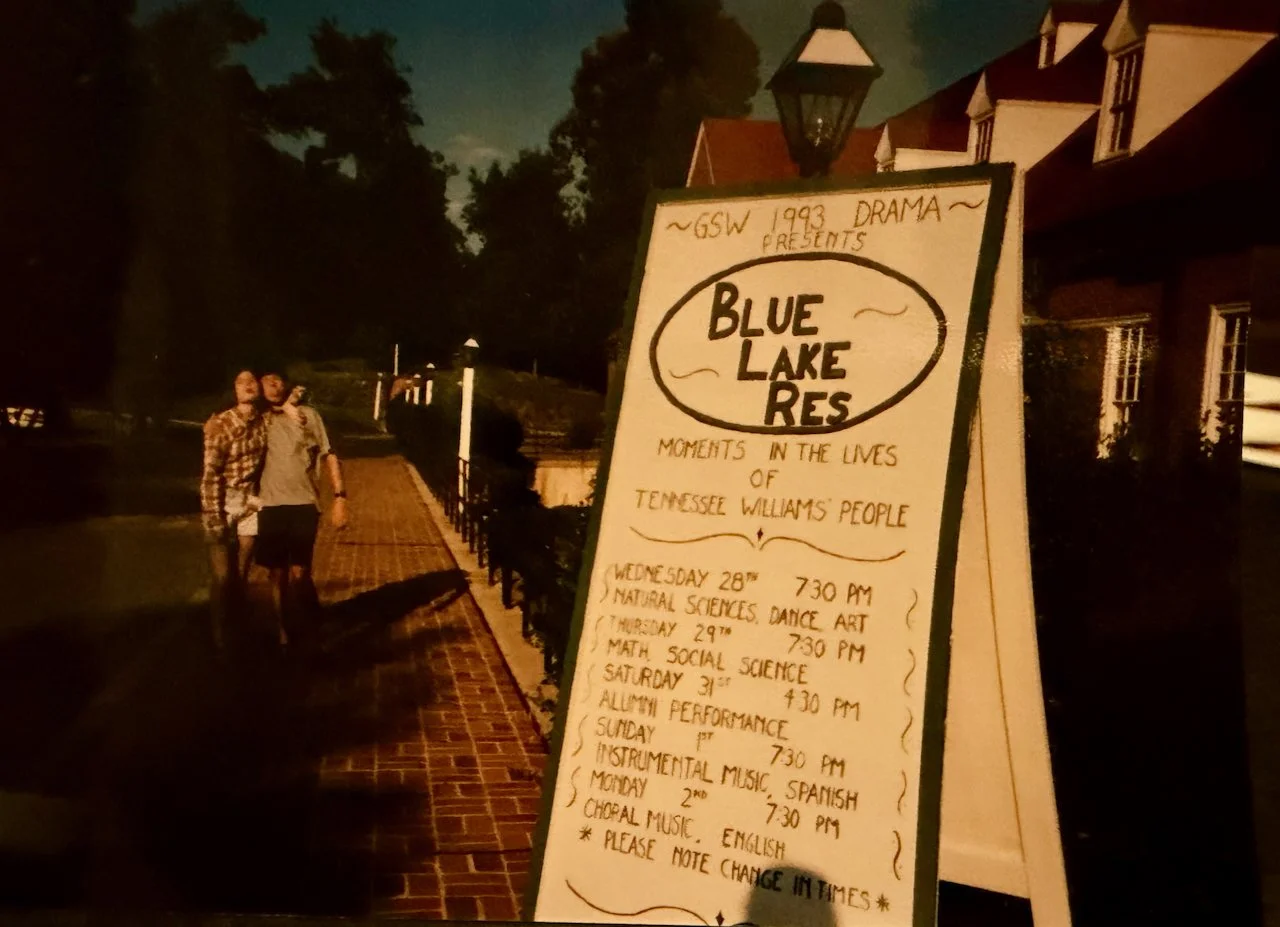
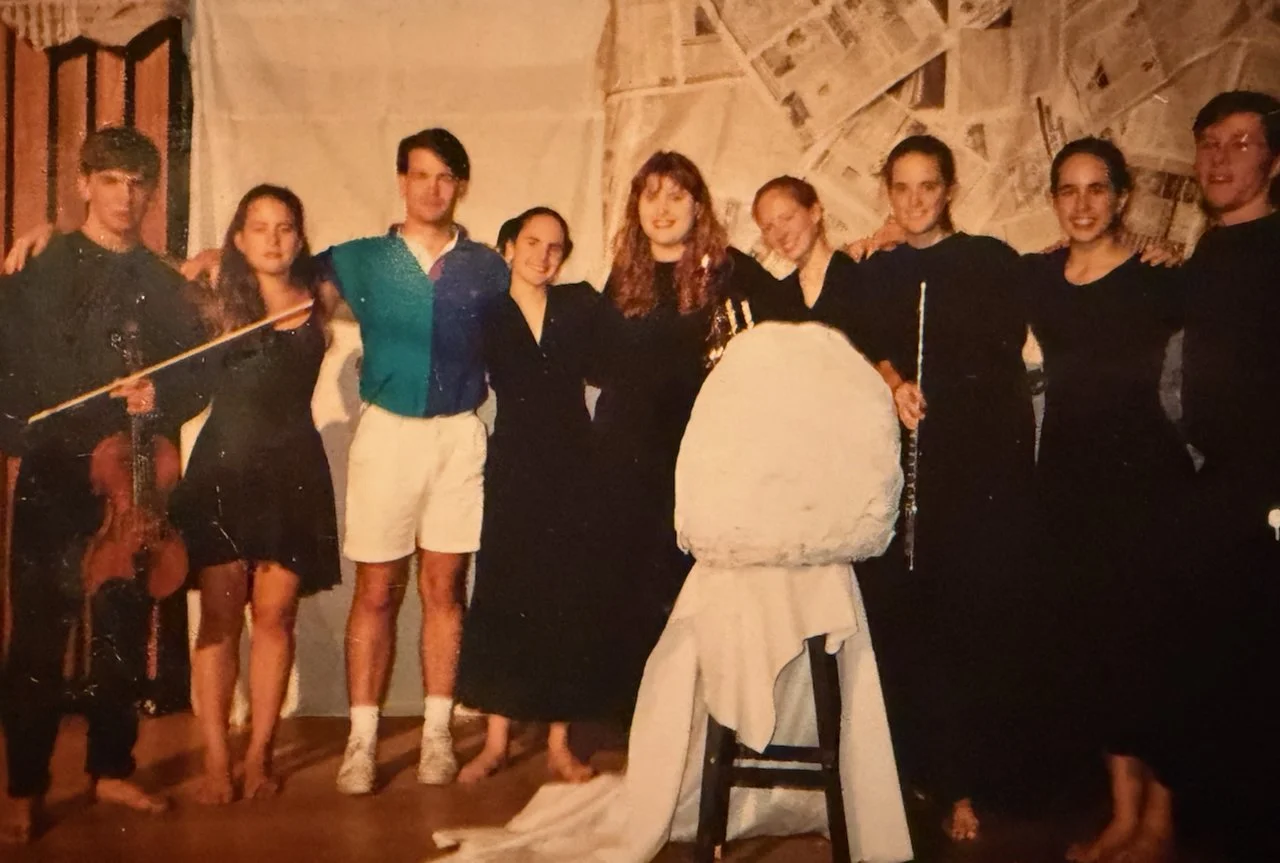
And yet I found myself this summer at the Governor’s School of North Carolina. It's a six‑week public free residential school founded on the idea back in the ‘60s that our precocious students needed to know something about 20th century ideas. And those weren't happening in our classrooms.
They pulled this off on a tight budget by hiring grad students who needed summer income and thought it might be cool to hang out with us. And these students came from places so foreign, they might as well have been different countries. We were largely staffed by the Iowa Writers' Workshop. We had a choral director from Yale, Composition Studies person from Princeton. Robin Cox from Miami taught me some music. Dancers from New York who didn't think looking pretty was part of dance.
And we sat in these rooms that were built in the 1700s, no air conditioning, windows thrown open, and the fans beating the heat around. In these spaces, these grad students handed us, if you were in music, like I was, Steve Reich and John Cage and Philip Glass.
And if you came for math, you didn't even look at a number. You did knot theory in origami. If you came for English, you weren't reading Jane Eyre. You were reading graphic novels, and everyone else at this school thought you were looking at comic books.
My friend Abby from Whiteville, North Carolina, she played a woman on stage who thought she was a seal. It was a Tennessee Williams late one‑act play. She barked on stage like a seal. This was no You're a Good Man, Charlie Brown.
We saw Un Chien Andalou, like the Andalusian Dog in which someone slices an eye open with a razor.
There was one weekend they shepherded all of us into an auditorium to listen to Vexations, which is a piano piece you play 840 times in a row. You spend the entire weekend in the auditorium. Your clothes, the seats, the fabric of the whole space fills with this music. Time itself fills with this music. And I loved it all.
And then there was the peach.
So, to be clear, I have a sweet tooth. My friends in college would buy me bags of marshmallows on my birthday because that was my favorite snack. And yet when Blaze said, “What would you like to eat?” I didn't think about what I liked to eat. I thought about a bikini, and I thought about J. Crew catalogs. I thought about Kate Moss, and the Outer Banks. I thought about boys, Seventeen Magazine, and all the small ambitions that are available to a 16‑year‑old in Apex, North Carolina, and I reached for the peach.
But Blaze hadn't asked us about reasons. He'd asked whether we could choose at all. And that year, I had taken my first physics class and unexpectedly fallen in love with it. I took AP physics so that I could never have to take a science class again. I'd applied to the Governor's School in Music thinking I'd be a musician, but by the time I showed up that summer, I knew I would be a physicist.
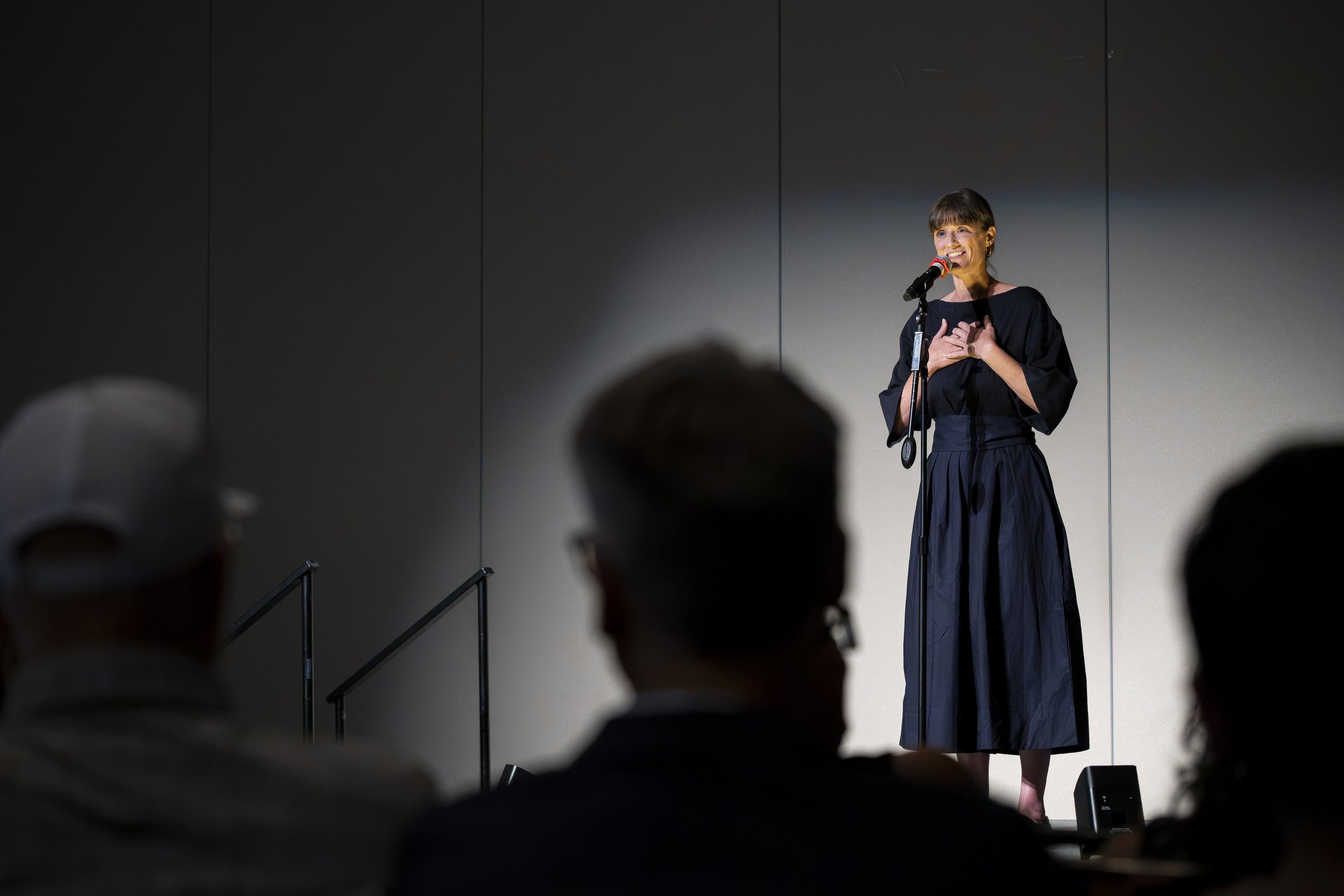
Leslie Atkins shares her story at Simplot Ballroom D at Boise State University in August 2026. Photo by Sean Evans.
So when I saw my hand reaching for the peach, I didn't see a hand. I saw a nerve impulse. I saw a cascade of ions. I saw the ratcheting of muscle fibers. I saw electrons that were obeying Maxwell's laws, not some abstract anomalous will that I had. And I said this with all my conviction to my class.
And Tiffany looked at me. She's a dance student from Southern Pines, and she said, “Can't you just feel it? Don't you feel yourself choosing?”
She didn't say it as a rebuttal. She said it like I had just said this weirdest thing she'd ever heard, that she couldn't understand how anyone could say such a strange thing. It was like I was standing there saying, “I'm not sure I have a hand.”
And I looked around this room at these 15 other faces. And if you've ever spent six weeks of your adolescence at summer camp, you know that those are the people you love more than anyone in the world. You think they know you better than your family does, and all of them are nodding with Tiffany.
I've never felt more alone than what I felt in that moment. And not because we disagreed on free will versus determinism, but because they all trusted their bodies. They all thought that that was like evidence they could take at face value.
I had learned not to trust my body. If you ask me if I feel like a good dancer, I feel like a good dancer. Objectively, by every measure available, I'm a terrible dancer.
That's what I loved about physics. If you touch a warm blanket and the cold metal frame of the bed beside it, you'll think they're different temperatures. But if I hand you a thermometer, you'll see they're both at room temperature. If you slam on the brakes and you feel the seat belt catch you and push you back, if you look outside of yourself, if you just look down from above, get outside of your body, you'll see that it's your body slamming into it.
I became a physics professor so I would feel less alone. And it worked. I was in classes where no one asked me how I felt. No one asked me about my intuition, what was my gut response. They asked me, “What's your p‑value?” They handed you the instrument and you used that to make sense of the world.
And I lovingly shepherded students into this worldview. We'd look at the yellow of a computer screen and I would hand them, “Here, here's a microscope. Here's a spectrometer. There's no yellow there at all. Don't you see how your eyes can deceive you? Here is a foundation on which to build your philosophy.”
Then I had a kid. She is newly four years old and I'm putting her to bed. We've done dinner, bath, books, books, one more book, song. The liturgy is nearly complete. When she rests her hand on mine and says, “Shh, Mom, do you hear that?”
I could hear it. It's a sound, it's a hum that comes low and from the north. It's a FedEx flight that comes into Boise most evenings, and you can hear it from our house.
And then she says, “Do you know the earth turns?”
“Yes.”
“Well, you can't feel it, but every once in a while, if you're really quiet, you can hear it.”
You can't, okay?
I spend my life showing students evidence that the earth turns, because it's actually not that obvious. We could live in a universe that spins overhead and we're still. Occam's razor says it's more likely that we're still, but that's not evidence. That's a heuristic.
If you hang a driven pendulum in a stairwell and set it moving, over the course of a day, it traces out a circle on the floor as the world spins under it. If you fire ballistics, I'm told, instead of going in a straight line when they go far enough, they arc left or right.
I've stood with students. We've stared at that pendulum in wonder together. So I could feel this familiar phrase rising in my throat. It's one that begins, “Actually, Kate…,” and it ends with a child no longer trusting her body.
I know where she learned about the earth turning. She learned about it in a place called the Little Neighborhood Preschool. There were eight students there. She's an only child and so her distant family lives like thousands of miles away. And those seven students, they were like siblings to her. The families there were like my family. And at the center of all of this is her beloved Miss Cindy, the preschool teacher, who gives them the world every day.
And once a year, on every child's birthday, so it must happen eight times a year, there's a candle in the middle of the room and the child holds a globe in her hand and walks around in a circle, spinning the globe, and sings, “The earth goes around the sun, the earth goes around the sun, it takes a year to get the job done.”
And I picture Kate leaving this ritual and walking on to a playground that is, for all intents and purposes, perfectly still. And she searches her world for some evidence that this could possibly be true, and she hears it that night in a low hum from the north.
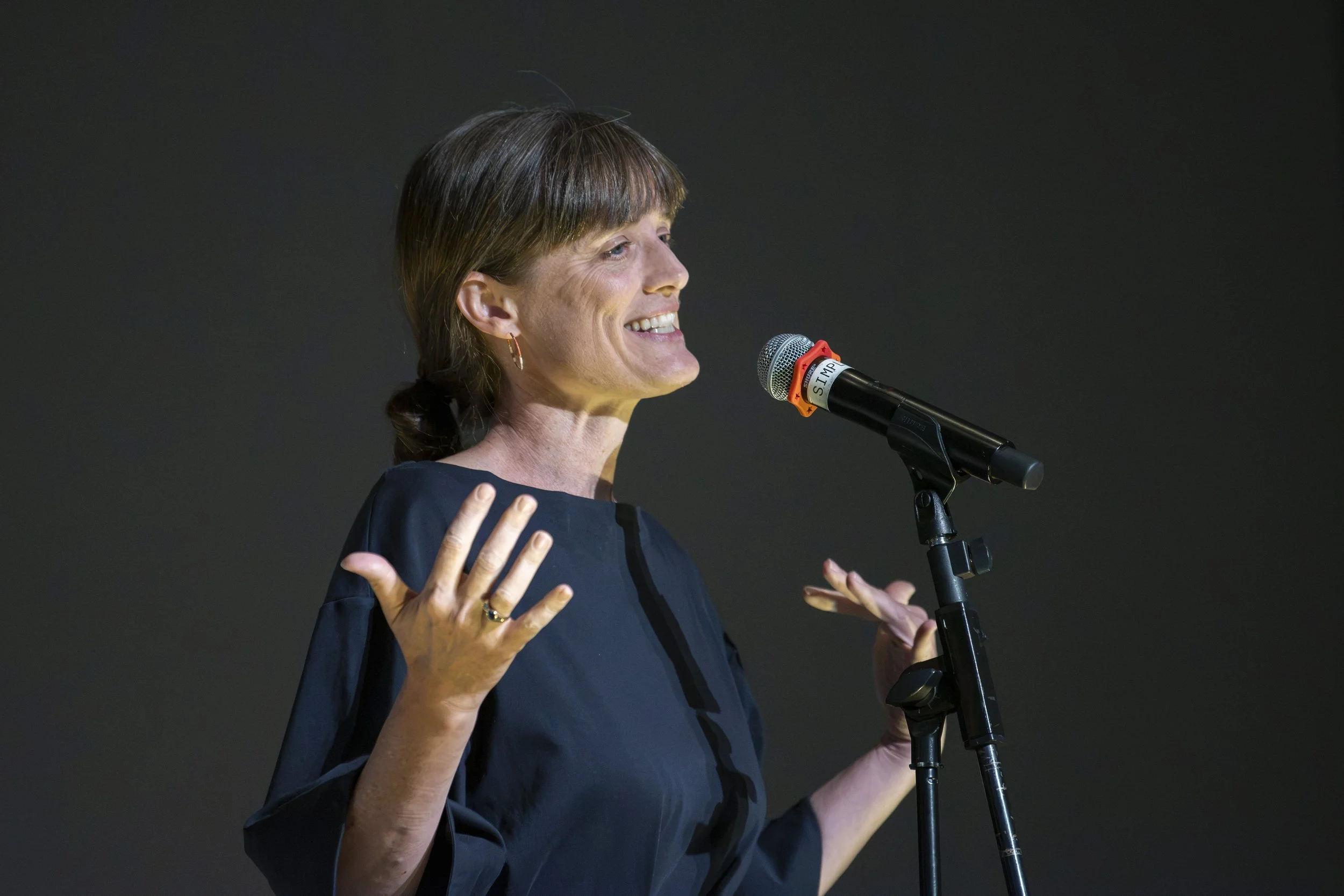
Leslie Atkins shares her story at Simplot Ballroom D at Boise State University in August 2026. Photo by Sean Evans.
So I didn't correct her, because she wasn't even wrong. She wasn't looking for evidence that the earth turns. She was looking for evidence that her teacher and her world was to be trusted. And there's no instrument for that.
I wish I could hand her a thermometer that says, “Do not trust him, trust her, do not click there, click that,” but it turns out that that's the kind of thing you just feel.
And I should know that because I think 35 years ago, when I thought I was choosing between free will and determinism, thought I was choosing like some epistemology, I was choosing the grad students. I was choosing the kinds of questions I thought we're dedicating a life to, the kind of life worth living, the best way to spend a summer, the best way to build a life.
I don't know what it is that I want Kate to believe. I don't know how I want her to come to those beliefs. I still, these many years later, don't even really think she gets to choose. That's a commitment I haven't loosened. But I do believe this. That that night, my four‑year‑old heard the earth turn on its axis. A small piece of evidence to hold a cosmology, with its epicycles and stray comets and its perfectly attuned little four‑year‑old body intact.
Part 2
I'm six years old, laying on the carpet of my living room with a wooden board with a grid on top of it between myself and my father. My father works a lot, so I cherish the rare time that we have together, but I'm really annoyed to be playing this game.
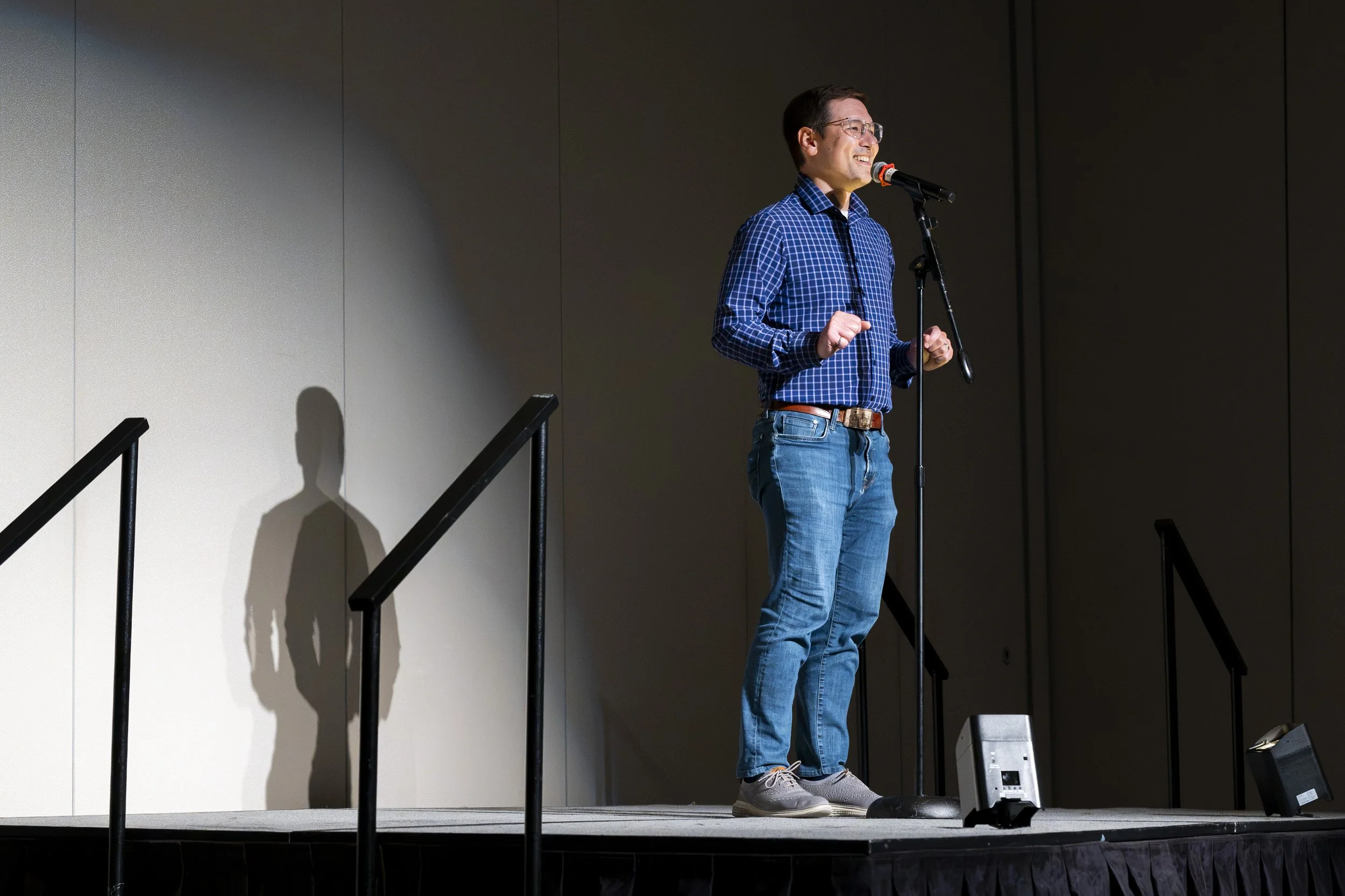
Eric Jankowski shares his story at Simplot Ballroom D at Boise State University in August 2026. Photo by Sean Evans.
I hate this game. It's called Go. I kind of like the board. It's got these nice perpendicular lines that make a 19 by 19 grid. There's these two different bowls of stones. There's slate stones that are black that have become shiny with years of use, that I get today, because I'm the weaker player. The stronger player gets this big bowl of Mentos. They're cut out of clamshell. It feels so good to plunge your hand into that bowl, but if you commit to one of these, they will crack your teeth.
Normally, when we add a stone to the board, there's a soft ‘click’, but an experienced player can wield one of these stones with a ‘crack’ to intimidate a weaker player. And as we're playing, I make a mistake, and there's a ‘crack’, and I start feeling a little scared. There's another ‘crack’, and I start feeling weak. ‘Crack’, powerless and afraid.
The explanation of why my position has fallen apart and why I've lost doesn't make sense to me. And it comes back again. It's iterated, louder and angrier each time.
My aunts and uncles always tell me how smart my dad was before the accident. He was a freshman at Columbia. And he won third place in this national math competition for math majors. He was an exquisite pianist and a painter, and he could recreate the flavors of a sauce that he tasted at a restaurant.
Then he was hit by a bus, was in a coma. And when he came out of the coma, math wasn't as easy as it used to be for an aspiring astrophysicist, a theoretical astrophysicist. So he settled on diagnostic neuroradiology and started a family that he could shout his aspirations into.
Now, it's the summer after my senior year of high school and I've got three things on my agenda. I want to move out of this stupid house. I want to make out with a girl. And I want to beat my dad. I want to show him that I'm the best. And he won't shut up about how Go is the ultimate intellectual pursuit, so I pick Go as the platform where I'm going to defeat him.
I sneak into his library, which has these floor‑to‑ceiling books on everything from World War II to Einstein to human anatomy, and I pick this small pink volume off the shelf called In the Beginning. It's a tutorial on how to play the opening in this 4,000‑year‑old game of Go.
This book is amazing. I love the creativity, the options you have in the opening to stake your claim in the world. And I love how, in the fighting that happens in the middle game, you might sacrifice a huge army to eke out a win in the overall war, and the precision with which the end game is played where one missed move for you or your opponent can mean life or death.
I'm studying every single night. And falling in love with this game with this book shows me the importance of the right introduction to a subject and that, sometimes, the best teacher can be you and a book.
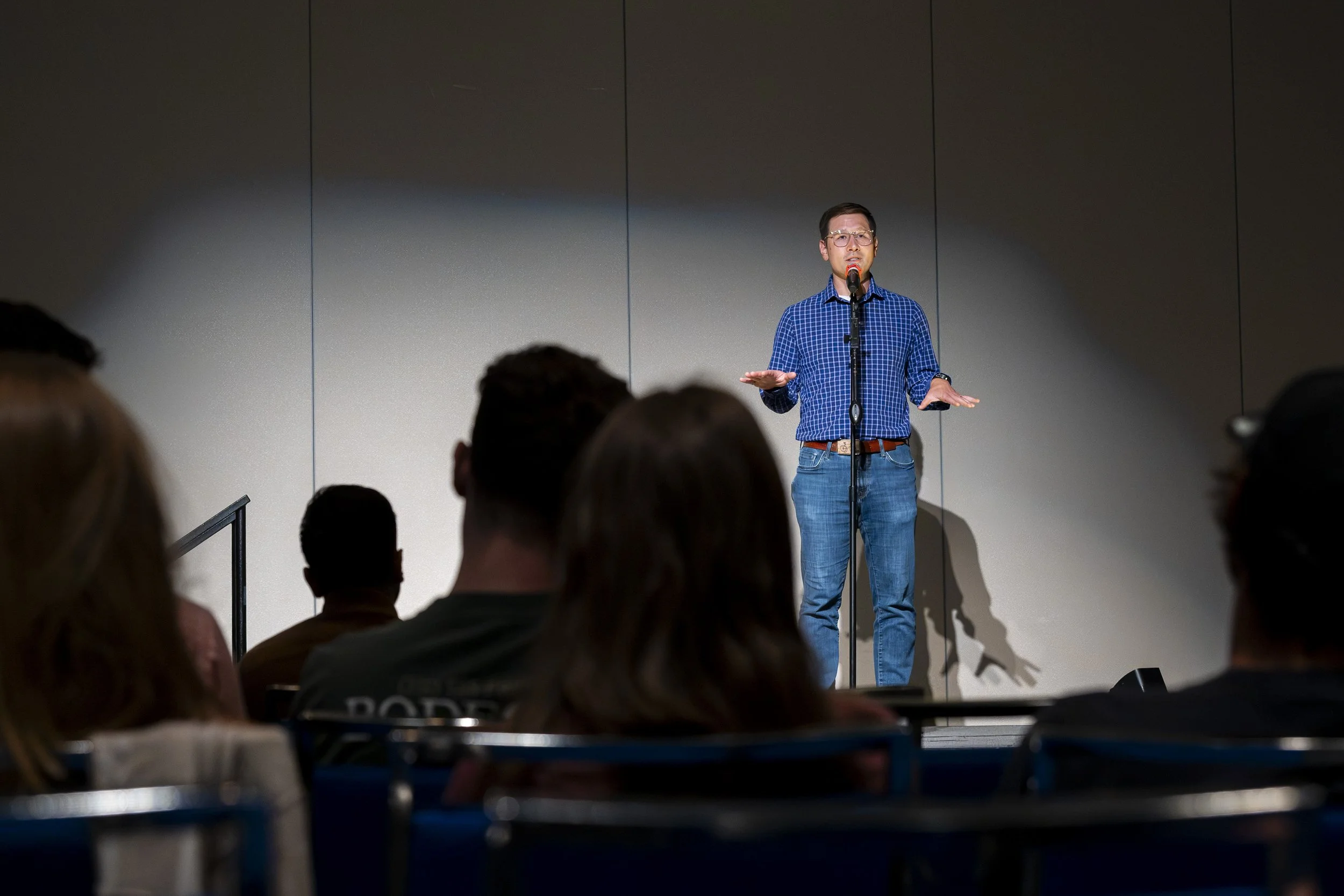
Eric Jankowski shares his story at Simplot Ballroom D at Boise State University in August 2026. Photo by Sean Evans.
At the end of the summer, I challenge my dad to a game of Go. He's surprised and really eager to play. There's a wonderful handicap system in this game where the weaker player gets the number of stones that's the difference in your rank on the board before the stronger player gets to play. So my father gives me the full nine stone handicap, the largest handicap that exists. He doesn't know I've been practicing. He doesn't know that I'm better.
An hour later, my position has collapsed, and I resign. But this loss is different. I don't cry today. This time, I want to play more. I want a chance to fix the mistakes that I've seen this time around.
So when I leave for college and I'm moving into my dorm in Ann Arbor, it's all I can talk about. I'm talking about how this game is more complicated than chess, and there's so many more possibilities. My siren song attracts people that have strong opinions about combinatorial complexity, and one of them, Ben Harter, convinces me to start the Ann Arbor Go Club with him.
Three months later, by the time I'm heading home for Thanksgiving, we have played so much Go. We've evangelized it and taught it to so many people that I can now play my dad with a zero stone handicap. We can play even at Thanksgiving.
One PhD and two national championships later, he has to take a nine stone handicap from me. A national championship in Go in the United States is like being the best football team in Japan. Like, if you need somebody to win something with an asterisk and a footnote, I'm your guy.
But when I begin the professor life in earnest, we stop playing so much. It's easy not to stay in touch when I'm spending all of my time writing lectures, applying for grants, going out on the road giving talks, and raising a family.
So at baseline, we're not great communicators. After the birth of my second son, the Father's Day afterwards, I get an email from my dad, and the subject line says, “Father's Day”. The body of the message is blank. Father's Day.
So we lose touch, and I don't see or hear about the Parkinson's creeping up. Ten years of creeping, and he's visiting this summer. And each step he takes, assisted by a walker, drags a foot that has lost an inch from that bus in New York City at Columbia. And he can't do the same math tricks he used to do where he could multiply five‑digit numbers in his head faster than I could operate a calculator, or recite the enrollment of a university like Boise State all the way across the country, 28,519 last fall. And he's repeating himself and he asks for the tenth time what that enrollment number is.
He's become weak. He's become frail. The times that I saw him bragging about how good I was at Go, he would talk about my achievements to his Go‑playing friends, and he would say how strong I had become, but it felt like he was stealing my valor. It felt like he was taking credit for the work that I had put in. Because when we played each other, he was always such a sore loser. He would say, like, “You got lucky,” or, “I've had too much to drink today.” Whenever we would play, even though I had become stronger, it felt like he moved the goalposts. I wanted him to feel weak and powerless and he was denying me that satisfaction.
So now, when he's visiting in Boise, it's so pathetic to watch him struggle over a threshold of a doorway. He's got a tremor that takes away the precision that's needed to play a game of Go. He's weak and he's powerless. I've finally gotten my wish. I'm ashamed.
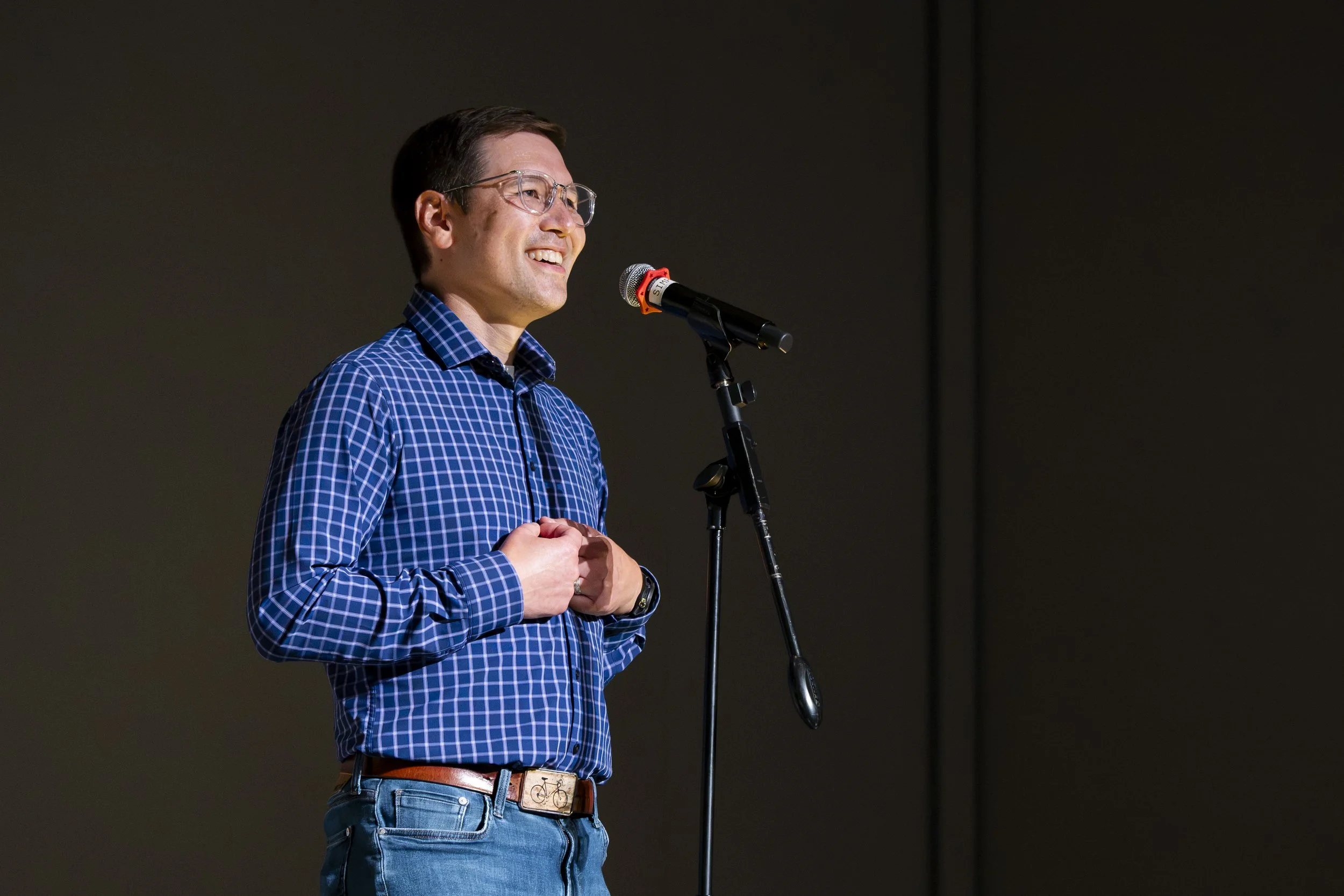
Eric Jankowski shares his story at Simplot Ballroom D at Boise State University in August 2026. Photo by Sean Evans.
And I'm bored. We can't do anything. We can't play Go. We can't go for a bike ride. We can't go for a hike. We can't even have an old‑fashioned shouting match because the mind of the imposing bully that I used to have is different.
But he still needs to eat and I can still make an okay sauce or two from a restaurant that we've tasted before. So we make our family favorites. I mix some cocktails, and my son Miles schleps his keyboard down from his bedroom and sets it up at the kitchen table where my dad is stationed.
And my son is bragging about how the piano skipped a generation. He's ecstatic about playing a recital for his grandpa.
When it's time to go, my dad stands up. I grab his hand and we make the first eye contact that it feels like we've made in 40 years.
And he says, “You've done a really good job.”
I want to play again. I want to try to fix the mistakes that I see this time around.
Thanks.