While many believe striving for perfection is a fool's errand, in this week's episode both of our storytellers chase it anyway.
Part 1: Weiji Ma grapples with the pressure of living up to his child prodigy reputation as he grows older.
Weiji Ma received his Ph.D. in Physics from the University of Groningen, the Netherlands, but ended up strongly disliking working in Physics. He did postdocs in computational neuroscience at Caltech and the University of Rochester, but then realized he cared much more about measuring human behavior. He became faculty in 2008 (in Houston, TX) and moved to New York University in 2013, where he is now professor of neuroscience and psychology. His research has covered many areas, including visual decision-making, multisensory perception, visual working memory, metacognition, multi-step planning, problem-solving, mindsets, and procrastination. Nevertheless, it hasn't helped him make better decisions or reduce his own procrastination.
Part 2: Chia Lin's meticulously structured life is upended by a chance encounter with a swarm of bees outside her lab.
Dr. Chia Lin is a Research Scientist at the Rothenbuhler Honey Bee Research Lab in Columbus, Ohio. Originally from Taiwan, she moved to the United States in 2003 to study pollination ecology. Her beekeeping journey began in 2013 when she joined the Department of Entomology at The Ohio State University as a postdoctoral researcher. Her current research focuses on developing farm management strategies to enhance pollinator health and improve crop productivity. During the summer months, she manages over 100 honey bee colonies to support various research projects across Ohio. In addition to her scientific work, Chia is a kindergarten teacher at the Columbus Chinese Academy. Outside of her professional life, she enjoys crocheting, building with Legos, and spending time with her family and two cats.
Episode Transcript
Part 1
I was born and raised in the Netherlands, as should be obvious from my name, my blonde hair, my blue eyes. For the podcast audience, I look more Asian than Chairman Mao. So yeah, my first language is Dutch, and I apologize for any cognitive dissonance I might be causing you.
As a kid, I loved reading and, particularly, math. I didn't come from a math or science family. I grew up with a single mom who had done one year of university, English Literature, but math just came naturally to me. It clicked and I wanted to do more of it.
I was in a K‑6 elementary school where I was able to do work from higher grades. I took advantage of that. And before I knew, when I was seven years old, I had run out of all the math worksheets that my school physically possessed, and, I believe, also out of the math knowledge that my teachers mentally possessed.
When I was bored, I became annoying. So I would ask too many questions, or I would cling to my teachers, literally hanging onto their arms. So at some point, my mom thought, like, maybe it's time to move him up and out. So that would be high school, because high school in the Netherlands starts in seventh grade.
After a lot of negotiations, that eventually happened. So I ended up skipping four grades in elementary school, which forever branded me a child prodigy. Now, that changed nothing and everything. So on the one hand, I was still this immature little kid, but on the other hand, people started seeing me differently.

Weiji Ma shares his story at Caveat in New York, NY in April 2026. Photo by Zhen Qin.
For example, my mom and I went to look at this prospective high school. We had a chat with the principal. All seemed fine, except that, the next day, it turned out that he had talked to a reporter. The local newspaper ran this headline, “Seven‑Year‑Old Genius About To Join (Name of school).” My mom was very wary of media attention so she was seriously pissed, and we went to a different high school.
So here I was, an 8‑year‑old among 12‑year‑olds. I never established deep friendships. A friend to me was somebody who would play chess or soccer with me during recess. I was also the kind of kid who would take pride in correcting teachers' mistakes or haggle about like a tenth of a point on a test. Honestly, I enjoyed those things. I was oblivious to how it made me look.
When I was 10 years old, I was in ninth grade. We had this school trip, sleepaway trip to this rural area of the Netherlands. We would stay in a converted barn. It was a very nice trip. I liked it. Until in the evening, the teachers took me aside from the group. We were all hanging out. The teachers took me aside and they said, “Weiji, your mom talked to us. And because you're 10 years old, you have to go to bed earlier than all your classmates.”
I was so mad. I was mad at my teachers for listening to my mom. I was mad at my mom for thinking that I needed some special treatment, or for making me feel singled out. But so I had to sleep in this adjacent room. It was dark. I'm in my sleeping bag. I was by myself, seething. I could still hear my classmates chatting on the other side of the door. I felt a victim of my age.
And to make matters worse, two of my classmates decided to sneak into this room, probably to make out, and I was so embarrassed. I was embarrassed that I was there. I didn't know what to say, so I just kept quiet. I pretended to be asleep.
Then after a while, their eyes adjusted to the dark. “Wait, there's somebody here!”
“Yeah. Sorry, guys, 10‑year‑old bedtime.”
So age is just a number for many people but, for me, it was a really important number. Many kids, they are just happy to grow a year older but, for me, being younger than everybody else was like a core part of my identity. It was my fail‑safe way to get attention and praise from everybody. So I was a prodigy first and Weiji second.
Also, even though I may not have had any friends, I had this number. I also quickly realized that attention and praise would come regardless of how much effort I would do. So that laid a solid foundation for a lifetime of procrastination.
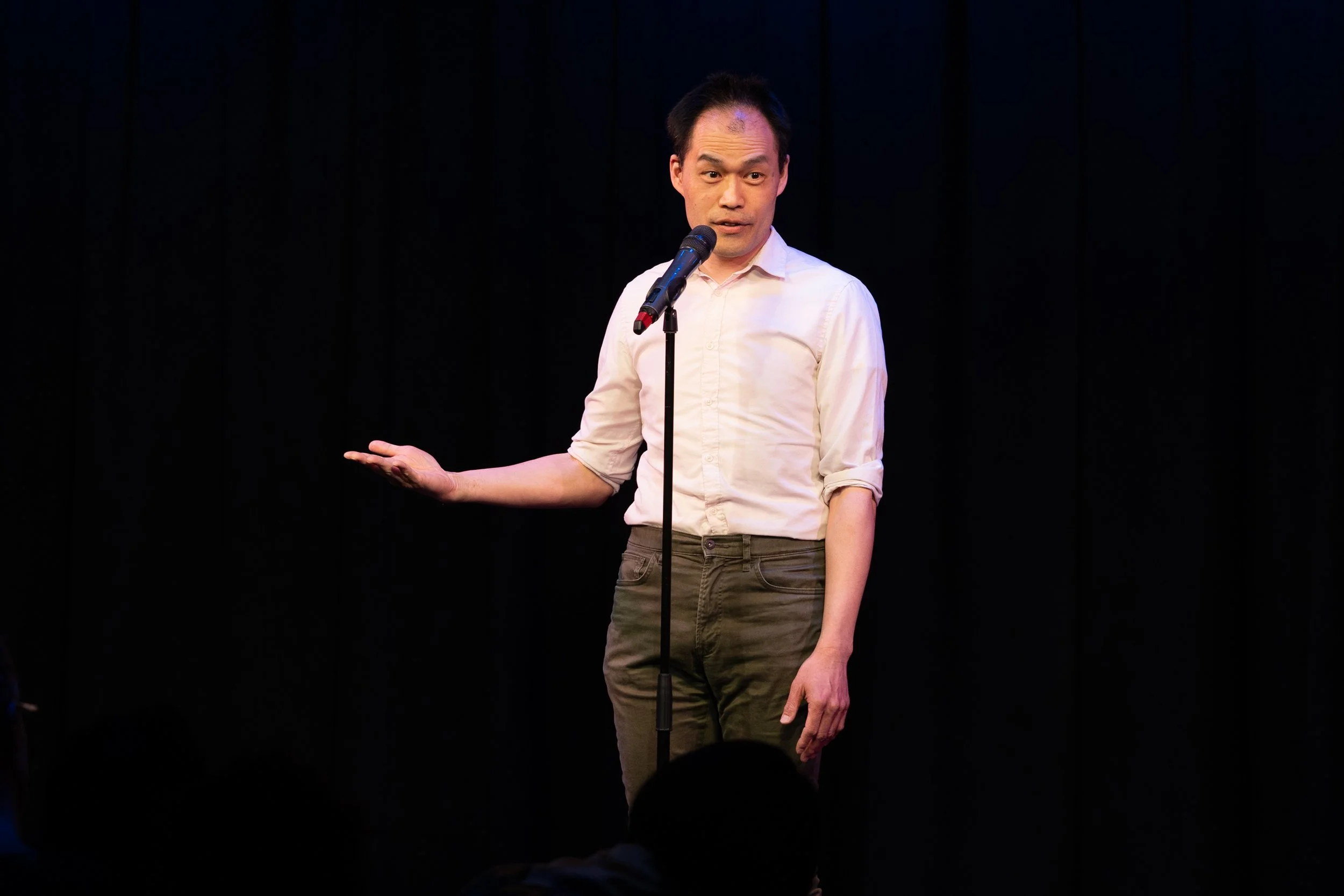
Weiji Ma shares his story at Caveat in New York, NY in April 2026. Photo by Zhen Qin.
I went to college when I was 14, in Physics. In the Netherlands, studying physics means that everybody takes physics and math courses and nothing else. The upside of that was that I was no longer the only weirdo. Because my self‑esteem was so tied to this age difference with my peers, I decided it was a good idea to increase that age difference. What that meant was that I would try to skip a grade in university by taking 84 credits where a normal person would take 42 credits. Because why would you bother learning if you can just rush through the material and remember nothing afterwards?
It worked. I managed to finish university in three rather than four years. But in the process, I lost all my interest in physics. Because physics is not the kind of thing that you can really rush, right? Especially when shit gets tough. I'm looking at you, quantum mechanics. I still felt like I had to do physics because I was like this genius, and geniuses are supposed to do physics, but the seeds of doubt started emerging.
I started my PhD when I was 17. And you should know, physicists, they think that physics is at the top of the pyramid of all the sciences. Chemistry is applied physics and biology is applied chemistry. And theoretical physicists are the worst, because they think they're the intellectual heirs to Einstein, solving all the big mysteries in the universe. And of those, I was the worst, because I thought I was going to be the next Einstein at a record age. Okay, reality check. I had no clue what I was actually doing. I had not the right background for this topic. What was worse, my advisor didn't have the right background for this topic. He was close to retirement. I was staying in the same university. Bad idea. And he thought that he could advise me.
But, honestly, I ended up struggling. I was not well equipped to do this kind of work. I had no intuition for this high‑level math. I saw my peers make more progress than me. And my advisor sometimes still gave me a lot of praise. He always gave me a lot of praise. Even I, who was so addicted to praise, started seeing that I was superficial and he didn't know what he was talking about.
So how did I deal with this? I had this intense internal tension between, like, I'm a genius, but I'm struggling. So what I did is I checked out a lot of books from the university library, advanced physics books, and I prominently displayed them on the desk, hoping that the knowledge would just diffuse through the air. Honestly, I hadn't read more than a few pages of each book, but it looked really nice.
And the other thing is I tried to walk like my advisor. I had noticed that my advisor had this slow, pensive walk through the hallways with his hands on his back, deep in thought, and I started walking like that. I was like, “I may never become a professor, but I can at least walk like one.”
And then somebody who has like an ounce of wisdom, I think, okay, this is the time to hunker down and focus on your work and catch up, but not me. My coping strategy was that I took up a lot of extracurricular activities. I had always been more of an organizer than a scientist, but I took it to extremes now.
So I worked, I organized a group of people from around Europe to write a report about education reform. I organized a debate about Israel‑Palestine for 200 people. I became a board member of this club for bird watchers. Essentially anything to not have to do work. It came to the point that I spent most of my working days just on the phone doing this organizing work.

Weiji Ma shares his story at Caveat in New York, NY in April 2026. Photo by Zhen Qin.
I actually had an officemate who was a serious PhD student. He must have just bottled up this immense amount of frustration over the months and years, and then one day it just burst. He physically disconnected the phone. He said, “Weiji, this is enough. I'm trying to work here. You can take your conversation elsewhere.”
So yeah, Paula likes stories about transformation. I could say at this moment that this was my wake‑up call, and I apologized and I turned my life around, but that will be a lie. I felt hurt and misunderstood. I felt unfairly treated by him because my work was important, and what was he doing? He was just small‑minded and he was merely doing his PhD.
In retrospect, this was probably a classic case of self‑handicapping. I was trying to make up excuses for myself. Like, I didn't do well in my work because I was doing all those other things, and not because I was inherently not suitable for this kind of work.
I eventually got my PhD. I'm not quite sure how. And being a former child prodigy, it did fuck me up socially, but not forever. I had to catch up. I didn't do drugs. I ended up married. I even have two kids now. I'm never telling my kids that they're smart, only that they're doing something good. But sometimes there's still little bits and pieces where you can see that I didn't have a normal childhood.
For example, when somebody tells me that they have had a childhood friend since middle school or high school, I'm just baffled because in high school you don't have friends. Or I'm secretly still very happy when I'm the youngest person in any group, although that never happens anymore. Oh, and there's this thing that I sometimes spend perfectly good Monday nights in dark basements talking to fellow nerds. I'm not sure what's going on there.
Thank you.
Part 2
I'm someone who likes routine. Every morning when I wake up, I run the schedule of the day through my head before getting out of bed. And I drink my coffee with the same mug that I’d had since graduate school. I take the same route to work like an ant following an ant trail. I also thrive on being on time, and my husband is looking at me with disbelief.
But when I say on time, I don't mean arriving early to a meeting. If I have an appointment at 10:00, I don't plan to be there at 9:55. I want to be there at 10:00, that exact moment when the seconds on my digital watch change from “:59” to “:00”. That is on time. And that is what I like to call a small achievement in life.
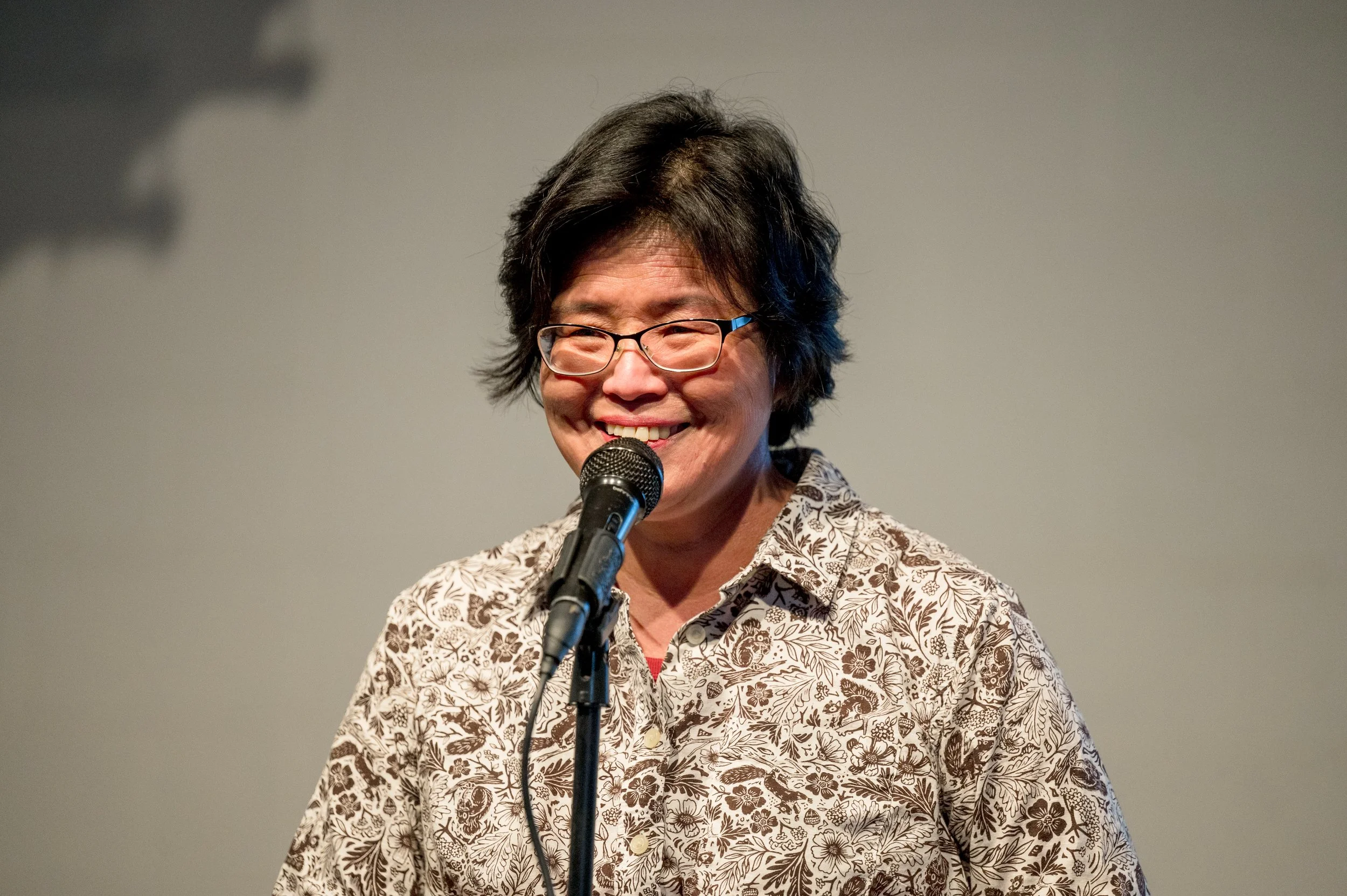
Chia Lin shares her story at Wild Goose Creative in Columbus, OH as part of a show we did with Ohio State University in March 2026. Photo by Jessica Miller.
Now, I also tend to take on more tasks than I have time for. My day job is a scientist at a honeybee research lab where I design experiments, I apply for grants, collect data, and so forth. And I manage the honeybee colonies for research projects that need them.
In the evening, I take online classes in Biostatistics. And on Saturdays, I teach Mandarin Chinese to little kids at a nonprofit organization.
And I'm doing all of that not because I have to, but I really want to. I love bees. I love research. I love my students. And believe it or not, I do love studying Biostatistics.
One Saturday morning, this is about two years ago, I woke up, ran the schedule through my head, had breakfast, and started packing my bag for Chinese school, which my family goes to on Saturday afternoons. Then I realized that I have left my computer at work and I needed it to teach class.
So I told my husband, “I'll be back in 40 minutes.” It usually takes about 15 minutes to work, and then 15 minutes back, that would leave me about 10 minutes to unlock the door, get in the building, find my computer, lock up and back to my car again. There's plenty of time.
It took me exactly 15 minutes to get to bee lab. Well, first step one achieved.
So Rothenbuhler Bee Lab, in case you haven't been there, it's an old, ranch‑style building with an orchard in the backyard. That's where we also have honeybee colonies. So I get in the building. I found my computer. I did a quick walk around to make sure windows are shut and light are off, like what I usually do when I'm leaving the building.
And I look at my watch. I say, “Oh, I still have five minutes.” So I decided to exit through the back door and look at the bee yard to make sure everything is okay there, too.
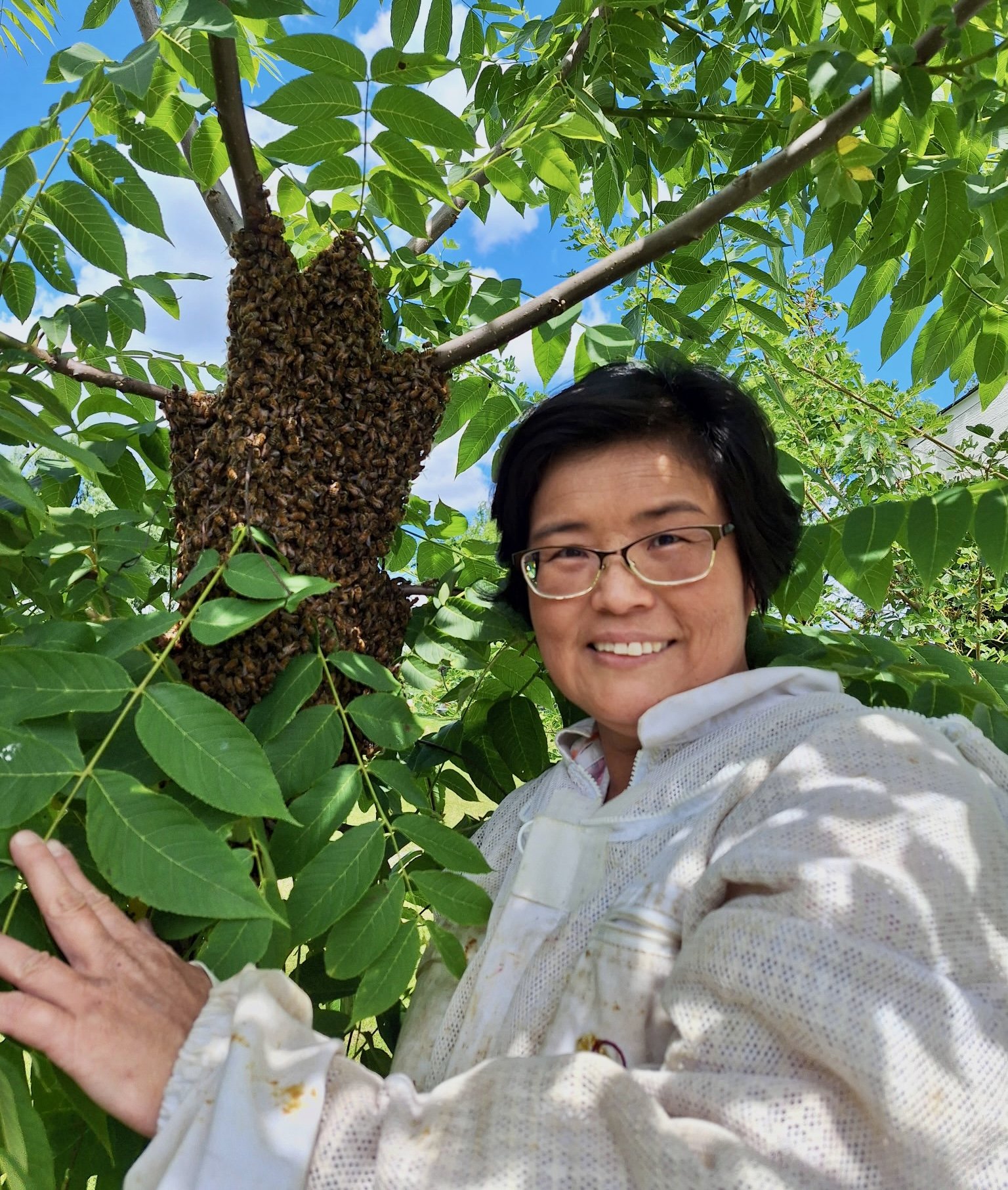
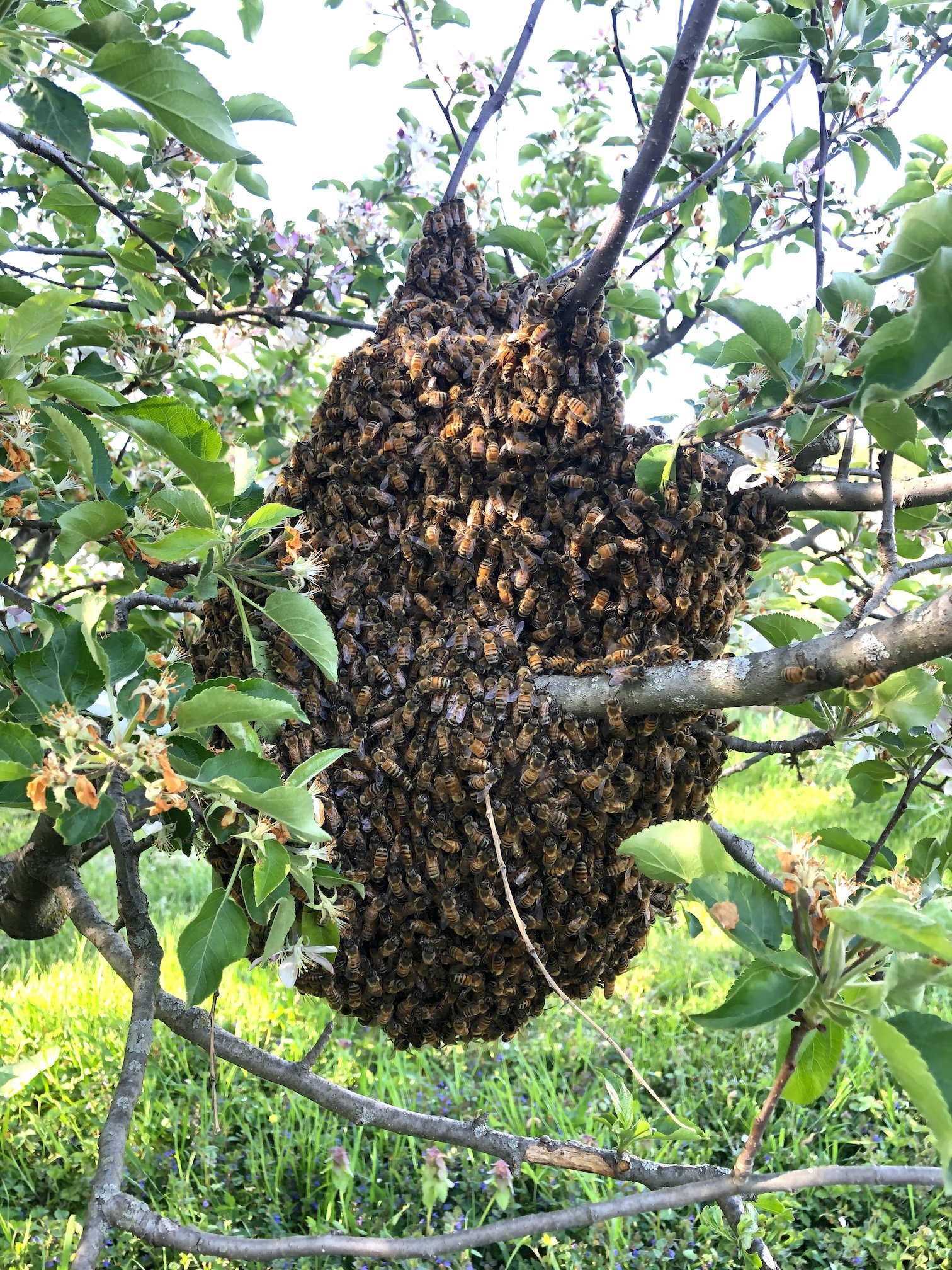
Now, as I was walking out the door, I look up and there it was, a basketball‑sized cluster of bees, hanging on the low branch of a peach tree. That is a swarm.
Now, a swarm, a cluster of bees, may be intimidating for someone who is not familiar with honeybees but, in reality, that's actually the state when the honeybees are most docile. So swarming happens when a colony grows quickly and is about to exceed the capacity of the hive structure.
Now, the queen will take about half of her worker‑bee daughters and some resource and leave the hive to start a new home, while the remaining bees will make a new queen and take over the colony. That's just the natural process of reproduction for honeybees.
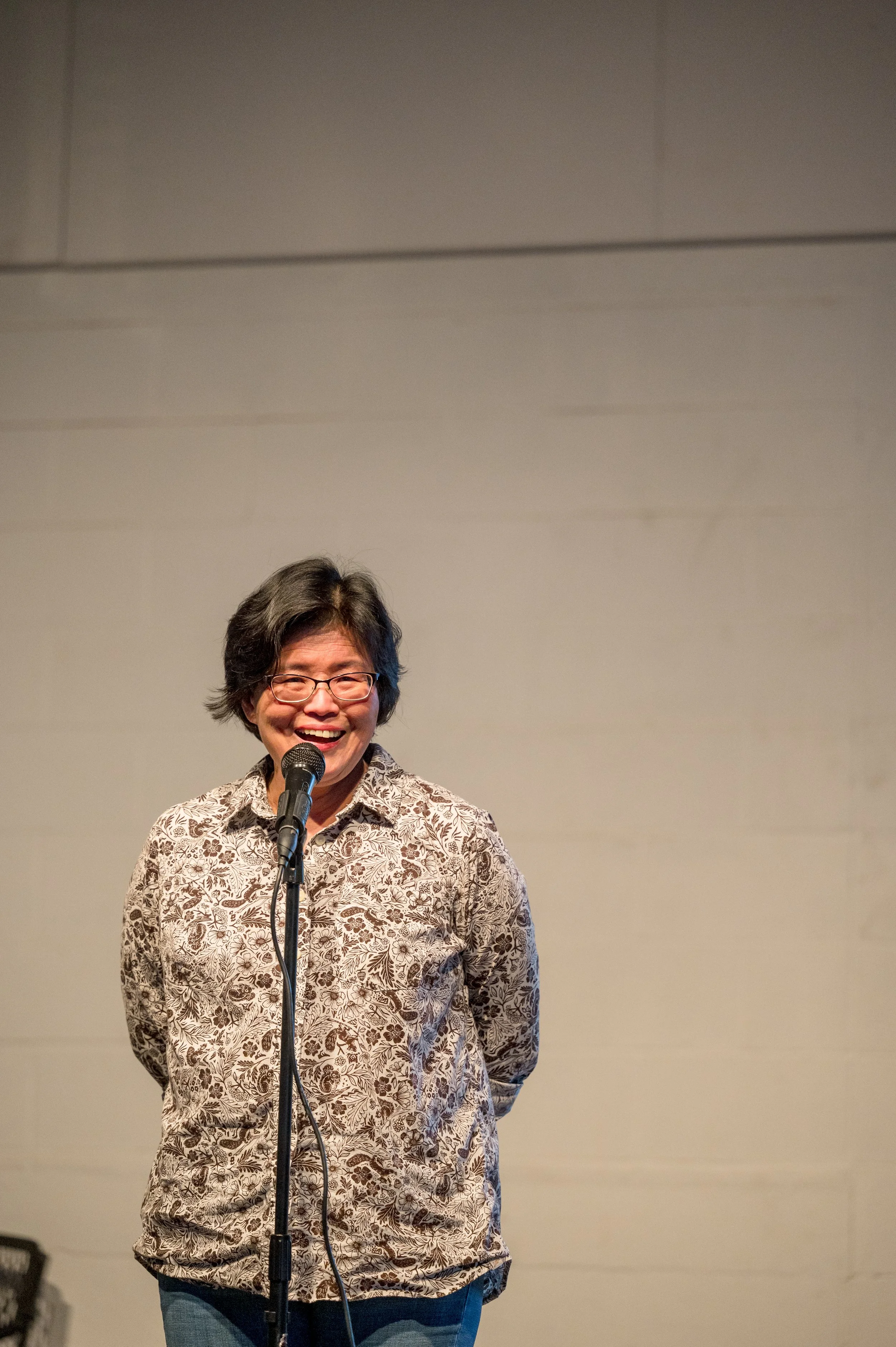
Chia Lin shares her story at Wild Goose Creative in Columbus, OH as part of a show we did with Ohio State University in March 2026. Photo by Jessica Miller.
Now, the swarm leaves the hive without knowing where they're going. So the next thing is they will find a structure to hang on nearby, like a tree or the side of a building, and they just wait there patiently for the scout bees to find a place to go.
If you ever come across a swarm, and you feel particularly brave that day, I would encourage you to walk up and gently pet the bees and feel that warm buzzes. It's amazing. And you won't get stung, I promise you. 95% of the time, you will be okay. 95%.
Now, for beekeepers, a lot of us fall in love with honeybees through our first experience of catching a swarm. And even as an experienced beekeeper, we still love catching swarms. It's like collecting trophies.
Economically, a swarm, if we were to buy package bees, that is an artificial swarm from bee suppliers, a swarm of that size, a basketball size, it will cost about $150 to $200. So a decent looking swarm within my arm's reach, that's really hard to pass on.
Remember that the swarms are looking for somewhere to live. So the idea of catching a swarm is really simple. You probably have seen this before. The beekeepers come up, put a box under the swarm and they will shake or brush the bees in the box, and then take it away. That's it. Easy‑peasy.
And now, back in the bee yard, I had five minutes. I have this beautiful swarm in front of me. I have two choices. I forgot to mention, if you just leave the swarm alone, usually they will leave in a couple of days as soon as they find a place to live. So my two choices are, I can leave it alone and move on with my day, or I can catch the swarm then move on with my day.
Of course, guess what do I choose? But I only have five minutes. I don't have my bee suit with me. It's going to take time to find the bee suit and the tools to do this safely.
I'll be fine. I'll be fine. I've caught swarms many, many times, and I've seen people catching swarms without bee suits and they're fine, so I will be fine.
So I grabbed a nuc box. It's a wooden box about the size of a small carry‑on suitcase. And I walk up to this door and it's just right above my head. At this point, a small ladder would have been helpful to set my box on, but I don't have one. So I decided to use my shoulder.
So I hold the box on my right shoulder and I position myself under the swarm, and I grab the branch with my left hand. And I say, “Okay, now I'm just gonna…”
I count to three in my head. So, “One, two…” that's it. And as I shook the bees, the box started to slide off my shoulder. The next thing I know, the big cluster of bees fall on my head. In case you're wondering how it feels to have a cluster of bees falling on your head, imagine someone dumps a big bowl of Cheerios on your head. And every one of these Cheerios have tiny, tickly legs that they all start running up as soon as they touch your skin. That's how it feels like.
So I panic. I panic for a second. Then I quickly remind myself, “Well, the swarms are gentle. I'll be fine. They won't hurt me.” Until when I feel a zap under my arm. A poor bee has gotten squeezed between my body and the arm that was holding the box as I was trying to balance myself. And even though honeybees are the most friendly and lovely creatures, when she's threatened with danger, she will release defense pheromones to communicate with her sisters about the situation, right?
And another fun fact for you. The defense pheromone of honeybees smell like a sweet banana. So the next second, I feel my face getting hit with a banana cream pie, and a very, very painful one.
So I was trying to balance myself. And I was like, “Oh, my God.” I drop everything because it's so painful and I start to run toward the building. And the cloud of bees just followed me into the building. They just would not leave me alone.
So I ran under the sink and I turned on the faucet, and I stuck my head under there to wash the bees off. And I grabbed a ruler nearby to scrape them off my arms. It was chaos.
Finally, the buzzes calmed down. I look at the mirror and I counted, from what I can see, about a hundred stings. I couldn't see the back of my head, so I imagine there's probably another hundred more back.
I take out my phone. I look at it and I look at the time. I was, “Oh, I'm really behind schedule.” I have the phone in my hand, so I was, “Okay, maybe I should call someone. I can call my husband to tell him I'm going to be late. Maybe I can call the ambulance just to be safe. But then I can't teach my class. Who's going to teach my class? I want to see the kids.”
So I call my beekeeping friend, Dale. And the reason I call Dale is because if, in the event that I end up in the emergency room, he will be the best person who can explain to the doctor what happened to me.
So I call and then Dale picked up the phone. I say, “Hey, Dale, I just broke the record number of stingers today.”
He said, “What?”
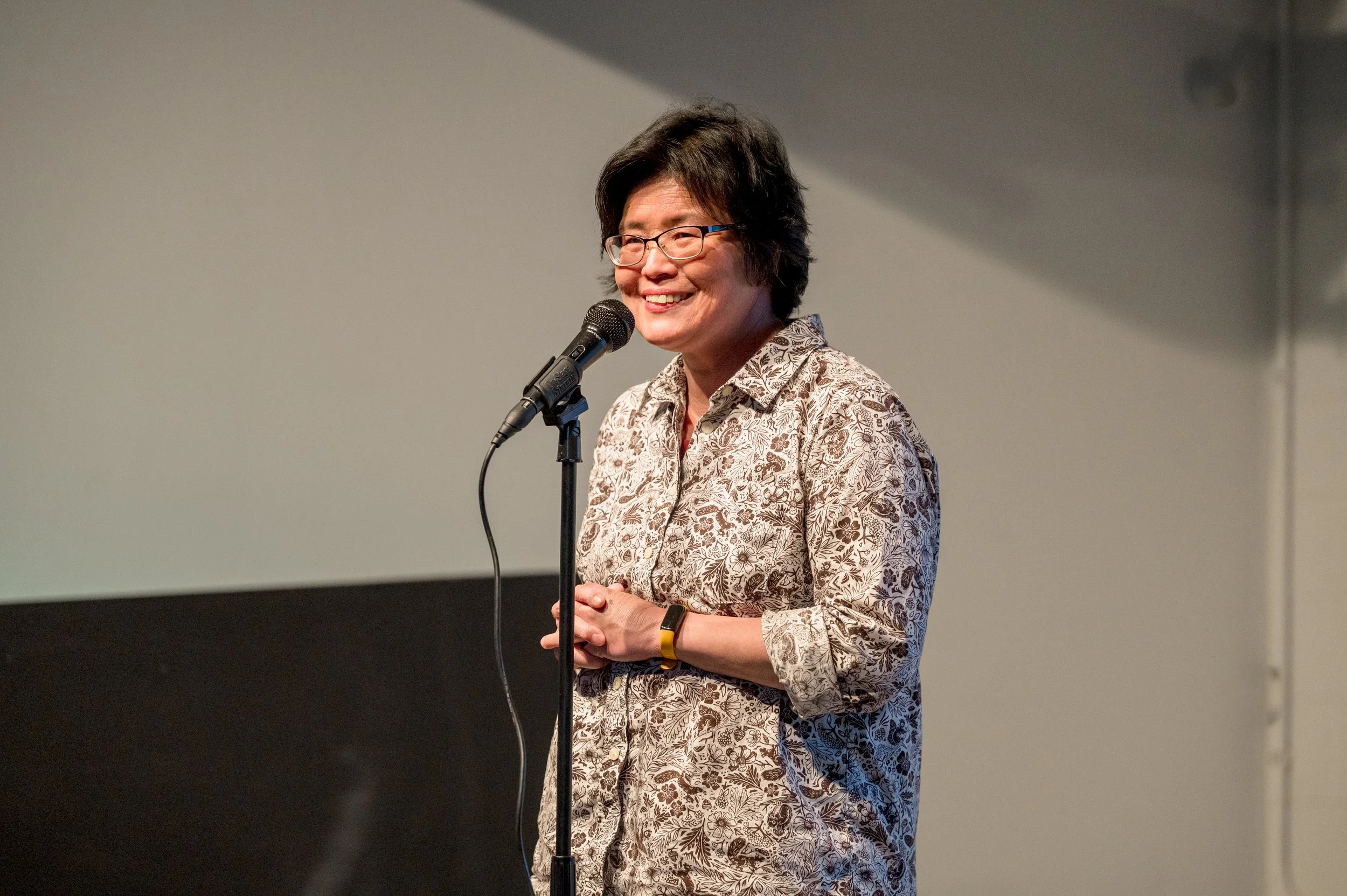
Chia Lin shares her story at Wild Goose Creative in Columbus, OH as part of a show we did with Ohio State University in March 2026. Photo by Jessica Miller.
You know, another thing that you didn't know about beekeepers, we like to brag about how many stings we get. It's like a battle and the stories, you know, like it's all cool to make you look like really cool beekeepers.
So I talked to Dale for a bit. After that, I hung up the phone, I found the bee suit and went back out and put everything away. And I left.
I try very hard to remember what I did for the rest of the day and I seriously can't remember. All I remember is, the next morning when I woke up, my face swelled up and it hurts to just talk and eat. But at that point, I'm extremely, extremely thankful that, after 10 years of beekeeping, my body actually have desensitized to bee stings and bee venom so I could stand here and tell you about what happened that day.
But still, even to this day, I think about that moment often, especially when I'm competing with myself to be on time, and especially when I'm thinking, “It's okay. Let's skip this step. I'll be fine.” That's when I will remind myself to take a deep breath, slow down, and reassess my priorities.
And I did it on time.