In this week's episode, two storytellers reclaim their power—one by challenging a broken system, the other by confronting the ways trauma continues to shape her life.
Part 1: Kimberly Babiarz sets out to fight human trafficking, only to discover that one of the biggest obstacles is the lack of reliable data.
Kimberly Babiarz is Research Director of the Stanford Human Trafficking Data Lab. A founding member of the lab, she works on the development and evaluation of new technologies to support anti-trafficking interventions and survivor support, quantitative research on trafficking markets and the protective role of public policy, and several direct collaborations with frontline anti-trafficking agencies. She specializes in large scale quantitative studies to evaluate the impact of public programs and interventions on health and well-being. Babiarz has conducted primary research on labor and sex trafficking, as well as large scale studies on global health initiatives in China, India, Malaysia, and Brazil. Her work has also included studies on fertility and family planning programs, infant and maternal health, and the gender dynamics of global health.
Part 2: After years of therapy, Denise Cai believes she's moved beyond her trauma—until her family notices patterns she can't yet see.
Denise Cai, PhD, is an Associate Professor of Neuroscience at Mount Sinai, which is ironic since her last science class was high school biology. Her two biggest regrets are not trying out for the cheerleading team and not starting antidepressants sooner. Both helped shape her path toward understanding how our past experiences guide who we become. She studies how the brain organizes and integrates experiences so memories can inform future choices and how this process changes with trauma or aging. Denise co-developed open source Miniscopes (tiny head-mounted microscopes) that let researchers watch neurons interact in real time. Using these tools, her lab has shown that memory systems are not tidy photo albums. They are more like chaotic group chats that constantly link, relink, and reshape our identities. Denise is passionate about fostering curiosity, creativity, and community. She believes that real scientific breakthroughs arise when diverse perspectives are welcomed and empowered. She still suspects she would have made a great cheerleader.
This story does include mentions of sexual assault and rape. In case you’d find them helpful, now or at any point in the future, we have some resources available on our website.
Episode Transcript
Part 1
I got my start doing human trafficking research more than 25 years ago, back when most of us knew almost nothing about it. Now, at that time, all the information that we had came from some scattered reporting and collections of survivor interviews. I came across one of those collections as a sophomore in college and, honestly, it was shocking. These were stories from Southeast Asia of young girls who had experienced exploitation like I couldn't have even imagined.
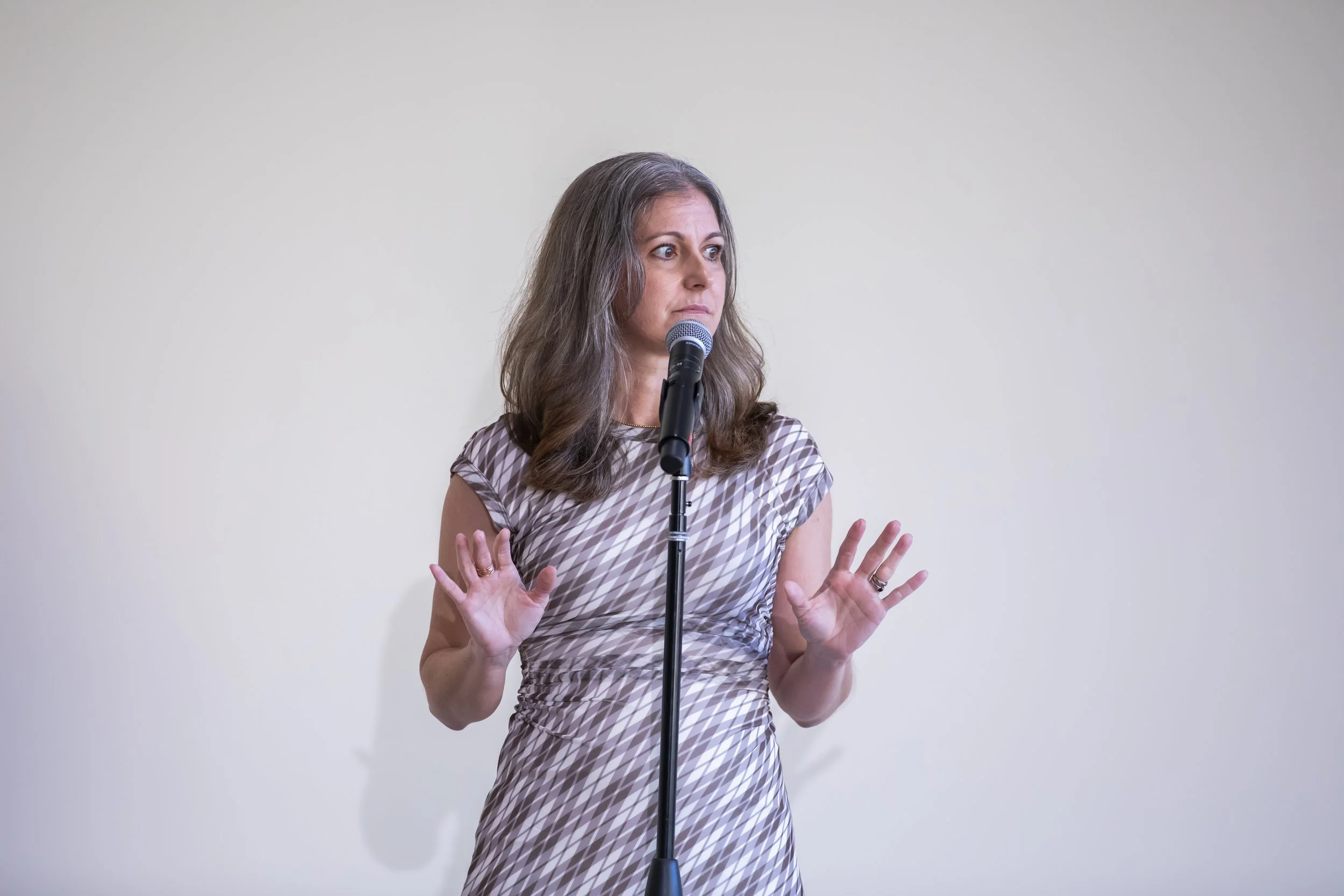
Kimberly Babiarz shares her story at The Cantor Arts Center in Palo Alto, CA. Photo by Christine Baker for Stanford Impact Labs.
It would have been impossible for any human being to read that and not feel compelled to do something, and I felt that really deeply. Now, I wasn't naive enough to think I could fix a problem like trafficking. I was barely 20 years old, and I didn't know anything about anything, and I knew that. But at the same time, I felt like I couldn't turn away, like I wanted to find a way to help. I wanted to find a role that I could play toward a solution, even if it was a small role.
To do that, I knew I had a lot to learn. And this was the late ‘90s. We didn't have Google. So the only way to learn was to jump all the way in. So that's what I did. When it came time to pick a senior thesis project, I went off to southwestern China. This is the part of China that borders Vietnam and Myanmar. And I started spending time in massage parlors and karaoke bars, learning about the obvious trafficking that was happening in those locations just by talking to the young women who were working there.
Now at first, we talked about regular things that teenage girls talk about, music and movies and clothes, right? I practiced my Chinese and they practiced their English, and we did a lot of karaoke together. They really loved the Backstreet Boys, really loved the Backstreet Boys, which stretched my skill set in a new direction and it was unfortunate for everybody involved.
But I got to know them and I earned their trust. In return, they were generous with me in sharing about their experiences and about the risks that they knew that they were taking. I would ask them, “Where are you from?” Always somewhere really far away. “How did you get here?” Always with the help of the bar owner or the guy who was running the massage parlor.
I asked them if they were afraid. And they always had some version of the same response for me. Like it didn't matter that they were afraid because they had no other choices. There was nothing for them at home. And even if this was a risk, there had been a chance that they could earn some money and build a better life.
What I learned during that first attempt at trafficking research is that there's a casual cruelty about the whole process, this widespread exploitation of those women in those massage parlors and those karaoke bars. People with very few choices and nothing to lose.
And what I also learned is that trafficking is everywhere. And it's not just sex trafficking, but also labor trafficking, forced labor and modern slavery. It is a big problem, a systemic problem. One that needs a big systemic solution.
Now, my time in China changed the direction of my life. After that, I knew that I wanted to work on trafficking and I knew I wanted to work on it from a policy perspective. So I went and got a PhD in development economics because that's a field where we can use big micro datasets to learn something about how programs and policies can help improve the lives of people in low and middle income countries.
It seemed great, except when it comes to trafficking research. That was very frustrating, because we just didn't have any data. And without access to high‑quality datasets, it felt like we didn't have the tools that we needed to learn about prevention or how to intervene at scale.
After grad school, I landed here at Stanford over in the Department of Health Policy. I was working with Professor Grant Miller on global health issues a little bit more generally. Now, I had continued to work on trafficking on and off over the years, but I was always frustrated by this lack of data. It made it impossible to do the kind of rigorous quantitative work that I knew was needed in the field.
Then in 2018, my colleague at the Center for Human Rights, Jessie Brunner, hosted a talk by a Brazilian federal labor prosecutor named Luis Assis. And I remember, the talk was entitled, “Using Data to Combat Human Trafficking.” And I thought, “Obviously.” My interest was piqued, right? So Grant and I went to this talk together, and we immediately saw an opportunity spark.
Now, Luis had prosecuted hundreds of cases of trafficking through his career, but that's not what this talk was about. He also happened to be a data scientist. And he had this personal commitment to making Brazil's counter‑trafficking efforts more data‑driven. He had pulled together dozens of datasets, micro datasets on over 60,000 cases of trafficking in Brazil. And he put them together into these dashboards so that local policymakers could access and understand that data.
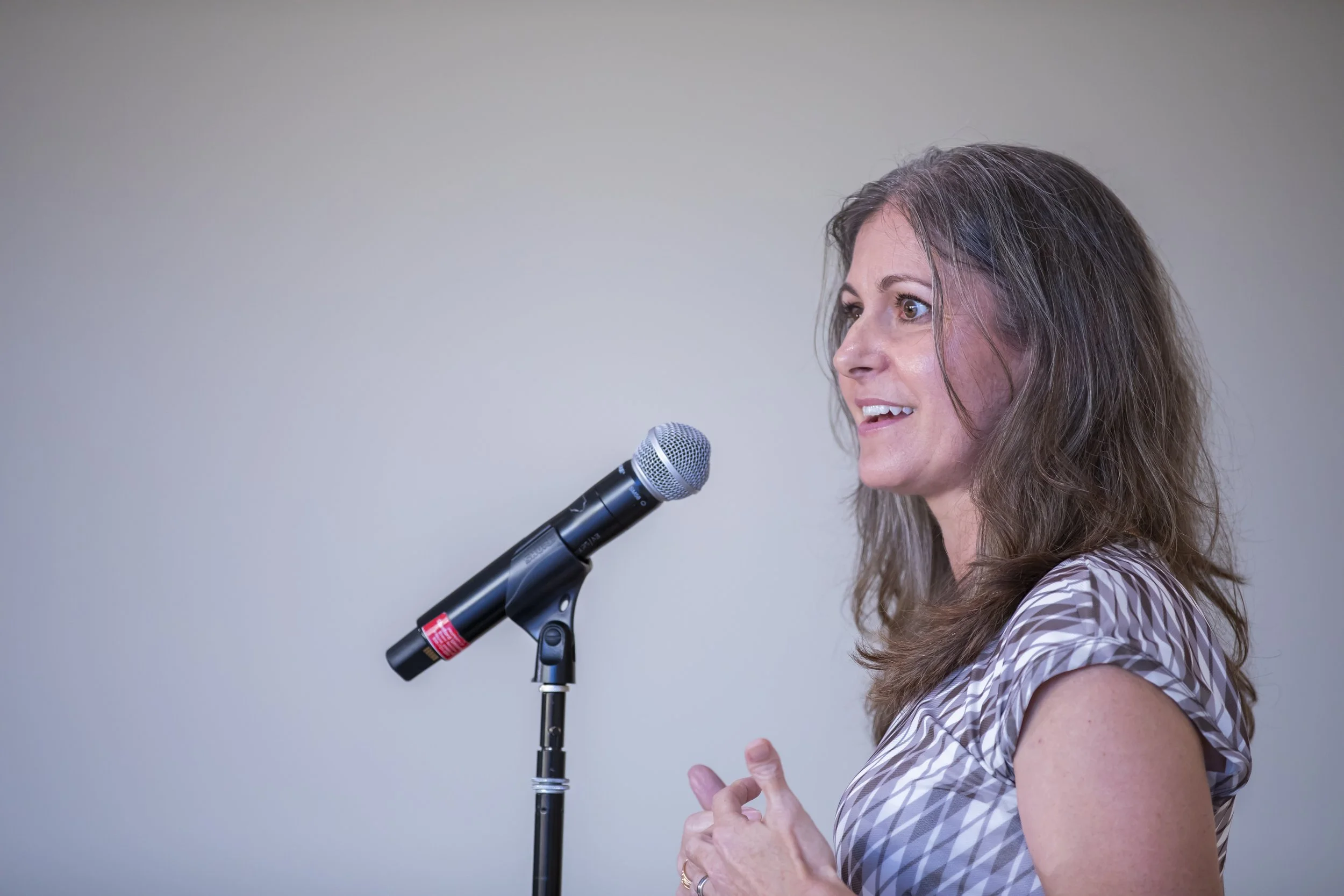
Kimberly Babiarz shares her story at The Cantor Arts Center in Palo Alto, CA. Photo by Christine Baker for Stanford Impact Labs.
Now, seeing this was a really big deal. These were the biggest datasets that I had ever seen on trafficking cases. So it felt really exciting to think that maybe the era of big data has finally caught up to trafficking work. It felt exciting to think about the opportunities that might be opening and finally being able to do those big quantitative studies I had always wanted to do.
The next year, Luis came to Stanford as a visiting scholar. And together with Grant, Jessie, and another colleague, Vicky, we formed the Stanford Human Trafficking Data Lab together. Now, our lab is focused on finding ways to adapt data science and modern AI technology to combat human trafficking, and we use the most rigorous quantitative methodologies possible in our research so that we can build an evidence base to try to figure out what works to fight trafficking and why it works.
Now, in our first year, we spent a lot of time trying to understand the ground reality in Brazil. One of the things that we learned about is that Brazil actually has a pretty big forced labor problem in the arc of deforestation. Now that is a big zone in Brazil where the Amazon and other native forest is cleared away to make space for agricultural use, and the timber is used to make charcoal, and then that charcoal is used to make steel.
I had, of course, heard about deforestation in the Amazon. Everybody here knows about that. But I didn't know that they were turning the trees into charcoal, and I didn't know how much modern slavery is involved in that process. They're literally using slaves to turn the Amazon into charcoal.
And the worst producers preyed on the most vulnerable workers, a lot of times transient workers who have very little education or literacy. They have no permanent homes, no families that can come help them.
Turns out, it's very difficult for law enforcement to intervene in cases like this, because they actually just don't know where these charcoal production sites are located. And without knowing where they are, it's impossible to do any kind of active monitoring. And they can't really figure out where to invest their resources. They have to wait for workers or bystanders to call in to human rights hotlines before they can act.
Unfortunately, these areas are extremely remote. There's probably no cell phone service. So it's actually very difficult for a worker to call a hotline to ask for help. And they're so isolated that there's no bystanders around that can see something is wrong and call on their behalf. And then on top of that, half of the roads aren't even mapped. So even if they could make a phone call, they have no way of describing where they're being held. They might not even know where they're being held. They might only know that they were driven in some general direction outside of the nearest town. So investigators will put together a task force and drive 10 hours out into the middle of nowhere only to have to spend two weeks driving around just trying to physically locate the sites.
And of course, these are small communities, right? So if a team of federal investigators is driving around for two weeks, the traffickers get word pretty quick and they just move their work teams to another location and evade detection.
It's like an impossible cat‑and‑mouse game. In this case, the good guys are trying to catch a mouse while blindfolded.
I remember sitting in a conference room over on the other side of campus talking to Luis about this problem and just how hard it is to figure these cases out. We decided to look at a success story. Like, what does it look like for success in this area? Maybe we can start to think about how to replicate that.
So we pulled up a case report from a task force that had rescued more than a dozen workers from conditions analogous to slavery. I remember, right on the cover page was a picture of the worksite. You could see the kilns. There's big white domes all arranged in a row, in two rows. And then in the middle, there were piles of charcoal waiting to be trucked away. You could even see the kilns still smoking in the photo. And something about seeing that captured in time, you could really envision it unfolding.
Then right under that photo was printed a set of GIS coordinates. So Luis and I immediately did what everybody here in Silicon Valley would do. We threw those coordinates right into Google Earth, because we're a couple of looky‑loos. And there it was. It was a solution. It was like one of those cartoon light bulbs went off over our heads in that little conference room.
Because from space, these sights are clear as day. The kilns show up as little white circles, all arranged in perfect lines, right? And the charcoal in the middle doesn't reflect light in the same way that anything else does. They look very distinct from the surrounding landscape. And sometimes, you can even see the smoke in the satellite imagery. These things are hiding in plain sight.
So Luis and I looked at each other and we thought, “This is a job for an algorithm.” If we can train an algorithm to scan a billion YouTube videos to look for cat content, surely we can train one to find these sites. And not just one at a time, but across the entire region.
We had so much energy in that moment. Here was an elegant solution to a really big problem. It was a solution we knew that we could build and one that we knew we could scale. And if I'm being very honest with you, we kind of knew right away that it was going to work.
It wasn't easy. It was very slow going in the beginning. To train an algorithm to find a particular object, you have to first tell it what the object looks like. You need examples. And we didn't have any examples because we didn't know where the kilns were. That's the whole problem. So we had a lot of experimentation in the beginning, and we had to kind of become these digital shoe leather detectives.
But eventually we got there, and it worked. It really worked. Like, how often does that happen? Right away, our model found almost 200 charcoal production sites that nobody had known existed before. Then we put all those sites onto this little interactive map so that we could show investigators where they were in relation to each other, and we could help them understand which ones had the highest risk of trafficking.
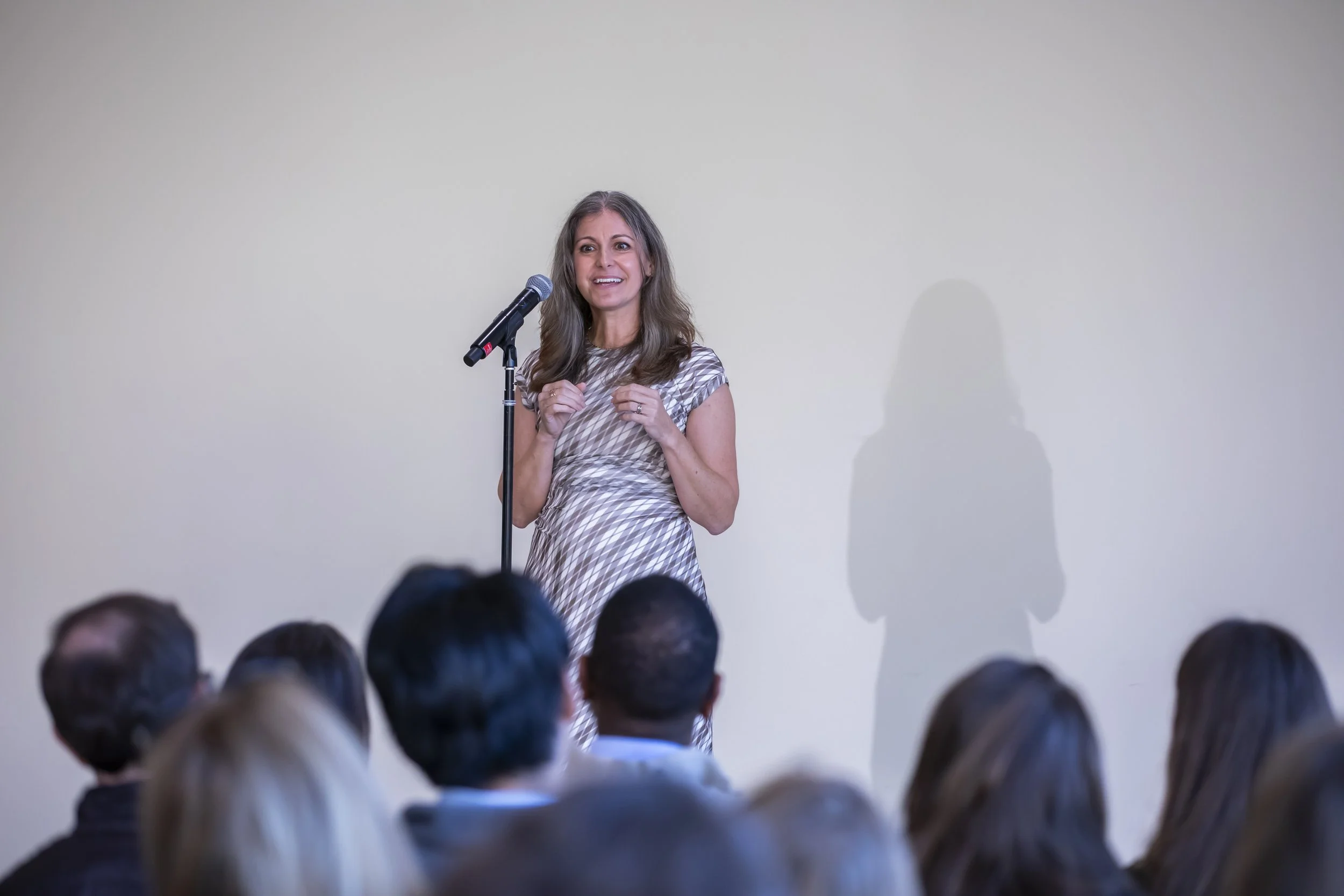
Kimberly Babiarz shares her story at The Cantor Arts Center in Palo Alto, CA. Photo by Christine Baker for Stanford Impact Labs.
And within one month of launching our tool, the first task force was organized to go out and investigate a big cluster of sites that our model found in an area that was known to be a trafficking hotspot.
My colleagues and I were actually invited to go tag along on that operation. I admit that it felt a little bit intimidating to go out and raid some illegal charcoal kilns with half a dozen big guys with guns and bulletproof vests. I'm small and I don't have a gun. But it also felt deeply meaningful to have a front row seat to see one of the tools that our team built, in fact, the first tool that our team built together, out there in the world doing something real and something good.
They rescued workers from trafficking at the very first work site that was investigated because of our tool. And for me, I felt a lot of hope in that moment. Like maybe we won't be stuck forever. Maybe technology can finally give us a leg up in that cat‑and‑mouse game. Maybe technology can help us lift the blindfold.
So in the 18 months since we launched, we have gotten to watch in real time as the tool that we built transformed the way that trafficking is investigated in that sector. And so far, 70% of the sites that our model found have gotten at least a preliminary site inspection, and there was a tenfold increase in the number of task forces that targeted those sites. And more important than that, a tenfold increase in the number of charcoal workers that were rescued from modern slavery.
We haven't solved every problem, of course, but we did solve this one. And it's already making a difference in the lives of some of the most vulnerable and exploited workers. And 25 years later, I finally found a role that I can play toward a solution.
Thank you.
Part 2
I was at a work conference in Vegas. I was 21, finally legally able to hit up the clubs. After a long day at work, I was hanging out at the bar with some work friends and this guy brought me a drink. I thought, “All right. You know, he's, like, sweet, kind of nice, normal.” And then within minutes, my body just collapsed onto the floor.
I remember he picked me up and took me out of the bar into a taxi. Then he carried me from the taxi into a hotel room. He laid me on the bed, and I remember inside of my mind, I was just screaming, “Stop! Get off of me.” But no words came out of my mouth. And the terrified spirit inside of me just said, “Get up, Denise, just get up. Just fight him off.” But it was like my body was paralyzed. My fighting spirit was fighting in a listless body.
After he left, I just clutched the blanket and I looked out the window, waiting for the sun to rise, hoping that the morning would undo what the night did. But it didn't.
After years of therapy, I found my new normal, and I started to rebuild my life. And decades later, I actually had a really great life. I married my super hot best friend over there. I had two joyous, healthy, rambunctious kids who sometimes wanted to hang out with me. I found a great church that wanted to serve the local community. Thank you, Pastor.
And I had my dream job. I was a neuroscientist and I got to study how trauma alters a brain. And every day I got to go to work with the most creative, kind, and generous people out there, and solve the mysteries of the brain. So I thought I had it pretty great.
But then there were two red flags that gave me pause that didn't seem like my reality connected to what was actually going on. The first red flag was when my husband said to me, “Denise, I know you love me, but I don't know if you're in love with me anymore.”
I was shocked. I adored my husband. Marriage was the best part of my life. How did he not see how much I loved him?
The second red flag was when my son came to me and said, “Mom, how come you don't like hanging out with us?”
I was floored. I tried so hard to be present. I always tried to put on a smile, but yet there was a disconnect between how I saw I engaged with my family and what they felt.
So I thought, “You know, maybe I'm just stressed.” So I went to go see a psychiatrist.
I said, “Hey, I'm just a little stressed. I just need some benzos to take off the edge.”
And he said, “Have you ever thought about taking antidepressants?”
I was like, “No, no, that's for people with real mental health challenges. Okay, I'm just a little stressed. I have grant deadlines and everything.”

Denise Cai shares her story at Caveat in New York, NY January 2026. Photo by Zhen Qin.
And he said, “Well, what if antidepressants could help you be not stressed longer? Would you want to try it?”
I was like, “Okay, gotcha. It's an experiment. I like experiments. I'm a scientist. Let's do this. N of one, but starts with one.”
So I was really interested in trying these antidepressants. And the craziest thing… So I first started Lexapro, and three days into my first antidepressant, I remember I was in my office and it was my day to pick up the kids. I was packing up my stuff and I had this weird feeling I've never had before. I couldn't identify it.
But then I went to go pick up my kids and we're hanging out. I was like, “Oh, my gosh, this weird feeling is not being anxious around my kids.” Ten years of being a mom, and it was the first time I did not feel anxious being around my kids.
So it took me a while to find the right combination of antidepressant. Finally, I found my magic drug. It was called Viibryd. It just brought everything to life. The colors seemed brighter and crisper. Textures seemed deeper and richer. The French croissants from the bakery nearby my apartment smelled more tantalizing than ever. I was alive.
But in the nighttime, I was captive to my recurring nightmares. In my dream, I was in my hometown and I was flying around so free above the town. But then I can sense that he's behind me, and I just think, “Fly faster. Just fly farther, faster, higher,” but I can't. I feel like there's just this cloak of heaviness just pulling me back.
And just as he's about to grab me, I wake up, heart racing, panting, in a pool of sweat. I clench my wet blanket and I just stare out my window, waiting for the sun to rise, because I just can't go back to sleep. Because what if he gets me tonight?
I talked to my psychiatrist about my nightmares, and he said, “You know, did you know that recurring nightmares are the most common symptom of PTSD?”
I was like, “Wait a second, are you saying I have PTSD?”
“Are you surprised by this?”
“Yeah, you said I had symptoms of PTSD. You didn't say I had PTSD.” And as I was saying this, I realized, “Oh, that is what PTSD [is], having symptoms of PTSD.”
And in the DSM‑5, like the formal criteria for PTSD, having a traumatic event happen to you, check. Recurring nightmares, check. Panic attacks, check. That's cool. That’s not one of my symptoms. Panic attacks, checks. Excessive drinking and mindless Netflix streaming to mind the pain, check. I checked all the boxes. I was literally the canonical definition of a patient who had PTSD.
Naming the diagnosis was actually really freeing, because it made me realize I wasn't weak. I was just human.
Years later, I started to feel much more stable on good drugs. I joined this church community and I started to get together with this group of women. And we went through this book called Soul Care, where we would support each other by caring for our souls. One of the nights, we had to do this exercise about forgiveness. I was like, “You know, I don't have any more resentment in my heart. Okay, I've been doing a lot of therapy. So, okay, I'll give it a try.”
I was given a piece of paper. It was blank, and I was supposed to write down all the names of people that I held resentment against. And I filled both pages. Then we had to go and vocally, actively declare to each other and to God about our forgiveness.
So I thought, “Okay, I can do this. I've, again, gone through a lot of therapy.” So I realized I needed to forgive him, but I was ready to do so. And I try so hard not to judge people by their worst actions on their worst day. And God, I hope that was his worst day. I prayed forgiveness and blessing on him and his family. I prayed that he would find forgiveness in himself and he would never do that again.
And my friend said, “Denise, I think God is telling me that you need to forgive him.”

Denise Cai shares her story at Caveat in New York, NY January 2026. Photo by Zhen Qin.
“I know,” I said annoyingly. “He already told me that. That was the first thing he told me.” As I said this, tears streamed down my face because I knew that that anger and resentment had jumped down so deep.
“Where were you, God? How could you let that happen to me? Why didn't you protect me?” And as I said these things, I realized the person that hurt me the most all these years was my most critical self. Because if it was my fault, then I had control. Maybe if I didn't wear a dress so short or maybe if I didn't flirt, or did I give some signal to say I wanted that to happen to me?
That night, I forgave her and I let go of the blame and the shame. And as I walked home that night, I tore up that piece of paper and I threw it in the New York City trash. I stepped into freedom, and I felt so light and so bright and so free. Free to fly, free to forgive, and free to soar.
Thank you.