Every family has secrets. But some secrets have the power to completely reshape who you think you are. In this week’s episode, both of our storytellers uncover revelations that change everything they thought they knew about themselves.
Part 1: When Ryan Jones receives a DNA test from his mom for Christmas, he expects to learn a little more about his family history and heritage.
Ryan Jones is an award-winning spoken word artist, an environmental engineer, lawyer, and a lemon pepper wing connoisseur. In October 2025, Ryan founded the non-profit organization, Black Empowerment for Environmental Sustainability (BEES), that seeks to create culture and conversation around the pursuit of social and environmental justice by using the performing arts. Ryan was a participant in the Round 11 Reiser Atlanta Artists Lab with the Alliance Theater, where he began development of his debut stage play, "in spite of years of silence," a choreopoem about love, forgiveness, and healing in Black parent-child relationships. Ryan was born and raised in the Metro Atlanta area, where he currently resides. You can find out more about Ryan and his work at gohomeryan.com.
Part 2: After years of unexplained headaches, Alicia Silver is finally diagnosed with multiple sclerosis.
Alicia Silver is the Founder and Chief Experience Officer (CXO) of The Silver Lining Experience, a wellness and personal‑development platform rooted in Rest, Clarity, and Alignment. Her work spans restorative hospitality, storytelling, and community experiences designed to help people regulate, reflect, and reconnect with themselves. She spent 30 years in global financial services, building a career defined by precision, pressure, and performance — all while her body was quietly signaling that something was changing. That disconnect between what she projected and what she was actually experiencing became the turning point of her story. Alicia is now writing her debut memoir, drawing from her lived experience navigating invisible illness while rising through global financial services to the role of Director in 2019. She uses storytelling and health‑literacy advocacy to help people recognize the early clues their bodies offer, communicate more clearly with their providers, and move through major transitions without shame. Alicia lives in New Jersey and is a partial empty nester who believes in the power of pausing long enough to hear yourself again. Her mission is to make conversations about health and identity easier, earlier, and more human — one story at a time.
Episode Transcript
Part 1
So it's 2019 and my mom decides to purchase me a commercial DNA test for Christmas. And if you know anything about me, you know that I had some complicated feelings about that because I've hated them for the entirety of my life. Not because it's not cool to know your family history or to know where your people come from, but rather, being a black person in America, it's kind of hard to trace your lineage. So much of our family history records, so much of our family history is lost to the transatlantic slave trade, to Jim Crow, to just poor recordkeeping in general. And I just had a really, really difficult time with that.
It's kind of like searching for a needle in a haystack where somebody has taken all the pieces of hay and replaced them with other needles. So you're looking for information, but everything looks the same and you don't know necessarily what to touch, because anything you touch could potentially hurt you.
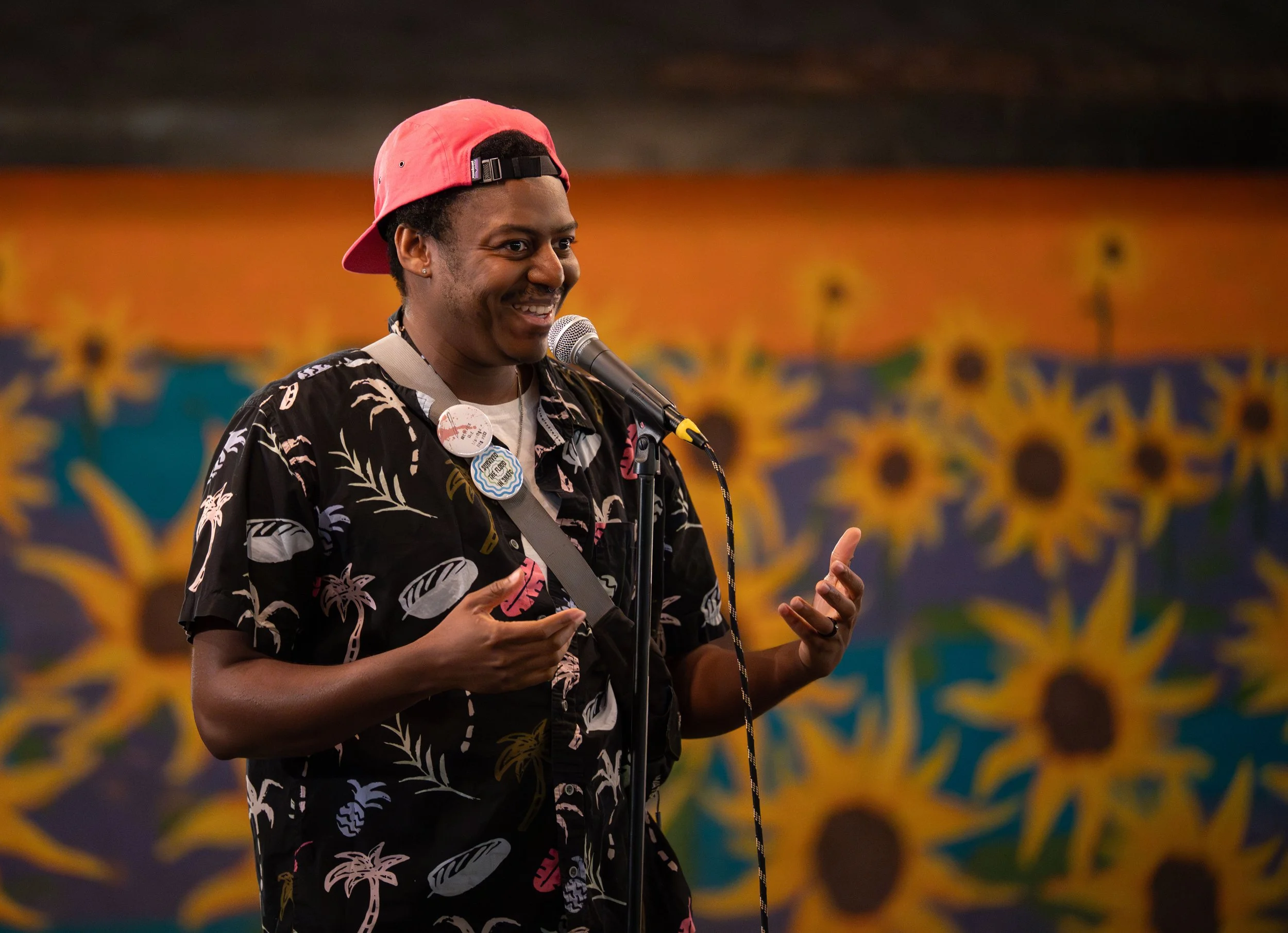
Ryan Jones shares his story at Waller’s Coffee Shop in Atlanta, GA on March 19, 2026. Photo by Rob Felt.
But I made the decision, I think, to kind of try to overcome my anxiety around searching for my family history, some of my anger about that, and started talking to my family members about it in 2019, having conversations with them.
I started having conversations in particular with my dad's side of my family who are all from the San Antonio, Texas area. I'm having a conversation with one cousin in particular at Thanksgiving. I started mentioning how, like, I'm starting to come out of my shell about family history, about heritage. I'm starting to become a little bit more interested. And they suggest to me that I try to purchase for myself a commercial DNA test because these commercial DNA apps, what they do is they connect you with other people and they match you on a chromosomal level. You can work together to build out these family trees and it can be really useful to you. So that way, you're not alone when you're doing all of this work.
So I start getting interested. They convinced me. I started talking about it to my mom. My mom gets convinced and decides to purchase me one.
So she buys me one for Christmas. It comes in the mail. I don't know if you've ever purchased a commercial DNA test yourself, but what comes in the mail is this little box. In this box are a set of instructions. The instructions tell you how to collect a DNA sample to send back in for analysis. Then in the box also comes this little tube for you to spit in.
I think as soon as I got the box, I rip it open and I'm like hocking loogies for genealogical justice. I'm just spitting in this tube, because I just know. If I fill it up really quickly, I'm going to send it back just as immediately. The analysts are going to see my DNA test and they're going to be like, “He's special. He's the one.” And they're going to return it in, like, two days.
So I pack it up. I send it in the mail. And six weeks later, I get my results back via this little DNA app. I'm looking through my results and it confirms something I had long suspected about myself. That I am black, but a particular flavor of black. There's Nigeria, Benin, Togo, Ghana, names, places, and faces that I had never seen before. It's just so interesting to me. And then there's all these people that are reaching out and sending messages. It's just so awesome.
Around the same time, though, I become a father. I have a little baby boy. My wife births a beautiful baby. And the search for our family history becomes so much more important to me at that point, because I had walked around with so much uncertainty about where my people come from, about who I was, about who I was connected to. And I wanted him to be able to walk with a certainty that I didn't have.
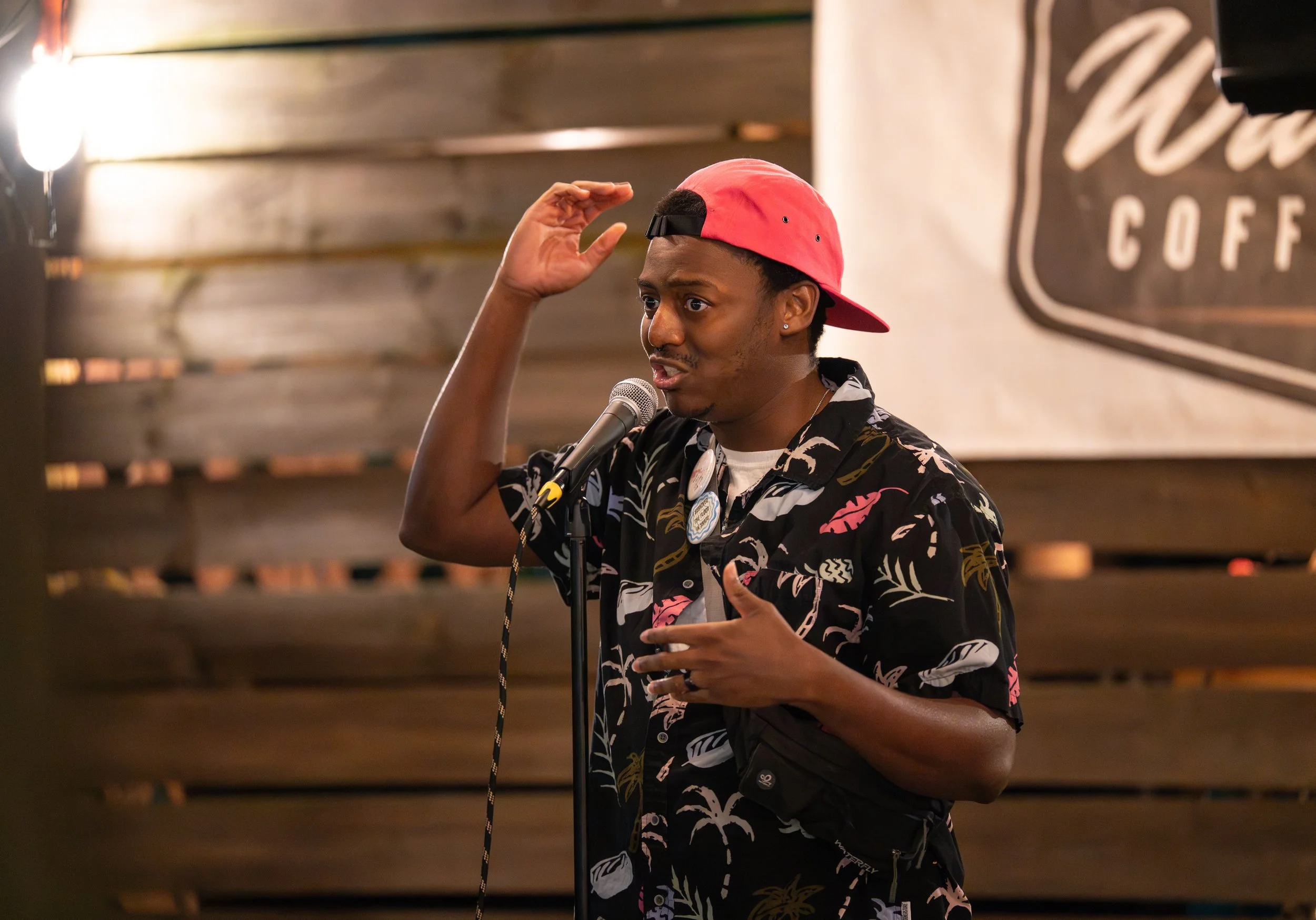
Ryan Jones shares his story at Waller’s Coffee Shop in Atlanta, GA on March 19, 2026. Photo by Rob Felt.
So I was just really excited. I was like, “Okay, you know what? I'm going to steel myself. I'm going to steel my resolve. I'm going to continue this genealogical search.”
And at the same time, too, because I like to do too much, I enrolled in law school. Because black excellence, right? I enroll in law school and I'm like, “Okay, you know what? As much as my genealogical search is important, it's also important that I show my kid that studies are important.”
I'm like, “Okay, you know what I want to do? I'm going to take some months on, some months off in my family history search.” So I spend as much time as I'm able to outside of my traditional semester doing my genealogical search.
Fast forward to December of 2021. It's the first week of December, a couple weeks before finals week. With the commercial DNA app, you get messages. Those messages go to your email. And you get a little email that has the first couple lines of a message that somebody sends you.
I get an email from somebody on the commercial DNA app that had reached out to me. It's from this woman named Tammy. Tammy reaches out, and I look at her message in the email. It's only a couple lines.
It says, “Hi, Ryan. We matched on this Ancestry app, on this DNA app. I'm looking for my family. I was based out of the San Antonio area. I grew up in the San Antonio area.” And that's all that I see.
I know San Antonio is related to my dad's side of the family. I like them, but it can wait.
So I'm like, “Okay, I'm going to focus on my studies, finish out finals week, and then I'll return this message. I'll go back and answer.”
Finals week comes and goes. Christmas comes and goes. New Year's Eve comes and goes. And I still have not replied to Tammy.
But then on January 1st, 2022, I get a message on Facebook, as so many of us do. I, unlike many of us, though, decide to open up my Facebook message, unafraid of what it could potentially be. I open up this message. It's from this woman named Samantha.
And Samantha says, “Hey, Ryan, I'm reaching out to you because my mom matched you on this commercial DNA app. I think that her dad is your grandfather, which would make her your aunt and would make me your cousin. Hey, cousin.”
Right. Exactly. I was stunned into silence, too. I'm like freaking out because I know my dad's side of the family. My dad has two siblings, Debbie and Eric. Eric passed away, so there's just Debbie now.
And so I'm like, “Okay, there's no way there's another sibling out there that I have no idea about.”
I think to contact my dad. My dad is a little conflict avoidant. So I'm like, “Well, if I reach out to him, I'm probably going to end up nowhere, so let me go reach out to Debbie.”
So I reach out to Debbie. I call Debbie. Debbie, at the time, lives in San Antonio, is caretaking for my grandparents. I reach out to Debbie. I'm like, “Debbie, hey, what are you doing right now?”
And she was like, “Well, I'm with the grandparents. What's up?”
I'm like, “Okay. Call me back later, because I don't think this is a conversation you need to have around them.”
So she's like, “Yeah, I'll call you back.”
She hangs up the phone, she goes and does what she needs to do, and she gives me a call back.
I'm like, “So hey, Debbie, have you ever heard of a woman named Tammy?”
And she goes, “No.”
I'm like, “Okay, well, she's, like, claiming to be your sister.”
And Debbie takes a second. She pauses. Then just immediately freaks out. She's like, “There's like no way that that's possible. You're dealing with a grifter. Clearly, somebody wants money. Are they asking you to send money down to Mexico or something? Like, what's happening here?”
And immediately she starts telling me about what she understood our family history to be like. She grew up and her parents taught her that they were supposed to be like the model family on the block. They were the house that had three bedrooms and two baths, and had two‑and‑a-half kids in a fenced‑in backyard. They were the model family for their church. So there was just absolutely no way that there could be this other child out there.
I'm talking to Debbie and I'm like, “Okay, you know what? I see where you are. I'm going to go and do a little bit of reconnaissance.” In the meantime, I decided to go alert my dad, too, just so he was in the know.
I'm like, “Hey, Dad, just so you know, this woman is claiming to be your sister.”
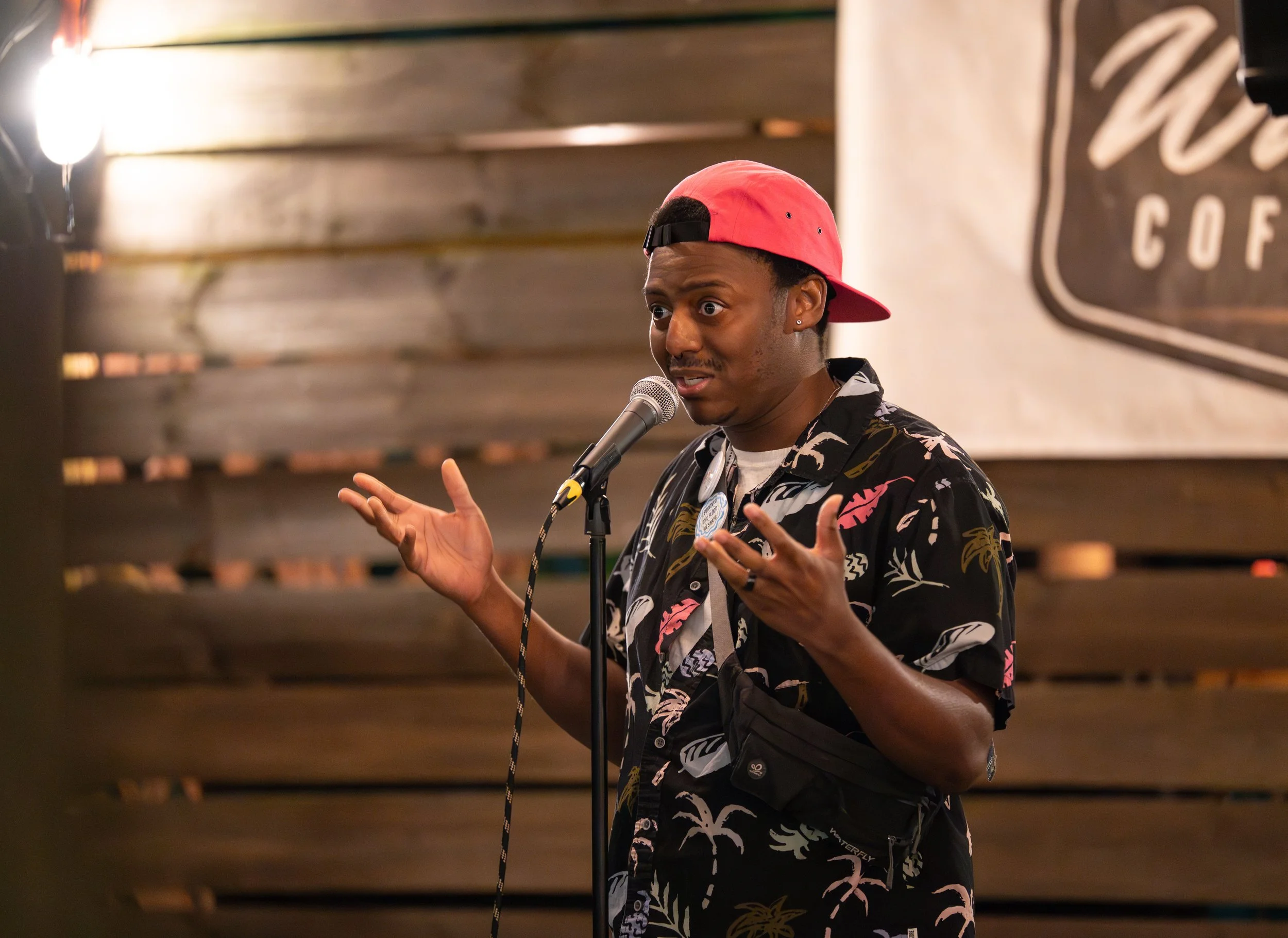
Ryan Jones shares his story at Waller’s Coffee Shop in Atlanta, GA on March 19, 2026. Photo by Rob Felt.
And he says to me, he's like, “Yeah, you know, I'm too old to have new siblings. Y'all deal with that and I'll get at you later.”
I'm like, “Okay. Cool.”
So I follow up with Tammy. I reach out to Tammy. I reach out to Samantha and we organize a call, and we start talking more regularly. Over time, I'm starting to notice a lot of the details about her family history line up with details about my family history. A lot of things are starting to overlap. It just starts becoming a little bit too solid to be coincidence.
So I reach back out to Debbie and I'm like, “Debbie, I think you have to have a conversation with Tammy. I think it's time, because I'm starting to believe that this is the truth.”
Debbie decides to reluctantly reach out to Tammy, and they start developing this weird bond where they start talking, they start hopping on Zoom calls with each other and talking all into the night. It's exciting for me because I know that Debbie has always wanted a sister and they're starting to develop this sisterly bond. They're watching movies together. They're just really enjoying one another.
They decide, ultimately, after bonding for so long, to go and take a professional, like actual DNA test together. So they go and they take this DNA test. It reveals something that we had long suspected about the both of them, that they too are black. But also, that they are 99% likely to be half‑sisters.
At that point, the gloves are off. Debbie goes back to my grandparents and is like, “Hey, we need to talk. We need to talk about something.”
At this point, my grandmother is a little ill. My grandfather, he's suffering from a little bit of dementia. And both of them are like, “You know what? We don't want anything to do with this. We don't want to talk about this. This is like digging up the past, digging up ghosts. We don't want to tackle any of this right now.”
So we, me and Debbie, we coordinate and we try again. We try to have multiple conversations. Ultimately, they're like, “We don't want anything to do with this.”
And then my grandmother, in the time that we're talking to them, passes away. So Debbie re‑approaches my grandfather thinking that maybe my grandmother was the barrier. So they start talking again. My grandfather is like, “I don't… I just can't. I can't do this. I don't want anything to do with this. I'm sorry.”
Unfortunately, shortly after, my grandfather passes away and Tammy never gets to meet her dad.
It was just weird to me watching this whole thing take place, because here I am, a father now, with my own little baby boy. I'm just imagining holding this bundle of joy and looking into his face. And I'm like, I can't imagine a world or reality where I never had the opportunity to interact with him, and I never had the opportunity to get to know who he is or to experience his laughter or to be a part of his life. I just feel such immense sadness for Debbie, for Tammy and for my grandfather, because everybody in the situation has been robbed of a relationship that could have been so beneficial to each of them.
I try to be angry at my grandfather, but then I try to also give him some grace because I don't know what was going through his mind. It's possible that the dementia took away some of the details about his younger life. Maybe he didn't actually remember whether or not he had this secret daughter that no one knew about. And maybe he was doing it because, or saying that he couldn't do anything because he was honoring his late wife and felt that that was the right thing to do. And so I try to give him a little bit of grace in that.
But it also made me realize too, at the time, that family isn't just our blood, isn't just some chromosomal match, isn't some match on a DNA app. It's a choice. We actively get to choose who we're family with.
And Tammy, Tammy didn't go without. She, of course, had her mom and had her siblings, but then she also had a father who chose her every day, and continued to choose her every day and grew up. Then for some reason, still decided to wade into this haystack looking for a particular needle, thinking that she would find it. And she picked one out and found me. I was the needle and it was great.
I'm glad that we had the opportunity to connect with one another because, now, I'm afforded the choice. Now, Debbie is afforded the choice, and we get to choose her every day too. We get to continue to be family and to continue to love one another. It's great.
I need to call her. Honestly, it's been a while. Yeah, sorry, Tammy, if you're listening.
But it's just fantastic. Family and blood and love are so much more than the DNA that binds us. And I'm so grateful for the opportunity to get to choose who my family is.
Thank you.
Part 2
So my daughter, Allison, was finishing fifth grade, and I wanted to do something unforgettable for her. So I planned a seven‑night trip to Disney World. I planned everything. The rides, the meals, the entertainment. I even made an appointment to go see a neurologist since I had headaches since I was a child. Nothing, absolutely nothing was going to interrupt our Disney magic.
I remember when I was seven and I had my first migraine headache. It was so intense that my mom, she had to turn off all the lights in the house. She let me lie on her because her skin felt like soft, cool cotton.
When the pounding in my head slowed down a little bit, I began to relax. But that's until my mom had to go to the bathroom. I begged her not to move, and she begged me to let her pee. Eventually, we came to a compromise. My mom, she got my permission for every single inch that she moved until she could slide off the bed and tiptoe to the bathroom.
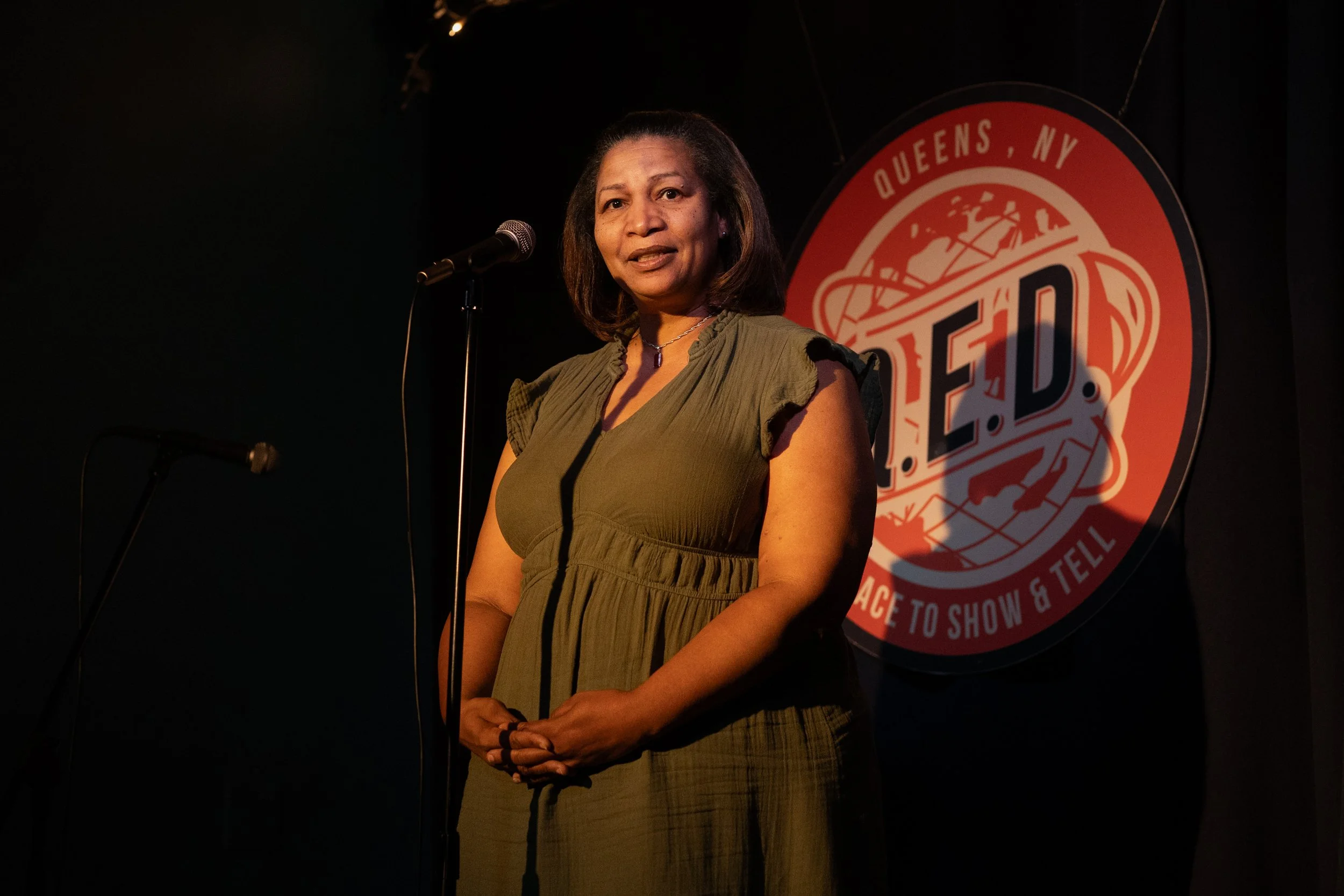
Alicia Silver shares her story at QED Astoria in Queens, NY on June 5, 2026. Photo by Zhen Qin.
The headache scared my mom so badly that the next day, she kept me home from school. She took me to see an eye doctor because she thought my headaches meant I needed glasses.
So as soon as we got into the doctor's office, the nurse, she took me to pick out my frames. As soon as I looked on the wall, I saw these pink eyeglasses, and I had to have them. I thought to myself, “All you have to do is fail your eye exam, and you'll get those pink glasses.”
So I kind of mixed up a few letters and I failed my test, and I got those pink glasses. But those glasses, in my mom's mind, were the remedy for my headache.
My mom, she did as best as she could with the information that she had, but there were some gaps. My mom, she didn't know a lot about my father's side of the family, especially about health. So when my headache started again years later, my mom did the best that she could with trying to soothe it, soften it, and make it smaller.
When I turned 10, those headaches came back every single month by clockwork. They would always scare my mom, and you could see it in her face. Even when I didn't have a headache, any little flinch, my mom would always say to me, almost in a whisper, “What about your head?” Like it was my best friend or a secret that we both shared.
She would try to soften the pain a little bit every month by buying me things. Sometimes she would buy me clothes, new outfits. One time I got a VCR. She wasn't trying to make up for the pain. She was trying to use the language that she knew best, how to translate it into words that she understood by being a mother and softening my pain.
A few years later, as I became an adult, those migraines, they slowed down. But then in 2011, after my mom passed away, my body started to whisper again. Not enough for me to stop, but enough for me to wonder if those migraines meant something.
So I went to the doctor's office and I went to see that neurologist. I brought my Disney map with me. Yep, it was the paper map. I spread it across her desk and I laid it out like it was a business plan. But it wasn't. It was just me trying to get permission to take my daughter to a trip of her lifetime.
So my doctor, she took a look at the map and she took a look at me. And she said, “Why don't we send you for an MRI first?”
I didn't think anything of it, so I went. And when I came back to her office with that big MRI floppy disk and my Disney map, I gave it to her.
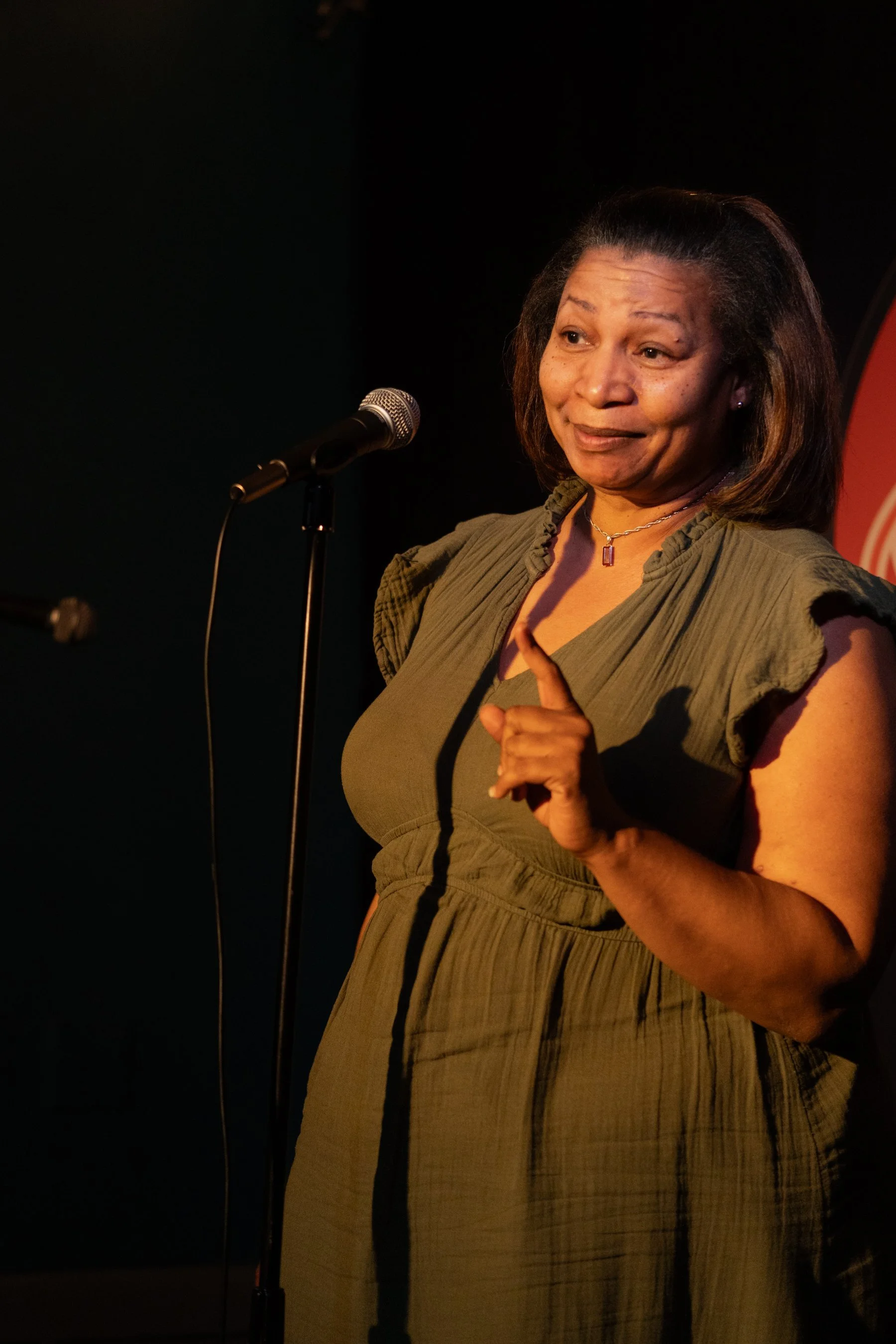
Alicia Silver shares her story at QED Astoria in Queens, NY on June 5, 2026. Photo by Zhen Qin.
She took the MRI and she put it up on the screen and she just stared at it. And she casually said to me, “You have multiple sclerosis.” And the room went quiet. Not a dramatic kind of quiet, but more like a what the F kind of quiet.
Then I said to her, “Is this curable?”
She said, “No, but you can slow it down, get as much rest as you can, and try to reduce your stress.” “By the way,” she said, “you can't be in the heat either, but you need the vitamin D from the sun.”
That's when the room really shifted. Because, you see, stress wasn't just part of my life. Stress paid my bills. I had a high, stressful, well‑established career on Wall Street. Stress was my normal. Pressure, deadlines. So my first thought as I looked at her was, “Bitch, you want me to quit my job?”
So I marched out of her office. And what did we do next? You guessed it. I packed our bags and I took us to Disney World in the hot July sun. I ignored the world with my daughter for seven days. My daughter, she was so distracted when we got to Disney World by Mickey Mouse, I was able to just sidebar the attendant and tell her, “My doctor said I can't be in the heat, but I need the vitamin D from the sun,” like it's some kind of note from my parent.
Little did I know, and at that time, Disney World had this pass called the Disability Access Pass. It was called the DAS Pass. You didn't have to wait on lines with this pass. So I told my daughter it was our “DASH Pass”, and she thought I was the coolest mom, at least for seven days.
When we got back home from Disney, a few months later I went to North Carolina to visit my cousin Ruby. North Carolina is where I spent my childhood summers at.
So when I was sitting down with cousin Ruby, I asked her, “Do you know anybody with MS? Have you heard of that before?” She didn't even blink. She just nodded, like she was waiting for me to tell her this my entire life.
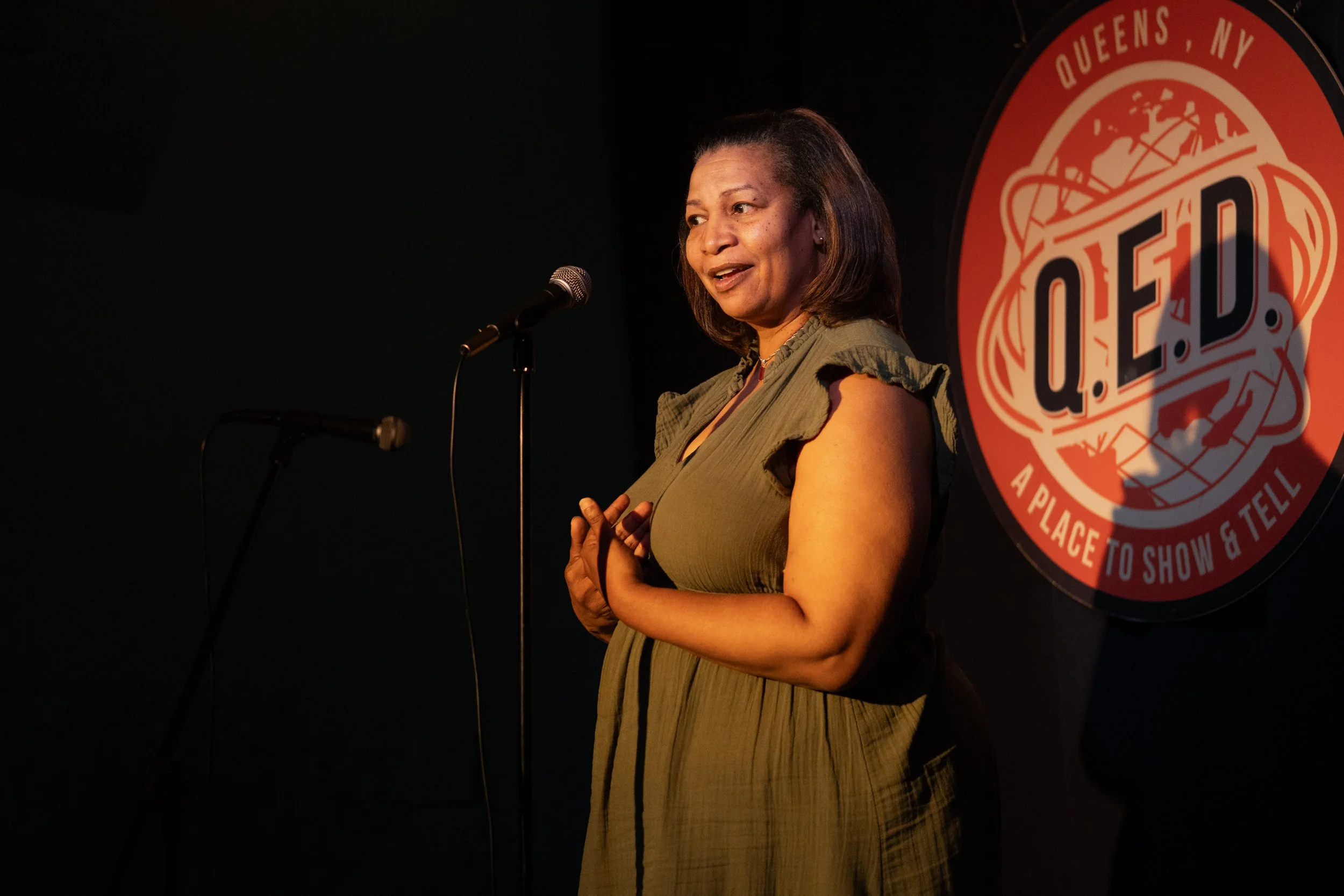
Alicia Silver shares her story at QED Astoria in Queens, NY on June 5, 2026. Photo by Zhen Qin.
Then my cousin Ruby just started naming names. She named uncles, cousins, some relatives I barely knew, like it was a roll call. And all I could think about was, how was I supposed to give this information to my doctors? How was I supposed to recognize something that I never knew or was talked about? And how was I supposed to prepare for something that lived inside of my bloodline but was erased from my childhood?
Then I started to ask more questions of my cousin Ruby, and I learned a lot of stuff about my family that I didn't know, especially about health. It wasn't shock. It was grief. It was grief because it took decades for me to find out this information. It was grief because my mom never had the signals to be able to interpret what was going on with me. So in that moment, I realized that MS was on my father's side of the family, the side that my mom didn't really know about. The side that my father was estranged from and the side I grew up with.
But it was the side where silence wasn't just a habit. That was the way our family operated. And so my MS diagnosis became a bridge between the world I grew up in, where people didn't talk about these things, and the world of science, where it has to be named to be treated.
So I decided that I would tell my children. My son Jared was 19 at the time. My daughter, Allison, was 11. So I sat them down. But before I sat them down and told them, I paused because I could feel the weight of what I had to share with them. But I wanted them to have this information early, sooner, and I didn't want it to take as much time as it took me to find out about it.
So I told them. I told them I had multiple sclerosis in my brain. I told them what I thought it meant. I told them what I thought it didn't mean. But the most important thing is I told them I was still their mom. And that, more than any Disney World trip, more than any map, more than any ride, that's the gift that I'm giving them.
Thank you.