In this week’s episode, both of our storytellers experience something that that defy scientific explanation.
Part 1: After ACL surgery leaves Valarie Walker unable to walk, she can't make it to her dying mother's bedside to say goodbye.
Valarie is a published writer and award winning storyteller. Her stories have been featured on the Moth Radio Hour and the Volume Knob podcast, among others. A Moth Grand Slam winner, she is currently working on a one woman show, Love and Other Hard Truths. One woman, one mic, and a world of possibilities.
Part 2: When Robyn Jay learns her abusive father is in palliative care, she sees it as her chance to finally watch the beast fall.
Robyn Jay is a college English professor with a passion for neurobiology and a keen interest in human behaviour. Storyteller, stage hypnotist, and former player with Montreal Improv, Robyn is on the constant lookout for novelty, adventure, and ways we can broaden our understanding of how we define ourselves.
Episode Transcript
Part 1
Growing up, in school, I was taught to believe in science, things that I could see or prove through scientific investigation. At home, my mother also made room for the things that you couldn't see, predict, or prove. She called it faith, and I called it magic. But not the kind of magic where there's a sleight of hand or a misdirection involved. I'm talking about those moments that happen that pushed the boundaries of the natural order and delve into the realm of the supernatural, like the belief in angels.
My mother would burn candles and solicit advice from the dead through tea leaves and prayer. She attributed much of her gut instinct to an angel sitting on her shoulder. I scoffed at such things, because I thought if there were invisible forces guiding things, then that would take away my free will. I definitely wanted to be in control of my destiny.
As I got older, I took a spill, a very bad spill. And those forces laughed at my naivete. I tore my anterior cruciate ligament, my ACL. You have one in the back of each leg. It's like a rubber band that keeps your knee from hyperextending when you move or walk forward.
Now, I could have worked on the muscles and built the muscles around it through physical therapy, which I did for a time, but I decided, ultimately, to have the surgery to replace it.
The day of the surgery, I did all the things I was supposed to do. I arrived early. When I was there, I took off my jewelry, my earrings, my nose rings and a leather amulet with a cowrie shell. And then I had my surgery where something unexpected happened. I woke up, requiring them to put me out-out. So, though my surgery was scheduled for 7:00 AM, I didn't wake up until 7:00 PM. And then I had to stay in the hospital.
Now, I survived all of that and I got home the next day. Fell asleep, was woken in the morning by a call from my sister, letting me know that the hospital had released my mother to go home to die. She had been battling breast cancer and she lost.
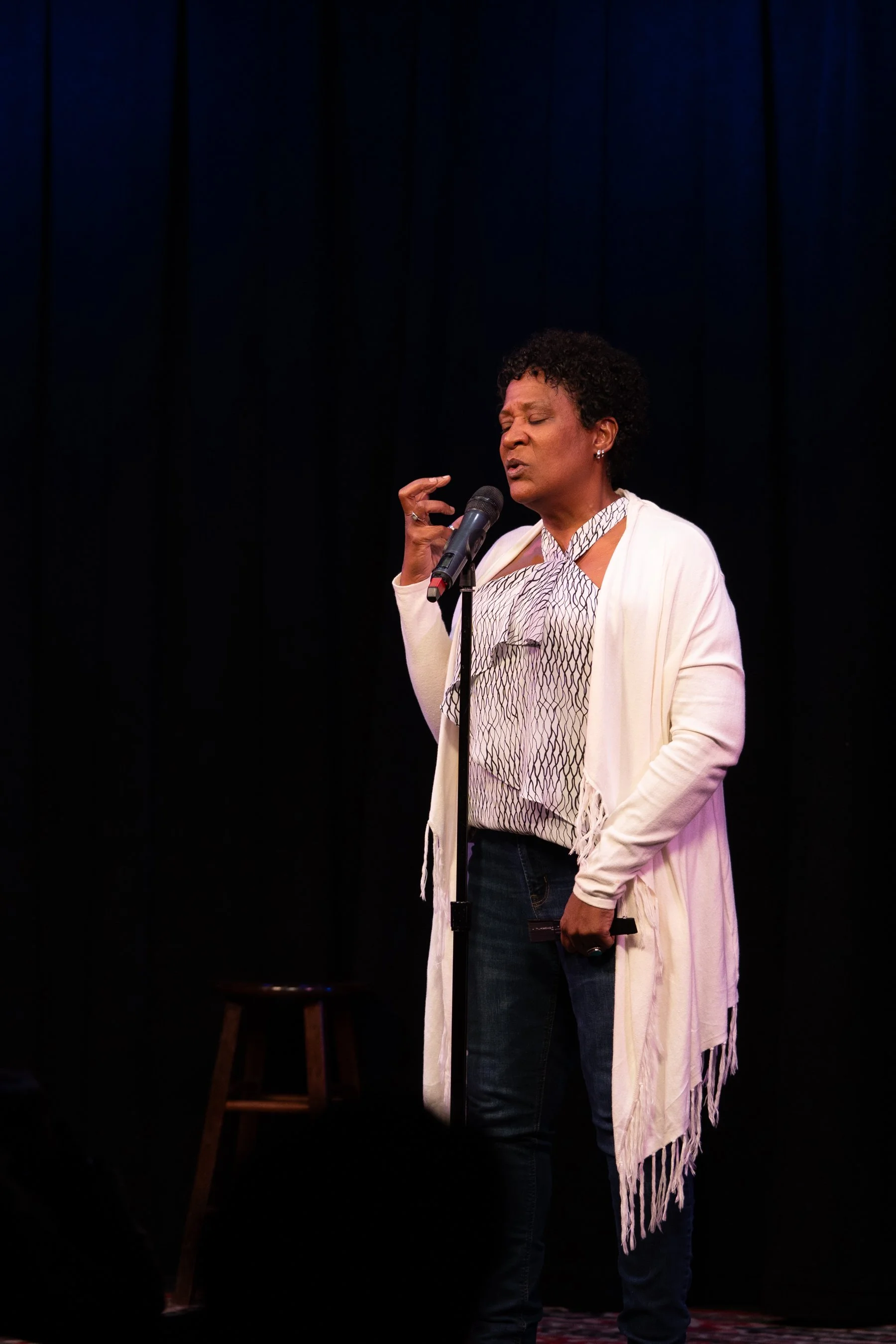
Valarie J Walker shares her story at Caveat in New York, NY on October 13, 2025. Photo by Zhen Qin.
When I got off that phone call, I was a riot of feelings, mostly that I had to figure out a way to get to my mother before she left this life, but also incredibly frustrated because I couldn't walk. My leg was easily two times the size it was normally. They didn't even use stitches. They just glued the skin together. And despite the softest gauze in the world, the pain I was in was frightening, especially considering how much Percocet I was on. I definitely and literally felt like I was in a race against the clock.
The next couple of days passed in a drug and sleepy haze, and then on the third day, my doorbell rang and I somehow managed to buzz them up by hopping and using my crutch to buzz them in. She said she was from the Visiting Nurse Services. I'm not going to lie, I thought that was entirely made up, because I knew I did not have the kind of insurance that allowed for a visiting nurse.
But she was there and she said she had this machine that was going to help me to walk. It was this rectangular box that had two metal plates that would raise and lower with a motor and bend my knee without dealing with my muscles, with no impact. She said, the more I used it, the better it was. And then she left. She said she'd be back in two weeks to pick it up.
I understood the assignment. This machine was going to help me get to my mother.
And so that first night, I took an extra Percocet. I trussed my knee up in that machine and I turned it on to the lowest incline but the maximum duration, which was eight hours. And I slept in it. And I did the same thing for the next five days deepening the incline each time.
People say that I was crazy. People ask me, “Did it hurt?”
The answer to both of those things is, yes. But like I said, I was motivated by the desire to see my mother once again that I would have acted crazier and I would have taken more pain to get there.
Somehow, I managed on the sixth day to get to physical therapy, which I live in Brooklyn. It was in Manhattan. Even my physical therapist was surprised that I was there. Which I was confused by because why do you make an appointment with somebody that you know physically they really can't make?
But since I was there, he took me through my paces and he put me on the stationary bike. All I had to do was take my good knee and make it rock the pedal of my bad knee back and forth, right down here at 180 degrees. No going over. Just right here, the sweet spot. And that's a monotonous thing to do that you can easily get distracted from, which I did, and my sense memory took over and I started biking.
I screamed. He came running over.
“What's wrong?”
“I turned my knee 360 degrees.”
He was like, “How did it feel?”
“Okay.”
“Do it again.” So I did it again.
Did about five minutes of that. By the end of the session, he had me on the balance ball with my surgery leg.
I decided, the next day, the crack of dawn, I went to go see my mother. By some miracle, she had been hanging on. And I got to spend time with her before she left. It was like she was waiting for me. I loved up on her and we had a magical time, and I was there to see her take her last breath. I will forever be grateful to that woman with the machine.
My grief from my mother was acute. I felt it in everything, large and small. I remember being undone by the fact that my leather amulet didn't make it home from the hospital. It was the only thing that didn't make it home. Somehow, that loss of that amulet, it wasn't expensive. It was easy to replace. I could have gone to another African market, another street fair. Somehow, it became the symbol of my mother passing. It had to be a loss that I learned to live with.
Then a friend that I adore suggested I get grief therapy, and I did that. It was really helpful to begin to figure out how to live with such a big hole in my heart, such a big part of me missing.
And then several months later, my movie came out. Now, I wasn't an actress, even though I did some theater as a kid. Somebody had just asked me to be in their movie. Who says no when somebody asks you to be in their movie? It was finally done.
The premiere was happening at the New York Film Forum, and I was a mess. I was, since my mom had passed, really uncomfortable on the outside of my skin in a way that I was not used to. I started being flooded with doubt.
“Would people like the movie? Would they like me in it? Do I really even have to go?”
And the only thing I wanted, the only thing that I felt could make me feel better was my mommy. If I could just be in her arms and have her rub my back that way and tell me that it was going to be okay, that I was her child and, thus, was meant to shine, to hear her say that I was a chip off her block and so could survive anything. But I couldn't because she was gone.
So I did some deep breathing and I practiced retail therapy. I went to the mall. I got an outfit that I thought made me feel cute, and I returned home.
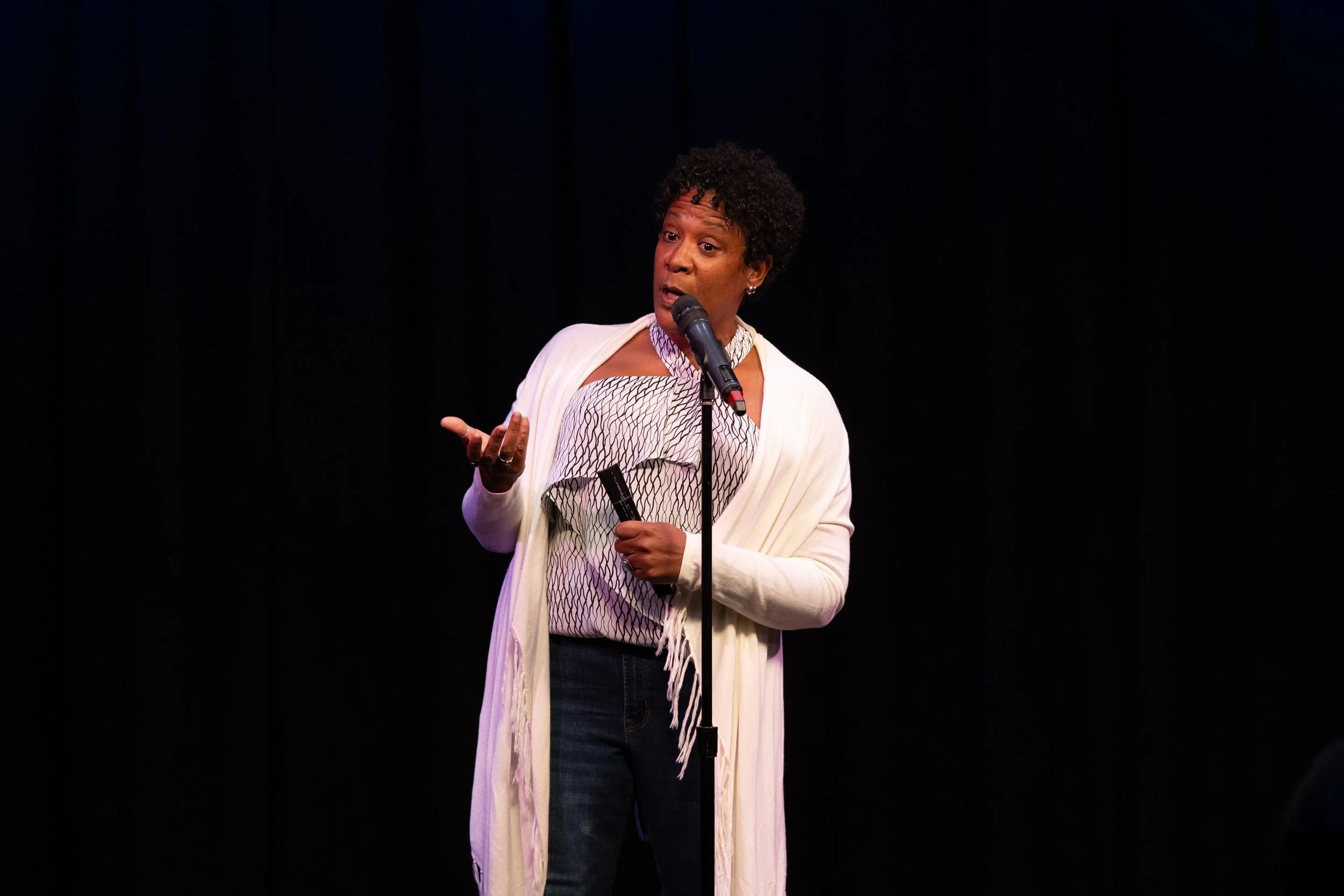
Valarie J Walker shares her story at Caveat in New York, NY on October 13, 2025. Photo by Zhen Qin.
I lived in a railroad apartment, had two entrances, but the only entrance I used walked into the living room. My living room was spacious. It had a full fireplace and a faux crystal chandelier hanging from the high ceiling.
I took one step in my apartment and, lying in the middle of my living room floor where it could not have fallen from anything, was my missing amulet. And I knew in that instant that that was my mother. She had found a way to let me know that it was going to be okay.
I put the amulet on, and I was crying because I had needed this moment. I had felt my mother with me since she had passed many times, but my grief made me feel like that was just wishful thinking. So I needed this confirmation of knowing that, though she was gone, she was still with me.
And she was right. It was totally okay.
The event was really lovely. The movie was well‑received and I was well‑received in it. One critic even called me scene stealing.
And now, whenever I see somebody with a similar scar to mine, I ask them about their healing process. No one else has ever had a visit from Visiting Nurse Services, and nobody else, until recently, had ever heard of the machine. And I have a head for faces. I never forget them. But I could not tell you what that visiting nurse looked like, not her height, not her weight, not her hair color. And she never came back to pick up the machine, nor did she leave me any identifying information with which to return it.
My mother would say that she was an angel. Honestly, I agree. So I believe in science, but I also believe in magic and angels.
Thank you.
Part 2
It's early March 2020. In Montreal, we're a little behind everybody, and the pandemic has yet to do its thing.
I come home after a long day, and my phone rings, and it's my uncle Tom. He says, “Hi, Robin. I'm calling to let you know that your dad's been put into palliative care, and that cancer he's been dealing with is going to kill him.”
My initial reaction was indifference. I was like, “So?”
He sighed and said, “I know you'll do the right thing and go say a final goodbye to your dad.”
So I said, “I'd think about it.”
And I did think about it. I sat down and thought about it, and the more I thought about it, that indifference turned to dread. It's a feeling of resignation and dread that I'd known my whole life.
While I was thinking about it, I realized that I'd already said goodbye to my dad many, many, many times over the years. Just the year before, I'd said goodbye a final time.
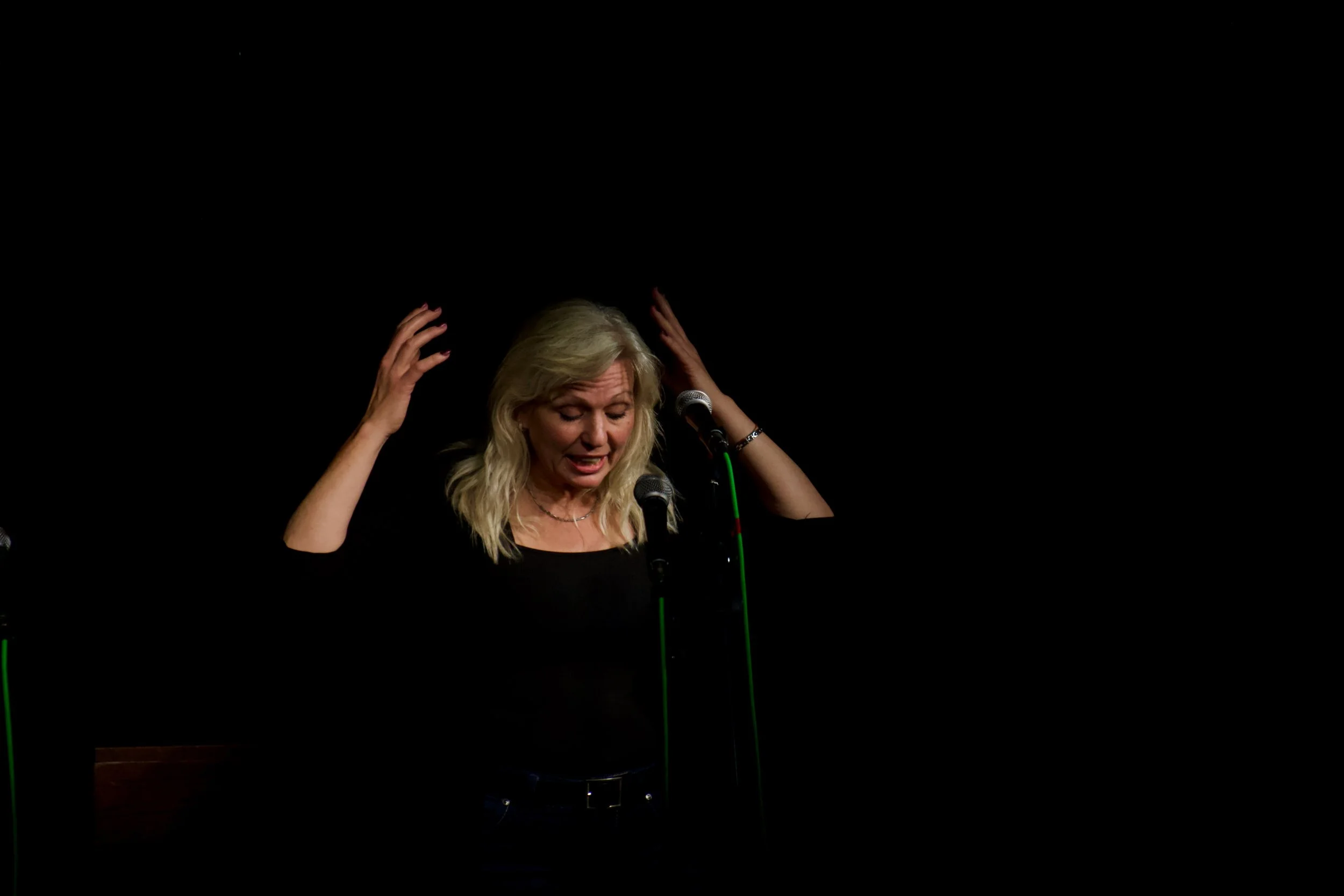
Robyn Jay shares her story at Aces and Eights Saloon Bar in London, UK on November 14, 2022. Photo by Richard Mukuze.
See, my dad was a really bad person. And when I say that, I'm being super generous. He was a toxic narcissist. He was cruel, unapologetically so. He was abusive in every which way. And out of self‑preservation, I said goodbye to him lots, only this would be the last time, so I gave it more thought. And for two days, it's all I thought about.
Then eventually I decided, you know, I think I know what's going to happen. If I go, he's going to try to make me feel bad and I'm going to walk away feeling whatever. I didn't know what would happen if I didn't say a final goodbye to my dad. I think in retrospect, I was kind of hoping for reconciliation that death had sort of changed him and made him drop all of his bullshit.
So I decided I'd go, but I did it under the guise of I'm going to go and I'm going to walk in there, guns blazing, and say, “Fuck you, asshole! Have a nice trip and be gone,” you know? Two minutes in, two minutes out, that's it.
So I get in my car and I'm pumping myself up and I'm coaching myself along the way, and I'm driving and I'm thinking, “Yeah, yeah, I'm going to go watch the beast fall,” because my dad was this big beast of a man. He had a rug on his back and a beard and a booming voice and he was big.
I get to the hospital and I park the car. I go inside and get to the palliative care ward, and I'm looking for his room. Finally, I find it. I walk in and there's this skeletal, frail, white old man lying in this enormous, what looked like an enormous bed. I thought for a minute I was in the wrong room, and then we locked eyes. And there was no mistaking those icy blues.
It felt like I'd been sucker punched right on the solar plexus. The wind literally, it sounds dramatic but the wind left my chest.
I locked eyes with him and I staggered over to the bed to sit down in the chair that was there. And as I went to sit down, he grabbed me. But he grabbed me and then he starts stroking my hair. And I'm lying there on his chest, his bony chest and he's stroking my hair awkwardly, because he doesn't know how to stroke hair. He's never done it before.
And I'm going, “Okay.” And then I thought to myself, “Hey, I've got an opportunity here that I'm never, ever going to get again.”
So I said, “Dad, tell me you love me,” and he did.
And then I said, “Dad, tell me you think I'm pretty,” and he did.
And then I said, “Dad, tell me that you're proud of me,” and he did.
And this went on, I can't say how long. But I kept doing it until I finally felt like that inner child, that inner five‑year‑old me who had needed to hear these words in her dad's voice, her whole life needed that validation, I kept going until I felt she was satisfied.
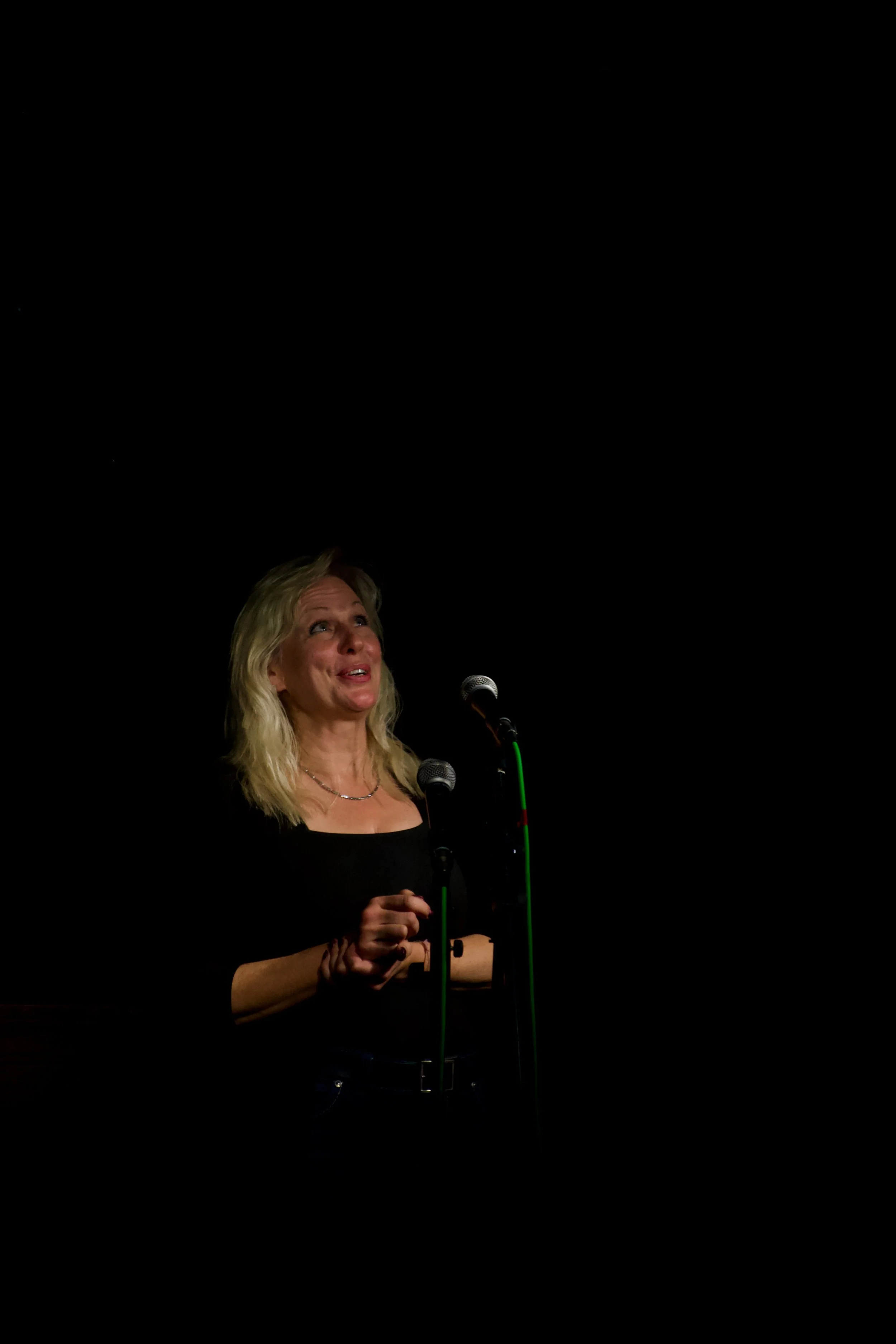
Robyn Jay shares her story at Aces and Eights Saloon Bar in London, UK on November 14, 2022. Photo by Richard Mukuze.
Then I sat up, and I looked at him with a warm smile and tears in my eyes. He looked back at me, and he said, “You stupid little girl, waiting all those years just to hear a handful of words. Idiot.”
The floor opened up and I started to free fall into that inky emotional well of shame and embarrassment, like I'd fucked it up again. That's when I realized, I'm in a Skinner box.
See, a friend of mine a few days before was talking about the Skinner box and how this dude, this behavioral psychologist in the 1960s, Dr. B.F. Skinner, created a box and he put his kid into it. I was curious and I looked it up. He never put his kid in it, but he did put animals in it. It was this box with a metal floor to it and it could give electric charges. He'd put rats and pigeons into it.
In one experiment, he took a rat who was already trained to pull a lever for food and then, randomly, after the rat got the food, he'd get a shock. The idea was to find out whether or not the rat would keep going for the food regardless of whether or not the shock might come. There was always the hope in the rat, though, that the shock wouldn't.
I was in a Skinner box. And every time I went to my dad for emotional nourishment, I never knew when the shock would come.
But I decided I'd show him. I wasn't a stupid little girl. I wasn't an idiot. I was going to show up and I was going to get the kudos that I'd always wanted. I was going to prove that I'm a woman now. I'm not a little girl.
So I gave. Oh, man, did I give. I went to the hospital every day for hours. I rubbed his legs because they were sore. I put ointment on his bed sores. I held up, actually with my daughter, we held up this photo album. It was really heavy. It was from like the 1920s and he would gaze at these pictures for minutes at a time.
I took a piece of sponge and I dipped it in wine and I put it to his lips. He hadn't been able to swallow for a while and I just wanted to have a little bit of wine with my dad. And every time I did one of these gestures that touched him, that moved him, he didn't thank me. He thanked God. He thanked God.
And I'm not a religious person, but I rubbed his legs and he thanked Jesus. I held up the photo album and, “Oh, thank you, Lord.”
I gave him wine and he said, “God, you're so good to me.”
And I thought, “Oh, buddy boy, if there's judge and jury at the end of this road, you're in for it. Oh, boy.”
Then one night, I thought he was going to die. He had a rattle in his chest and he hadn't eaten or had anything to drink in a really long time. He was lying in the bed, the lights were dim, I was holding his hand. And suddenly, he started to smile. I'd never seen a smile like that on my father's face before.
And then, guys, seriously, he started to glow. I'd never seen that either, literally light coming from his face. It was the most beautiful thing I've ever seen in my life.
And I thought to myself, “How could something so beautiful come from someone so ugly?” That's when I understood that I was seeing his soul.
Suddenly all the pieces and puzzles came together and I had this moment where I understood things from a totally different place. What kind of universe would this be if we were judged for the sum of our acts? When in fact, we know now, with psychology and all of the neurobiology, that everything is fixed between the ages of three and eight. We're somewhat victim to the environments that we grow up in.
See, my dad was also in a Skinner box of his own. And at that moment, I thought about all of those stories that I'd heard from my mom and from different members of the family, how his father was a toxic narcissist and beat him regularly. How his mom left when he was a little boy, taking with her the family dog. And she moved to Florida. That's a 36‑hour drive from Montreal.
His dad remarried. He married a prostitute. They thought it was a really cool idea to wake him up on his 14th birthday and take his virginity. So he woke up with his dad's wife in his bed when he was 14. Happy birthday.
I understood all of this, and it made sense all of a sudden.
Unfortunately, my dad didn't die that night. It was a long, horrible, horrible, horrible death. In the end, he was begging, with little breath that he had and with little voice he could muster, he was begging for help. He was begging to die. He kept saying, “Why am I still here?”
So I went to the doctors, and I said, “What can we do?” They finally decided to put him on an anesthetic that's supposed to bring him to the threshold. And I left. They set him up and I left.
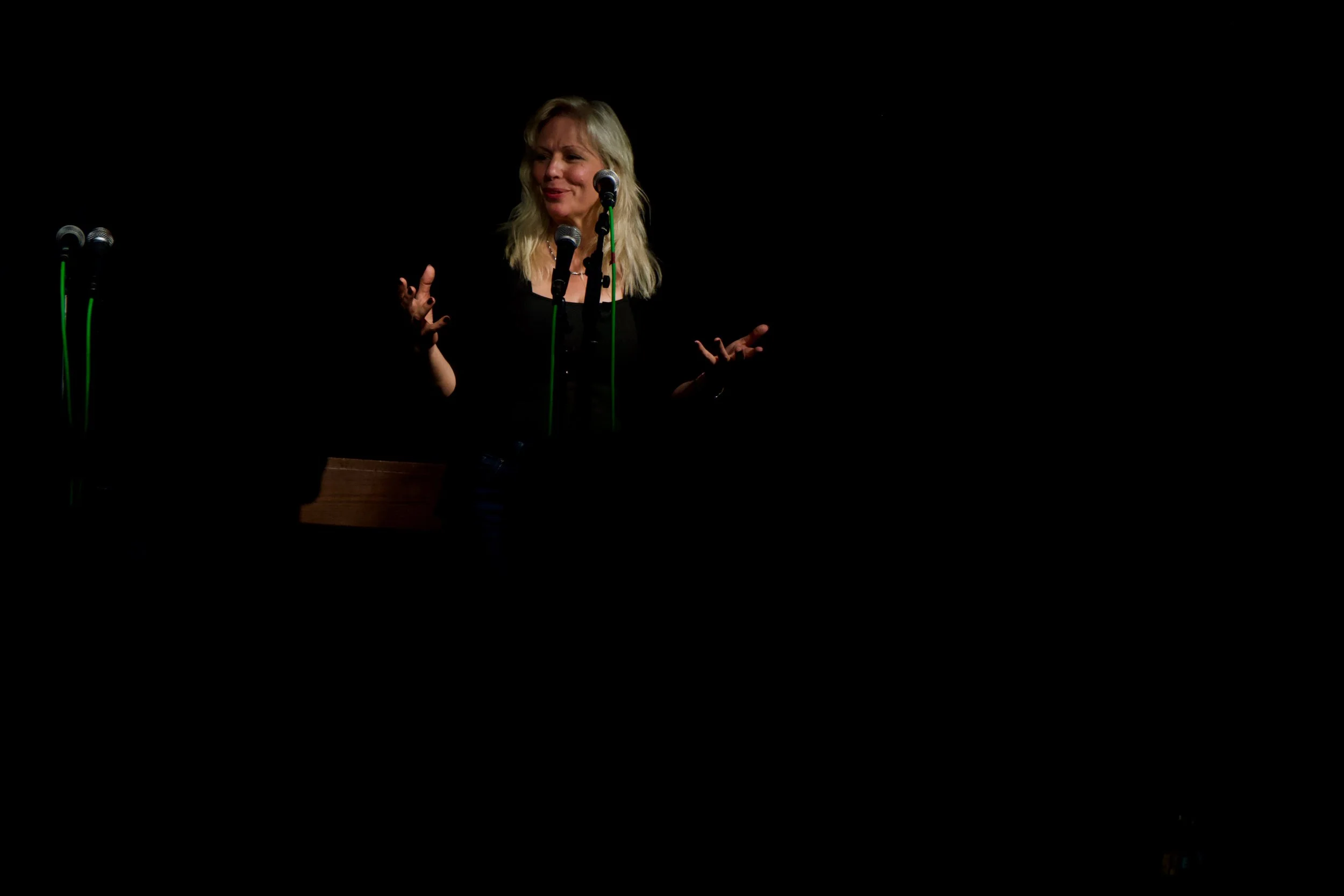
Robyn Jay shares her story at Aces and Eights Saloon Bar in London, UK on November 14, 2022. Photo by Richard Mukuze.
When I came back the next day, I walked into his room and I could tell, I could tell he was totally conscious but now he was paralyzed. And I don't care who you are, man, that's just awful.
I went over to him and I could see that he was there with his eyes closed and everything. So this man, who hasn't had anything to eat or drink in weeks, had a single tear going down his face. That’s when I said, “That’s it. that’s it.”
I sat down and I said, “Dude, it's time to hit the road. All right, asshole, you’ve done enough damage in this lifetime. It's time for you to put on your big boy pants and get out.” And then I thanked him for showing me his soul.
The next morning, I woke up at 6:45 AM. I found out later my sister woke up at 6:45 AM. I called the hospital 45 minutes later, and I found out that my dad died at 6:45 AM.
This isn't a story about forgiveness. It's not a story about forgiving my dad, but it's a story about seeing him from a really different place. We come into this life as pure positive energy, and we leave this life as pure positive energy.
My dad got out of his Skinner box, and when he did, he released me from mine. That’s it.