In this week’s episode, both of our storytellers share the unconventional paths that led them into science journalism.
Part 1: Keren Landman always wanted to be a writer, but her family didn’t see it as a practical career — so instead, she went to medical school.
Keren Landman, M.D., is an independent health reporter and author of the newsletter Landmansplained. Her freelance writing has appeared in a range of publications, including The Guardian, The Atlantic, National Geographic, NPR, and the New York Times, and she has also worked as a staff reporter at Vox. She is trained as an infectious disease physician and epidemiologist, with experience serving as a disease detective at the CDC and conducting HIV and malaria research in resource-poor countries.
Part 2: When Adithi Ramakrishnan gets to college, she only sees two career paths ahead of her: medical school or scientific research.
Adithi Ramakrishnan is a science reporter with The Associated Press and covers space, dinosaurs and the occasional tadpole. She told this story while she was a science reporting fellow with The Dallas Morning News where she wrote about solar eclipses, sweltering Texas summers and the science of spicy food. Adithi has a degree in neuroscience from The College of William and Mary and was a 2021 AAAS Mass Media Fellow at North Carolina Public Radio-WUNC.
Episode Transcript
Part 1
People will try to tell you who you are. Sometimes, it's a trap. Other times, it's a trap door. Let me tell you what I mean.
In August of 2010, at 6:00 AM on a Tuesday morning, in the second month of the first year of my infectious disease fellowship, I was sitting in a Peet's Coffee in Boston, Massachusetts, waiting for somebody to arrive. I was in such a state that when he walked in the place, I looked up and saw the first sun of the morning coming in the window behind him and thought, “I am literally in a tunnel, and he is the light at the end of it.” And then I laughed at myself for being such a mawkish fucknut.
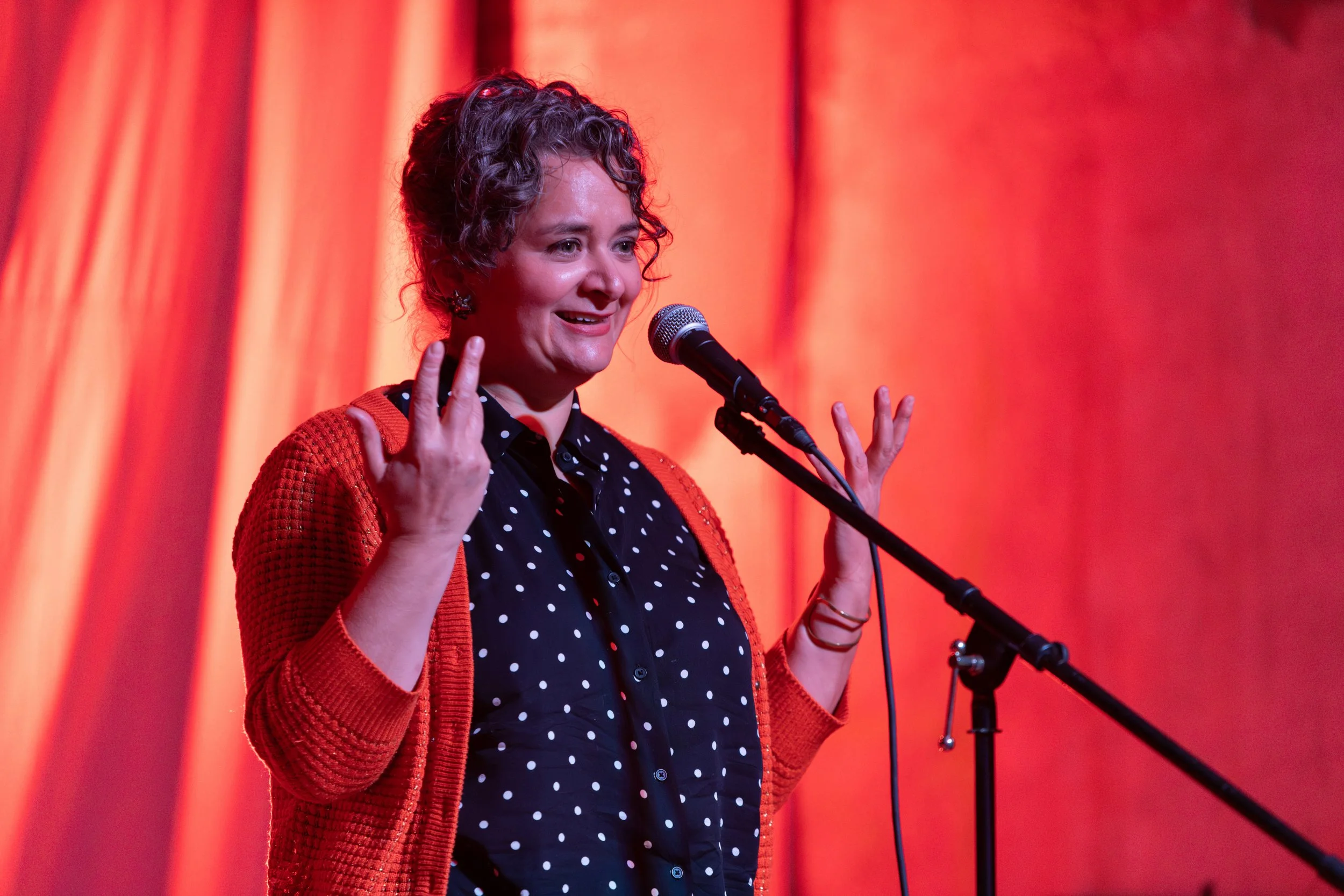
Keren Landman shares her story at Underground Atlanta in Atlanta, GA in December 2023. Photo by Rob Felt.
But he sat down and took the notebook that was in front of me. Now, he was there to talk to me about being a global HIV researcher, because he was a very famous global HIV researcher. This is something I wanted very badly.
In the notebook that he took from me, he made a drawing and it looked like this. It was a deep V, something shaped kind of like a dagger. Above the point of it, he made a little notch, and he asked me, “How many scientific papers have you published?”
I said, “Six.”
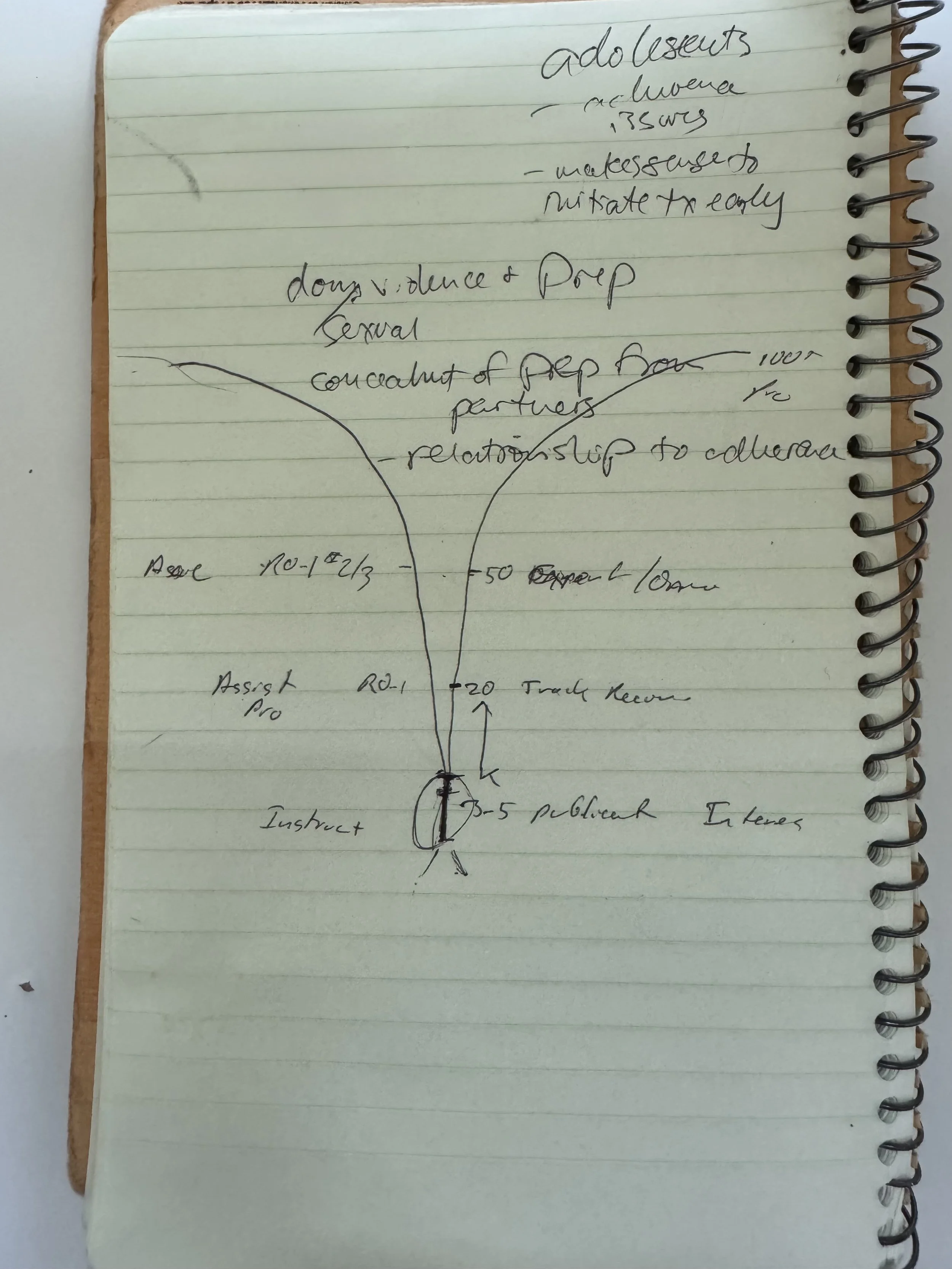
The V in Keren’s notebook that she talks about in her story. Photo courtesy of Keren Landman.
And he wrote five, just rounded me down, and said, “This is you.”
He made another notch a little bit further up and wrote a 20 next to it. And he said, “When you publish 20 papers, you can be an assistant professor.” And another notch a little further up, wrote a 50. “Here you can be an associate professor.” And 100 plus at the top, “That's full professor.”
Now, this man was a full professor. I mean, he was well more than a full professor. He was some kind of an endowed chair, had published hundreds of papers.
I thought back to a story I read as a kid in a set of cloth‑bound books from the 1950s that my mom had bought at a garage sale, I think maybe a Polish folktale or something, about a princess who climbs a mountain made of glass for three days to find her prince. I imagined myself scaling the glass walls of that V with no footholds, no tufts of grass to hold onto, and nothing at any waypoint but more glass.
And I thought to myself as I walked out of that coffee shop, “No, thank you. I didn't want to be anywhere near that V.”
See, I did not want to be a doctor growing up. I wanted to be a writer. In my free time, I would write and illustrate stories for people. I tried to write my first novel when I was nine. It did not work out. But everybody knew that writing was my thing.
But it was not an appropriate profession, according to my family. And as I got older and went to college, I realized that the writers that I liked and valued and that my family valued, they were people who knew something. They were experts in something. And who was I? I was a schnook. I had nothing important to say. So I went to medical school instead.
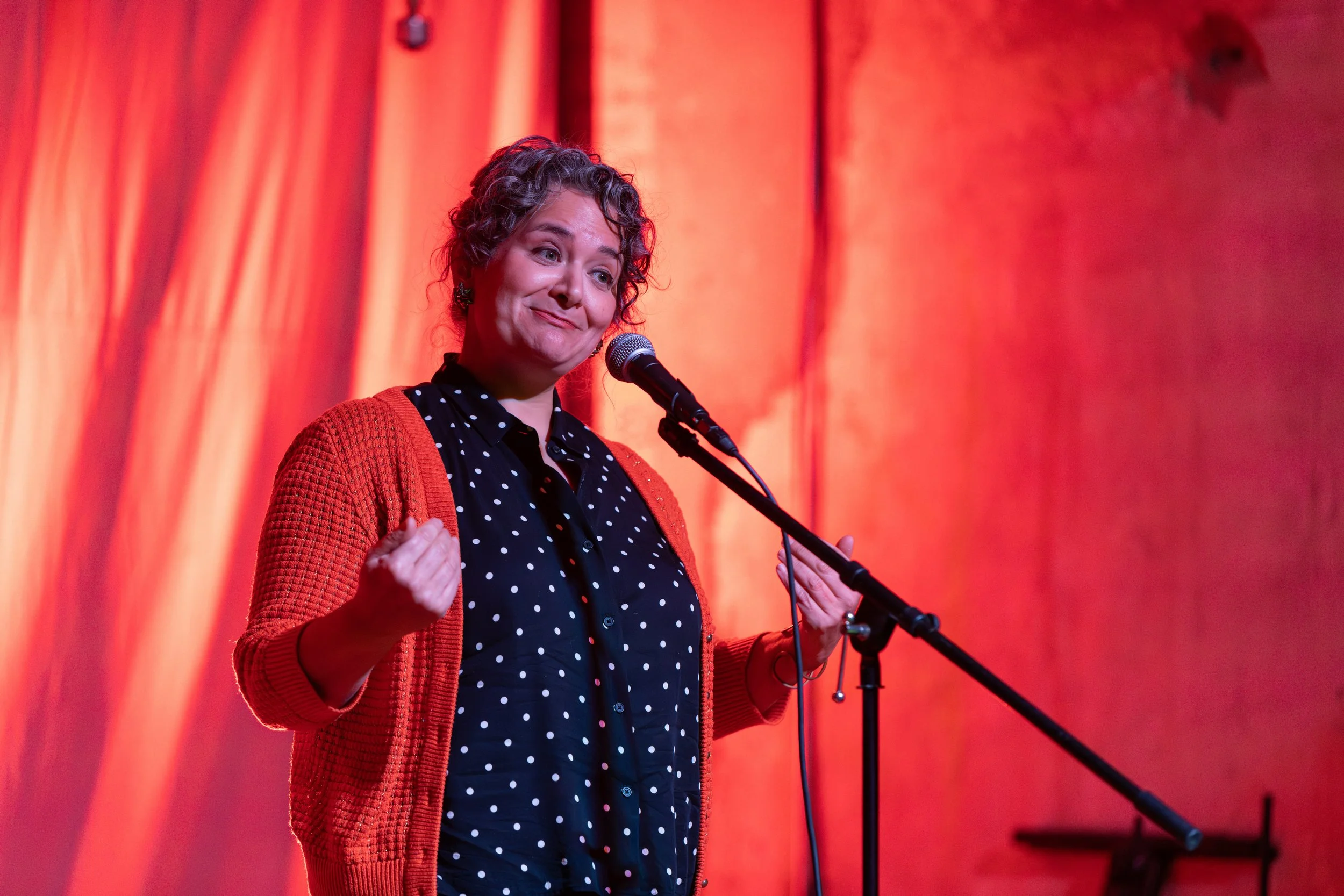
Keren Landman shares her story at Underground Atlanta in Atlanta, GA in December 2023. Photo by Rob Felt.
I kept writing. In fact, the first time I ever realized I had some power as a writer was in medical school. It was between my third and fourth years of med school. I moved to Tanzania for the year and did global HIV research with a group that was working there. We stayed in this doctors compound next to the hospital, and on evenings and weekends, I would sit under the tall mango trees in our yard and write. I would post what I wrote to what we called a blog back then, and people would read it.
There's one story that got a particularly strong response from people. It was about this woman named Husna, who I met really early in my time in Tanzania. She brought her little twin babies to the pediatric HIV clinic because they were starving to death. She had end‑stage HIV. She had AIDS. She was very malnourished. She had no more breast milk left, and she was trying to get them to take this sort of weak, milky tea out of a cup, and they weren't.
This was a pivotal time for Tanzania. Shortly after I arrived, the first in a thin trickle of HIV medications started coming into the country, and Husna was one of the people who got them. Five months later, she came back to my office to show me the dimples in her little baby's fat cheeks and how she was filling out a dress. And I realized I am the person to tell these stories. People read them, but I was there seeing it and I could write them. There was power to that.
For residency, I matched in the same shitty Rust Belt town where I went to medical school, and I was very, very, very upset about it. To console myself, I made a deal with myself that since I couldn't be spending my free time having the fun I would have had in a Chicago or a Seattle or New York City, I would at least do something else valuable with that time. I would write.
So I did. I started another blog, first day of my intern year, before I'd even washed the creases out of my white coat. And now I had material. Being in a hospital 80 hours a week for four years in your 30s will change you. It changed me. And I wrote all about it.
People noticed. An editor noticed and asked if I had any interest in writing a book. And I submitted a manuscript, final draft, two months before I graduated. I knew well before then that the hospital was not for me. I wanted to somehow recapture some of that magic I had in Tanzania. And the natural path to that was an infectious disease fellowship and a research path. So that's what landed me in Boston.
But a week after I arrived, I got a call from that editor and he said, “Book project is off.” It's nothing personal. This was the height of the subprime mortgage crisis. Passion projects were dying left and right. Mine was just one of them.
And when he told me these news, I was standing on this glass footbridge between these two hospitals that had only just begun relentlessly abusing me. There was nothing in front of my face beyond the glass but air. I remember feeling suddenly, like there was also nothing beneath my feet and I was just plummeting.
I tried to write about what I was going through and I couldn't find words. I just lost my voice. Then that meeting in the coffee shop happened a few weeks later, and then I was adrift. See, I had spent four years nourishing these two separate identities. I was never just a doctor. I was also a writer. And these things nourished each other. They were two halves of a whole. Now, they were just gone, just crumbling between my fingers like dust.
I survived that year, and then I survived the slightly less awful one that followed, and then a few more after that. Then in 2015, I got a job working on public health in New York City, and I liked it. I had a great boss. I had wonderful colleagues. They valued my work. It was meaningful.
That summer, we had an outbreak of Legionnaire's disease in the Bronx. It was a really big one. Legionnaire's disease is a pneumonia that you get through contaminated mist particles of water in the air. This one had been caused by contaminated water coming off of a cooling tower on the top of a big hotel in the Bronx. A bunch of people had walked by it, inhaled the mist, got pneumonia, and died. It was a big fucking deal.
We did a lot of media. I did a lot of media because everybody in my division was out on summer vacation.
I was sitting in a Bronx cable station, Channel 2, talking to a very smart reporter who was asking me really good questions when I thought, “Man, I wish I had her job.”
So I quit, and I started a journalism program. I loved it. Here I was, all my life, just wanting to communicate important ideas and words, and, suddenly, I was surrounded by people whose whole reason for being was to do exactly that. I immersed myself in it. I went to journalism talks. I read about journalism. I listened to journalism podcasts.
I was listening to a podcast about journalism when I heard the voice of Taffy Brodesser‑Akner. She's a celebrity profile writer. I don't care about celebrity profiles, but I did care about her voice. It was incredible. It struck me immediately. She was so smart. She was so funny and relatable and compassionate and incisive.
I was boarding this flight to L.A. and I downloaded a few of her stories. Before we landed, I was her number one fan.
She'd also done something that felt very relatable to me. She had pivoted from a different kind of desperation to writing mid‑career. I knew that story. Freelancing was tough. I should have been, at this point in my career, taking off. And here I was, starting on the ground floor.
I kept reading Taffy. She kept inspiring me. I kept muddling through. In 2019, I saw that she was teaching a writer's workshop. I couldn't sign up fast enough, booked my ticket.
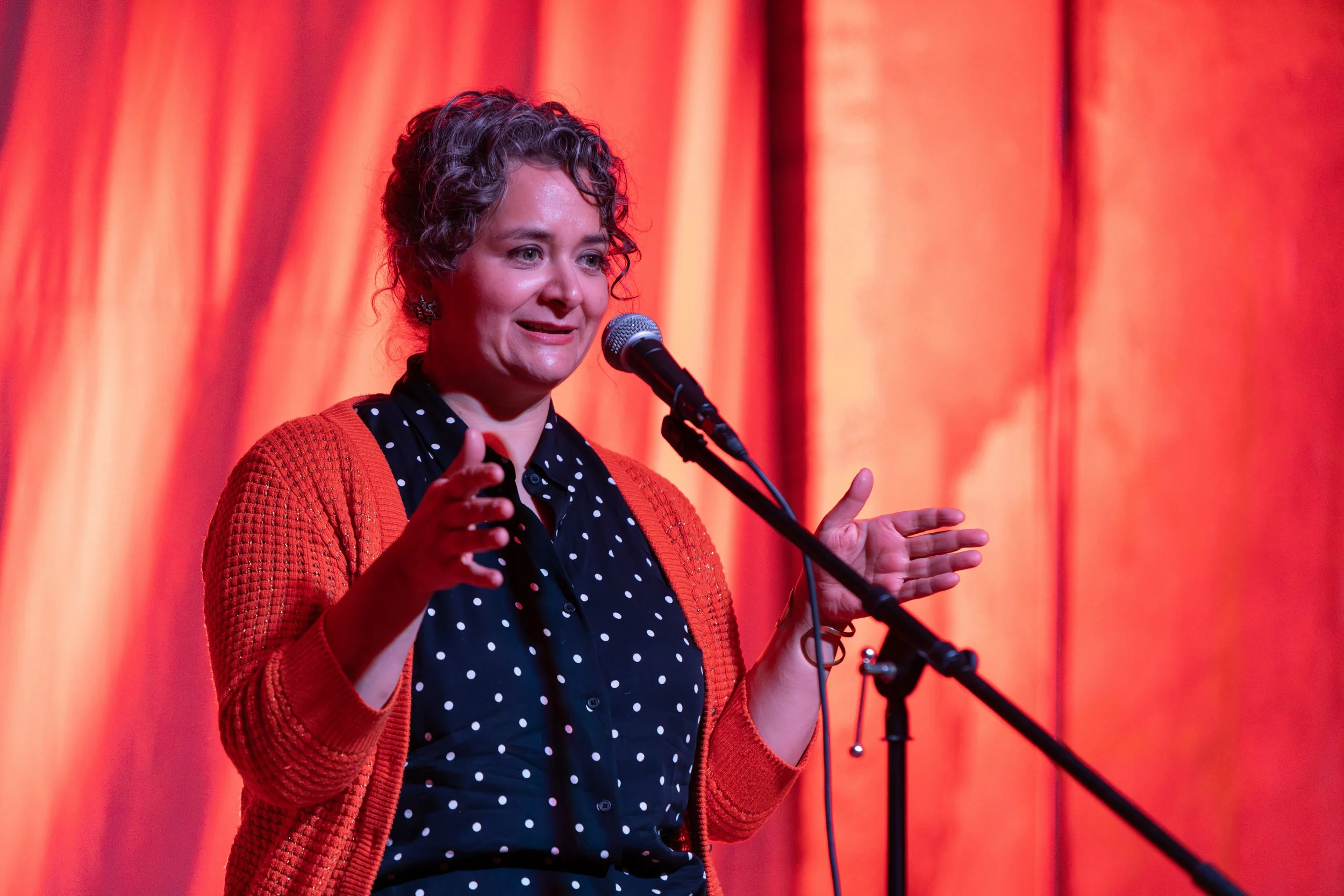
Keren Landman shares her story at Underground Atlanta in Atlanta, GA in December 2023. Photo by Rob Felt.
It was a weekend workshop, and we spent most of Saturday picking apart stories that we'd read that she had assigned us and talking about our own ideas. And then she spent a little time talking about how she does things. She started talking about voice, and I immediately felt the hairs on the back of my neck come up.
Somebody else in the room asked, “What do you do when you've lost your voice?” And my eyes filled up.
She said, “Well, you don't go looking for it, because voices, like people, change and grow. And if you're busy looking for an old voice, you're denying a new one that, inevitably, guaranteed, is more profound than that old voice.”
By now, I was fully sobbing. With the utmost gentleness, she and everybody else in that room just let me.
She started talking about structure. And, here, she took out a piece of paper and drew something on it. She held it up to us and it was a deep V. But it was upside down and it was tilted just a little bit to the right.
She pointed to the part of the line where it takes off from the bottom of the page. She looked at us and she said, “This is you, starting to tell a story.” And then she pointed at the peak and she said, “This is the thing you knew all along going into this story that you are just now sharing with the reader. This is where the story turns because you specifically turned it. This is a crisis point. And after this is where we show the reader, because we care for them, that even despite a crisis, we soldier on.”
I cried straight through that. I cried straight through the rest of the day, I cried through the dinner I had with the people from the workshop afterward. And then I couldn't sleep all night. I stayed up writing. I wrote what eventually became this.
I did not know then that within a year, all of my experience would suddenly become tragically extremely relevant. I also didn't know that three years later, when I got my first full‑time journalism job, it would fit like a glove. And I would wonder what had taken me so fucking long.
What I did know was how different that shape looked depending on which way it was pointing. In the wrong hands, that deep V was a prison. But in the right hands, it was a ramp. You know, the kind that kids in a skateboard park would just fly off over, their hands outstretched, reaching for the sun. Like they don't even have bones in their body to break, just totally free. Maybe I could jump off that ramp, too. Maybe I could reach for the sky, too.
In the wrong hands, that shape was a trap. But in the right hands, it was a story. And it was mine.
Thank you.
Part 2
I pushed open the door and stepped into my very first college lecture hall. Five‑subject notebook in one hand and this bulky pencil case in the other, I shuffled into a seat comfortably in the middle row, avoiding making eye contact with the professor.
I opened my notebook to a blank page and wrote down the course title in big capital letters. INTRO TO BIOLOGY. This was the year that I'd finally answered that elusive, mind‑numbing question of what I was supposed to do with my life. It's one I'd been asking myself for a long time.
My dad came to the United States from India when he was nine, and my mom joined him when they were married 15 years later. Both my parents are software engineers. The life they'd built afforded us stability, the ability to keep food on the table, provide for the family, buy me the princess dolls and science experiment kits that I wanted for Christmas. I wanted that same stability, the ability to make my family and future generations proud.
In high school, I took this really intense science class where we had to read 60 pages of scientific research about the brain every single week. I had to Google what a word meant at least once a paragraph. But reading about how scientists were distilling these big, complicated emotions like love, fear, passion, down to these microscopic zaps of electricity inside the brain fascinated me.
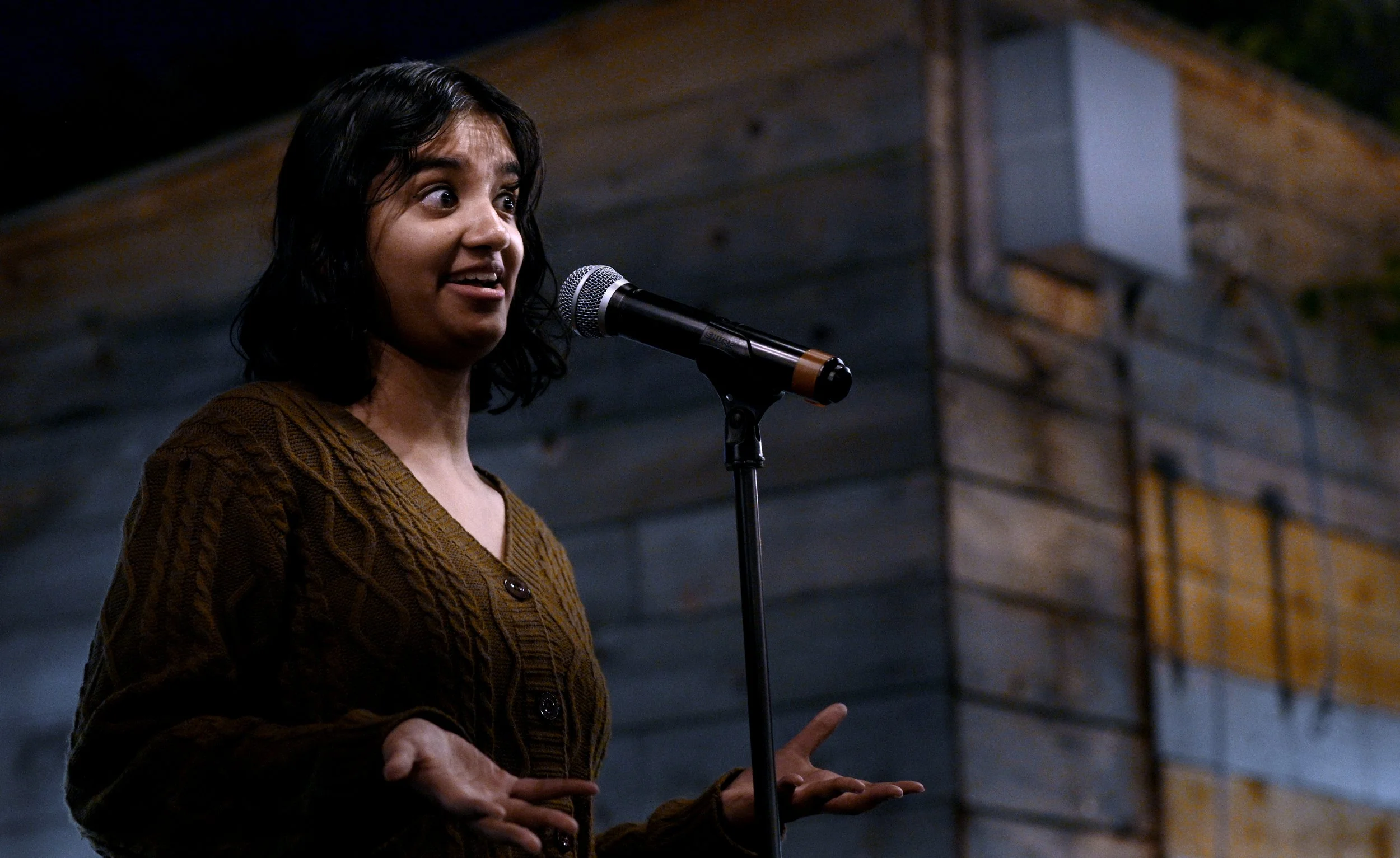
Adithi Ramakrishnan shares her story in November 2023 at Wild Detectives in Dallas, TX. Photo by Jason Hensel.
I knew the brain was what I wanted to learn more about, but once I finished my four years at school, I wasn't really sure what would come next.
I looked behind me at the students filling in some of the back rows, whispering to each other about how many credits they'd signed up for. There I saw option one, the pre‑meds. I could become a doctor, lump five to six extra courses into my schedule, find time to study for the MCAT, take a bus 10 to 15 minutes off campus to volunteer, and apply to medical school. It seemed like most of the kids in the room were dying to do it, so it could be a natural fit for me.
Then I thought back to the summer when I was watching an episode of Grey's Anatomy with my mom. I watched this doctor hold up this glinting silver needle against the patient's shoulder, about to jab it into this bulging red vein. I yanked my hands up to cover my eyes and my nose scrunched up even though I knew it wasn't real. Eww. Okay. So medical school might not be the path for me.
That left me with option two. I looked in front of me at the students filling in the first three rows. A few of them were already out of their seats, introducing themselves to the professor and asking to join her research lab. My friends that didn't want to become doctors had instead elected to become researchers, making discoveries that change the way we see the world around us.
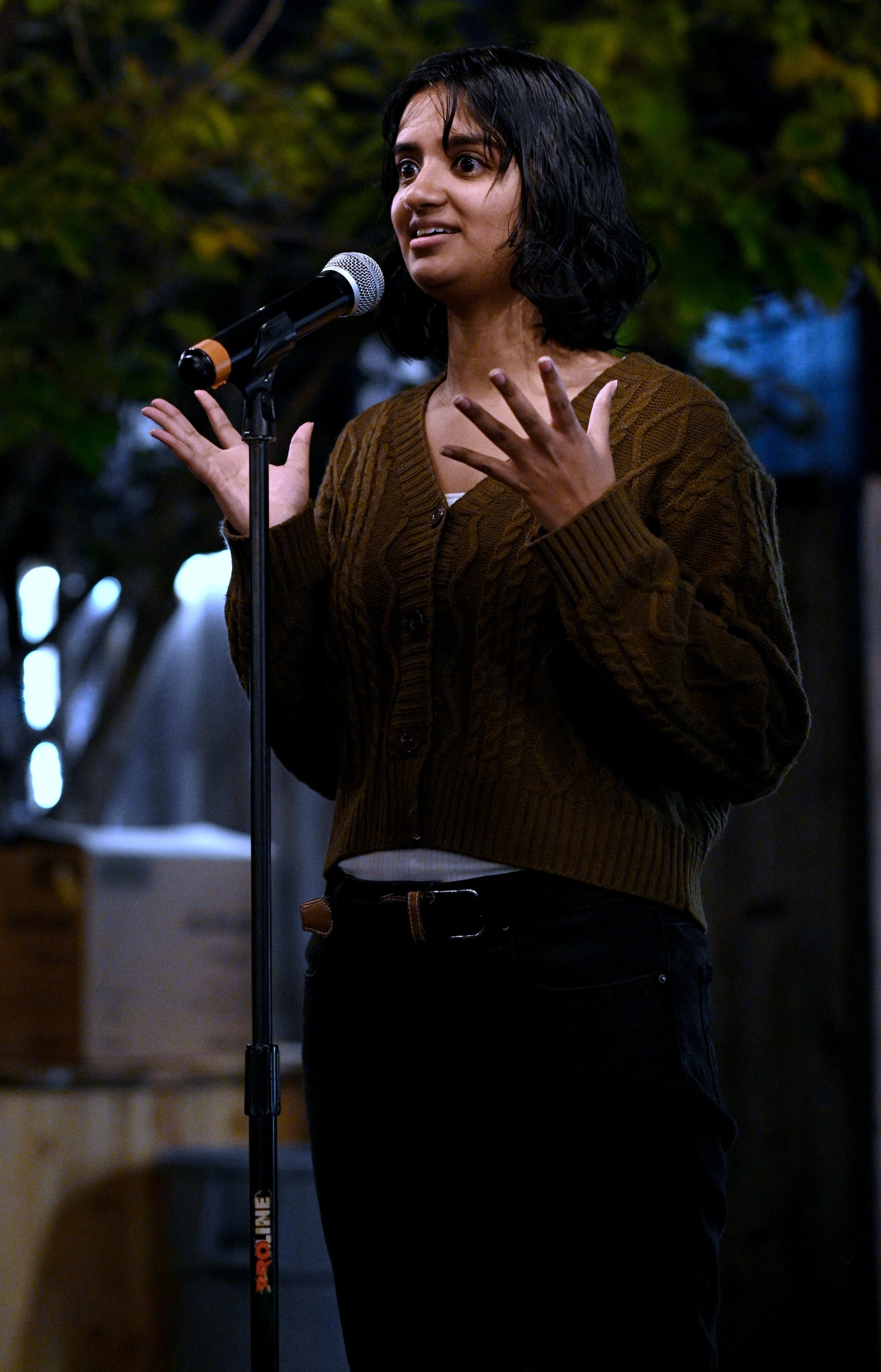
Adithi Ramakrishnan shares her story in November 2023 at Wild Detectives in Dallas, TX. Photo by Jason Hensel.
I thought about my time reading those scientific research papers in high school and wondered what it would be like to be the one writing them. I had so many questions about how the brain worked. Answering them in a lab seemed like something that I'd want to do.
Which is how I found myself bending over a microscope, holding a needle so thin I could only see it under the microscope lens, looking down at a tadpole. The research lab that I had joined was trying to answer the question of how humans learn to see. But before answering that question in humans, we were starting first with tadpoles, these wriggly little creatures with beady eyes, pointy tails, and covered in dots. They were so small that one could barely fit on my fingernail, though that would be nearly impossible considering how quickly they wiggled around in the plastic trays that we kept them in.
The first time I put a tadpole under a microscope and looked at it, I couldn't believe what I was seeing. I could see this tadpole's brain so clearly through its transparent head. It didn't look anything like our brain. It was long and narrow, like a little caterpillar running between its eyes to the very start of its tail. But I could see this triangle‑shaped area called the optic tectum, where its brain cells were multiplying to teach its eyes to see. I was fascinated.
And I had so many questions. How well could tadpoles see? How long until their brains developed? How fast could they swim?
On day four in the lab, I finally learned how to run experiments. Gently, I scooped this little tadpole out from the plastic tray and into this little dish about the size of a bottle cap. Using a pipette, I squirted a few drops of anesthesia into the dish to put the tadpole to sleep. Then I put the tadpole under the microscope, and I inserted this super thin needle into the triangle‑shaped optic tectum, and I injected this blue liquid that contained DNA. The whole triangle filled up with blue.
Then I put these two electrodes on either side of the tadpole's head and pushed this button to shock the tadpole with just enough electricity to get its brain cells to take in this DNA I just injected. I felt like the coolest person in the entire world.
And I had even more questions. How well could tadpoles see? How long until their brain cells took in this DNA I injected? And why was it blue?
On day five, I injected the tadpoles again. Wow! Still very cool. And then I injected them again on day seven and day 10 and day 12 and day 15 and day 17 and day 20. Day 30, I heard my phone alarm go off and I threw the covers off my bed. Time to go inject some tadpoles, again.
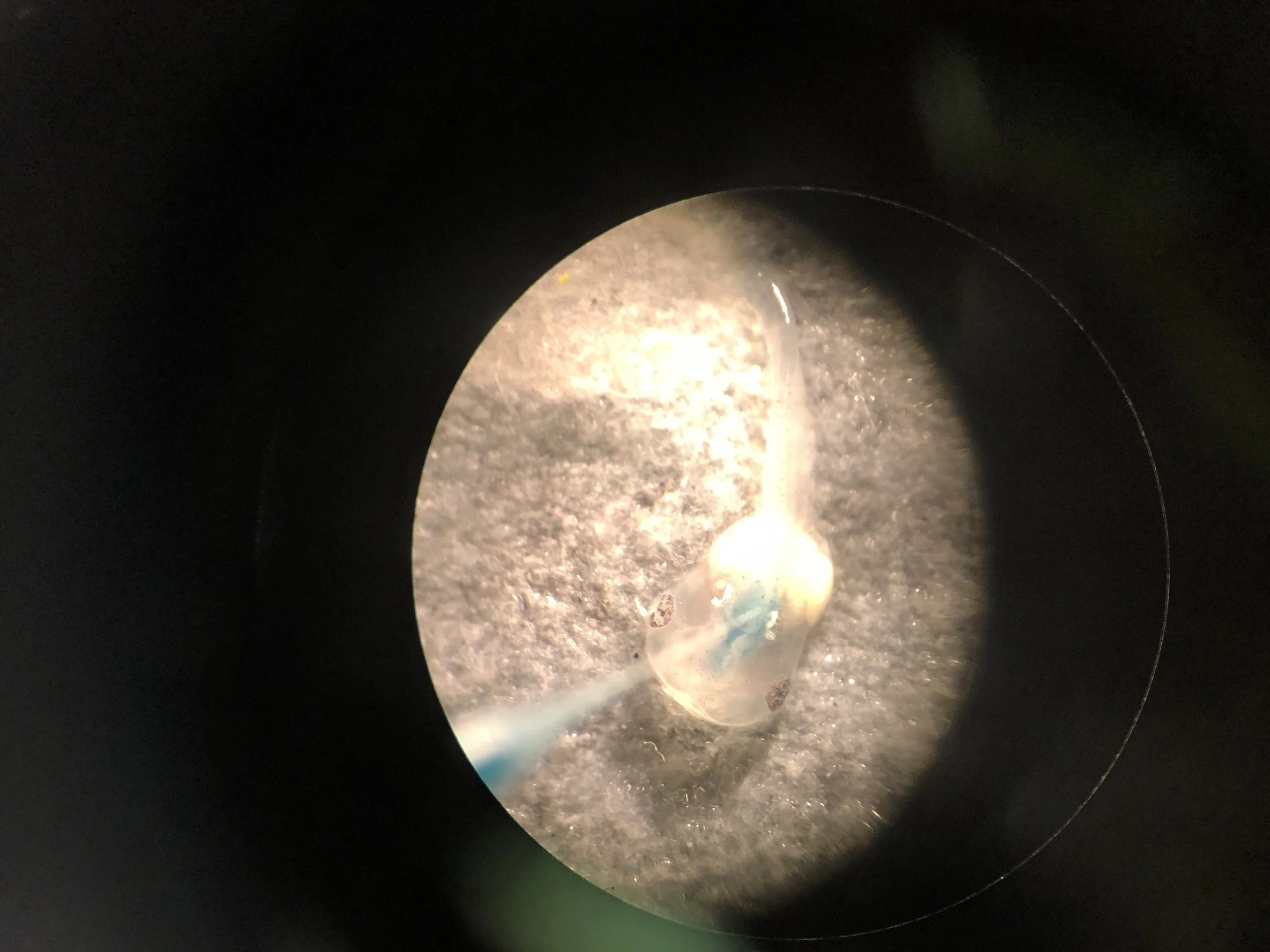
A tadpole under a microscope. Photo courtesy of Adithi Ramakrishnan.
I pushed open the door to lab and I sat down on the swivel chair looking down at the microscope. I watched all the tadpoles swimming around in their tray. I didn't want to be the person injecting them over and over again. But I still had so many questions about how their brains worked and how their brains were going to change as they grew up. I still thought that their wriggly little bodies and their caterpillar‑shaped brains were so cool that I wanted to tell everyone I knew about them.
Could I still ask questions about tadpoles even if I wasn't the one studying them? Could I be the person telling people about research instead of being the one doing it? I opened up my laptop and I typed in the question, “How do tadpoles learn to see?” Dozens of results popped up, including articles written by science reporters.
Was there an option three for me? A future like that wasn't really part of the stable life that I'd envisioned for myself. I had no idea how to get started and I didn't know anybody who was doing it. I didn't know how hard it would be, how stressful it would be, if I would even be good at it. But the more I thought about it, the more it was starting to feel like that was the thing that would make me happy.
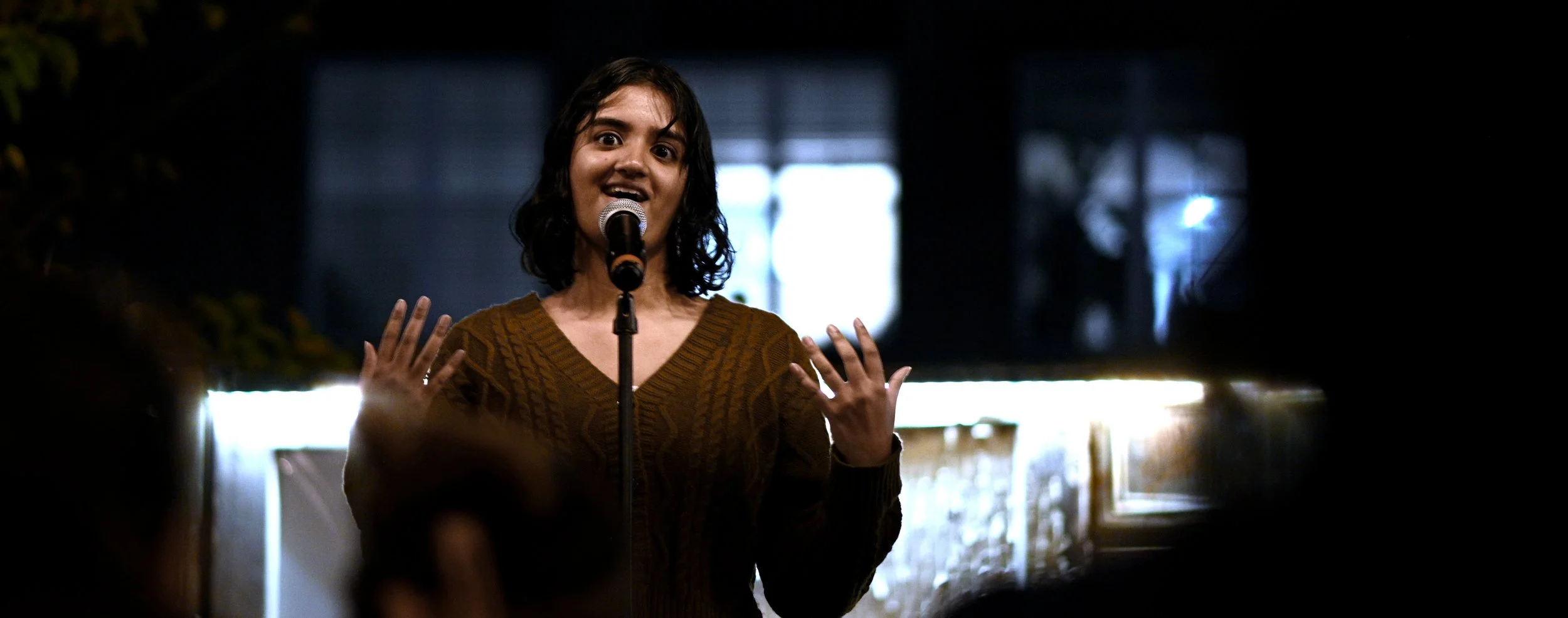
Adithi Ramakrishnan shares her story in November 2023 at Wild Detectives in Dallas, TX. Photo by Jason Hensel.
So I talked to my lab director and I took a step back from the tadpoles. I called science reporters at universities like Johns Hopkins and research labs like Howard Hughes to ask them how they got started and if they had any advice.
And I wrote, a lot. Most of it was pretty bad, but little by little, I got better. Now, I tell stories for a living. As a science reporter with the Dallas Morning News, I write about researchers who are exploring all of the nooks and crannies of science, just like my lab director. I've written about a researcher who discovered a molecule by accident that could treat one of the most aggressive forms of breast cancer. I've written about a student that developed a spoon to stabilize Parkinson's tremors so that his grandmother could enjoy their family dinners again.
Because I used to work in a lab, I understand some of the complicated words that scientists use when they explain their work to me, like “optic tectum” or “frontal lobe”. Just like I did in high school, I read tons of scientific research papers, and I still Google all the words that I don't know. And because I'm a writer, I'm able to break down those words into terms that anybody can understand.
And because I used to work in a lab, I know to ask scientists about more than just what they did and why it matters. I ask them how they feel, because I remember how I felt. Excited, confused, even bored. I bring out the emotions of the scientists that I write about because I want people to see them as more than just these mysterious silhouettes plugging away in a research lab. I want you to see them as people.
Five years since I first stepped into the research lab and saw a tadpole, I don't really have that stable life that I thought that I wanted. I don't know if I'll be able to support myself financially with this career or if the pace and the stress will burn me out too quickly. But a few months ago, I called up a doctor for a story that I was writing. I asked him all my questions and I summarized everything I'd understood back to him, just to make sure that I understood everything properly.
And he told me, “You put it much better than I did. What you guys do is really important and very cool as journalists.”
I thanked him, wrapped up the call, and got to working on my draft. Yeah, I think so too.