In this week’s episode, both of our storytellers explore the challenges, opportunities, and unexpected lessons they encountered as immigrant scientists in the United States.
Part 1: Michelle Lanuza has her sights set on a career designing communication systems for airplanes, yet each new opportunity comes with the same obstacle: her immigration status.
Michelle Lanuza is a first-year Ph.D. student in the Department of Materials Science and Engineering at Boise State, originally from Guatemala. Growing up surrounded by breathtaking landscapes, she developed a love for nature, often spending my free time hiking volcanoes and backpacking. She enjoys reading, playing the piano, cooking with friends, and watching and playing soccer. Michelle’s passion for understanding how machines work and solving problems began in high school, inspiring her to pursue a career in engineering and, ultimately, to continue her studies in materials science.
Part 2: For Saba Banaian, the opportunity to study biomedical engineering in the United States comes with a painful cost: she can't return home to Iran for five years.
Saba Banaian, 25 years old, from Iran. She is a Ph.D. student at Boise State University and a professional violinist with the Boise State Symphony Orchestra. It has been a year since she moved to the United States to continue her graduate studies in biomedical engineering.
Episode Transcript
Part 1
When I started my undergraduate program at BYU-Idaho, I was very excited about the possibility of fulfilling my dreams and all the other opportunities that I was going to find here. It was very hard for me to leave Guatemala, my home country, my family, my friends, my job as an aircraft technician, and all the other things that I love to do there. But I really wanted to design communication systems for airplanes, and I knew that that was the only way to make it possible.
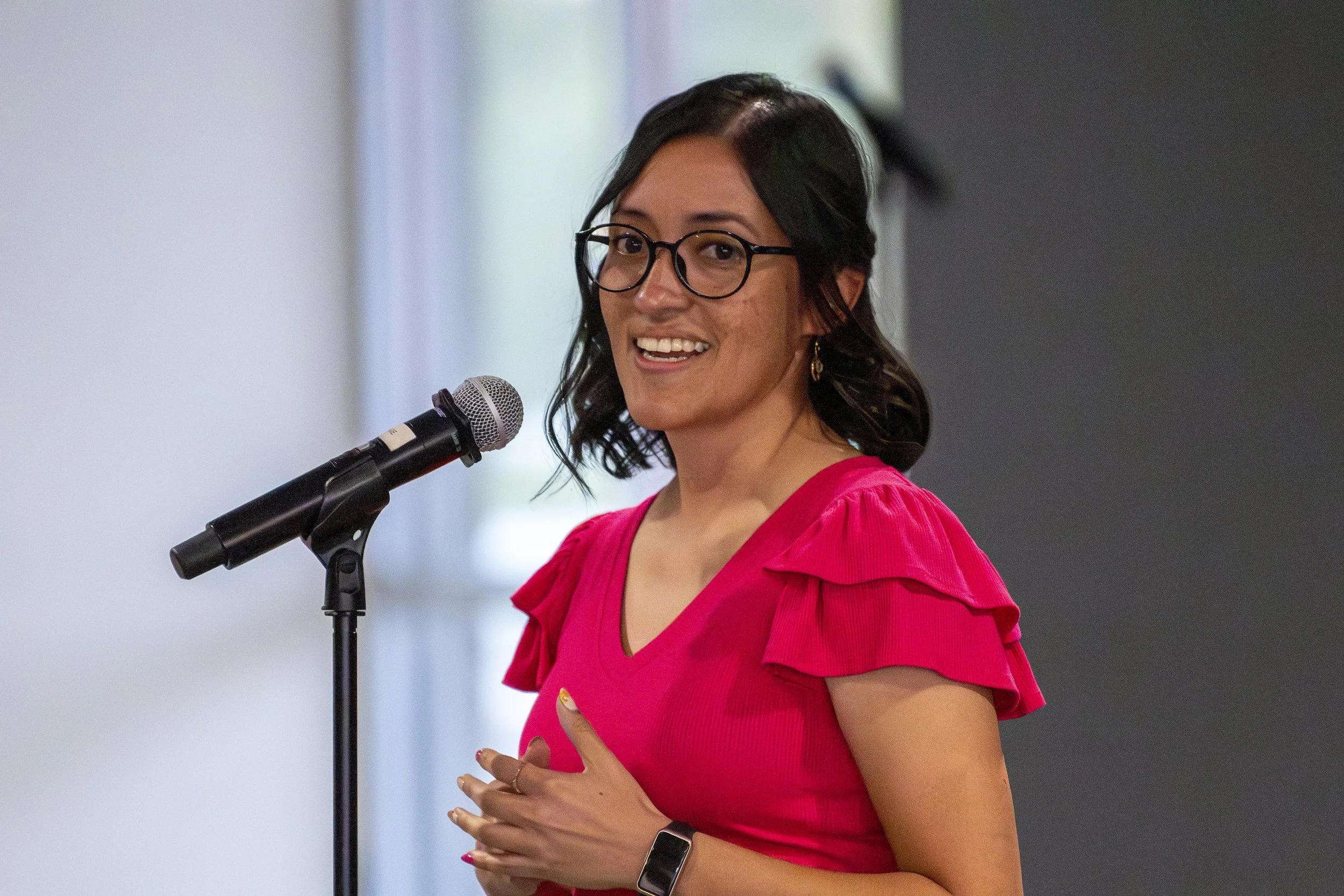
Michelle Lanuza shares her story at The Lookout Room at the Boise State Student Union in Boise, ID in September 2025. Photo by Sean Evans.
In Guatemala, I used to spend Christmas eve helping my grandmother making tamales. Guatemalan tamales are a little different than Mexican. They are bigger and they're wrapped in some sort of banana leaves. And if we have tamales, it's a celebration. So tamales are very important for us and we love them.
There's a saying in Spanish that says, “Al que nació para tamal, del cielo le caen las hojas.” The direct translation is, “For one that is born to be a tamal, the leaves that wrap him will fall from the sky.” It means that if something is for you, it's going to happen. It's going to find you.
So thinking about that, I was working very hard. I was meeting with tutors, asking a lot of questions to my professors, because I'm not a genius and I have a lot of questions because I don't understand most of the time. But I was working very hard and trying to be prepared for the opportunities that I was going to find.
I started to have interviews for internships. I was very excited and everything was going well until the question about my immigration status came. Every single time, things went well until they asked me. Because to work on aviation, you need to have clearance from the government. And since I'm not a US citizen, I just can't have it. I just can't get it.
I was very frustrated. I was very sad, because it didn't matter, all the experience I had, how much I wanted to be doing that or to work doing that. It wasn't possible. So I didn't know what to do. I still feel very good about being an electrical engineer. I knew that I needed to keep going. I just didn't know what to do with my degree anymore.
I remember thinking, “What have I done? What am I doing here? I should have stayed in my country doing something that I didn't love, because now I can’t find anything that I love here. So what's the point?”
But I knew that I needed to keep going. I remember I worked on my classes. I had good friends that helped me. Everything was just flowing.
At the beginning of my senior year, I needed to take an extra class. I decided to take the semiconductors class. I didn't know about semiconductors, and I wasn't sure what the class was about, but Dr. Jack was going to teach it. I worked as his TA for a couple of semesters and I knew that he was a good professor. So I had no idea what this class was about, but I knew that, because he was going to be there, it was going to be fun.
When I took the class, I learned that semiconductors are materials that have the electrical conductivity between a conductor and an insulator. They are essential for modern electronics. On top of learning that, I realized a lot of things that I learned in my previous classes just clicked. A lot of things started to make sense and I started to get very excited about semiconductors.
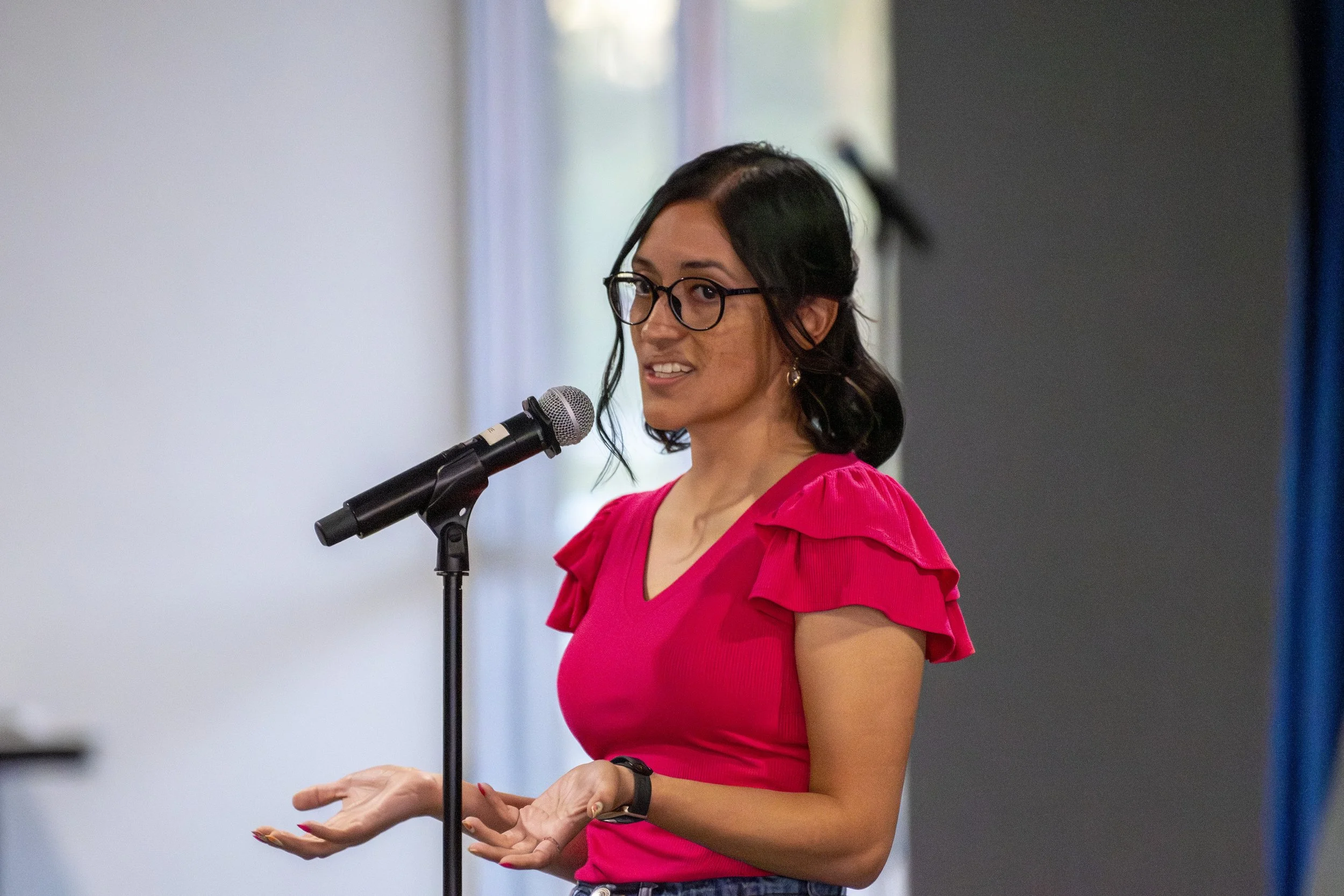
Michelle Lanuza shares her story at The Lookout Room at the Boise State Student Union in Boise, ID in September 2025. Photo by Sean Evans.
I decided to ask Dr. Jack about what do you need to have a career in semiconductors. So I set an appointment with him and I went to his office. It wasn't the first time I was there because I was his TA, so I knew him pretty well.
So I went, I knocked on the door. He opened with a friendly smile, as always. He invited me in, grabbed a piece of candy and sat.
I remember I knew his office, all his books, pictures of his family, Thank You notes from other students. And I started the conversation like, “I really like your class and I want to know what do I need to do to work with semiconductors.”
And he said, “Well, with your undergraduate degree, the best you can get is a job as a technician working with the machines in the clean room.” That broke my heart because technicians work 10 to 12 hour shifts wearing very uncomfortable and ugly suits. I don't care about the ugly part, but they're very uncomfortable. And it was a really hard job. I felt like I just wanted to cry again.
And then he said, “If you want to have a career in semiconductors, you might have to go to grad school. But that means that you need to keep going to school for a couple of years. Are you aware of that?”
I just wanted to cry. I didn't even answer. I didn't know what to say. I was feeling so frustrated and heartbroken. So I tried to keep it cool and just end the conversation.
When I left his office and I was walking home, I was thinking, “What should I do now?” I don't know. Again, I didn't have an opportunity. For the second time, all the promises that I had about opportunities and fulfilling my dreams were shattered. I just felt lost.
In the past. When I thought about tamales or the saying, that kept me motivated but, this time, it was just impossible. It didn't matter what I did, I was not one of those people that can fulfill their dreams. On the one hand, I was tired of doing homework. I don't know. Don't be engineers. I'm just kidding. Be engineers. But I was tired of doing homework. I was tired of not having time to do anything else. I just wanted to start living like an adult and having money.
But then on the other hand, I really wanted to do something that was important for me, something that I was passionate about. I knew that the only way was going to grad school.
So I started asking all the professors in my department, “What do you need to do to go to grad school? How does that work? What do you do?” And every single one of them were very, very kind, but they all told me the same. You need to be aware that it is very late in the process and it's very likely that you're not going to be able to do it, or that you're going to have to wait.
That was very sad again because, again, I kept getting this message that I couldn't fulfill my dreams, that that was not for people like me.
I still needed to graduate, right? So I kept working on my classes. A few days later, I met with Dr. Swanson. He was the first professor that I had for my engineering classes, and he was teaching in electromagnetic class. As always, I was pretty lost, so I had to meet with him.
In this meeting, I asked my questions. He was very nice. He was very patient. Then after he explained some things, he told me to read some books.
And I remember telling him, “You know, in the last couple of years, I've just started liking reading textbooks. I have no idea what it says, like I really don't understand, but I'm so excited about the idea of learning something new, just learning something that I don't know.”
He paused, he looked at me and said, “Have you considered grad school? I think you will be good at it. It's a lot of work, it is hard, but I know that you're not afraid of working hard. So I think that that will be good for you.”
I told him that I thought about it, but I wasn't sure if it was good for me or if I was good for grad school or if it was even possible.
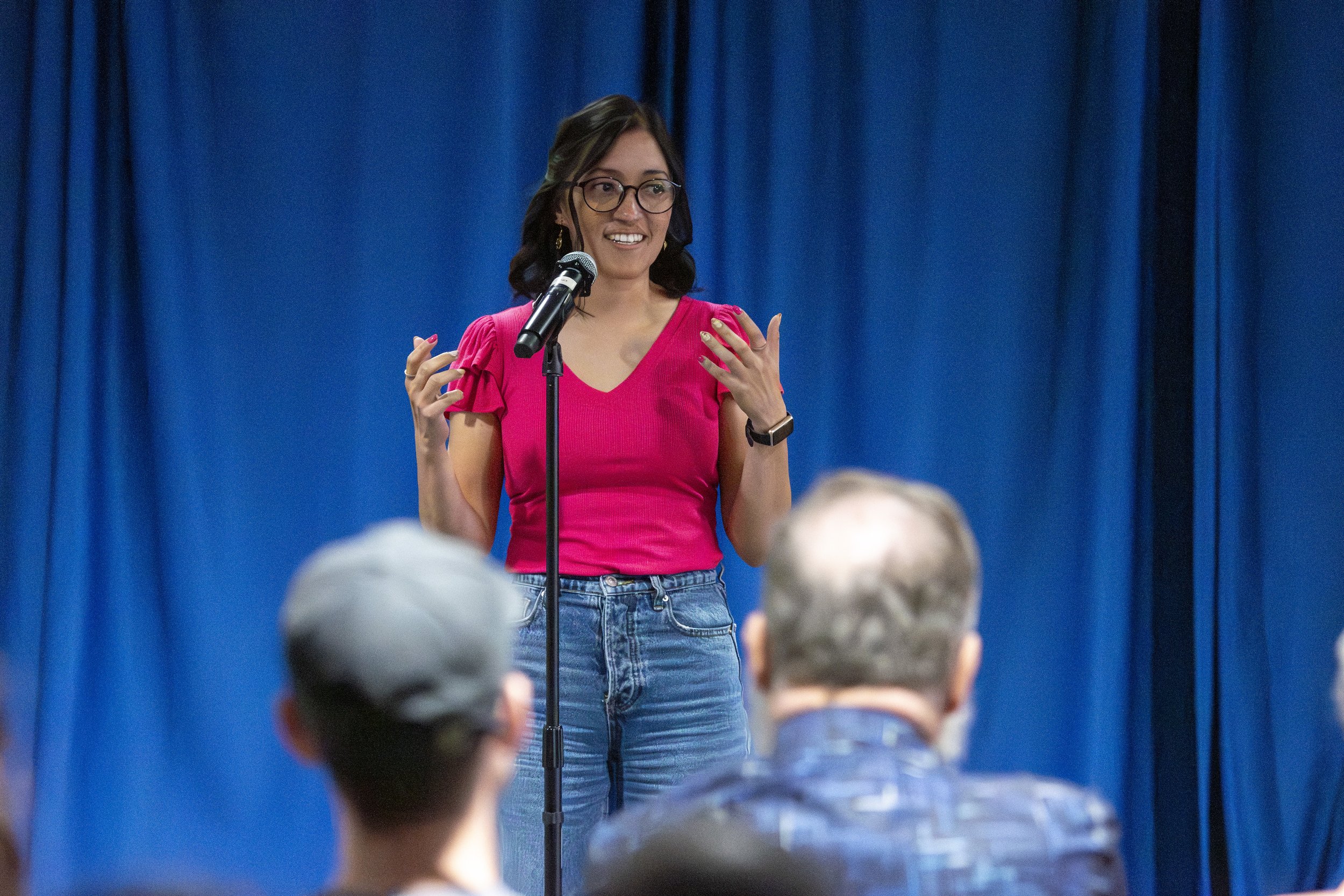
Michelle Lanuza shares her story at The Lookout Room at the Boise State Student Union in Boise, ID in September 2025. Photo by Sean Evans.
The conversation ended soon after that. But after this meeting with him, I just couldn't stop thinking about his question. For the first time, someone saw me, like the kind of person that goes to grad school, the kind of person that belongs in grad school. That changed everything. I got very excited and I was determined. I was going to make it happen. I was going to do everything I could to go to grad school.
So I kept talking with people. I went to other departments to ask other professors, and I found out about a fellowship. And every year, every summer, they send one student to do a research internship to a different university. For some reason, they chose me. I was so excited because someone was giving me a chance. Someone thought that I was good enough to get an opportunity.
Then I learned about a program with a mentor to guide you through the application process and all the things that you need to do and all the letters and everything. And I was working with this Colombian scientist, and she was so amazing. She helped me to understand a lot of things. It was great. But I still didn't have an opportunity or something that was firm.
So I remember thinking again, like, I don't know what to do. I decided to go and ask Dr. Jack again. I was a little nervous because the last time we met, he kind of gave me bad news. But I admired him a lot, and he was a good professor, and I knew that I could trust his advice.
So I went back and asked him, “Should I keep applying? Should I keep trying? Or should I just apply for jobs and then, I don't know, take some time, save some money and then try to go back?”
He looked at me and said, “You really want this, right? You know, I have a friend at Boise State and he told me that if I ever met a good student that really wanted to go to grad school, that I should send this student to him. So I'll send him your resume.”
That was awesome, because I was not doing this alone anymore. Someone was helping me. Someone thought that I was a good student too. And thanks to that email, I had the opportunity to talk with some professors and I found the perfect place for me.
It has been very hard, but amazing. And my path to grad school is very unconventional. It's full of good and bad surprises. But I know for sure that for the one that is born to be a tamal and is willing to work hard and keep trying, the leaves that wrap him will fall from the sky.
Part 2
I grew up in Mashhad, Iran, which is one of the biggest cities in Iran and known for its deeply religious spiritual aspects. The streets were an extension of my home. Even now, I can still see myself and my friends in cafés and restaurants enjoying a cup of coffee and talking about our day.
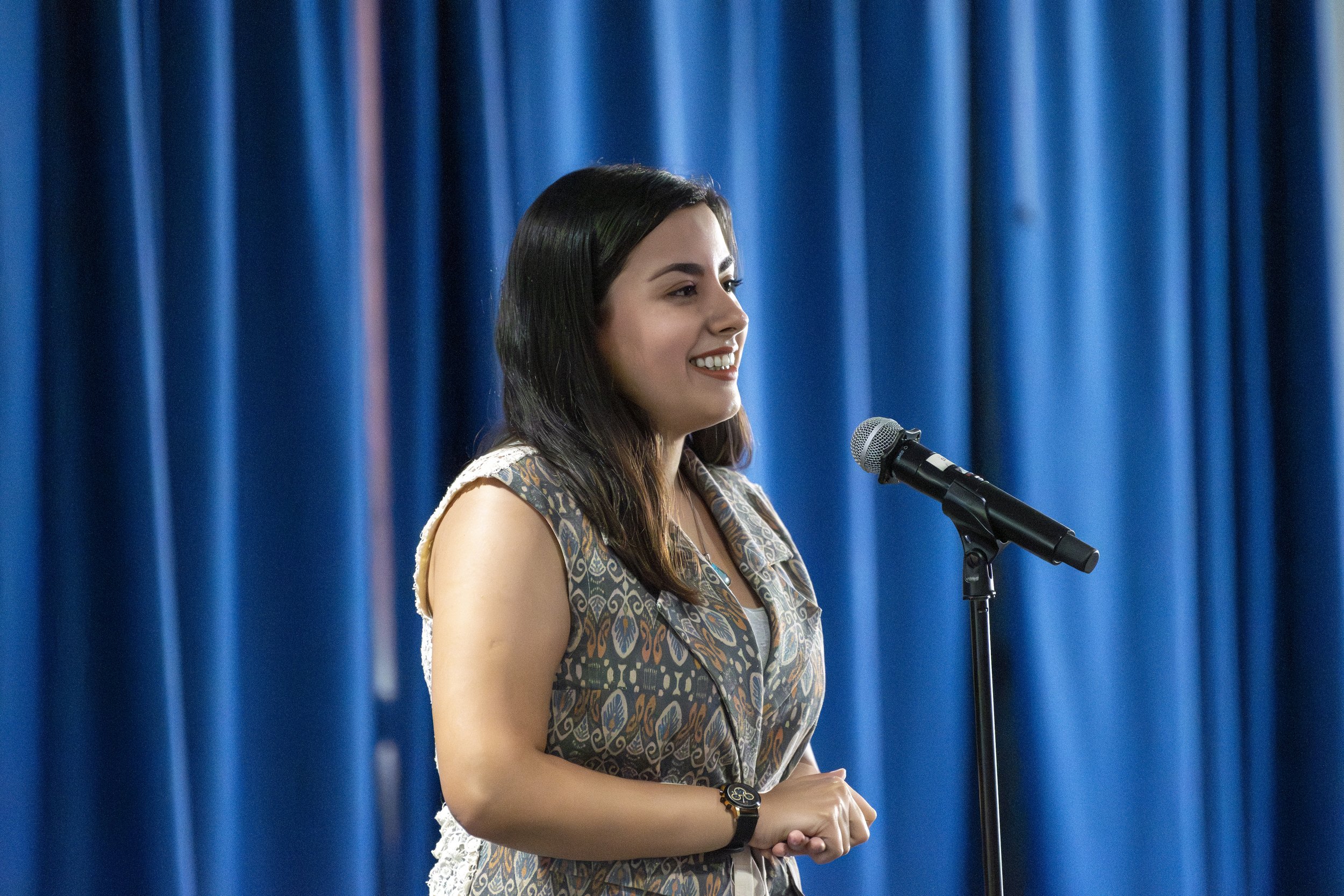
Saba Banaian shares her story at The Lookout Room at the Boise State Student Union in Boise, ID in September 2025. Photo by Sean Evans.
My parents were the center of my life. They were both doctors. I could see them growing up healing people, making their lives better. I could also see how people respected them deeply.
However, I found myself fascinated by numbers, physics, and mathematics. I couldn't stand in the room with somebody bleeding, and I would definitely faint. So I started my studying in mechanical engineering as an undergrad, which was my favorite.
Right at the very last semester, I came across a course called Introduction to Biomechanics. That changed everything. I could see that my world of engineering and my parents' world of medicine didn't have to be separate. I could bridge them too. And I could also heal people, comfort them, and help them, but in my own way.
So the decision was inevitable. I had to go to grad school and continue my studying as a biomedical engineer or biomechanics. Also, the United States was the dream destination to do so.
But the decision came with a very heavy price. I don't know if you know this, but the United States gives only single‑entry visa to Iranians. So for a five‑year PhD program, I could not go back home. It doesn't matter what happened, like if my parents become sick, if something bad happens, or even if something good happens, I cannot go home for five years.
Moving was really hard because I was really close to my parents, really close to my partner and my friends. And I used to teach violin, so I had a lot of kids, a lot of students that I used to teach. And when the day of departure arrived, there were like 40 people in the airport who came to say goodbye.
I looked back and I took one last mental picture because I didn't know if I can see them again or when will I see them again. I could see their eyes glossy but holding back tears, my friends trying to smile but failing.
My mom holds me tightly and says, “Go make us proud.” My dad kissed my forehead and said, “We are really proud of you.” My partner squeezed my hand and he said, “Our love is bigger than any distance. We'll make it through this.” And I went for the airplane, just like a boat being pushed out into the storm.
Boise, Idaho is my second home. From the beginning, everybody was so friendly. They smiled at me, held the door open, cared to join in for a very casual conversation, like, “How is your day? It is a nice weather.” Everybody was so friendly.
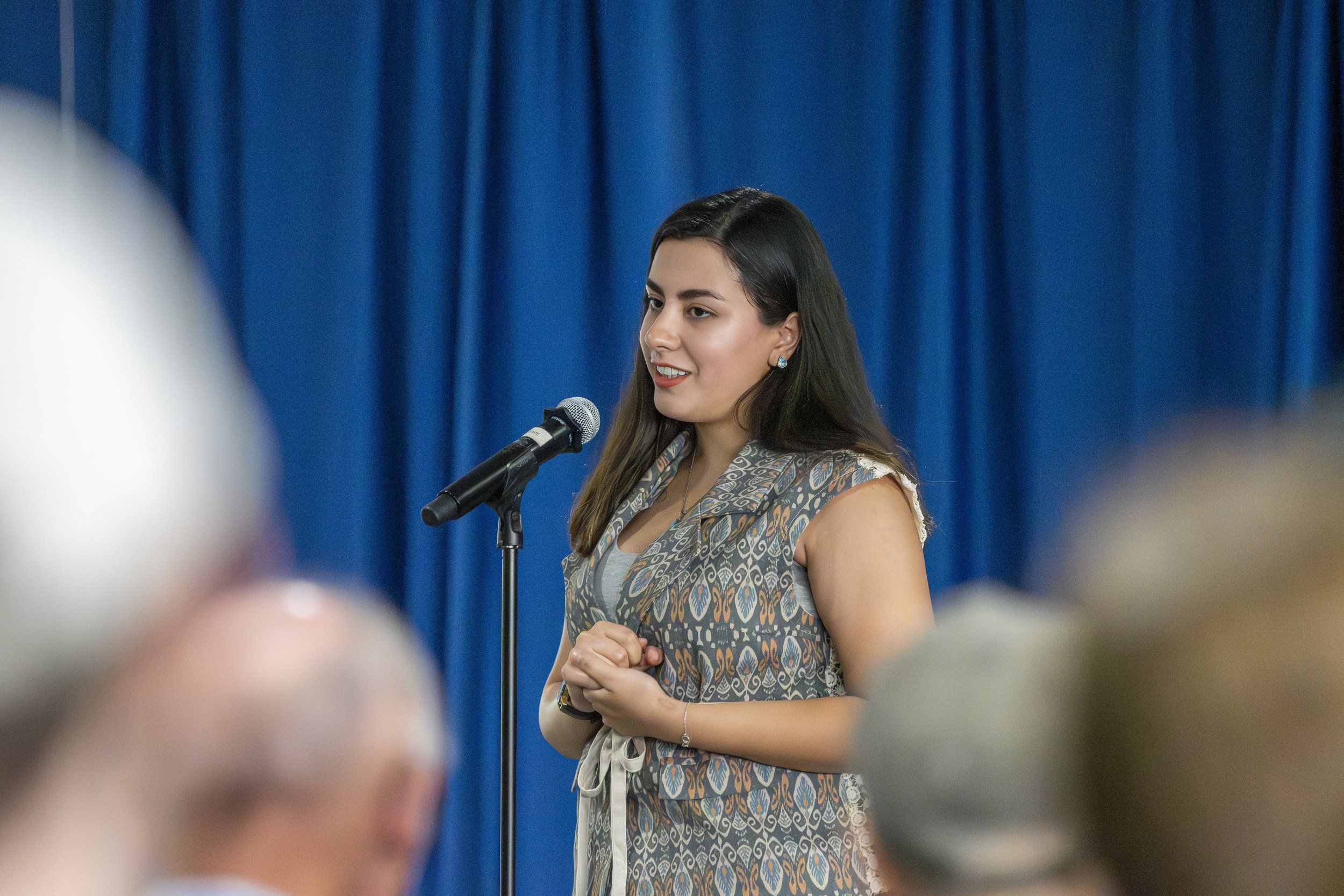
Saba Banaian shares her story at The Lookout Room at the Boise State Student Union in Boise, ID in September 2025. Photo by Sean Evans.
But still, everything was so different. Like, the food was really different. There were no comforting stew, no saffron spice in the air, no fresh lavash bread that I could buy. Also, people dressed very differently, very freely, in a way that I was never used to.
In the classroom, things were even harder because lectures were moving so quickly and I could see all of my classmates debating ideas, engaging in the course. Even if I knew the answer, I couldn't dare to raise my hand and answer because I was thinking, “Okay, what if I don't understand the follow‑up question? Or what if it's not right? Or what if my accent makes everybody feel uncomfortable? Or what if I sound strange?”
So every day was full of silent panic and curiosity. I was in the land of opportunity and yet I was so scared to take any chances.
The first big test came when I went for the group lab meeting. I worked in the computational bioscience lab. All I knew at that point was that I'll be working on simulating the knee for total implantation surgery patients. I went for the group lab meeting. Everybody was there. My advisor was there, Claire. And the students started to discuss a very detailed simulation about knees, muscle force, joints, and everything. I felt completely lost.
I started thinking, “What if I made the wrong decision? What if I never belong here?” Or what if I can never find my place here?” All I knew was that Introduction to Biomechanics and now I had to do very advanced simulations.
My advisor said that he'll be working on a full lower limb model, and I just froze. I said, “I've never done that before and I don't know how to do it.”
She said, “You'll figure it out.”
Deadlines were coming up. I sat in my chair in the lab looking at my monitors with a lot of tabs open, one for YouTube tutorials about mesh generation and contact definition, one for the documentation of softwares that I was going to use. I even had to call my parents and ask my dad, who was thousands of miles away, like, “What is the difference between MCL and NCL? What does PCL do?” So I had to teach myself biomechanics and anatomy while racing deadlines.
Eventually, very slowly, things started to work out. I'm just saying things started to work out, but it took a lot of late nights, a lot of sleepless nights thinking about my simulations, a lot of trial and error, a lot of failed simulations. But at some point, in yet another lab meeting, I showed some results and plots to my advisor and she said, “Yeah, that's exactly what I wanted.”
And I said, “Really?” I really expected to be told otherwise. But she said, “Yeah, you're right on track.”
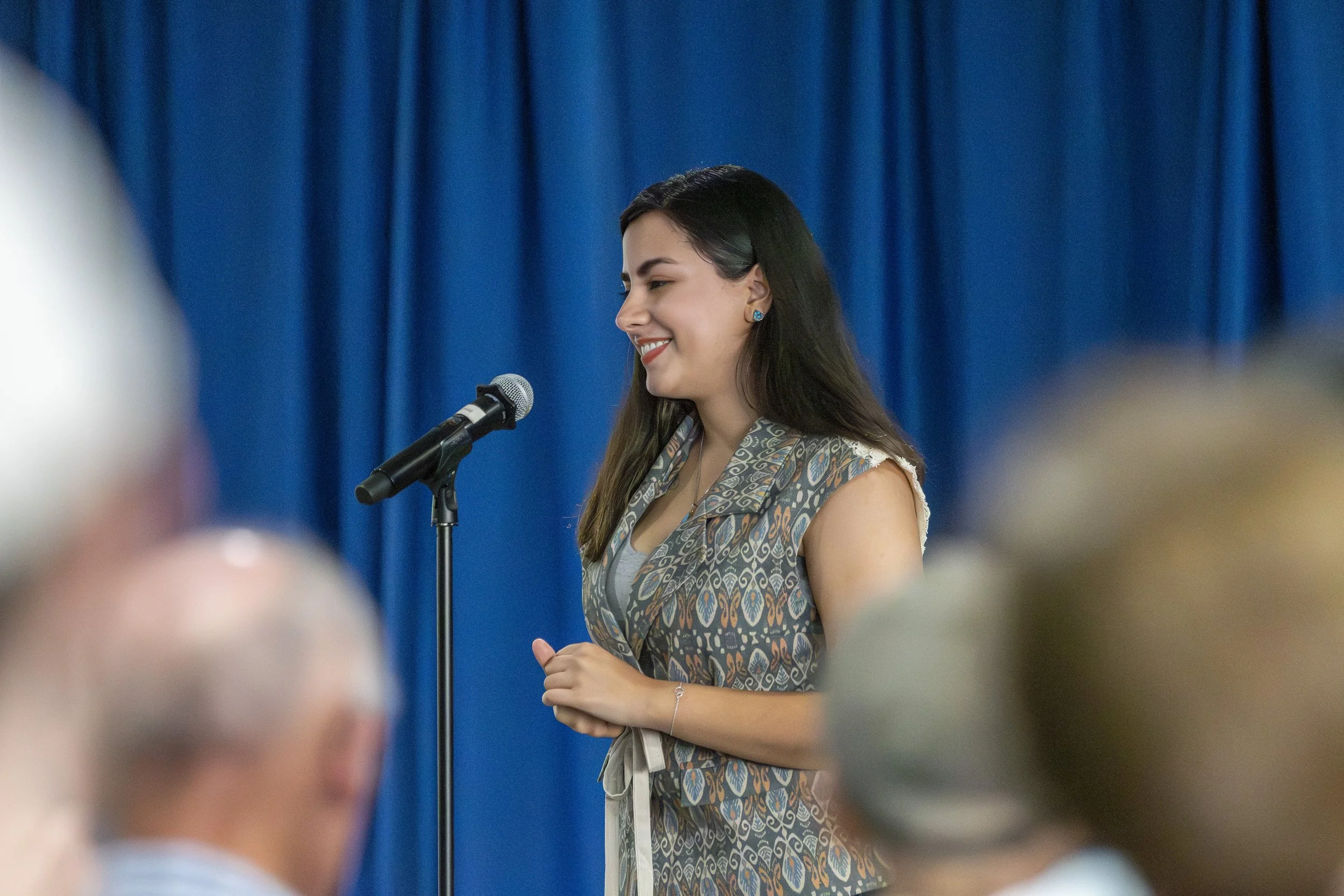
Saba Banaian shares her story at The Lookout Room at the Boise State Student Union in Boise, ID in September 2025. Photo by Sean Evans.
I'm sure she doesn't remember this, but “you're right on track” meant the world to me. It meant that I wasn't stuck anymore and it meant that I was further than where I started. It was a very small step comparing to the other projects that my other lab mates were doing, but it meant a lot to me. For the first time, I felt something different. I didn't feel scared or I didn't feel failure. I felt pride. At that moment, I realized that doubt isn't a sign of failure. It is actually a part of growth.
Right now, I'm doing very advanced simulations in my lab, contributing to science in a way that I never imagined. I joined the Boise State Symphonic Orchestra, and I play my violin, which was always my dream, and I enjoy it so much. I sing Persian songs that remind me of home. I found a lot of friends who feel like family to me. And when I think of home, especially with everything that has been going on over there, I don't think that leaving was abandoning my roots. It was actually expanding them.
I'm still that same person, walking the same streets in my memory, talking to the same people on my phone, but I'm also somebody who traveled across the world, faced the unknown, and found a way to thrive.